
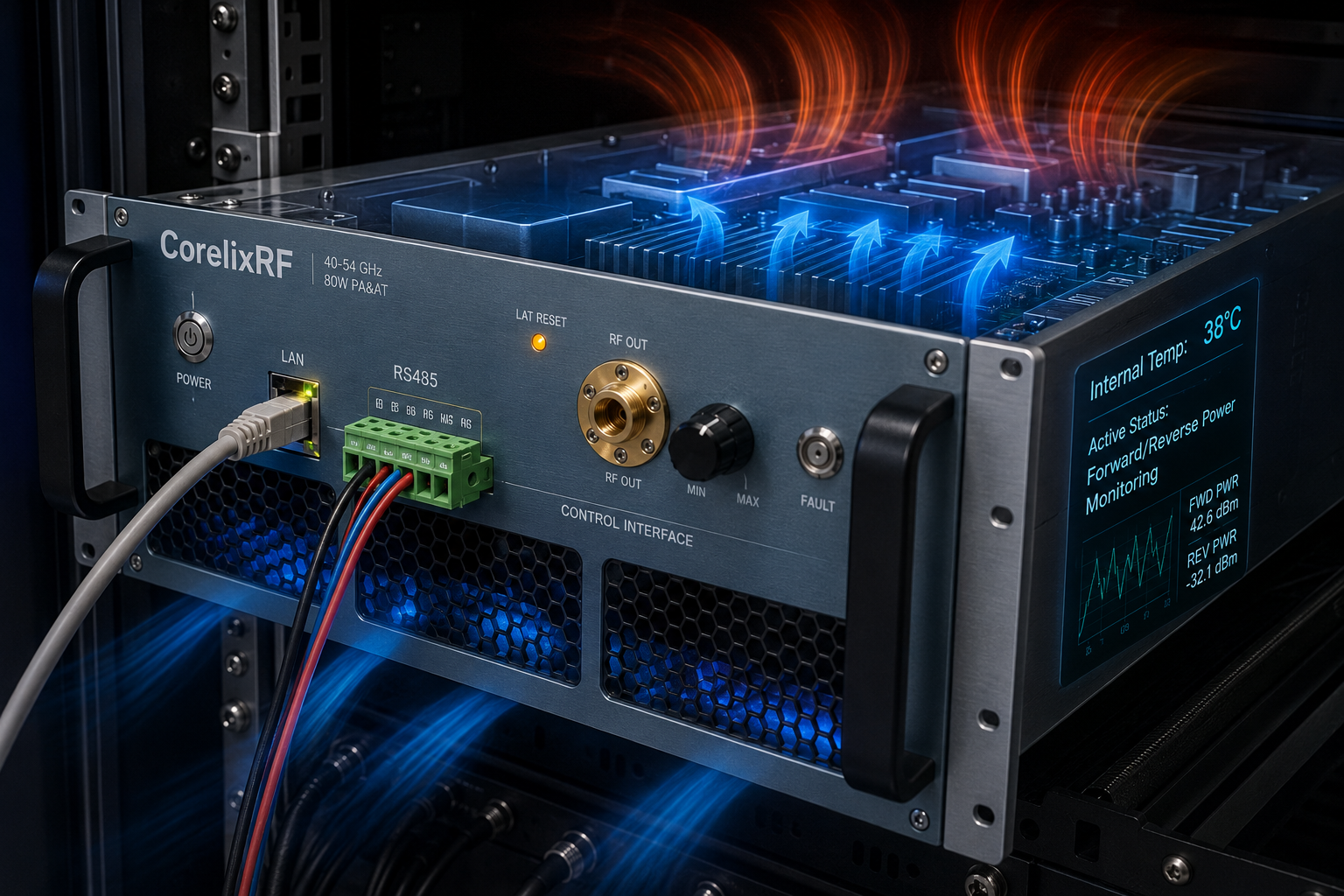
Engineers searching for a millimeter wave power amplifier usually need more than a headline output-power number. They need a solid-state amplifier that can be reviewed against frequency coverage, gain flatness, drive level, connectors, control interface, cooling, protection, and acceptance test evidence. The CorelixRF CRF-PA-40000M54000M-80W is based on the local product specification for 40-54 GHz operation and 80 W rated output power.
This article follows CorelixRF’s B2B keyword library by focusing on product selection, RF test use, performance verification, and supplier review language. It does not claim unverified certification, inventory, customer cases, or guaranteed compliance results. For a broader product conversation, start with CorelixRF’s RF power amplifier capability or submit project details through the CorelixRF contact page.
Why this 40-54 GHz amplifier matches buyer search intent
The CRF-PA-40000M54000M-80W fits the search intent behind terms such as millimeter wave power amplifier, millimeter wave SSPA, millimeter wave radar power amplifier, and millimeter wave amplifier for SATCOM. These are not casual education keywords; they usually indicate that an engineer, buyer, or integrator is narrowing a shortlist. The useful content for that reader is specific: frequency range, output power, gain, RF interfaces, thermal limits, monitoring, and the information CorelixRF needs for an RFQ.
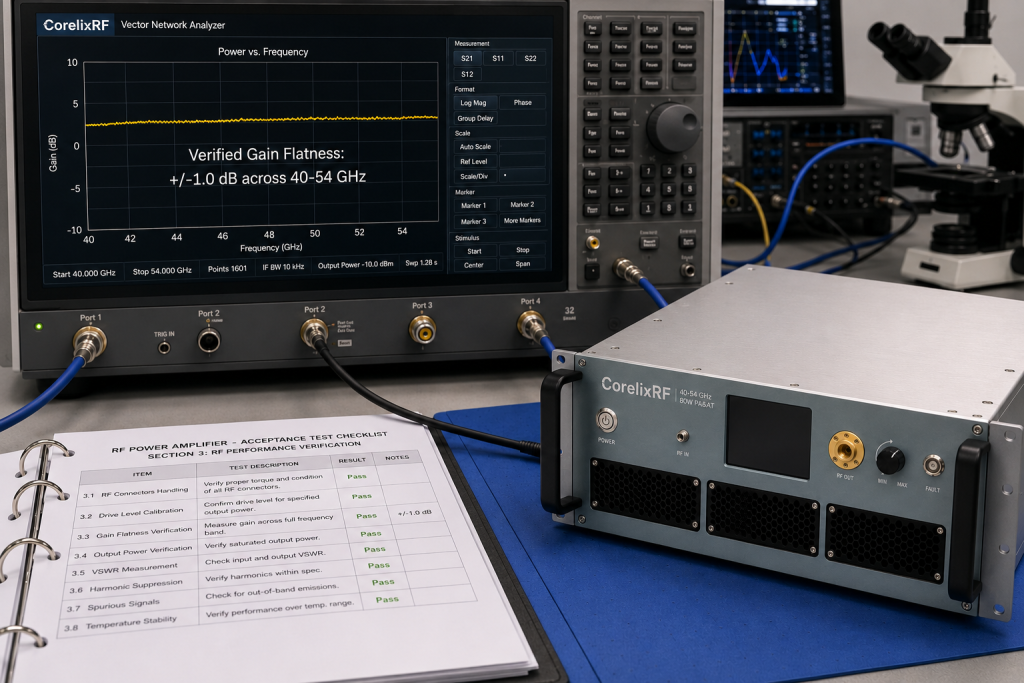
The datasheet lists 40-54 GHz coverage, 80 W output power, 50 dB min. small-signal gain, and +/-10 dB gain flatness. Those values help estimate signal-generator drive level, cable and fixture loss, calibration margin, and expected delivered power at the load. When teams compare a broadband RF power amplifier with a custom configuration, they should evaluate the full RF chain rather than treating the amplifier as an isolated box.
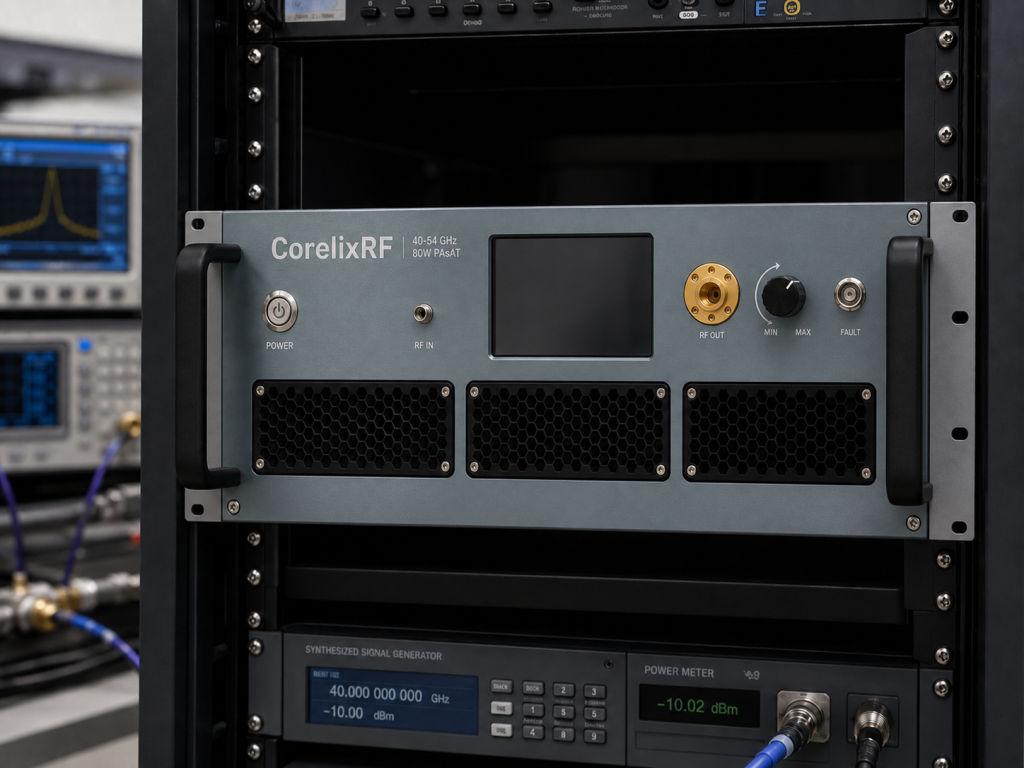
The RFQ should include waveform type, CW or pulsed operation, duty cycle, test duration, expected mismatch condition, ambient temperature, and preferred monitoring or control protocol.
How to evaluate output power and gain flatness
The keyword library includes pain-point searches such as RF amplifier power flatness problem, SSPA gain variation across frequency, and RF amplifier not meeting rated output power. Those queries are valuable because they reveal real procurement risk. A buyer may have seen a system pass at one frequency and fail at another because the complete RF path was not calibrated.
For CRF-PA-40000M54000M-80W, gain flatness should be reviewed with cable loss, coupler response, switch insertion loss, antenna or load behavior, and the test receiver setup. Output power should be measured with a defined frequency step, stable thermal condition, calibrated sensor, and known load match. The amplifier’s input limit of project review required for final input-drive plan also matters; source startup routines and calibration scripts should not create accidental overdrive.
Integration notes for RF test and system platforms
The CRF-PA-40000M54000M-80W is relevant for radar test platforms, SATCOM-related high-frequency benches, millimeter-wave RF laboratories, and communication-system validation. Its 1.85 mm-F input / WR19 output interface means the output path must be reviewed for power handling, insertion loss, return loss, and connector or waveguide handling. The 1.85 mm input and WR19 output require precise handling, calibrated transitions, and stable fixture alignment.
Thermal design is equally important. The datasheet identifies forced air cooling and 19-inch 5U. Rack designers should verify inlet temperature, airflow direction, exhaust clearance, service access, and whether nearby equipment can recirculate heat. Module or waveguide installations should also review mounting, torque, alignment, and sensor access.
Control and protection should be part of the integration plan. The specification lists RS485 / LAN, real-time temperature monitoring, real-time current monitoring, and optional forward/reverse power monitoring where applicable. Protection functions include alarm and fault protection, over-temperature protection, over-voltage or over-drive related protection, and VSWR-related protection or alarm functions. A custom RF amplifier review can align these functions with the host controller before the mechanical design is finalized.
RFQ checklist for millimeter wave power amplifier
Before requesting a quote, prepare the target frequency range, required output power at the load, signal type, instantaneous bandwidth, duty cycle, drive level, load or antenna setup, mismatch exposure, rack or module limits, cooling conditions, control interface, and acceptance test method. If the project involves radar, SATCOM, RF laboratory testing, counter-UAS integration, or microwave test benches, note the legal and operational constraints that govern the test environment.
For higher-frequency comparison work, CorelixRF’s 18-40 GHz amplifier platform is a useful related page. For this specific article, however, the controlling facts remain the local datasheet for CRF-PA-40000M54000M-80W and the project review package supplied by CorelixRF.
Frequently asked questions
Is CRF-PA-40000M54000M-80W a solid-state power amplifier?
Yes. The datasheet describes CRF-PA-40000M54000M-80W as a GaN SSPA solid-state power amplifier for 40-54 GHz operation. Final configuration details should be confirmed during project review.
What is the specified output power?
The local datasheet lists 80 W rated output power. Delivered power in a real system depends on cables, waveguide or connector loss, load match, duty cycle, cooling, and measurement method.
Which keywords best match this model?
The best-fit search terms include millimeter wave power amplifier, millimeter wave SSPA, millimeter wave radar power amplifier, and millimeter wave amplifier for SATCOM, plus performance-verification terms such as RF amplifier test data, gain flatness, and output power verification.
What protection features should be reviewed?
Review over-temperature behavior, voltage and drive limits, VSWR-related protection or alarms, current monitoring, fault reporting, and how the host system should respond to each alarm.
Can CorelixRF customize this amplifier?
CorelixRF can review monitoring, control interface, mechanical constraints, waveform type, duty cycle, and environmental requirements during RFQ discussion.