
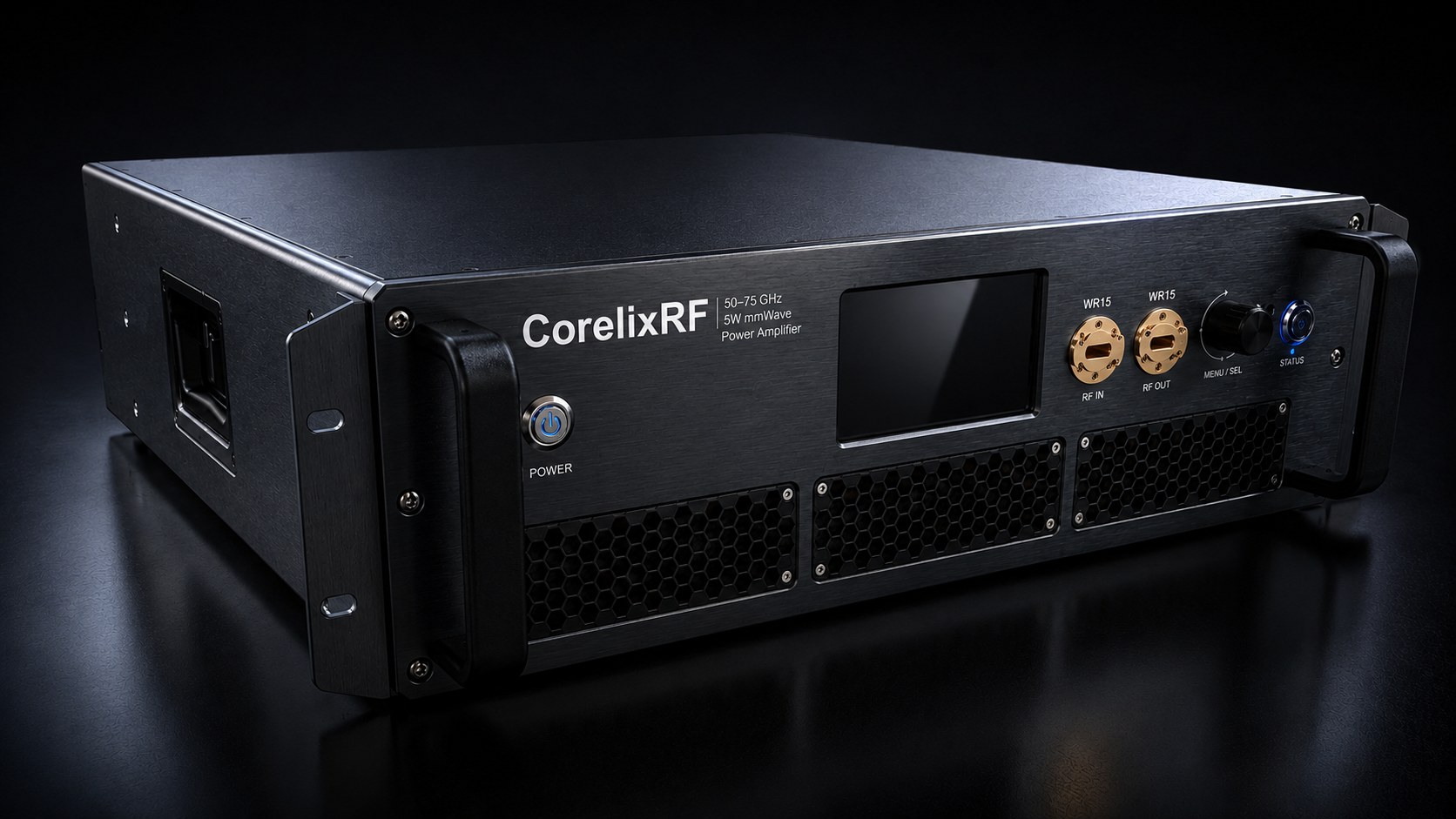
A 50-75 GHz 5W WR15 mmWave power amplifier RFQ should define more than a frequency range and wattage. The CorelixRF local datasheet identifies CRF-PA-50000M75000M-5W as a GaN solid-state RF power amplifier covering 50 GHz to 75 GHz with 5 W rated output power. It lists 37 dB minimum small-signal gain, +/-10 dB gain flatness, up to 15 dB gain control, WR15 front-panel input and output, RS485 and LAN control, AC 220 V +/-10 percent 50/60 Hz supply, forced-air cooling, 0 to +50 C operation, and a 19-inch 3U rack-mount format.
The same source lists real-time temperature monitoring, real-time current monitoring, optional forward/reverse power monitoring, alarm and fault protection, over-temperature protection, over-drive protection, over-voltage protection, and VSWR protection and alarm functions. It identifies test and measurement instrumentation, communication systems, RF interference system-level testing, and aerospace control systems as application areas. These facts align with searches for WR15 power amplifier, 50-75 GHz RF amplifier, 5W GaN SSPA, and rack mount mmWave amplifier.
Worksheet Field 1: WR15 Path Description
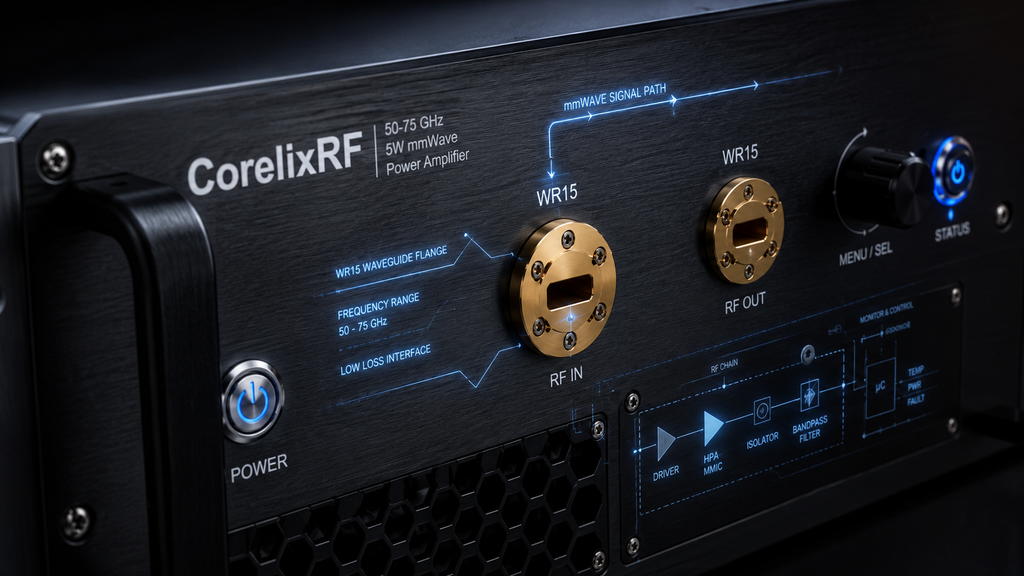
The RFQ should name the WR15 input path, WR15 output path, load, coupler, sensor, and output reference plane. A WR15 amplifier can be correctly specified but poorly compared if one vendor is measured at the amplifier flange and another is discussed after a fixture. Put the reference plane into the worksheet before requesting pricing.
Worksheet Field 2: Gain-Control Use
Because the source lists 15 dB gain control, the buyer should say how it will be used. Acceptance may happen at one gain condition, multiple gain states, or a project-specific operating point. If the amplifier becomes part of an automated RF front-end platform, gain state should be controlled and logged with the source level.
- List target frequencies from 50 GHz to 75 GHz.
- Define CW or pulse use and duty condition if relevant.
- Name the WR15 reference plane for output readings.
- State RS485/LAN control expectations.
- Request final drawing, test data, and control protocol where needed.
Worksheet Field 3: Rack and Cooling Context
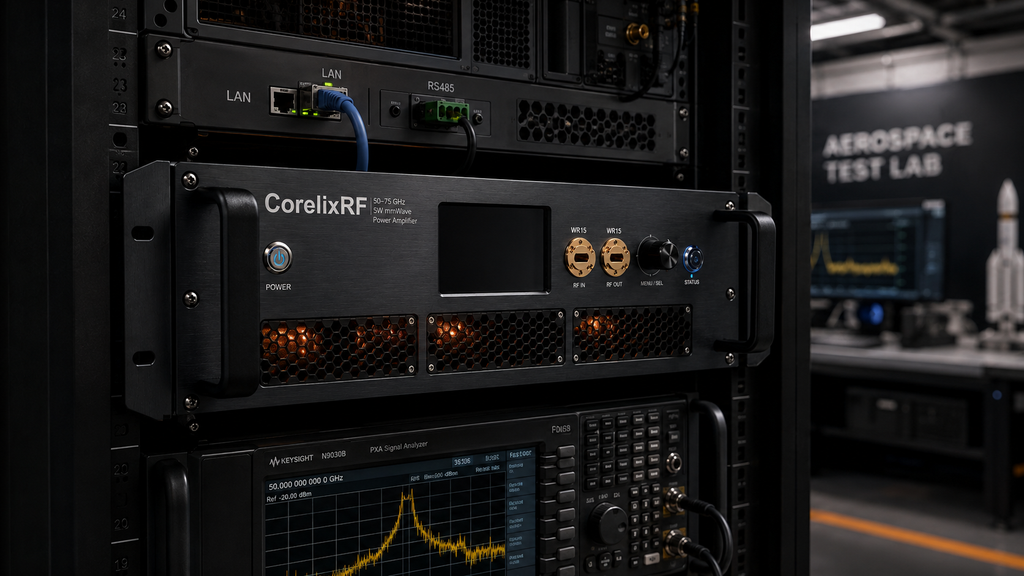
The 19-inch 3U forced-air format should be checked against rack depth, airflow clearance, neighboring equipment, and service access. Cooling conditions should be part of acceptance data, not a separate facility assumption. If the amplifier is mounted near heat-producing instruments, the inlet condition should be logged during baseline testing.
Worksheet Field 4: Monitoring Package
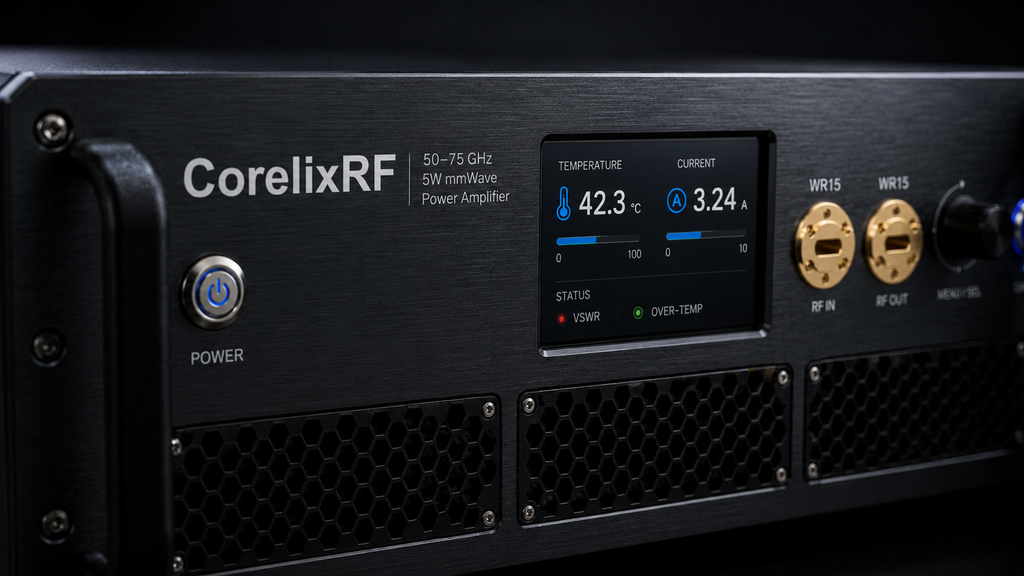
Temperature and current monitoring are listed, while forward/reverse power monitoring is optional. The RFQ should say which values must appear in the supplier report and which values the lab will collect after installation. Buyers who need a specific log format or remote-control behavior should discuss it through custom RF systems.
Worksheet Field 5: Documentation and Scope
The engineering and manufacturing page is a natural internal link for requests involving production test evidence, drawings, and control documentation. The worksheet should also define what is not being requested. If the buyer only needs an amplifier, do not imply a complete mmWave test system. If the buyer needs switching, safety interlocks, sensors, or enclosure work, write that scope clearly.
Why the Worksheet Format Works
Engineers searching for “50-75 GHz 5W WR15 mmWave power amplifier” usually have a defined band and need supplier comparison. The worksheet format matches that intent because it turns the article into a purchasing aid. It also gives CorelixRF natural internal links to RF power amplifier categories and integration pages without overloading the body with repeated anchor text.
RFQ Evidence Checklist
Attach an evidence checklist to the inquiry. It should request operating frequency points, output reference plane, source conditions, gain-control state, monitoring fields, cooling condition, rack format, control interface, and any optional monitoring. It should also ask whether final mechanical drawing and control protocol are available for project review. A buyer can compare responses more fairly when each supplier answers the same evidence request.
This also keeps public content accurate. The datasheet supports a 50-75 GHz, 5 W, GaN SSPA with WR15 I/O, RS485/LAN control, monitoring, protection, and forced-air 3U packaging. It does not support promises about finished chamber performance, link distance, inventory, or customer use. The CTA should therefore invite technical review rather than make unsupported claims.
Worksheet Review Meeting
The worksheet is most useful when it becomes the agenda for a short review meeting. Engineering should confirm the WR15 path, frequency points, output reference plane, gain-control plan, and cooling assumptions. Purchasing should confirm what documentation is needed before order placement. The supplier should confirm what test data, drawing, and control information can be provided for the requested configuration. This meeting prevents a common mmWave sourcing problem: everyone agrees on a model number, but no one has agreed on the measurement condition that makes the model useful.
The final worksheet should be stored with the quote package. When the amplifier is received, the same fields can become the incoming inspection checklist, so the receiving team does not rebuild the requirement from email fragments, chat notes, or incomplete purchasing comments during lab handoff.
The RFQ worksheet style is intentionally different from the audit and notes formats. It uses workbook phrases such as rf power amp, 5w rf amplifier, broadband rf power amplifier, high power amplifiers, and rf power systems as buyer-language references. The worksheet keeps the search terms tied to quotation fields, WR15 interfaces, acceptance data, and project scope, not marketing filler.
Application Scenarios to Name in the RFQ
The RFQ should name one of the real source-backed scenarios: test and measurement instrumentation, communication systems, RF interference system-level testing, or aerospace control systems. For this 50-75 GHz 5W WR15 amplifier, that means describing the WR15 input/output path, the measurement or communication hardware being evaluated, the authorized system-level RF test condition, and the documentation needed for review.
Avoid vague language such as asking only for an rf power amp. State whether the amplifier will be used as a standalone WR15 test-and-measurement power stage, a communication-system evaluation block, an RF interference system-level test amplifier, or part of an aerospace-control engineering setup. Then define source level, load path, cooling, control interface, and acceptance data.
FAQ
What frequency range does CRF-PA-50000M75000M-5W cover?
The local datasheet lists 50 GHz to 75 GHz coverage.
What output power and gain are listed?
The source lists 5 W rated output power and 37 dB minimum small-signal gain.
What RF interfaces are listed?
The datasheet lists WR15 front-panel input and WR15 front-panel output.
What rack format is listed?
The source lists a forced-air 19-inch 3U rack-mount configuration.