
An SDR bench can change frequency faster than the RF hardware around it can be rechecked. That is why this article is written as a chain playbook: source settings, channel boundaries, gain state, filtering, output load, and logged measurement data all have to travel together.
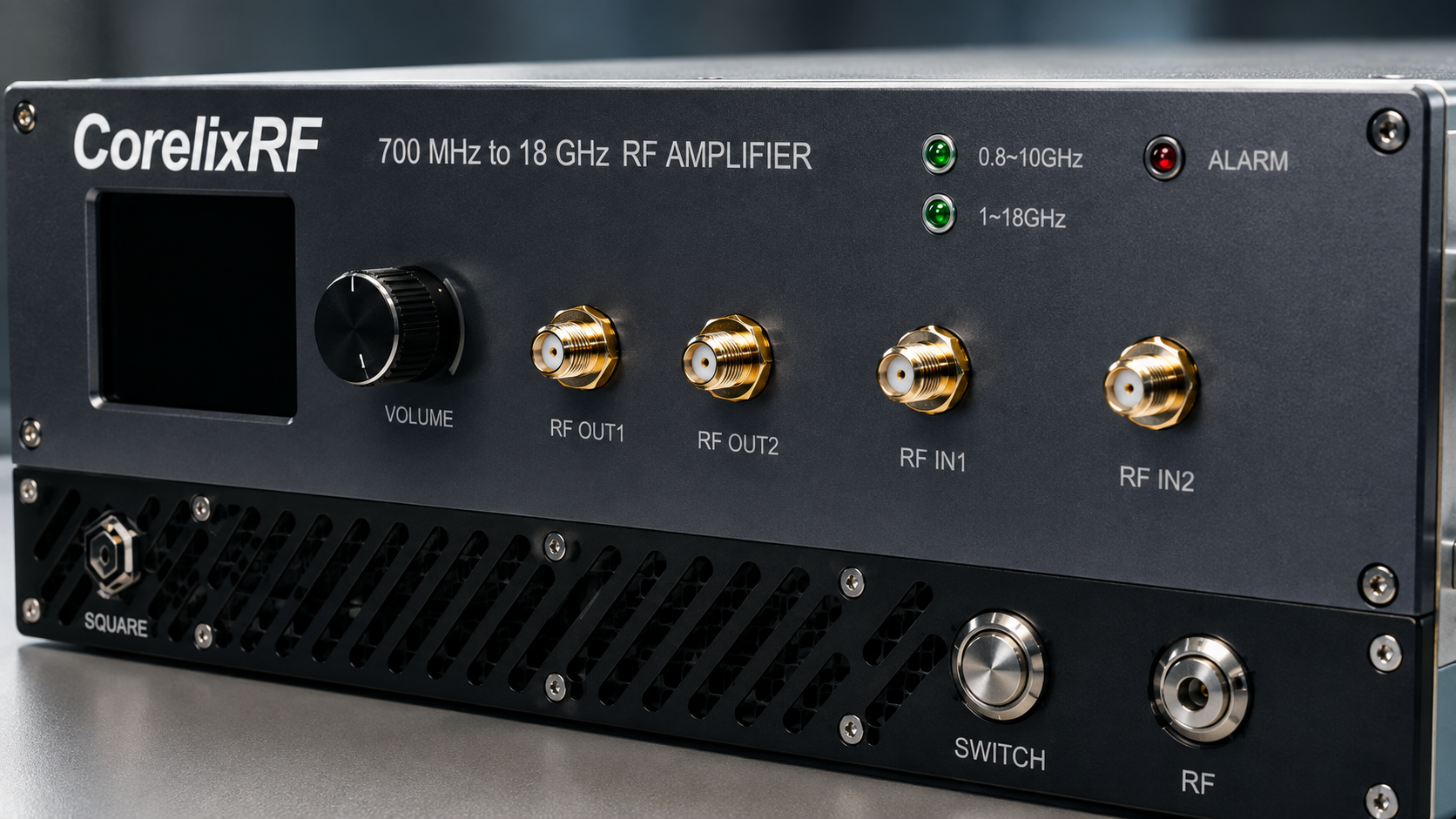
CorelixRF’s CRF-PA-700M18000M-11W is the hardware anchor for the playbook. The local datasheet extraction describes a dual-channel GaN SSPA covering 700 MHz to 18 GHz with 11 W rated output power, 41 dB minimum small-signal gain, 20 dB maximum small-signal gain adjustment, SMA-Female input and output, forced-air cooling, and a 3U rack-mount configuration for test and measurement instrumentation, communication systems, RF interference or EW system-level testing, and aerospace control.
Primary search phrase: 700 MHz-18 GHz SDR RF amplifier. Related long-tail phrases include SDR RF amplifier, 700 MHz to 18 GHz amplifier, wideband RF amplifier, dual-channel RF amplifier, 11W GaN amplifier.
Build the Chain Around Channel Boundaries
The product data describes a dual-channel platform from 700 MHz to 18 GHz. That makes it attractive for SDR validation and broad lab coverage, but the control software and cabling plan must make the channel split explicit. Operators should know which band, gain state, and calibration file apply before drive is enabled.
Playbook step: name the active channel in the test script and in the rack labels. A wideband setup should make it hard for an operator to drive the wrong path.
Separate SDR Flexibility from RF Hardware Limits
SDR sources can change frequency and waveform quickly. A 700 MHz-18 GHz SDR RF amplifier still needs controlled input drive, filtering, attenuation, and output monitoring. The amplifier should not be asked to compensate for a waveform plan that lacks power limits or spur review.
Playbook step: add source limits before adding amplifier gain. SDR flexibility is useful only when the RF chain has boundaries.
Use Gain Adjustment for Repeatability
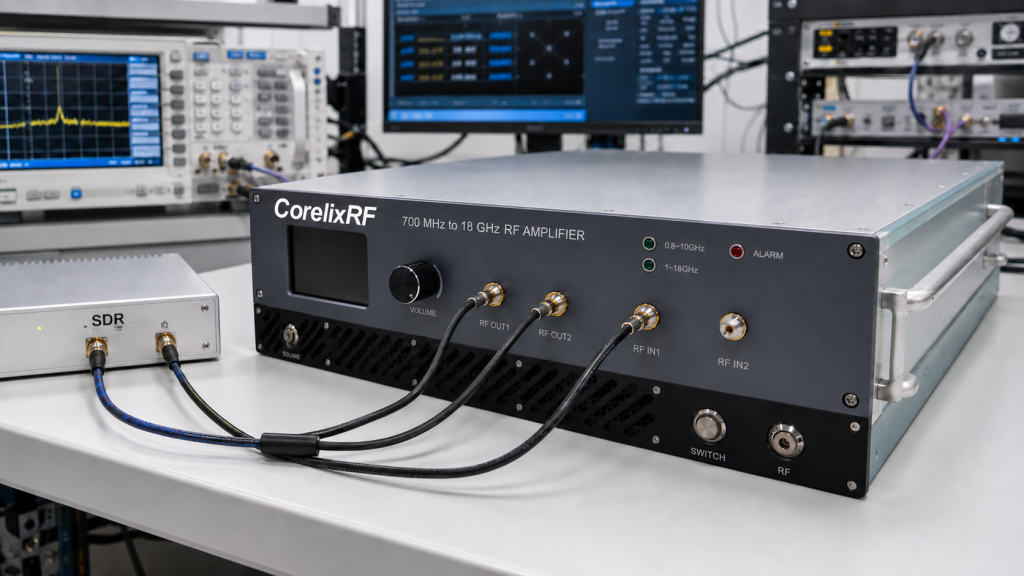
The 41 dB minimum small-signal gain and 20 dB maximum small-signal gain adjustment support leveling across different experiments. Define whether gain is set manually, by test software, or through a fixed recipe. Good SDR benches save gain state, frequency, waveform, and measured output together so later tests are reproducible.
Playbook step: save gain state with frequency, waveform, measured output, and load condition. Repeatability depends on metadata as much as hardware.
Plan SMA Cabling and Rack Layout
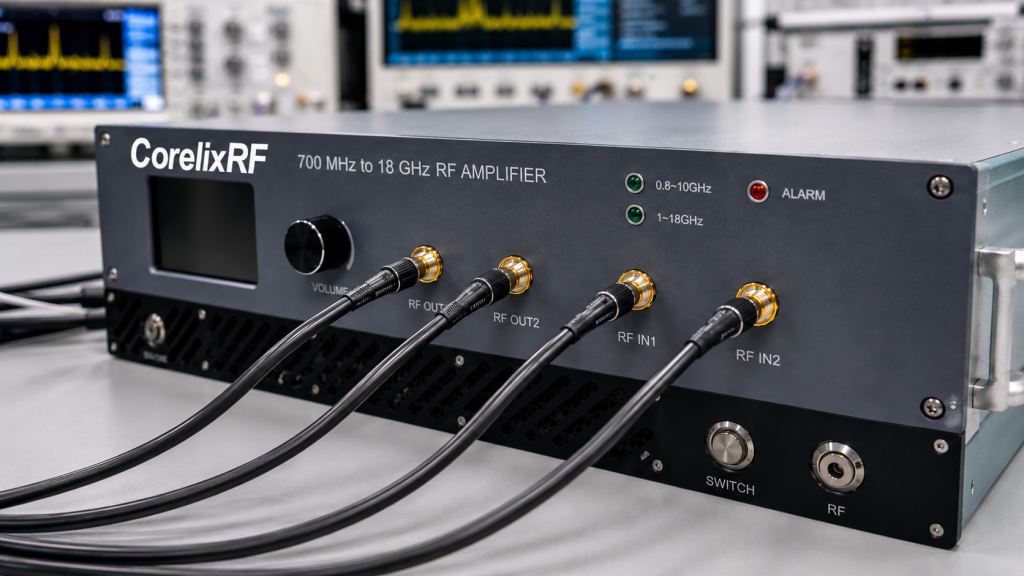
The listed SMA-Female input and output are convenient for lab equipment, while the 3U rack-mount configuration keeps the amplifier in a controlled rack format. Cable quality, bend radius, labeling, and output load verification still matter because the same rack may be used by several programs.
Playbook step: treat SMA cabling as a controlled part of the bench. Labeling and calibration prevent avoidable reruns.
Make the RFQ a System Request
For SDR and wideband validation, the RFQ should include source type, waveform bandwidth, sweep speed, modulation, expected output level, duty cycle, and whether the amplifier feeds a load, antenna, fixture, or switching matrix. That context helps prevent a generic recommendation.
Playbook step: make the RFQ describe the SDR workflow, not only the amplifier model. Include waveform bandwidth, sweep behavior, duty cycle, and output target.
SDR Chain Setup Record
For each SDR test recipe, record frequency, channel, waveform, gain setting, source output, attenuation, measured amplifier output, load, and alarm status. That record makes the wideband RF amplifier useful for repeatable engineering validation instead of one-off bench experiments.
A Practical SDR Test Recipe
A useful SDR recipe starts with the allowed frequency span and the active amplifier channel. It then sets the source waveform, output limit, external attenuation, gain adjustment, and measurement sensor. Before RF output is enabled, the operator or script verifies the load path and confirms that the expected channel is connected. During the run, the system logs frequency, drive level, measured output, temperature, current, alarm state, and any operator notes. After the run, the recipe is saved with the calibration file. This workflow is slower than improvising at the bench, but it is much easier to repeat after firmware changes, antenna changes, or fixture changes. The same record helps procurement because it explains why the team needs wideband coverage, why gain adjustment matters, and whether the amplifier is being used as a driver, a validation booster, or a repeatable source-chain element.
When a Lower-Power Wideband Amplifier Makes Sense
The 11 W rating is useful when the goal is controlled wideband validation rather than maximum transmitted power. SDR teams often need enough output to exercise receivers, filters, switches, antennas, or test fixtures across many bands. In that role, repeatable gain control, clean channel mapping, and logged measurements can matter more than a larger final-stage amplifier. If the project later moves to high-power radiated testing, the same recipe can help define the next amplifier requirement.
Related CorelixRF Resources
For readers comparing adjacent platforms, review SDR RF amplifier, RF testing and validation, broadband RF power amplifier, 6-18 GHz RF amplifier, and CorelixRF Contact page. These links keep the next step inside the CorelixRF site and help buyers move from amplifier selection to a specific engineering review without relying on competitor pages or generic catalog assumptions.
FAQ
Why is this article written as a playbook?
SDR users need repeatable operating steps because software-defined sources can change frequency, waveform, and output level quickly.
What is the focus keyword?
Use 700 MHz-18 GHz SDR RF amplifier as the focus keyword.
What makes the product suitable for SDR-style validation?
The local data lists dual-channel 700 MHz to 18 GHz coverage, 11 W rated output, 41 dB minimum gain, and gain adjustment.
What should be included in the RFQ?
Include source type, waveform bandwidth, frequency plan, output target, gain-control method, load path, and automation needs.