
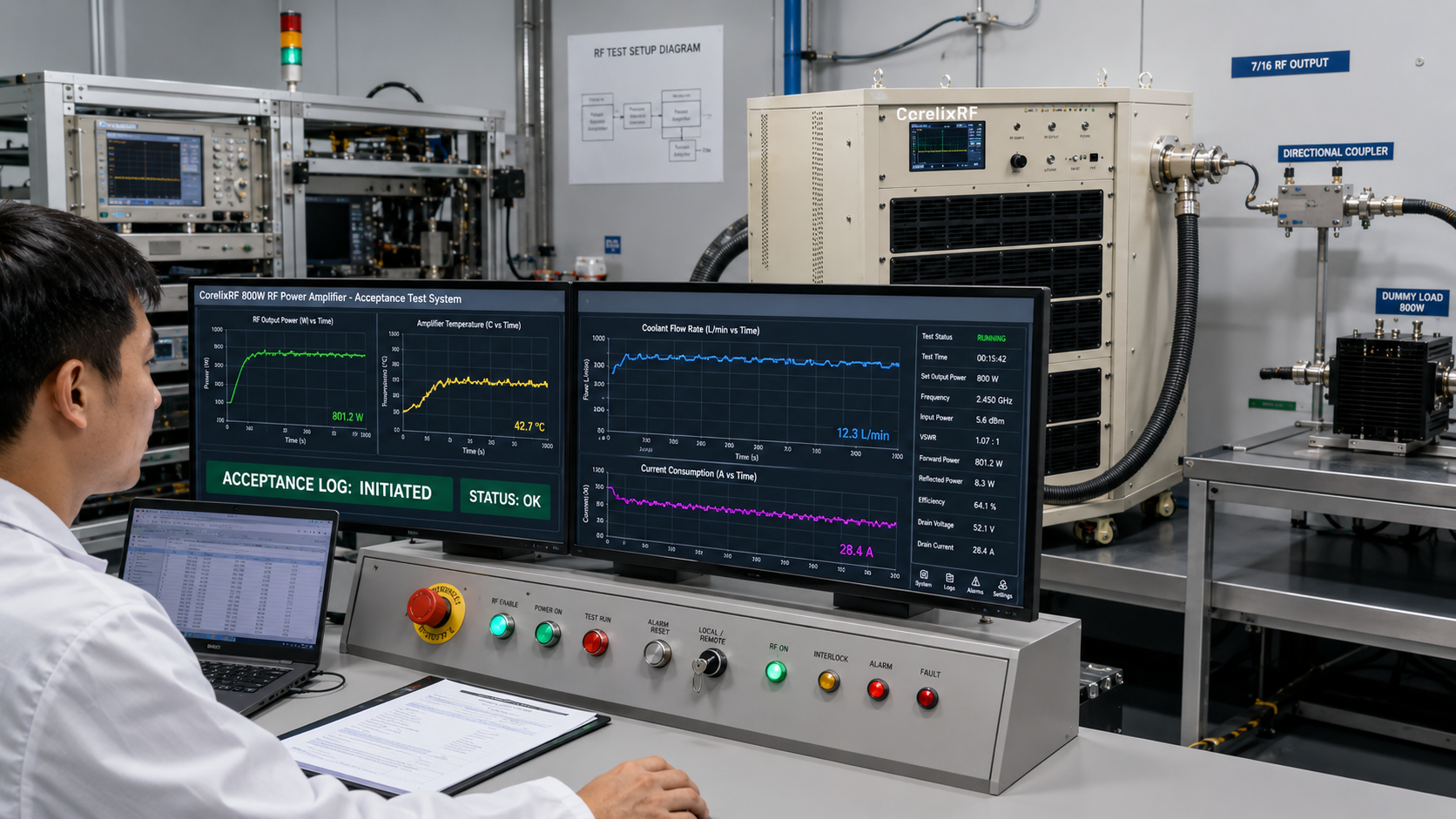
This is a thermal planning memo, not a catalog description. An 800 W broadband amplifier can satisfy the RF number and still fail the project if liquid cooling, service clearance, output routing, and acceptance logging are treated as late mechanical details.
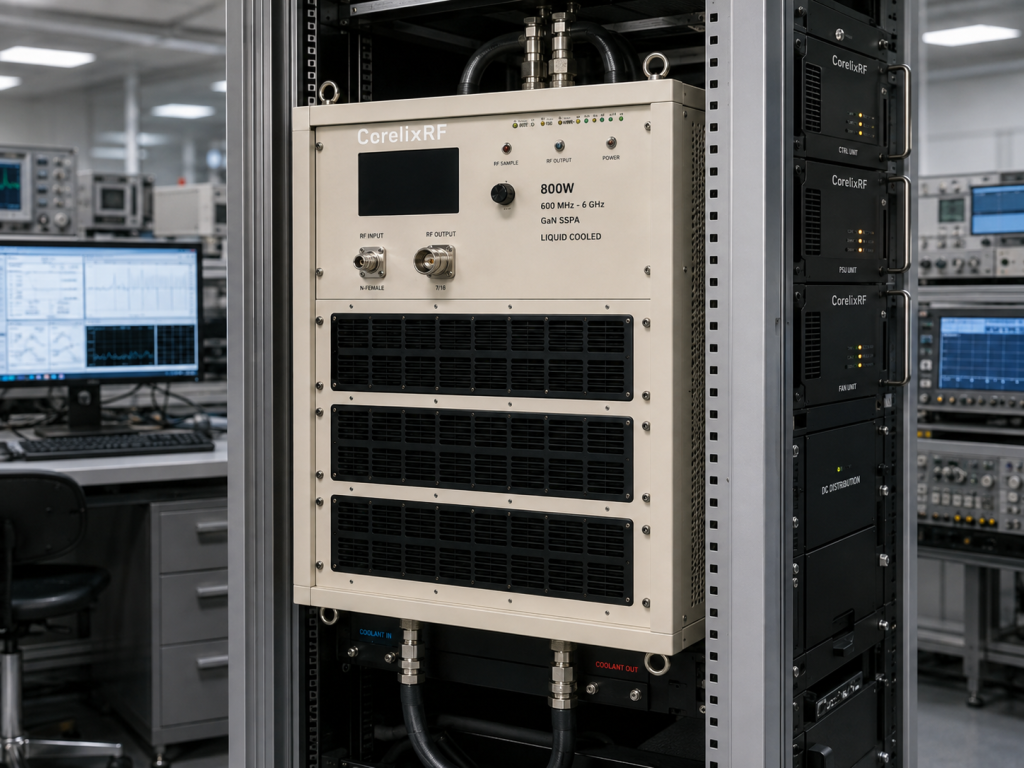
The reference product is CorelixRF’s CRF-PA-600M6000M-800W, a GaN SSPA covering 600 MHz to 6 GHz with 800 W rated output power, 62 dB minimum small-signal gain, -5 to +5 dB gain flatness, N-Female input and 7/16 output, and liquid cooling. The local datasheet extraction lists a project-specific mechanical configuration with temperature/current diagnostics and alarm protection for test and measurement instrumentation, communication systems, RF interference or EW system-level testing, and aerospace control.
Primary search phrase: 600 MHz-6 GHz broadband RF amplifier. Related long-tail phrases include broadband RF amplifier, 800W RF power amplifier, GaN SSPA, 600 MHz to 6 GHz amplifier, liquid cooled RF amplifier.
Start With the Heat, Not the Enclosure
An 800 W amplifier covering 600 MHz to 6 GHz is a system-level thermal project. The datasheet identifies liquid cooling, which means facility, plumbing, flow monitoring, service access, and leak-response procedure must be discussed before the mechanical design is frozen.
Design memo: write the cooling requirement before the enclosure drawing. Flow, fittings, leak checks, and maintenance access all belong in the first mechanical review.
Map the Broadband Power Requirement
A 600 MHz-6 GHz broadband RF amplifier should be specified by frequency points, reference plane, waveform, duty behavior, and delivered power target. Cable loss, output transitions, couplers, and load mismatch can make an amplifier that looks oversized on paper feel marginal in the rack.
Design memo: identify where the 800 W target must exist. If the reference plane is after a coupler, cable, switch, or fixture, the amplifier output is only one part of the delivered-power calculation.
Use the Gain Figure in a Complete Chain Budget
The listed 62 dB minimum small-signal gain helps reduce driver-stage burden, but it also raises the importance of input-level discipline. Define source maximum output, fixed attenuation, software limits, and startup sequence so the amplifier is not accidentally overdriven during setup.
Design memo: create a startup power limit. A high-gain amplifier should have fixed attenuation or software limits that prevent a source preset from becoming an overdrive event.
Output Hardware Must Match the 800 W Class
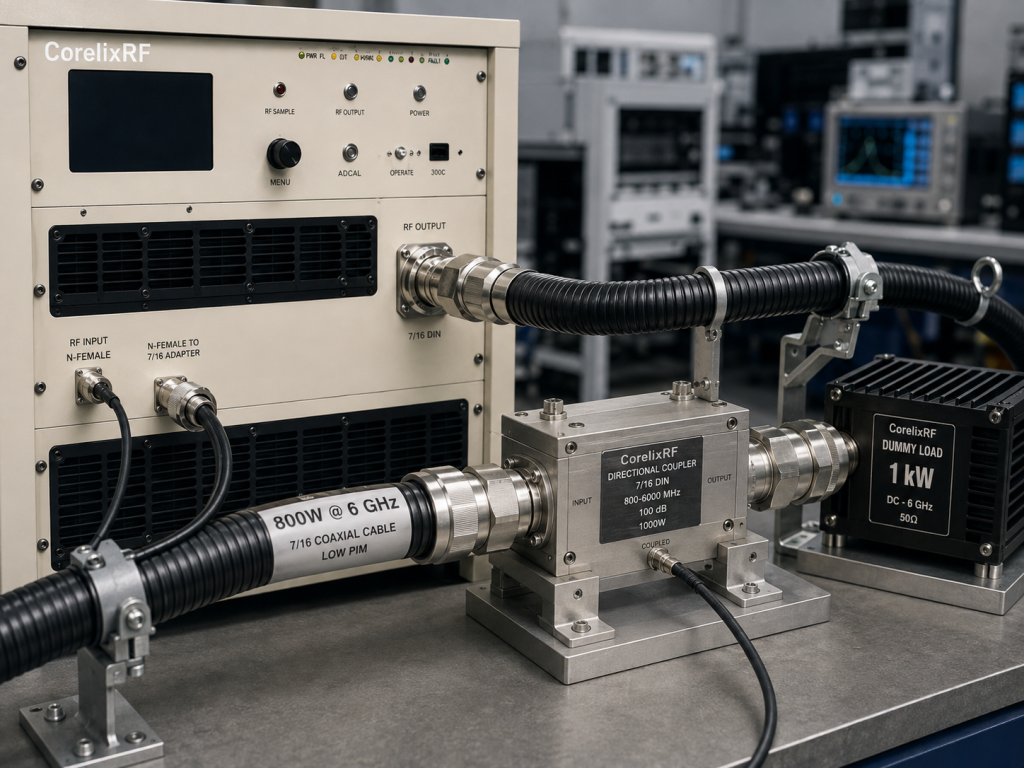
The N-Female input and 7/16 output combination should be mirrored in the system bill of materials. The 7/16 output path needs hardware rated for peak and average power, operating frequency, and mechanical strain. Do not let a small adapter become the weakest component in a high-power RF chain.
Design memo: rate the 7/16 output path as a system. Connector strain, cable radius, load rating, and switch power handling must be reviewed together.
Document Acceptance Around Cooling Stability
The acceptance test should log coolant condition, amplifier temperature, current behavior, output power, and alarm state while running the intended profile. A short power check is not enough evidence for a dense rack, long-duration validation bench, or production test system.
Design memo: acceptance should include coolant condition, RF output, current, temperature, and alarm state over the intended test profile.
Thermal Review Package
A useful thermal review package includes rack drawings, cooling-loop assumptions, ambient temperature, operating profile, RF output path, load condition, and expected test duration. That package lets CorelixRF review whether the 600 MHz-6 GHz 800 W platform fits the installation or needs a custom configuration.
Cooling Questions to Resolve Early
Early cooling questions should be practical. Where will the coolant supply and return lines enter the rack? Who monitors flow, temperature, and leaks? Can the amplifier be serviced without disturbing calibrated RF cables? Is the load bank or antenna path close enough to add heat to the same enclosure? Will the system run short verification bursts or long-duration profiles? These answers influence more than the amplifier enclosure. They affect rack layout, operating procedure, maintenance access, and the acceptance test. For an 800 W broadband RF amplifier, thermal planning is part of RF performance because unstable temperature can change repeatability and reduce confidence in test data. The review should also define what happens during maintenance. If coolant fittings, RF output hardware, or the load path must be removed, the return-to-service procedure should include leak checks, low-power RF checks, and alarm verification before the amplifier is released for normal use.
Acceptance Log Items
The acceptance log should capture coolant state, operating frequency, input drive, output power, current, temperature, alarm status, and the output hardware installed during the run. This is not paperwork for its own sake. It gives engineering, purchasing, and operations the same evidence when they later decide whether the amplifier can support a different waveform, longer test duration, or modified rack layout.
Related CorelixRF Resources
For readers comparing adjacent platforms, review broadband RF power amplifier, UHF RF amplifier, RF testing and validation, custom RF development, and Contact CorelixRF. These links keep the next step inside the CorelixRF site and help buyers move from amplifier selection to a specific engineering review without relying on competitor pages or generic catalog assumptions.
FAQ
Why is cooling the lead topic for this article?
The selected product is an 800 W liquid-cooled GaN broadband RF amplifier, so cooling and facility fit directly affect integration risk.
Which search phrase should the article emphasize?
Use 600 MHz-6 GHz broadband RF amplifier as the primary search phrase.
What output connector detail matters?
The datasheet extraction lists N-Female input and 7/16 output, so the high-power output path must be rated and mechanically supported.
What evidence should be requested?
Request output power, gain, thermal, current, and alarm behavior data under representative operating conditions.