
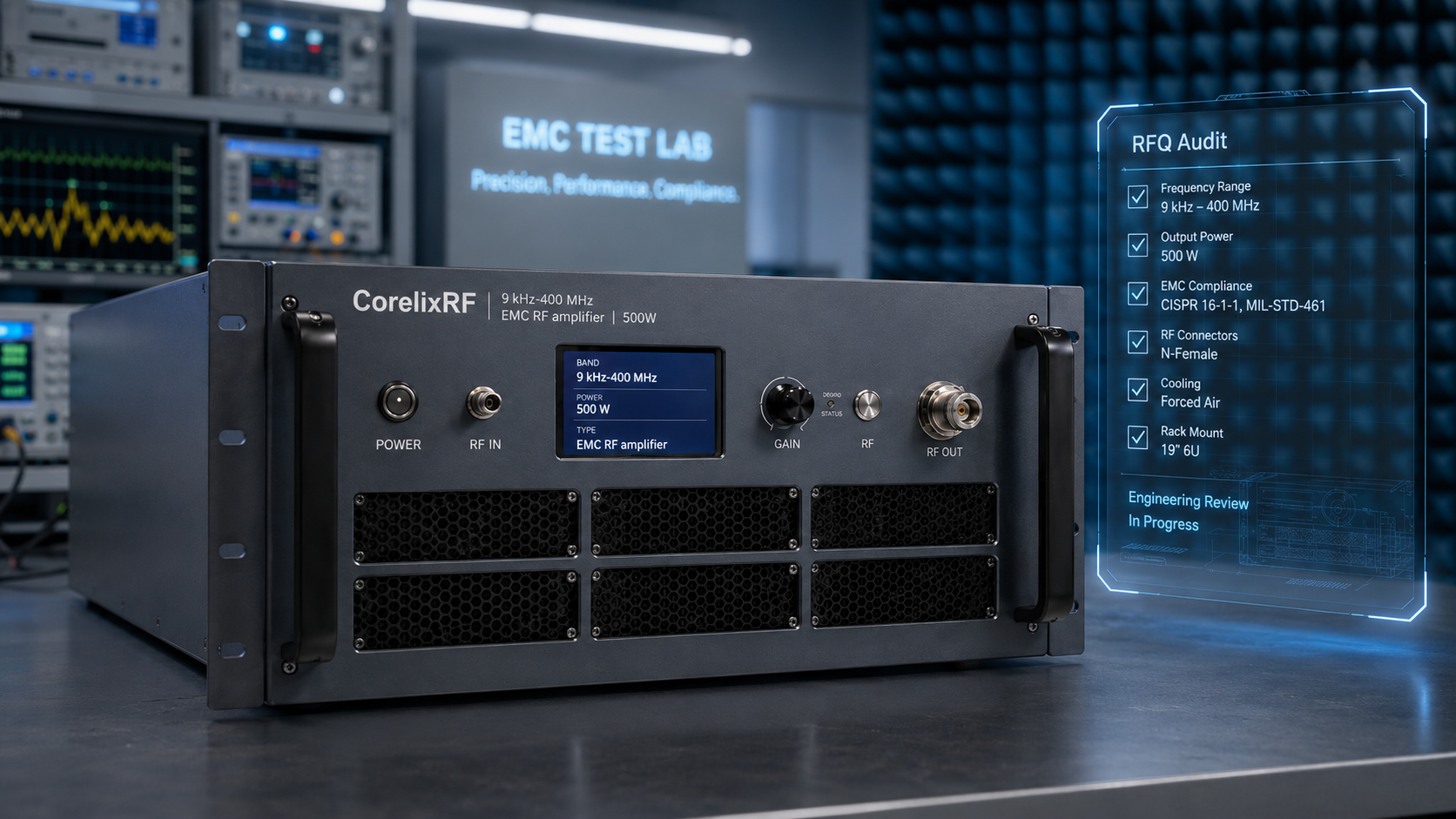
A weak EMC amplifier RFQ usually fails before anyone discusses price. It says “500 W” and “9 kHz to 400 MHz,” but it leaves out fixture loss, injected-power target, dwell time, modulation, load behavior, and how the lab will respond when protection trips. This audit format is written for test-lab buyers who want to catch those gaps before a quotation becomes a rack problem.
CorelixRF’s CRF-PA-9K400M-500W gives the audit a concrete reference point: a LDMOS solid-state RF power amplifier covering 9 kHz to 400 MHz with 500 W rated output power, 57 dB minimum small-signal gain, N-Female input and output, air cooling, and a 19-inch 6U rack-mount configuration. The local datasheet extraction also lists temperature/current diagnostics and alarm protection for test and measurement instrumentation, communication systems, RF interference or EW system-level testing, and aerospace control.
Primary search phrase: 9 kHz-400 MHz EMC RF amplifier. Related long-tail phrases include EMC RF amplifier, 500W RF power amplifier, 9 kHz to 400 MHz amplifier, LDMOS RF amplifier, RF immunity amplifier.
Audit the Test Method Before Selecting Power
Low-frequency EMC and broadband RF test work should start with the test method, not only the wattage line. The fixture, injection device, cable path, load impedance, modulation, dwell time, and field-strength target can change the required amplifier margin. A 500 W platform is useful only when the surrounding RF path can handle the same operating condition.
Audit question: does the RFQ define the actual test method, or only the amplifier band? If it does not state fixture type and required power reference plane, the supplier has to guess at the hardest part of the job.
Check Gain, Drive Level, and Leveling Margin
The datasheet value of 57 dB minimum small-signal gain gives the buyer a starting point for source drive calculations. The -4 to +4 dB gain flatness figure also matters because a multi-octave test can hide weak points in the chain. Specify whether leveling is performed at the amplifier output, coupler output, injection fixture, or calibrated field location.
Audit question: can the signal source reach the required drive level without accidental overdrive? The answer should be supported by a level table, not operator memory.
Treat N-Female Routing as a Power Path
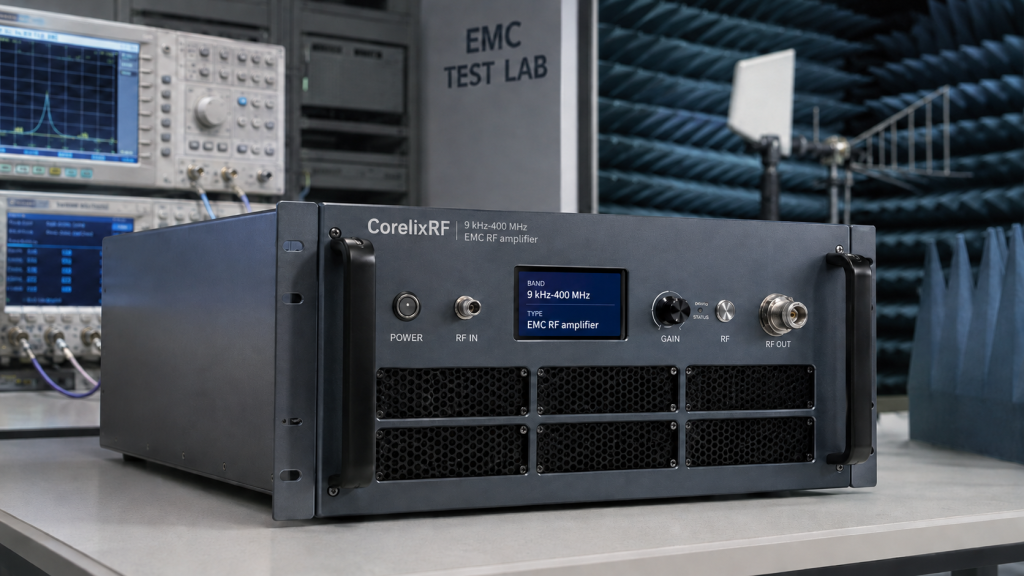
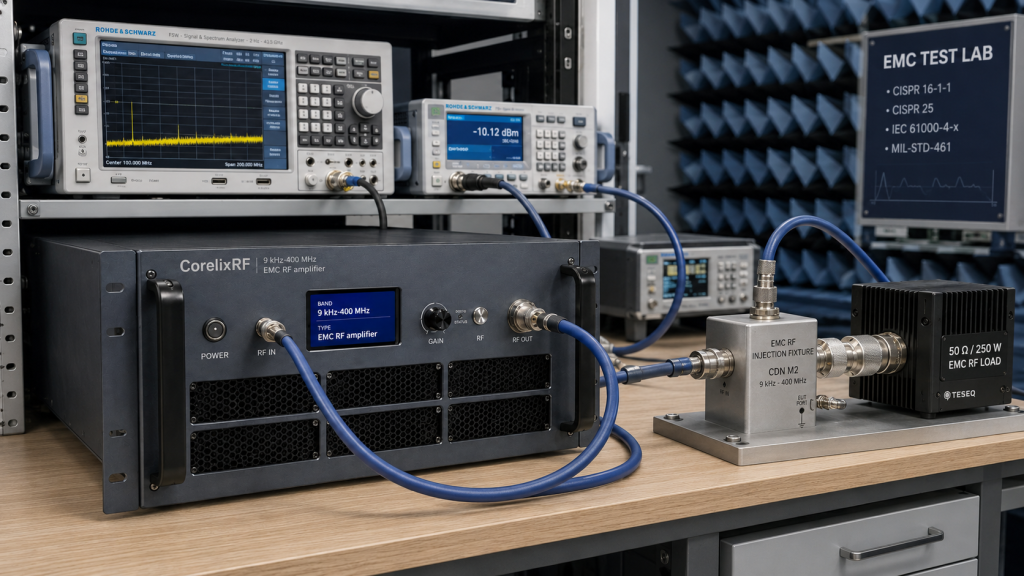
The listed N-Female input and output make cabling straightforward, but connector familiarity should not make the output path casual. At 500 W, every adapter, jumper, coupler, load, and switch must be checked for frequency range, power handling, and mismatch exposure. Include the load condition in the RFQ.
Audit question: are all output-side parts rated for the same frequency, power, and mismatch condition? A low-cost adapter can invalidate an otherwise careful amplifier choice.
Cooling and Rack Space Are Acceptance Items
The 19-inch 6U rack-mount configuration and air cooling approach should be reviewed with duty cycle and room conditions. In a lab rack, warm exhaust from nearby instruments can reduce margin. Ask for thermal behavior under representative frequency, power, and dwell-time conditions rather than a short bench demonstration.
Audit question: has the lab defined a thermal acceptance run that resembles real use? A brief room-temperature power check is not enough for high-power EMC work.
Diagnostics Should Feed the Lab Procedure
Temperature and current diagnostics, alarm protection, and project-ready controls are only valuable when the operating procedure uses them. Define how operators log alarms, stop drive, recover after a trip, and distinguish fixture faults from amplifier faults.
Audit question: who receives alarms, what does the source do, and what evidence is recorded? An alarm that is not connected to procedure is only a warning light.
Pass/Fail RFQ Scorecard
Score the RFQ against five items before sending it: frequency and power reference plane, fixture and load description, drive-level budget, thermal run condition, and alarm response. If any item is missing, the buying discussion is not ready. Use the CorelixRF resources below to move from a general EMC requirement to a reviewed amplifier configuration.
Common RFQ Red Flags
Red flags include a power request with no fixture description, a frequency range with no dwell or modulation detail, a rack requirement with no airflow description, and a request for full-band performance without saying where power will be measured. Another warning sign is treating a low-frequency EMC amplifier like a generic 50 ohm bench booster. At 9 kHz-400 MHz, injection devices, loads, cables, and coupling paths can dominate the result. The buyer should also avoid asking for guarantees that are not tied to a defined measurement setup. A better request states the target, the measurement method, and the evidence needed for acceptance. A strong audit also separates mandatory requirements from preferences. Mandatory items may include the band, rated output, gain control, connector type, rack height, cooling method, and monitoring outputs. Preferences may include documentation format, cable orientation, or whether a future control interface should be reserved.
Related CorelixRF Resources
For readers comparing adjacent platforms, review EMC RF amplifier, UHF RF power amplifier platforms, RF testing and validation, custom RF development, and CorelixRF Contact page. These links keep the next step inside the CorelixRF site and help buyers move from amplifier selection to a specific engineering review without relying on competitor pages or generic catalog assumptions.
FAQ
What makes this an RFQ audit instead of a product overview?
It checks whether the buyer has defined the test method, fixture, load, drive level, cooling, and acceptance evidence needed to quote the amplifier responsibly.
What is the core product basis?
The article is based on the CRF-PA-9K400M-500W local datasheet extraction: 9 kHz to 400 MHz coverage, 500 W rated output, LDMOS technology, and a 19-inch 6U air-cooled rack format.
Which search phrase should the title and first section reinforce?
Use 9 kHz-400 MHz EMC RF amplifier as the primary search phrase.
What should the buyer send to CorelixRF?
Send the required band, target power reference plane, fixture or load details, waveform, dwell time, cooling environment, and alarm-control requirements.