
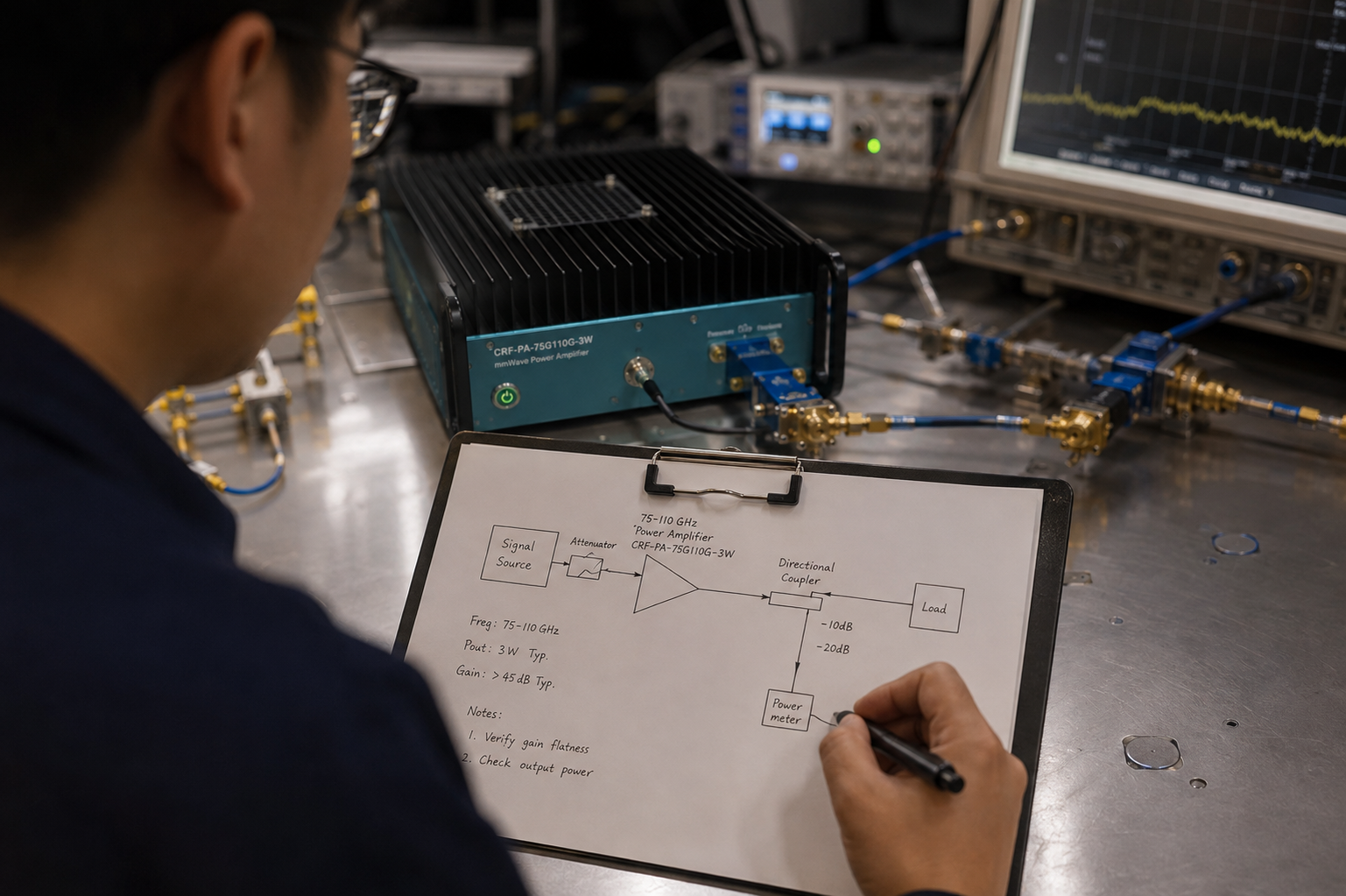
Field handover notebook
Bench: mmWave integration station
Equipment under handover: CRF-PA-75G110G-3W, listed for 75-110 GHz mmWave power amplifier and 3 W.
These notes use the order a technician follows on site: prepare the bench, inspect the RF path, establish a calibrated reference, run a controlled sequence, and hand the system to the next operator. It is deliberately a field record, not a generic mmWave selection guide.
The CRF-PA-75G110G-3W is specified as a GaN solid-state platform covering 75-110 GHz mmWave power amplifier with 3 W rated output. That combination should be read as an engineering starting point, not as permission to assume a complete system outcome. This waveguide field note explains how to turn the published band and power class into a useful request, installation plan, and acceptance record without claiming certifications, availability, or application results that have not been confirmed for the project.
Before arrival — define the operating window
Write down the actual frequencies inside 75-110 GHz mmWave power amplifier, not merely the broadest sweep a source can produce. Include CW or modulation details, target output level at the chosen reference plane, run time, source maximum, and the downstream load or antenna condition. A good request distinguishes a normal operating point from edge-of-band, warm-up, or fault-test conditions. This protects the test schedule from a common error: measuring at a connector while specifying power at a remote fixture.
For a continuous or swept application, record dwell time, leveling approach, and the frequency step or sweep rate. These variables affect how useful a nominal power figure is in a real rack. The purchase file should name the frequency points that matter, rather than importing a generic requirement from another program.
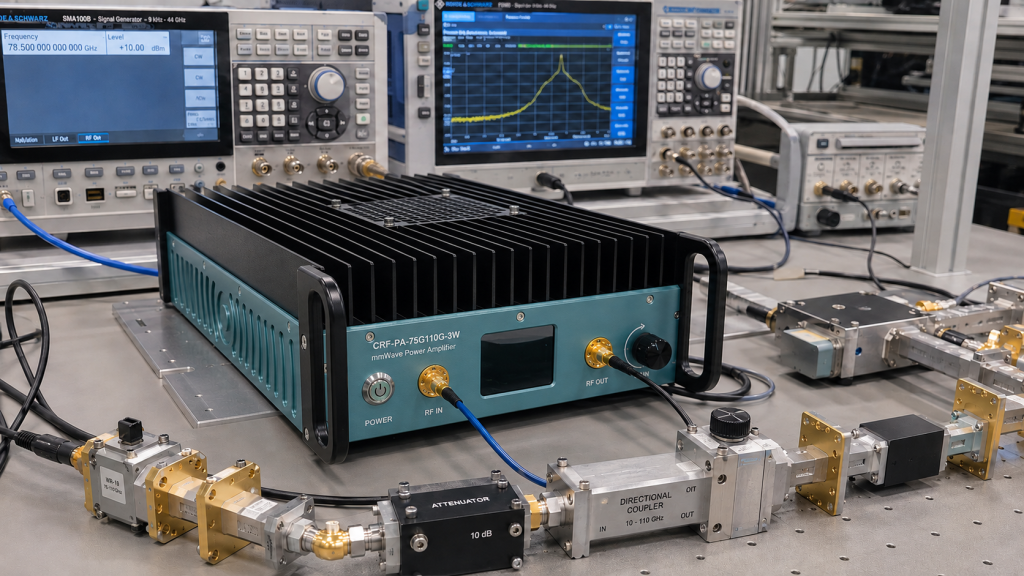
At the bench — inspect the waveguide chain
Sketch every item from signal generator to load: source, attenuation, switching, amplifier, coupler, cable or waveguide, fixture, and measurement receiver. Mark the power rating, frequency coverage, and expected loss of each item. The amplifier may be appropriate for the band while an adapter, coupler, load, or cable is not. Link-budget arithmetic and a defined reference plane make comparison between RF amplifier proposals more meaningful.
Specify what happens during enable, disable, and an abnormal condition. A source limit and a repeatable startup sequence are especially important for a high-gain solid-state design. Ask for the available control, monitoring, and protection behavior for the selected configuration, then decide how the test software or operator will respond. Do not assume optional monitoring or a project-specific interface is standard unless it is confirmed in the quotation.
During the run — preserve thermal and access margin
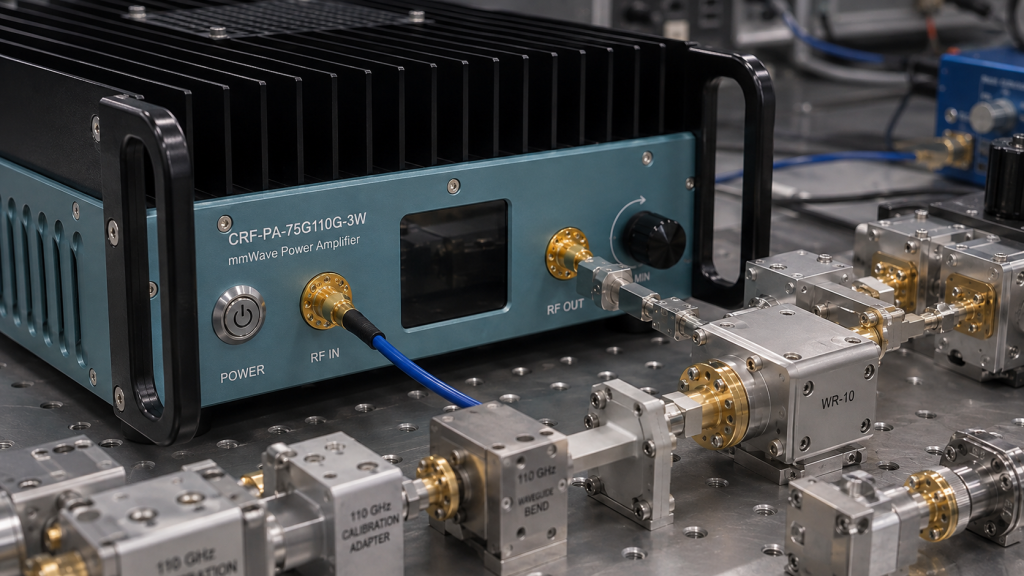
Cooling is part of RF performance planning. State the available rack clearance, inlet temperature, nearby heat sources, supply arrangement, cable routing, service access, and whether the installation is laboratory, vehicle, shelter, or OEM equipment. At these frequencies, waveguide routing, flange handling, bends, transitions, and calibration adapters also belong in the mechanical drawing review.
A short thermal acceptance run should record frequency, source level, output measurement, run duration, temperature indication if available, current indication if available, and any alarm state. The purpose is not to manufacture a pass result; it is to establish repeatable conditions that a future operator can reproduce. The CorelixRF millimeter-wave amplifier context is useful when choosing the closest platform, but final integration still needs the project data.
Handover pack — capture the evidence
A practical RFQ lists the model under review (CRF-PA-75G110G-3W), desired frequencies, output target and reference plane, waveform, source capability, load condition, waveguide/flange path and calibration plan, cooling and rack constraints, control preference, alarm expectations, and requested acceptance data. Ask which values are confirmed standard specifications and which need engineering review. This avoids treating a family description as a promise of an unquoted option.
Use measured data in the format the project can actually consume. A test team may need tabulated frequency points, gain or output data, a thermal run record, harmonic or spurious information appropriate to the application, and documentation of protection checks. A procurement team may additionally need an outline drawing, interface list, delivery terms, and a clear list of exclusions. Keeping these requests separate makes them easier to evaluate.
Sign-off note
Choose this mmWave power amplifier direction when the required band and output class align with 75-110 GHz mmWave power amplifier and 3 W, and when the surrounding RF chain can safely support it. Escalate to a custom review when a nonstandard frequency window, output interface, enclosure, control protocol, cooling method, or acceptance sequence changes the integration problem. A custom request is strongest when it begins with evidence rather than a vague request for “more power.”
The same discipline helps comparison shopping. Compare usable band, operating conditions, interface assumptions, thermal boundary, protection behavior, and requested test evidence—not only the largest headline wattage. This approach is suitable for lab integration, RF front-end development, EMC or communication test setups, and engineering evaluation where the claimed system performance must remain traceable to the actual chain.
Technician sign-off
Leave the next operator a readable record: frequency points, calibration plane, waveguide and load identity, source limit, run duration, and the location of measured data. A clean handover prevents a mechanically correct mmWave setup from becoming an electrically ambiguous one.
Engineering references
Use the broader RF power amplifier, high-frequency RF capability, RF testing and validation, RF front-end platform, and custom RF development resources to route an RFQ to the closest standard platform or a project-specific review.
FAQ
What frequency range is listed for CRF-PA-75G110G-3W?
The local product specification identifies 75-110 GHz mmWave power amplifier.
What output power is listed?
The product specification identifies 3 W rated output for this model class; final operating conditions should be confirmed in the quotation and test plan.
What should be included in an RF amplifier RFQ?
Include frequency points, waveform, output reference plane, source level, load, interfaces, cooling constraints, control needs, and acceptance data.
When is a custom RF amplifier review appropriate?
Use a custom review when standard frequency, interface, enclosure, cooling, control, or test requirements do not match the project.