
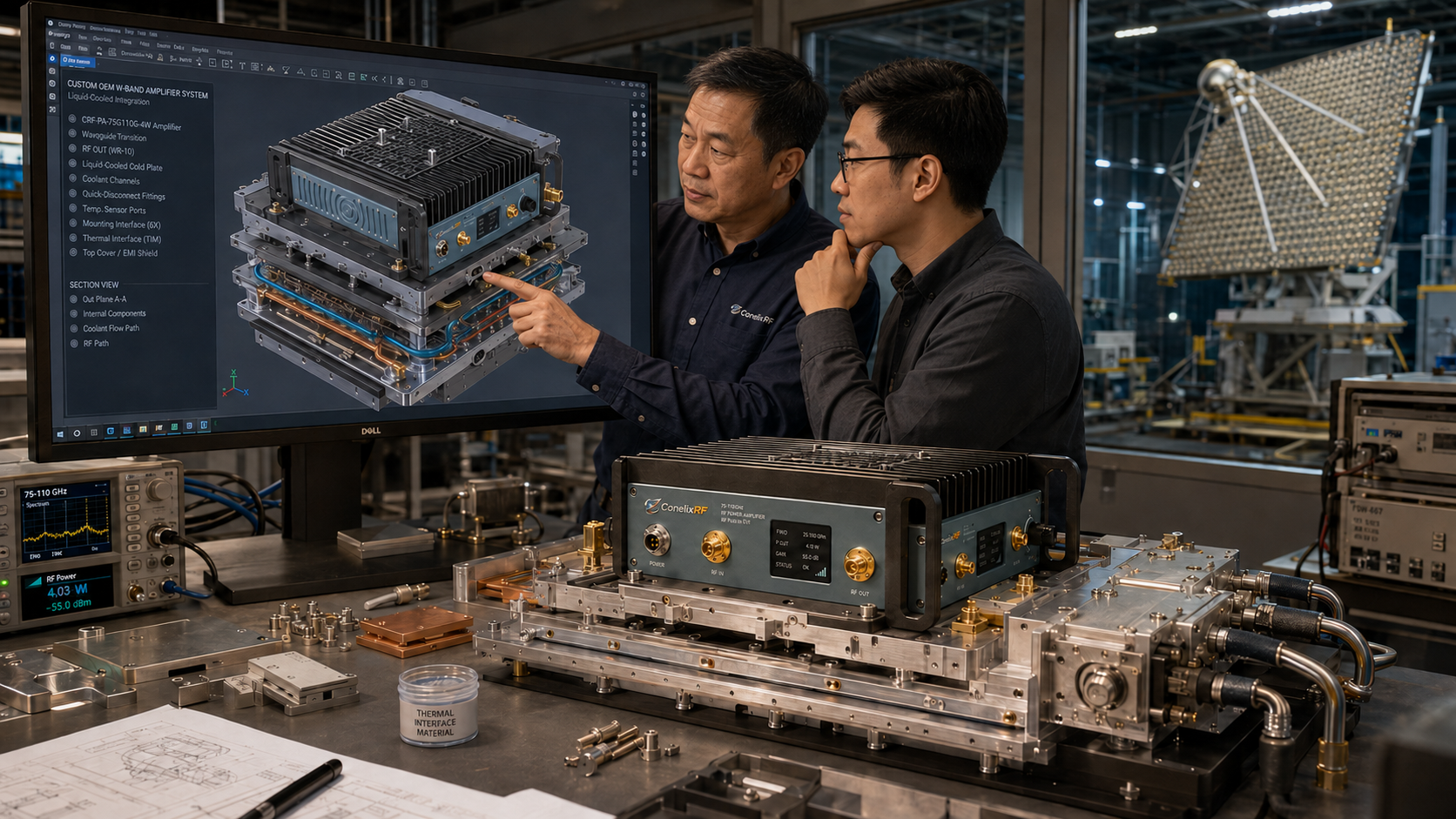
Article format: buyer Q&A guide. This article is written around the questions a technical buyer should ask before requesting a W-band amplifier quote. It is intentionally less like a catalog page and more like a purchase-readiness checklist.
W-band amplifier projects require a different writing and selection approach from standard RF power amplifier topics. At 75-110 GHz, public pages often provide model names for screening while reserving detailed specifications, drawings, waveguide details, and measured data for inquiry review. The CRF-PA-75G110G-4W is listed by CorelixRF as a representative W-band model name for 75-110 GHz mmWave amplifier inquiries.
CorelixRF’s millimeter-wave amplifier platform covers 18-110 GHz custom configuration, engineering review, and factory test validation. The public screening table identifies the CRF-PA-75G110G Series as a 75-110 GHz W-band platform, and the representative model list includes CRF-PA-75G110G-1W, 2W, 3W, and 4W. Because detailed specifications are not publicly displayed, this article avoids claiming gain, connector, cooling, or stock status.
Buyer Question: Is the Public Model Name Enough?
No. The CRF-PA-75G110G-4W is useful as a starting reference, but it should not be treated as a complete purchasing specification. A W-band buyer should request the datasheet, interface detail, measured performance data, mechanical reference, cooling guidance, and test data scope before internal approval.
Buyer Question: What Makes W-Band Different?
At 75-110 GHz, the amplifier cannot be separated from the waveguide path, calibration method, fixture, load, antenna, or frequency extender. Small interface changes can affect delivered power and repeatability. That is why the best inquiry explains the test setup instead of asking only for a model number and price.
Why W-Band RFQs Need More Context
A 75-110 GHz RF amplifier cannot be specified from frequency and output class alone. Interface type, waveguide path, input level, output reference plane, thermal structure, control method, load condition, test fixture, and calibration method all affect the final recommendation. CorelixRF states that datasheets are provided after inquiry review for mmWave models.
For buyers, that means the RFQ should be written as an engineering request rather than a simple part-number request. The CRF-PA-75G110G-4W can be used as a public inquiry reference, but the final configuration must be confirmed by CorelixRF before purchase.
Application Fit
The CRF-PA-75G110G Series is relevant to W-band mmWave test benches, high-frequency validation, radar and sensing development, laboratory RF chains, and project-specific integration. If the project needs a narrower band inside 75-110 GHz, state that directly. If the amplifier must interface with a waveguide system, frequency extender, mixer chain, antenna, or load, include the full path.
For broader system work, link the requirement to CorelixRF’s high-frequency amplifier and RF front-end platform paths, then use custom RF amplifier review for non-standard interfaces or mechanical requirements.
How to Prepare a W-Band Inquiry
A W-band inquiry should define the real operating band first. Although the public series range is 75-110 GHz, many projects only use a smaller window for radar, sensing, communication research, material measurement, or instrument development. A narrower frequency statement helps CorelixRF review whether the representative CRF-PA-75G110G-4W model direction is suitable or whether another output class or configuration should be considered.
The inquiry should also include the source chain. At W-band, the amplifier may be driven by a frequency extender, multiplier chain, mixer path, signal generator, or custom transceiver front end. The available input level and interface can vary significantly. Without source details, it is difficult to judge required gain, output class, or interface format.
Waveguide, Fixture, and Calibration Planning
At 75-110 GHz, the interface path is part of the performance requirement. Waveguide transitions, bends, fixtures, antennas, loads, and calibration adapters can affect output power and repeatability. The buyer should state the intended output reference plane and whether power must be verified at the amplifier output, after a waveguide path, or at the device-under-test plane.
Calibration method should also be described. Some benches require only comparative output, while others need traceable power measurement or repeatable test conditions across multiple units. If the project uses a frequency extender or probe station, provide the fixture architecture and expected losses. These details help prevent overpromising based on a representative model name alone.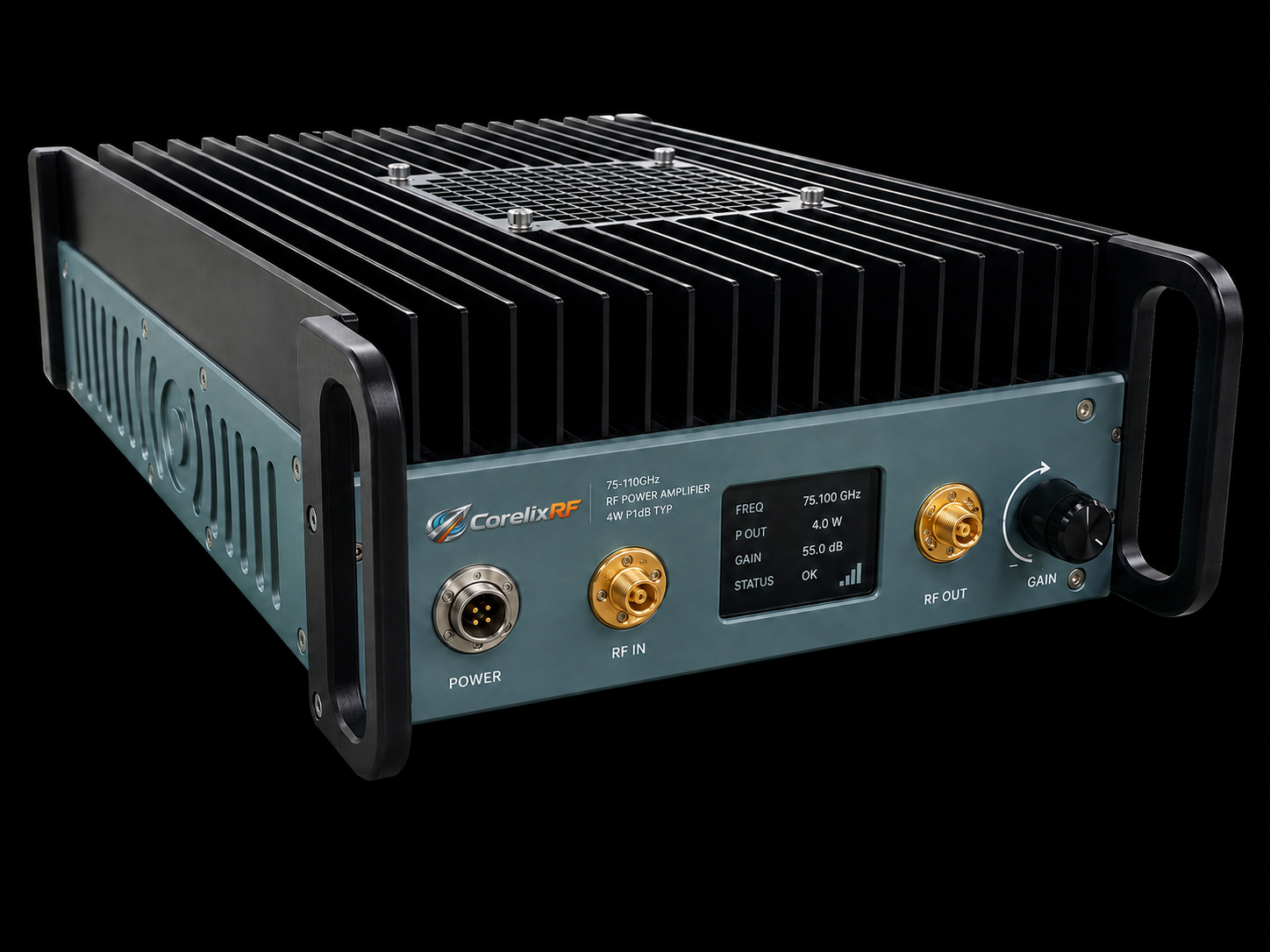
Thermal and Mechanical Review
Because detailed public specifications are not shown for the CRF-PA-75G110G-4W, thermal and mechanical details should be requested during inquiry review. Provide the operating environment, run time, cooling constraints, mounting method, enclosure limits, and service access needs. W-band systems are often compact but mechanically sensitive, so cable strain, waveguide alignment, and fixture repeatability should be considered early.
If the amplifier must be integrated into an OEM product, instrument rack, or shielded test enclosure, ask for outline drawings and interface information before the mechanical design is finalized. This avoids a common problem: selecting an RF model first and discovering later that the physical integration does not support the measurement plan.
Documentation and Purchase Readiness
The CRF-PA-75G110G-4W should be treated as a starting inquiry model. Before budget approval or purchase, request the datasheet, available measured data, mechanical reference, interface description, control details, cooling guidance, and factory test scope. If the project needs project-specific acceptance criteria, define them in the RFQ.
For buyers, this approach is more practical than asking for a generic W-band amplifier quote. It gives CorelixRF enough technical context to respond with a suitable configuration and prevents the article or inquiry from implying specifications that are not publicly documented.
FAQ
What is the CRF-PA-75G110G-4W?
It is a public representative CorelixRF model name for a 75-110 GHz W-band mmWave amplifier inquiry.
Are full specifications public?
No. CorelixRF states that detailed specifications, key parameters, test data, and datasheets are provided after inquiry review.
What should be included in the inquiry?
Include frequency window, output target, input level, interface or waveguide path, load condition, cooling, control method, test setup, and documentation requirements.
Is this a standard stock promise?
No. The public page presents representative model names for screening. Final configuration and datasheet release depend on engineering review.
When should a custom review be used?
Use custom review when the project has a special frequency window, interface, waveguide path, control logic, cooling structure, or OEM integration requirement.