
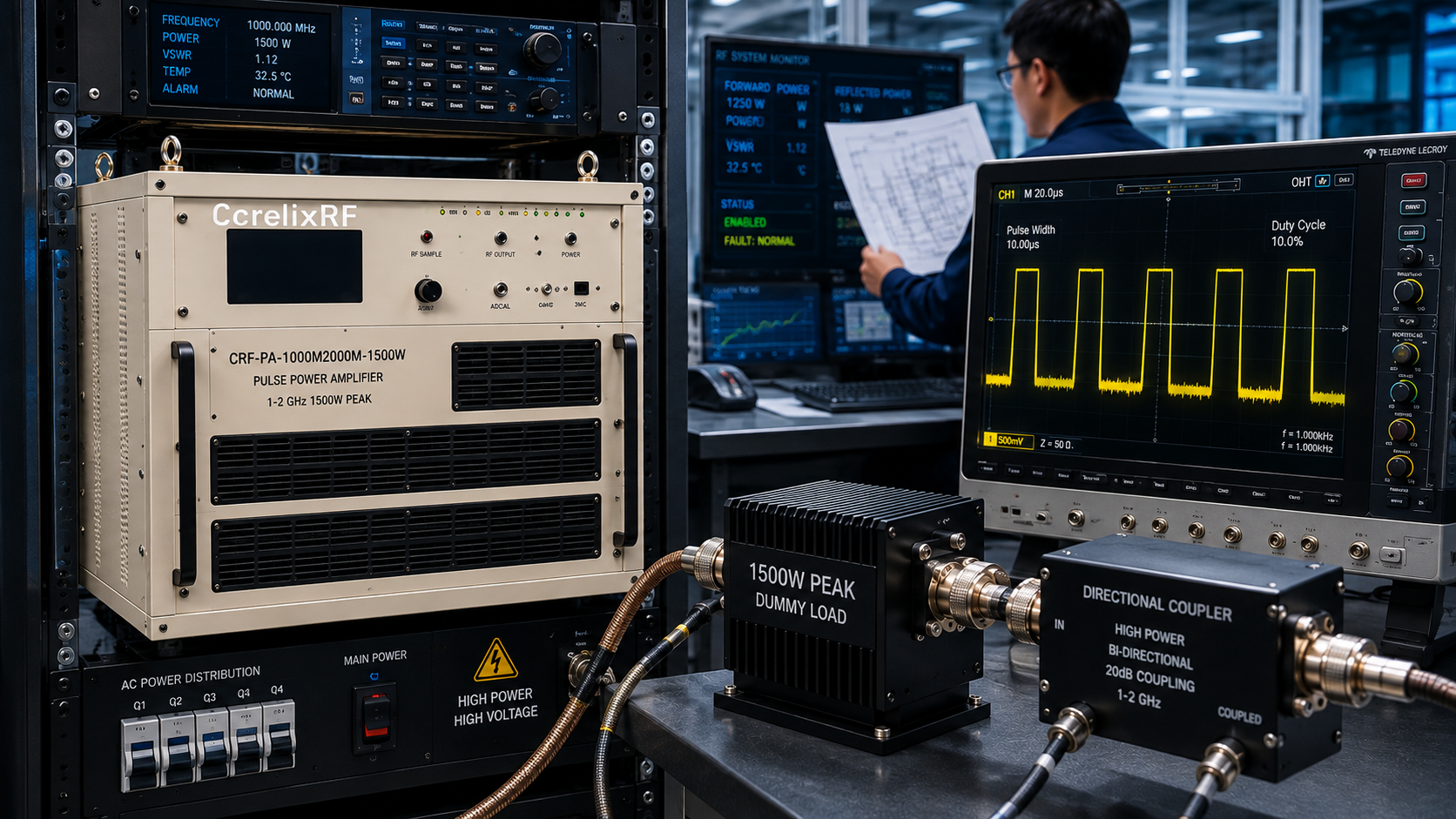
Article format: system integration workflow. This article is structured as a step-by-step integration guide for teams planning a high-power pulsed L-band RF chain. It starts from pulse definition, then moves through RF path, controls, rack planning, and purchase readiness.
Pulsed RF amplifier selection is fundamentally different from CW amplifier selection. Peak power, pulse width, duty cycle, pulse repetition behavior, thermal structure, control interface, rack format, and protection logic all affect whether a model fits the project. The CRF-PA-1000M2000M-1500W is a CorelixRF pulsed L-band model listed for high-power RF output and system-level pulsed RF projects.
CorelixRF’s public pulsed amplifier page lists the CRF-PA-1000M2000M-1500W with 1000-2000 MHz frequency coverage, 1500 W rated output, 62 dB gain, 1-50 us pulse width, 5% duty cycle, RS485 / LAN control, and 19-inch 5U structure at about 35 kg. Those parameters make it a much more distinct topic than the repeated standard broadband models.
Integration Workflow at a Glance
- Define the pulse: pulse width, duty cycle, repetition frequency, burst length, and run time.
- Map the RF path: source, driver, amplifier, coupler, filter, load, antenna, and measurement point.
- Confirm power handling: peak and average power ratings for every downstream component.
- Plan controls: RS485 / LAN integration, enable logic, fault handling, and operator workflow.
- Review the rack: 5U space, airflow, service access, grounding, cabling, and safety labeling.
- Request documentation: datasheet, drawing, test data, control notes, and acceptance criteria.
Why Pulse Conditions Drive the RFQ
A pulsed amplifier cannot be selected from frequency and peak power alone. The pulse width, duty cycle, repetition behavior, burst length, cooling interval, and thermal environment define the operating stress. A system that needs 1500 W for short low-duty pulses is different from a system that expects longer pulses or higher average power.
For the CRF-PA-1000M2000M-1500W, the published pulse condition is 1-50 us at 5% duty cycle. Any requirement outside that window should be treated as an engineering review case. CorelixRF states that custom frequency range, output power, pulse width, duty cycle, pulse frequency, control interface, power supply, cooling structure, and OEM integration can be reviewed.
Application Fit
This pulsed L-band RF amplifier can be reviewed for high-power L-band RF output, communication test platforms, RF chain validation, radar front-end validation, and system-level pulsed RF projects. For test benches, the RFQ should include source level, pulse timing, RF load, coupler plan, measurement equipment limits, and acceptance data needs.
If the amplifier is part of a larger transmit or sensing platform, route the discussion through RF front-end platforms or custom RF amplifier review.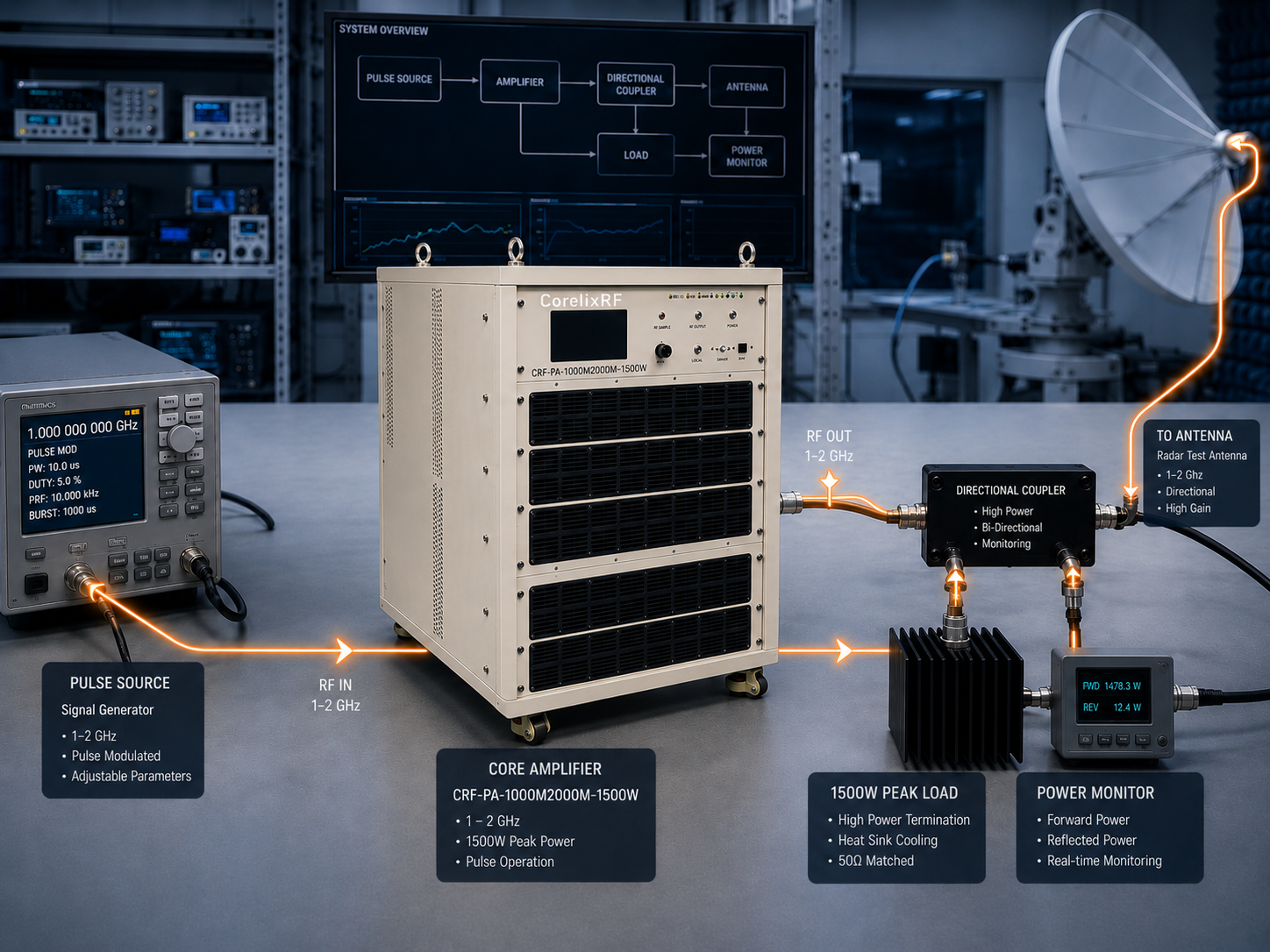
High-Power Pulse Timing and Thermal Margin
The CRF-PA-1000M2000M-1500W is listed with a 1-50 us pulse width and 5% duty cycle. Those values should be treated as central selection parameters, not minor notes. Peak power alone does not describe the operating stress. Average power, pulse repetition frequency, burst duration, cooling interval, and thermal recovery all influence whether a pulsed amplifier can support a given test sequence.
When preparing an RFQ, provide the minimum and maximum pulse width, duty cycle, pulse repetition frequency, expected number of pulses per burst, burst repetition interval, and total run time. If the system uses different pulse modes, include each mode separately. This allows CorelixRF to review whether the standard model fits or whether the pulse format requires custom engineering.
System-Level RF Path Requirements
A 1500 W pulsed amplifier requires a disciplined downstream RF path. The load must be rated for the peak and average operating condition. Couplers, attenuators, cables, switches, filters, and connectors must also be selected for the expected power and frequency range. If the amplifier output is connected to a test antenna, antenna gain, mismatch, cable loss, and safety distance should be reviewed together.
Measurement planning is equally important. The team should define whether output power is measured at the amplifier output, after a coupler, at a load input, or at another system reference plane. Without this reference, buyer and supplier may appear to agree on power while actually discussing different points in the RF chain.
Control, Protection, and Rack Planning
The public table lists RS485 / LAN control and a 19-inch 5U structure around 35 kg. That information is valuable for rack and automation planning. A high-power pulsed RF amplifier may need remote enable, interlock support, fault monitoring, temperature monitoring, forward and reflected power monitoring, and coordinated control with the signal source. The exact control feature set should be confirmed during inquiry review.
Rack integration should not be left until after the quote. Confirm rack depth, airflow direction, cable bend radius, power entry, grounding, service access, and operator safety labeling. If the amplifier will be part of an OEM system or mobile platform, include mechanical vibration, installation orientation, and maintenance expectations. These non-RF details can determine whether the selected model is practical in the final system.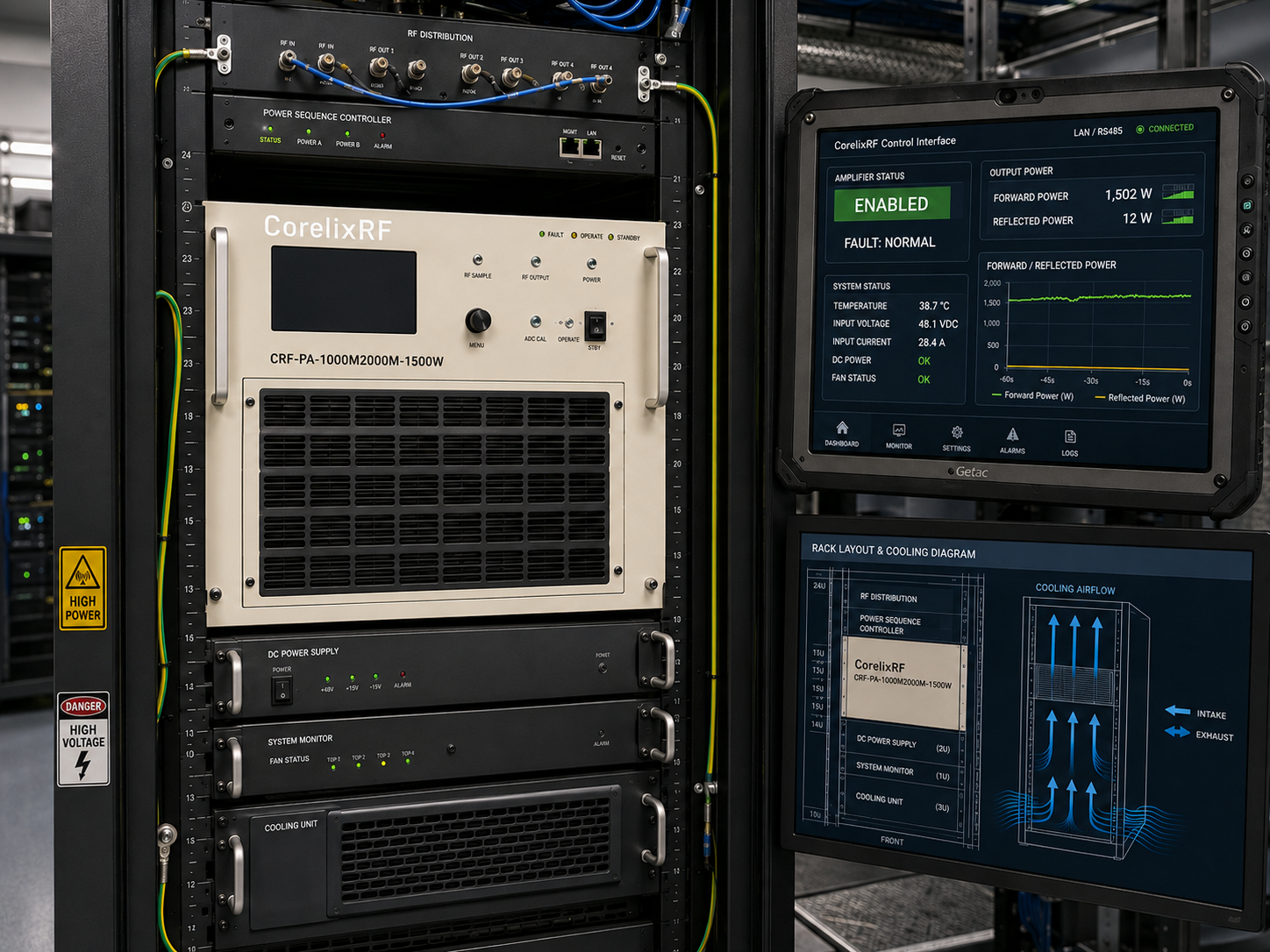
Procurement Checklist for the 1500W Class
Before purchase, request the datasheet, outline drawing, power supply requirements, current information, cooling guidance, interface details, control protocol notes, and test data scope. Confirm whether the unit will be evaluated by factory test records, customer acceptance testing, or both. If the project has compliance, traceability, export, or documentation requirements, mention them before quotation.
The CRF-PA-1000M2000M-1500W is best treated as an engineering-reviewed RF subsystem, not a generic catalog amplifier. A strong inquiry will reduce risk, improve model selection, and help CorelixRF recommend whether the published platform or a custom pulsed amplifier configuration is the right path.
FAQ
What is the CRF-PA-1000M2000M-1500W?
It is a CorelixRF 1000-2000 MHz pulsed RF amplifier model listed with 1500 W rated output.
What pulse condition is listed?
CorelixRF lists 1-50 us pulse width and 5% duty cycle for this model.
What control interfaces are listed?
The public table lists RS485 / LAN control.
What structure is listed?
The model is listed as a 19-inch, 5U unit with about 35 kg structure.
What should be confirmed before quotation?
Confirm pulse width, duty cycle, pulse frequency, output target, input drive, load condition, cooling, control, rack constraints, and documentation needs.