
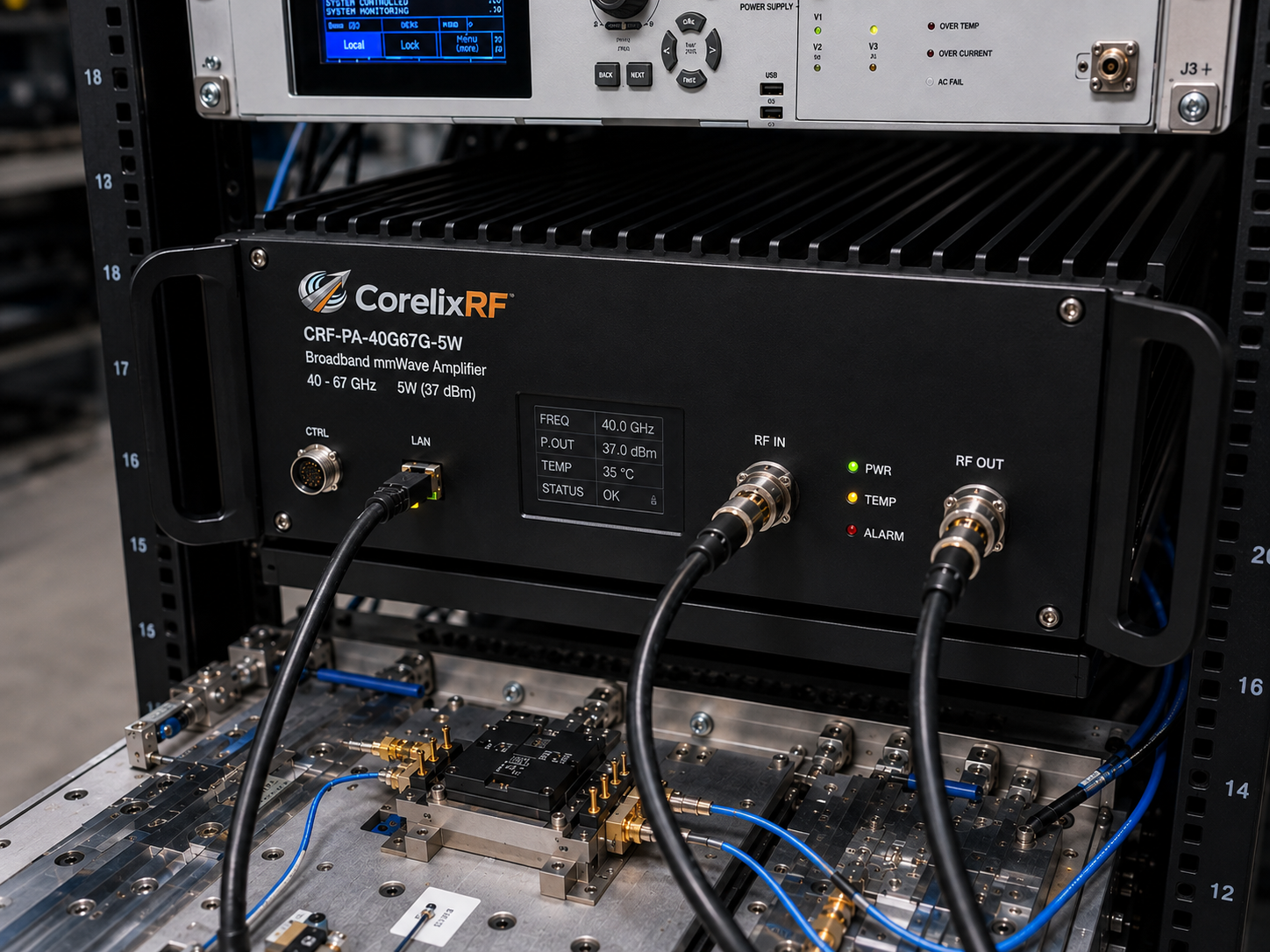
Article format: careful inquiry brief. This piece is intentionally written as a cautious engineering inquiry rather than a datasheet-style article, because the public millimeter-wave page uses representative model names and provides detailed data after review.
Broadband mmWave amplifier inquiries must be written carefully because public model names are often only the beginning of the engineering review. At 40-67 GHz, frequency window, coaxial or waveguide interface, load condition, cooling structure, test fixture, and datasheet requirements all influence the final configuration. CorelixRF lists the CRF-PA-40G67G Series as a broadband mmWave review platform, with representative public model names including CRF-PA-40G67G-1W, 2W, and 5W.
The CRF-PA-40G67G-5W should therefore be treated as a public inquiry reference, not as a fully specified stock promise. CorelixRF states that detailed electrical specifications, test data, mechanical information, and datasheets are provided after inquiry review for millimeter-wave amplifier models. This is the right way to discuss the model without inventing unavailable public parameters.
What This Public Model Name Can and Cannot Tell You
It can tell you that CorelixRF presents a 40-67 GHz mmWave amplifier series and includes a 5W representative model name for inquiry screening.
It cannot, by itself, confirm final gain, interface, cooling structure, enclosure, delivery configuration, measured curve, or stock status. Those items should be requested from CorelixRF during engineering review.
The right next step is to describe the real RF path and ask for the matching datasheet, interface recommendation, and test data scope.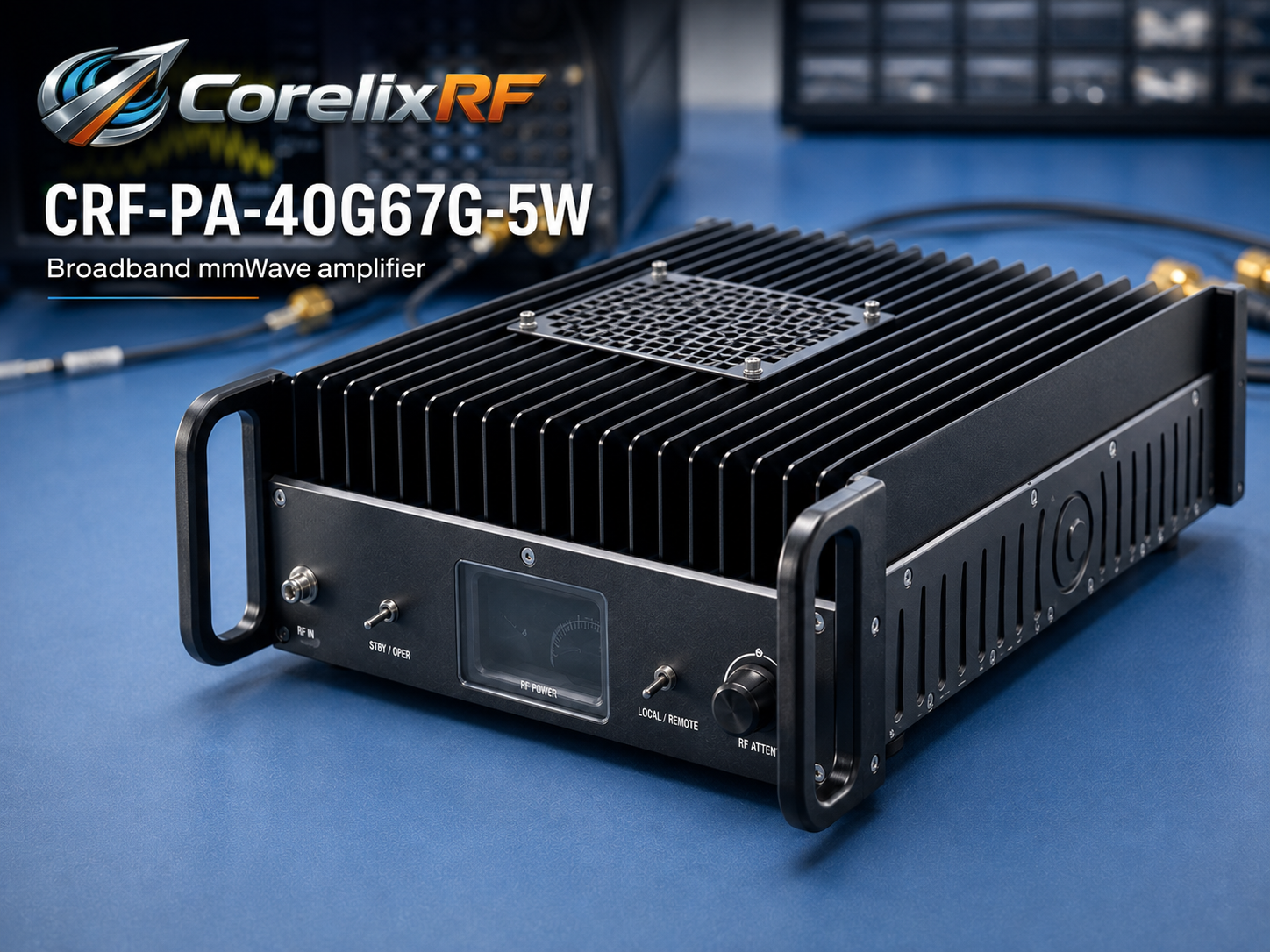
Why 40-67 GHz Requires Engineering Review
A 40-67 GHz mmWave amplifier sits in a demanding high-frequency region where small interface decisions can change system performance. Adapter loss, waveguide transitions, connector repeatability, calibration method, thermal structure, and output reference plane must be reviewed before quotation. A 5W representative model can be a useful starting point for broadband test systems, V-band engineering work, and custom mmWave integration.
If the project only needs a narrower frequency band inside 40-67 GHz, state that clearly. A focused frequency window may affect gain, output, interface, and cooling decisions. If the amplifier must connect to a frequency extender, mixer chain, antenna, load, or automated test system, include the full RF path.
Inquiry Checklist
For the CRF-PA-40G67G-5W, prepare frequency window, output target, input level, interface preference, waveguide or coaxial path, load condition, cooling method, control requirements, mechanical constraints, and test data expectations. If the amplifier is part of a larger platform, use CorelixRF’s RF front-end platforms link for source-to-load review and the custom RF amplifier path for non-standard configuration.
How to Write a Useful 40-67 GHz RFQ
A useful RFQ for a 40-67 GHz amplifier should not begin and end with the model number. The buyer should describe the operating purpose, frequency window, output target, input source, interface preference, measurement method, and environmental limits. If the amplifier will be used for a lab bench, say whether the bench is manual, automated, swept, pulsed, or modulation-based. If it will be built into equipment, include mechanical limits and control expectations.
This level of detail matters because 40-67 GHz systems are sensitive to small physical and electrical changes. A connector option that works for one setup may not be suitable for another. A waveguide path that is convenient mechanically may add transitions that affect delivered output and calibration. By stating the whole RF path, the user gives CorelixRF enough context to review whether the CRF-PA-40G67G-5W reference is suitable or whether another mmWave configuration should be considered.
Interface and Calibration Considerations
At 40-67 GHz, interface selection is part of the RF design. The final configuration may involve coaxial interfaces, waveguide transitions, test fixtures, frequency extenders, antennas, or precision loads. Each item can introduce loss, mismatch, and repeatability concerns. If the test setup relies on calibrated output power, the calibration reference plane should be defined before the amplifier is selected.
For example, power measured at the amplifier output may not equal power delivered to a device under test after adapters and fixtures. If the goal is to guarantee power at the DUT plane, the RFQ should include fixture loss and calibration method. If the amplifier will be connected to an antenna path, include antenna interface, expected mismatch, and whether reflected power behavior must be monitored or protected.
Thermal, Control, and Mechanical Requirements
Because CorelixRF provides detailed mmWave specifications after inquiry review, the buyer should provide enough information to guide the configuration. Cooling method, ambient temperature, run time, airflow constraints, mounting orientation, and enclosure limits should all be included. A broadband mmWave amplifier may be used in a controlled laboratory, a rack-mounted automated test station, or a compact OEM instrument, and each environment has different thermal and mechanical demands.
Control requirements should also be described early. Some benches only need manual enable and power supply control, while automated systems may need remote operation, status monitoring, fault reporting, and integration with test software. If the amplifier is part of a larger RF front-end platform, the control interface should be reviewed together with the signal source, switching, filtering, and load path.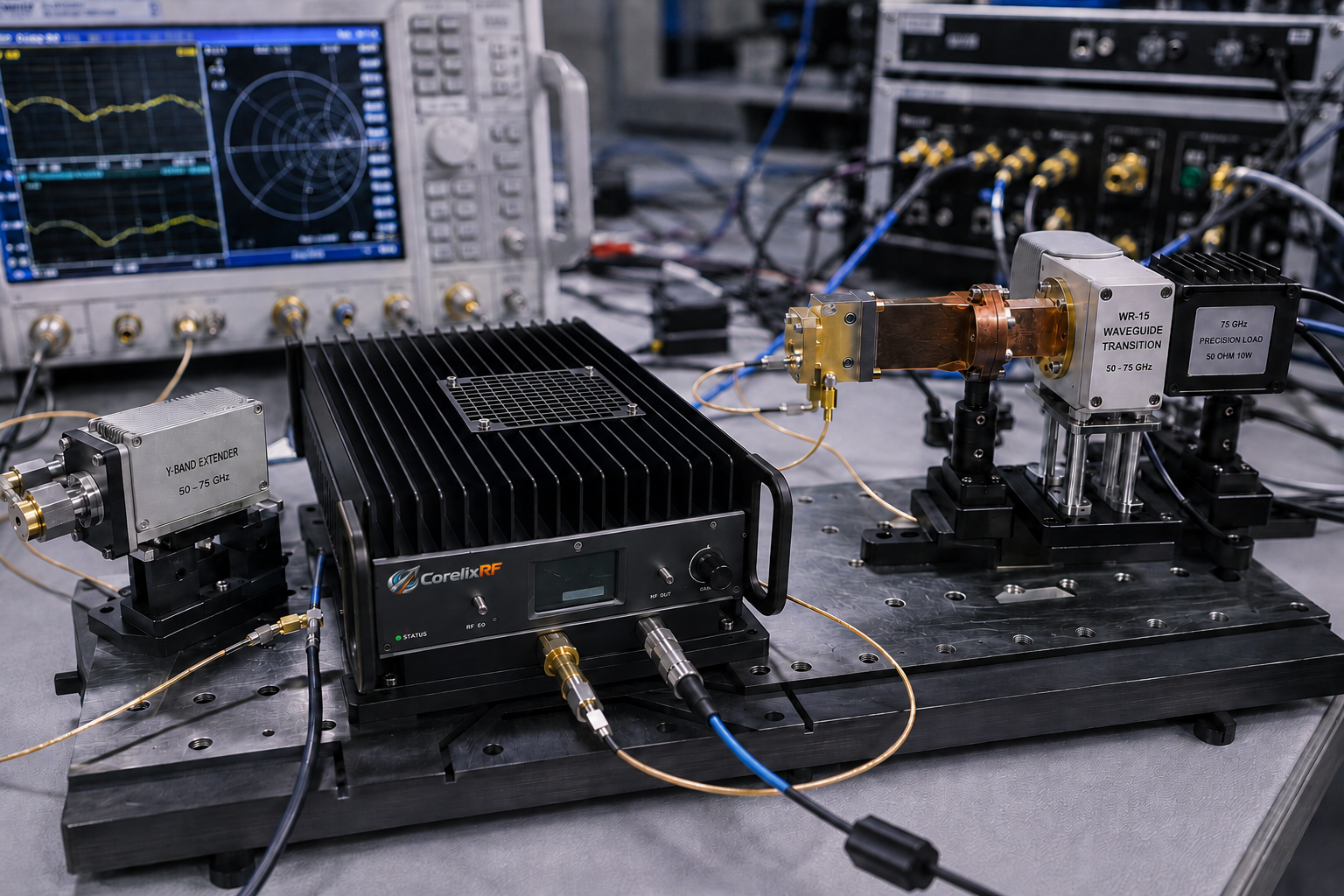
When a Public Model Name Is Enough and When It Is Not
The CRF-PA-40G67G-5W is useful as a public reference because it helps the buyer communicate the approximate frequency range and output class. It is not enough for final purchasing approval by itself. For purchase, the team should request the datasheet, interface details, outline drawing, power supply requirements, cooling guidance, test data scope, and any available measured performance information.
This is especially important for universities, laboratories, defense-related integrators, communication developers, and instrument builders that need documented performance before budget approval. A precise inquiry reduces back-and-forth and helps avoid claims that are not visible on the public page.
FAQ
What is the CRF-PA-40G67G-5W?
It is a public representative CorelixRF model name for a 40-67 GHz broadband mmWave amplifier inquiry.
Are detailed specifications public?
No. CorelixRF states that detailed specifications, key parameters, test data, and datasheets are provided after inquiry review.
What project direction fits this series?
CorelixRF identifies the CRF-PA-40G67G Series as a broadband mmWave review platform.
What should the RFQ include?
Include frequency window, output target, input drive, interface path, load condition, cooling, control method, mechanical constraints, and documentation needs.
Can CorelixRF customize this platform?
Yes. CorelixRF supports project-specific mmWave amplifier configuration based on frequency, output, interface, cooling, control, and test documentation needs.