
Article format: RFQ and procurement memo. This article is written for purchasing teams and project engineers who need to turn a pulsed L-band requirement into a clean supplier inquiry. It uses a checklist-driven structure rather than a general product overview.
Pulsed L-band amplifier projects need more than a frequency and wattage match. Pulse width, duty cycle, pulse repetition behavior, thermal margin, control interface, rack size, load condition, and protection logic all affect whether a model is suitable. The CRF-PA-1200M1400M-500W gives engineers a focused 1200-1400 MHz pulsed RF amplifier platform for narrowband L-band testing and OEM rack integration.
CorelixRF lists this model with 1200-1400 MHz frequency coverage, 500 W rated output, 57 dB gain, 50 us pulse width, 10% duty cycle, RS485 / LAN control, and 19-inch 3U / 18 kg structure. Those details make it a better fit for focused pulsed L-band work than a broad CW amplifier article or a repeated low-frequency standard module.
RFQ Memo Summary
| Decision Area | What to Confirm |
|---|---|
| Frequency | Whether the project truly fits 1200-1400 MHz or needs another L-band window. |
| Pulse timing | Pulse width, duty cycle, pulse repetition frequency, burst behavior, and run time. |
| Power path | Whether 500 W is needed at the amplifier output or after couplers, cables, and fixtures. |
| Control | How RS485 / LAN control will connect to the bench or OEM system. |
| Documentation | Datasheet, mechanical drawing, interface notes, test data, and acceptance criteria. |
Why the 1200-1400 MHz Window Matters
A narrower pulsed L-band RF amplifier can be useful when the project does not require a full 1000-2000 MHz span. Focused frequency coverage helps the RFQ center on the real test band, pulse condition, control requirements, and mechanical integration. For communication verification, RF chain validation, and rack-mounted test platforms, that can make the review more precise.
The 500 W output class also sits below CorelixRF’s 1500 W L-band platform, reducing the risk of over-specifying a project that only needs mid-power pulsed output. However, 500 W pulsed operation still requires proper load rating, coupler selection, cooling, rack airflow, and RF safety planning.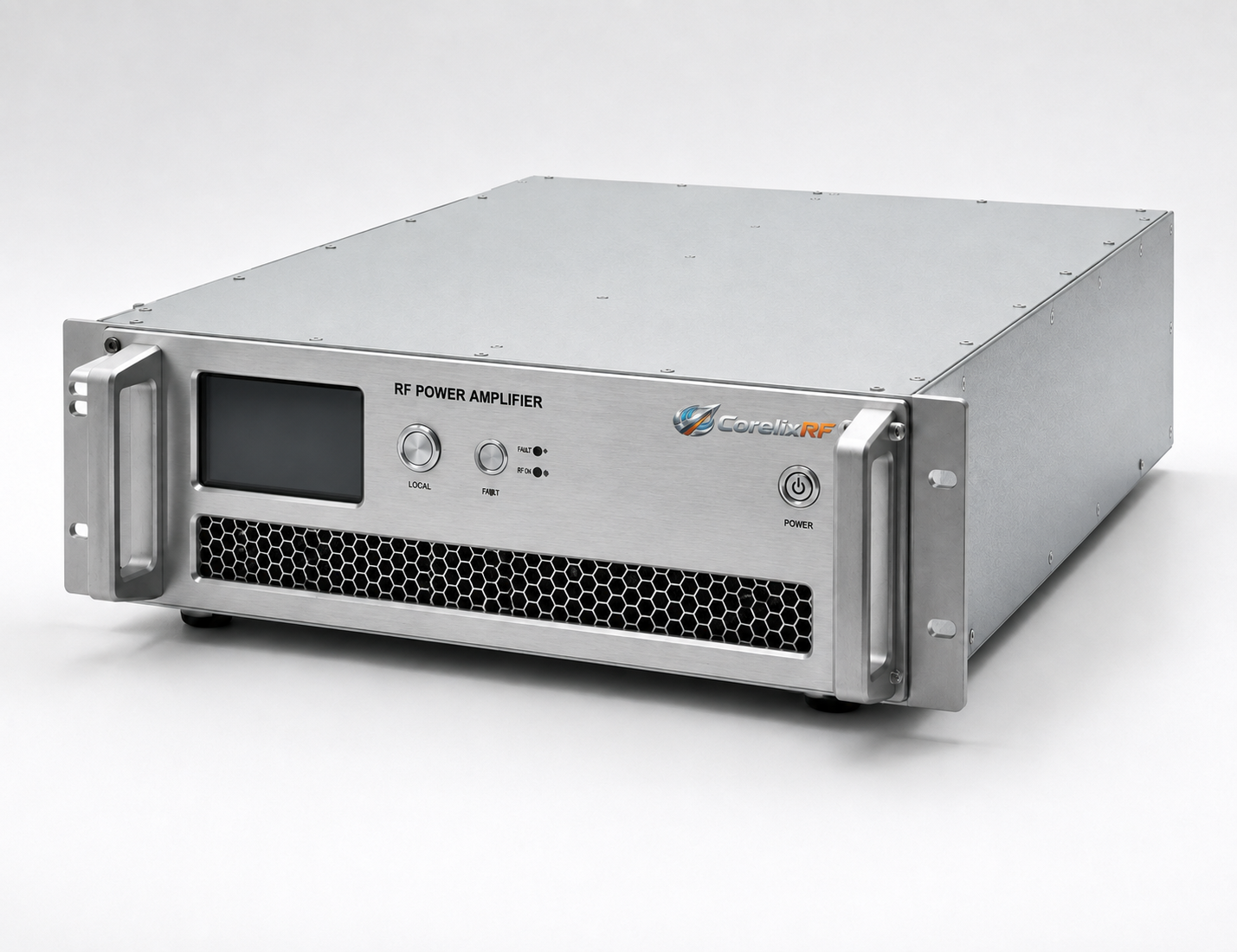
Pulse Conditions to Define Before RFQ
CorelixRF publicly lists 50 us pulse width and 10% duty cycle for this model. If the project uses different pulse width, duty cycle, pulse frequency, rise/fall requirements, or burst conditions, those should be reviewed before selection. The RFQ should also include input drive, gain target, connector path, monitoring needs, and acceptance data requirements.
If the standard pulse condition is not enough, CorelixRF’s custom RF amplifier review path can cover frequency, output power, pulse width, duty cycle, pulse frequency, control interface, power supply, cooling structure, and OEM integration.
Why Pulsed Power Cannot Be Treated Like CW Power
A 500 W pulsed rating does not mean the amplifier should be compared directly with a 500 W CW amplifier. In pulsed operation, peak power, pulse width, duty cycle, repetition frequency, and thermal recovery determine the stress placed on the RF device and cooling system. Two applications can both request 500 W output but place very different demands on the amplifier if one uses short infrequent pulses and the other uses longer pulses near the duty-cycle limit.
For that reason, the RFQ should include actual timing values instead of general statements such as “pulsed operation.” The more precise the pulse timing, the easier it is to evaluate whether the CRF-PA-1200M1400M-500W fits the system. If the timing plan is still changing, provide the expected minimum and maximum values so engineering can identify the most important constraints before quotation.
Load, Coupler, and Measurement Planning
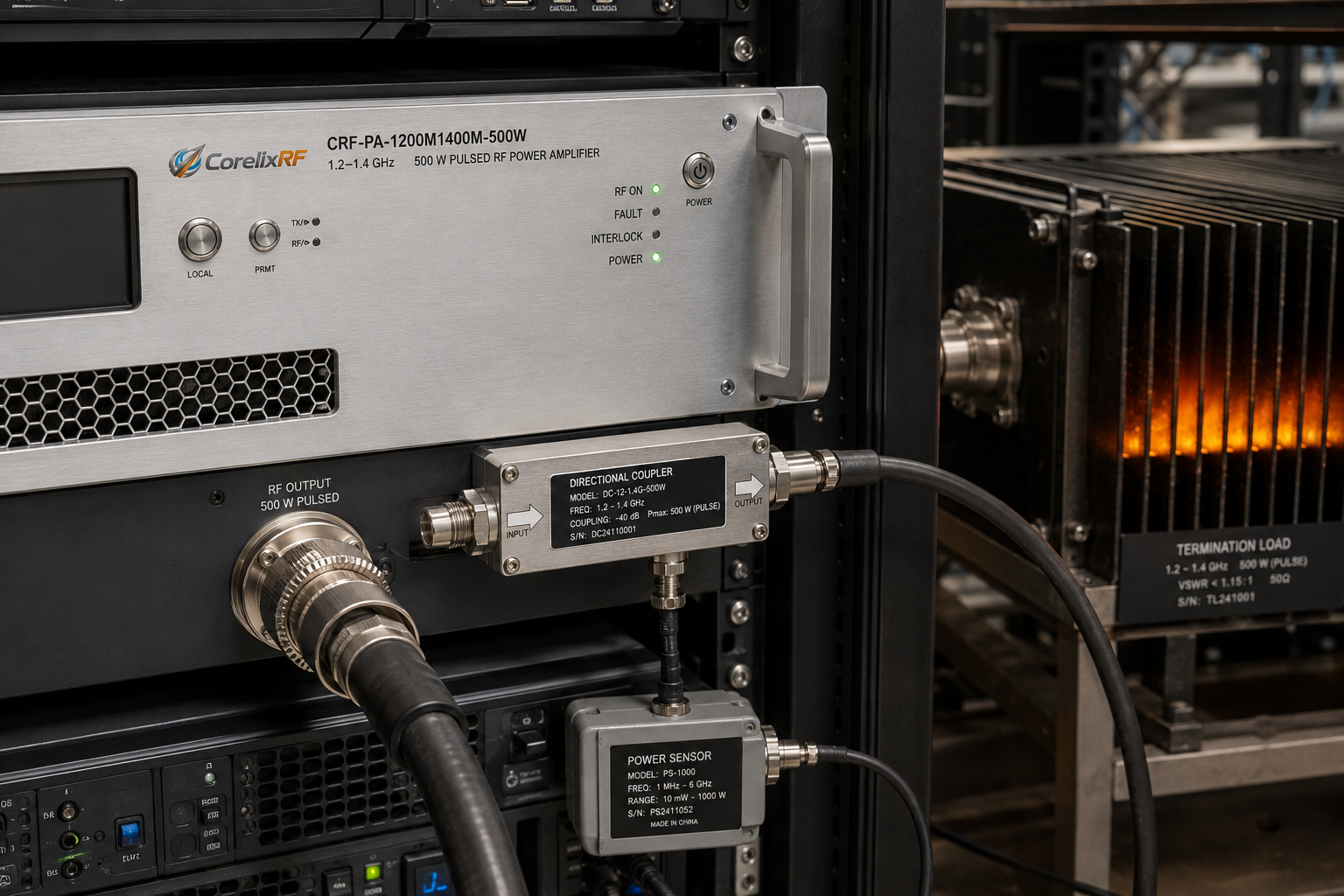
At 500 W pulsed output, the downstream RF path must be rated and documented. The load, coupler, attenuator, cable, connector, switch, and fixture must all support the expected peak and average conditions. Measurement equipment should be protected with appropriate attenuation and power handling. If the system uses a directional coupler, specify coupling value, directivity, frequency response, and power rating so the measurement method can be understood.
The output reference plane should also be defined. Some teams need 500 W at the amplifier output connector, while others need a target level after a cable, fixture, or antenna feed. Those are not the same requirement. Cable loss and fixture insertion loss can reduce delivered output, while mismatch can increase reflected power. A clear reference plane helps CorelixRF review whether the 500 W class is enough or whether a different model or custom path is needed.
Control Interface and Rack Integration
The public model table lists RS485 / LAN control and a 19-inch 3U structure. These details are important for automated benches and OEM racks. If the amplifier must be integrated into an existing control system, define whether the operator needs remote enable, fault monitoring, power status, temperature data, forward and reflected power readback, or interlock behavior. Even when the final interface details require project review, describing the control workflow early reduces integration risk.
Rack planning should include depth, weight, airflow, service access, front-panel visibility, cable routing, and safety labeling. A pulsed L-band amplifier can be easy to specify on paper but difficult to integrate if the rack does not have enough airflow or if RF and control cables are routed too late in the design. If the system will be shipped, vibration, mounting, and serviceability should also be considered.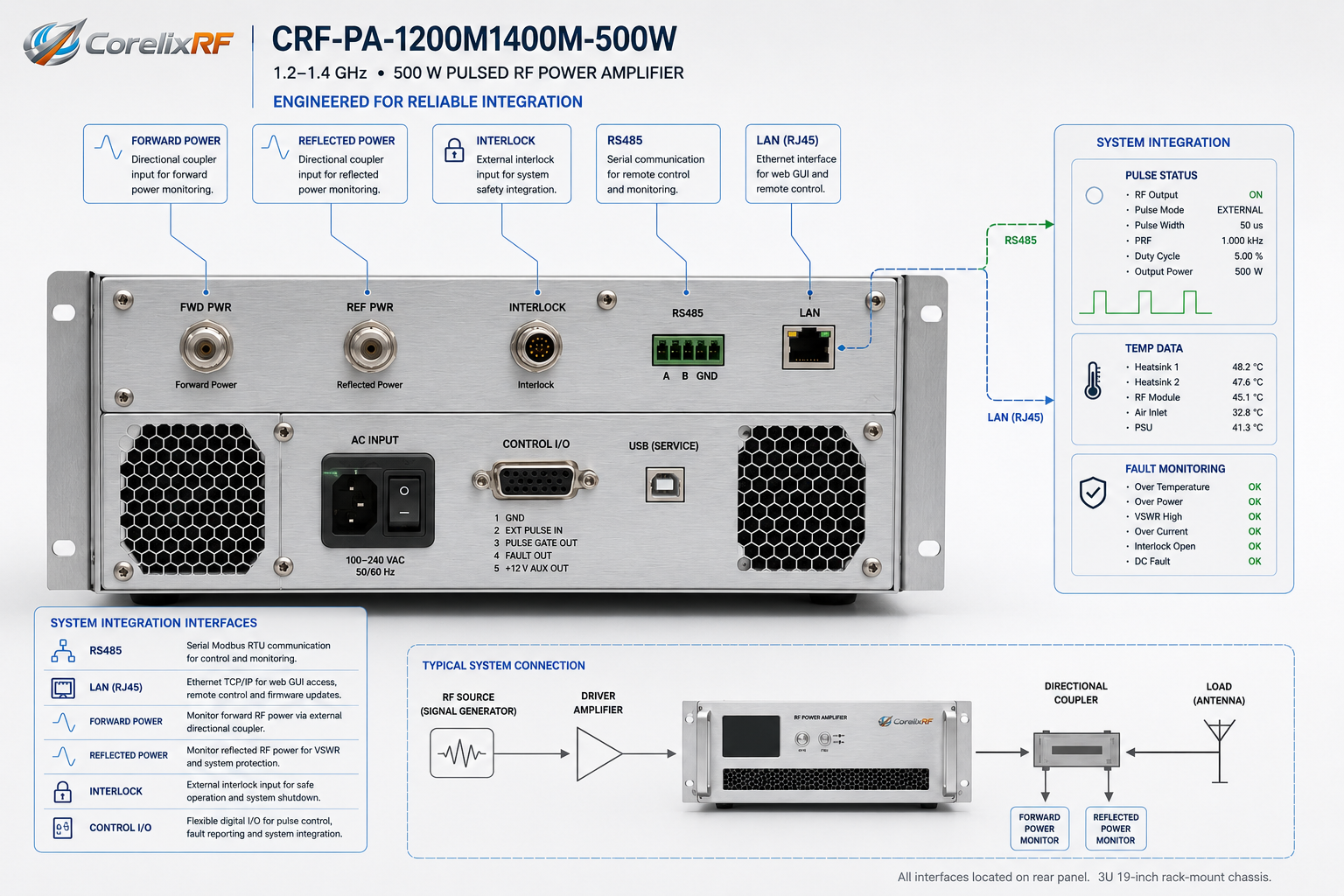
Best-Fit Applications
The CRF-PA-1200M1400M-500W is most relevant when the project needs focused 1.2-1.4 GHz pulsed output instead of a broader L-band range. Typical uses may include communication test platforms, pulsed RF validation benches, component stress testing, radar-related laboratory work, and OEM system development. The model is especially useful when the project values a narrower published frequency window, 500 W pulsed class, LAN or RS485 control, and rack-friendly integration.
If the project needs a wider 1000-2000 MHz span or substantially higher peak output, compare it with other CorelixRF pulsed amplifier options. If the project needs non-standard pulse timing, interface changes, or enclosure changes, the inquiry should explicitly request engineering review rather than assuming the standard table entry will match.
FAQ
What is the CRF-PA-1200M1400M-500W?
It is a CorelixRF 1200-1400 MHz pulsed RF amplifier model listed with 500 W rated output.
What pulse condition is listed?
CorelixRF lists 50 us pulse width and 10% duty cycle.
What control interfaces are listed?
The public table lists RS485 / LAN control.
What structure is listed?
The model is listed as 19-inch, 3U / 18 kg.
What should be sent for quotation?
Send frequency range, pulse width, duty cycle, pulse frequency, output power, input drive, load condition, cooling, control, rack limits, and documentation needs.