
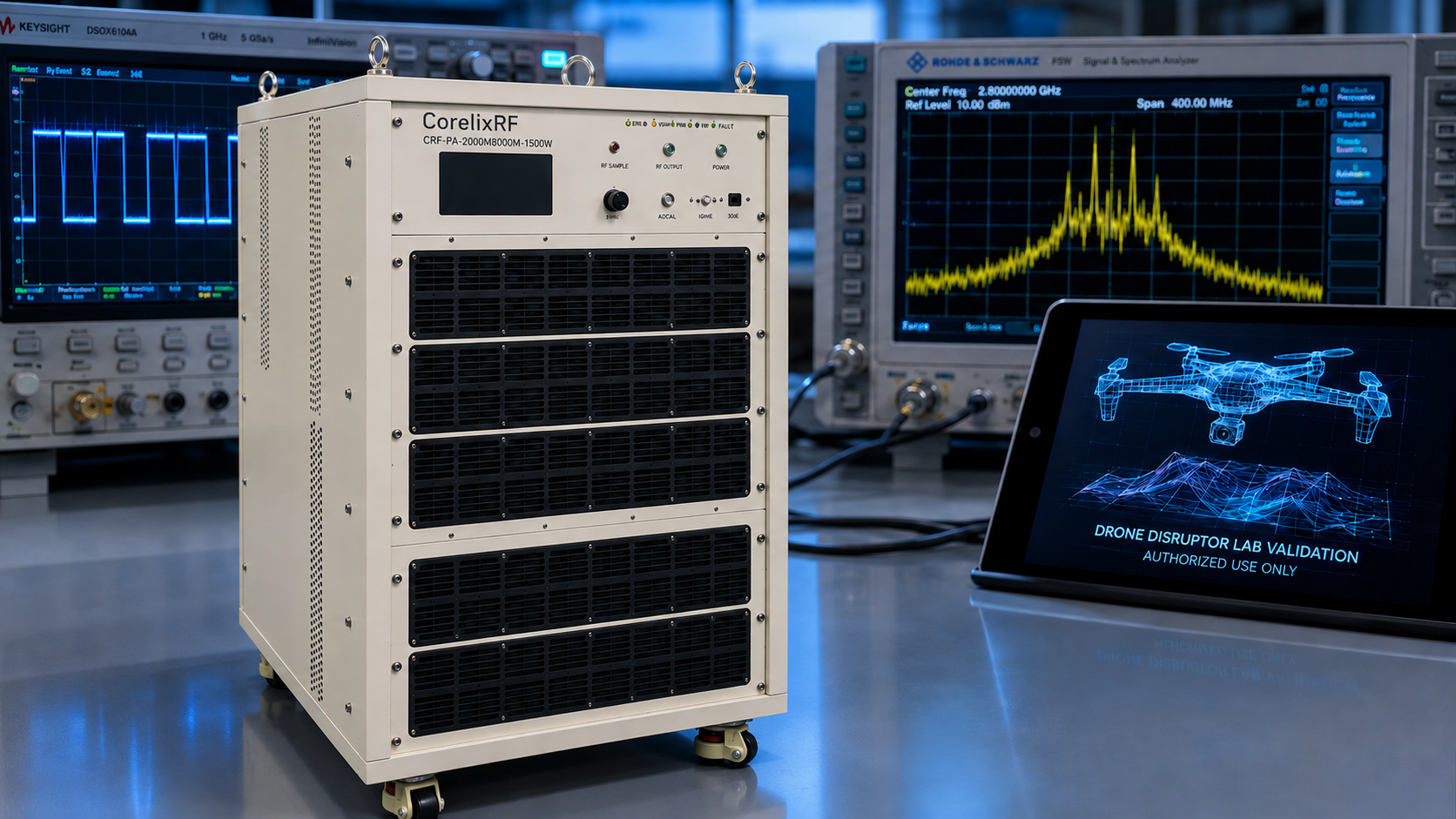
Drone disruptors is a sensitive search phrase, so this article frames the topic strictly for lawful laboratory validation, authorized range testing, and procurement engineering. It does not include tactics, targeting steps, deployment instructions, or guidance for unlawful interference.
The CorelixRF CRF-PA-2000M8000M-1500W is a pulsed RF amplifier reference for this discussion. The local datasheet identifies 2 GHz to 8 GHz coverage, 1500 W pulsed output power, 1-50 us pulse width, 10% duty cycle, N-F input, 7/16 output, and a GaN pulsed SSPA platform. For related product context, review CorelixRF’s pulsed RF amplifier page and 2-6 GHz RF power amplifier platform.
A Decision Framework for Pulsed RF Selection
Instead of starting with peak power alone, evaluate a pulsed amplifier through five decisions: frequency range, pulse width, duty cycle, load condition, and thermal recovery. A high peak-power number is not meaningful unless the waveform, repetition behavior, and cooling structure match the test plan.
Decision 1: Frequency Coverage
The 2 GHz to 8 GHz band can support S-band and C-band laboratory validation paths. Confirm whether the required range is continuous, segmented, or centered on a few test frequencies. This affects filtering, coupler choice, antenna selection, and calibration method.
Decision 2: Pulse Parameters
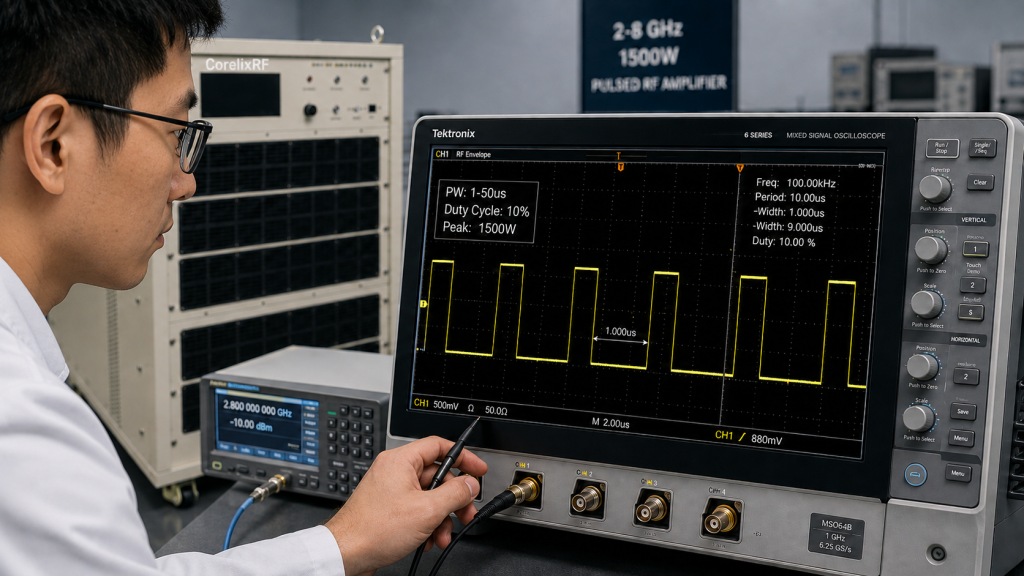
The datasheet reference of 1-50 us pulse width and 10% duty cycle should be compared directly with the intended waveform. If the pulse width, duty factor, or repetition profile differs, request project review rather than assuming interchangeability.
Decision 3: Load and Protection
Authorized test ranges often include antennas, couplers, switches, or loads that can create reflected power. Ask for monitoring options, reverse power review, and protection behavior. CorelixRF also provides broader RF power amplifier resources for system planning.
Decision 4: Mechanical and Cooling Fit
The final mechanical configuration is project-specific. Provide available cabinet space, cooling method, AC power, service access, and cable routing constraints. Pulsed systems still require serious thermal planning because average power and peak stress both matter.
Decision 5: Compliance Documentation
For sensitive applications, documentation can matter as much as hardware. Define acceptance tests, operating boundaries, authorization records, safety controls, and project-specific data needs before requesting a quotation through the CorelixRF Contact page.
Decision 6: Test Boundaries and Review Records
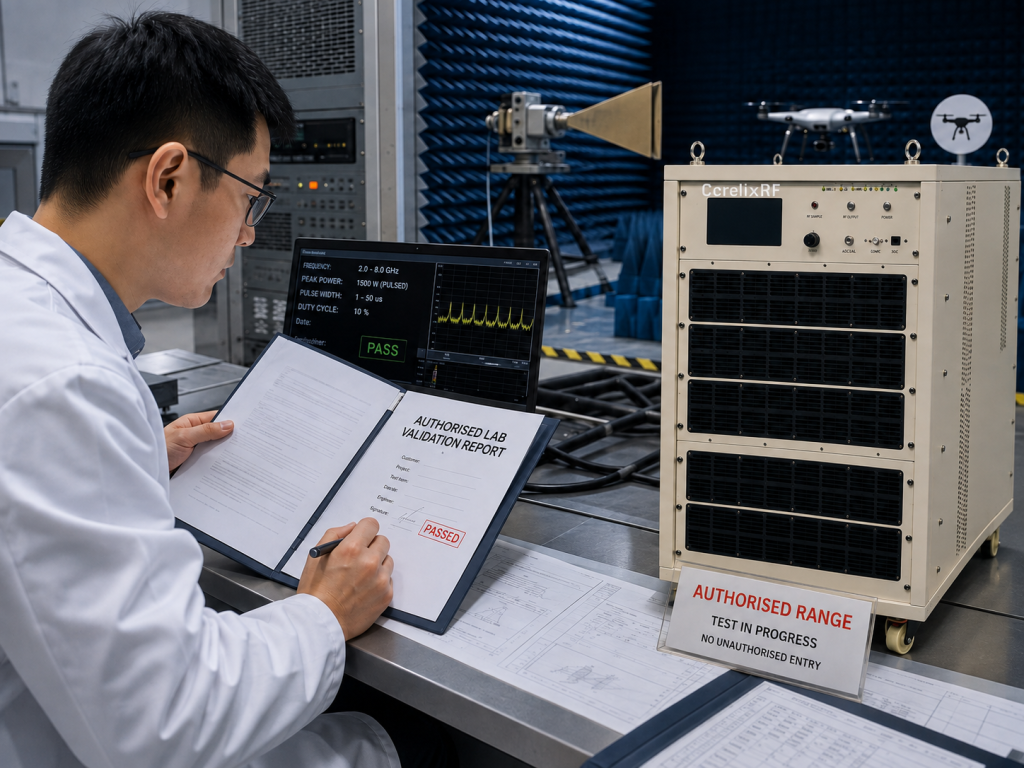
For authorized laboratory work, the test boundary should be written before amplifier selection is finalized. The boundary includes permitted frequencies, maximum pulse settings, test location, antenna or load path, personnel roles, shutdown process, and measurement records. A pulsed amplifier such as CRF-PA-2000M8000M-1500W can be technically appropriate only when those limits are known and when the supporting RF path can safely handle the peak and average conditions.
Decision 7: Peak Power Is Not the Whole Requirement
Peak pulse output attracts attention, but the final selection also depends on pulse width, duty cycle, cooling recovery, connector limits, coupler ratings, load behavior, and monitoring. A 1500 W pulsed amplifier used with the wrong duty cycle or an unsuitable load can create avoidable risk. The RFQ should therefore include the exact pulse width range, repetition behavior, expected operating duration, and whether the amplifier must tolerate mismatch during setup or calibration.
Decision 8: Procurement Language
Procurement language should avoid vague operational phrases and instead describe the lawful engineering function. A stronger request would say that the project needs a 2-8 GHz pulsed GaN SSPA for authorized range validation, with 1-50 us pulse width, 10% duty cycle review, N-F to 7/16 RF path planning, monitoring requirements, and final mechanical configuration review. That language gives CorelixRF enough context to discuss the amplifier without implying unsupported or unauthorized use.
What Not to Leave Ambiguous
Do not leave pulse width, duty cycle, load type, cooling method, or authorization status ambiguous. Those items directly affect amplifier selection and project risk. If a buyer asks only for a high-power amplifier for drone disruptors, the request is not specific enough for responsible engineering review. Reframe it as an authorized 2-8 GHz pulsed RF validation requirement with defined waveform and range controls.
The CRF-PA-2000M8000M-1500W can be discussed as a pulsed SSPA building block, but the final system must include suitable loads, couplers, interlocks, measurement equipment, and trained operators. A complete inquiry should also say whether the amplifier is used for component testing, antenna path validation, range instrumentation, or system qualification. Each use case changes the acceptance criteria.
Reviewing Test Equipment Around the Amplifier
The amplifier is only one part of the pulsed RF test chain. Signal generation, timing control, directional couplers, attenuators, filters, high-power loads, antennas, and measurement receivers must all be rated for the intended pulse conditions. If one element cannot support the pulse width, duty cycle, or reflected power condition, the amplifier selection should be paused until the surrounding equipment is reviewed. This approach protects both the equipment and the validity of the test data.
Summary for Engineering Teams
Use this model as a starting point when the authorized test plan truly requires pulsed 2-8 GHz power. If the project only needs lower average power, a narrower band, or a different control strategy, ask CorelixRF to compare alternatives before locking the specification.
FAQ
Does this article explain how to operate drone disruptors?
No. It only discusses lawful RF amplifier selection for authorized lab validation and procurement review.
Why choose a pulsed amplifier?
Pulsed RF systems are relevant when peak output, pulse width, and duty cycle define the test requirement.
What specifications should be provided?
Frequency, pulse width, duty cycle, peak power, load condition, cooling, control, and documentation needs should be provided.
Can a CW amplifier replace a pulsed amplifier?
Not automatically. The waveform and thermal requirements must be reviewed.