
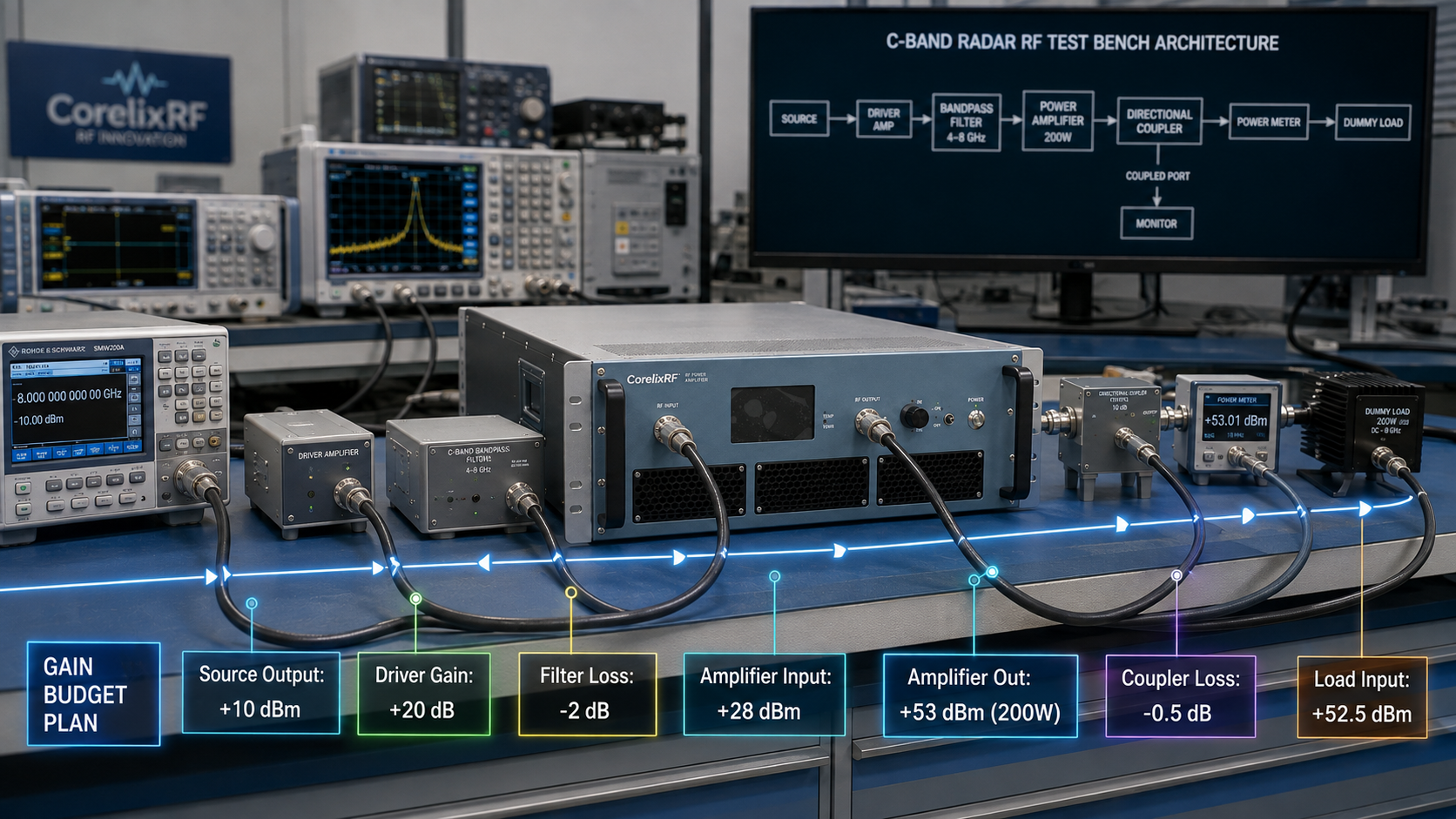
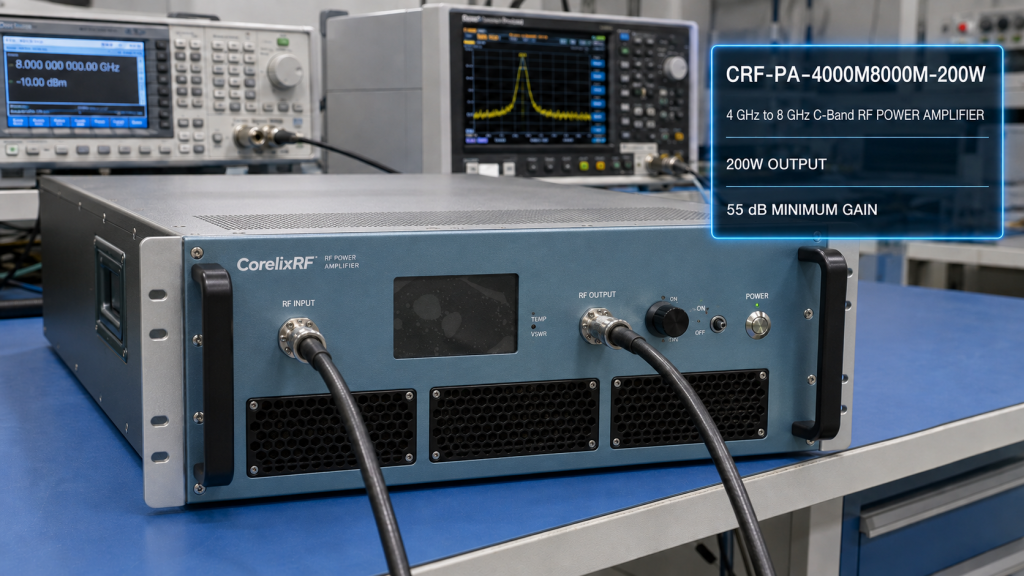
Radar amplifiers are selected by system behavior, not by frequency band alone. A C-band bench may require CW validation, pulsed subsystem checks, receiver protection verification, component stress testing, or calibrated RF path work. The CorelixRF CRF-PA-4000M8000M-200W provides a concrete 4 GHz to 8 GHz reference with 200 W rated output power, 55 dB minimum small-signal gain, -4 dB to +4 dB gain flatness, N-Female input/output, RS485 / LAN control, AC 220 V power, forced-air cooling, and a 4U rack-mount form.
The Planning Problem
Many radar test racks evolve over time. A signal source, driver, filter bank, coupler, switch matrix, and load may already exist before the final amplifier is chosen. This can lead to an amplifier that meets the band but fails the rack, cooling, or monitoring requirement. A better workflow is to review gain, thermal limits, connector layout, and control at the same time.
Gain Budget First
Start with source output and required power at the final reference plane. Then subtract cable loss, switch loss, coupler loss, filter loss, adapter loss, and any fixture margin. The CRF-PA-4000M8000M-200W offers 55 dB minimum gain, but the usable system result depends on the complete RF path.
Cooling and Rack Space
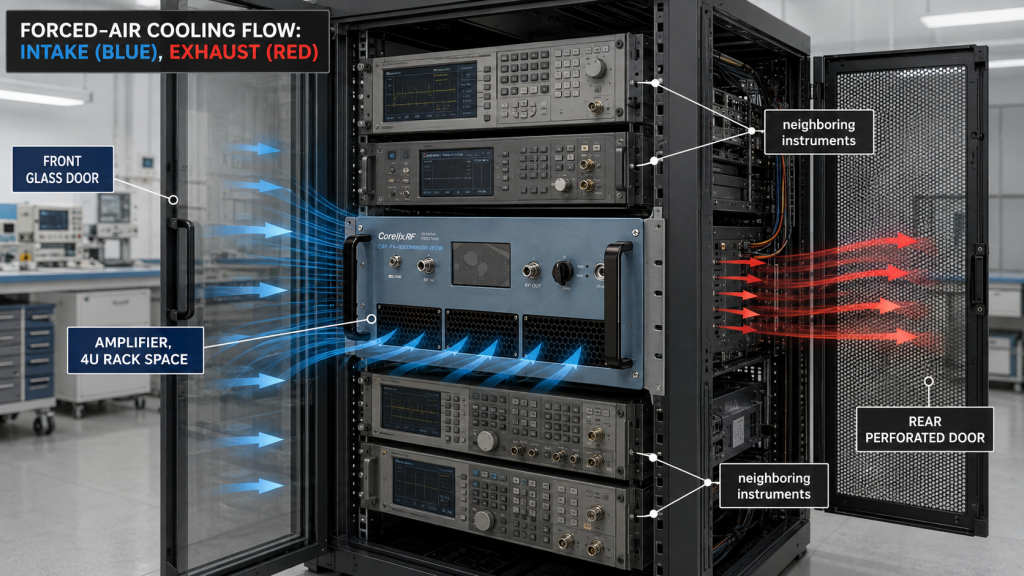
The amplifier is listed as a forced-air 4U rack-mount unit. Confirm airflow direction, rack clearance, inlet temperature, service access, and cable routing. Forced-air systems are straightforward only when the rack does not recycle hot exhaust into the intake path.
Monitoring for Radar Validation
The datasheet references temperature monitoring, current monitoring, alarm and fault protection, over-drive protection, and optional forward/reverse power monitoring. These features support automated test racks where repeatability and operator visibility matter. Review CorelixRF’s 6-18 GHz GaN RF amplifier article for adjacent microwave integration context.
Where This Model Fits
The 4 GHz to 8 GHz range is relevant to C-band validation and related RF subsystem testing. If a project expands below this band, compare CorelixRF’s 2-6 GHz RF power amplifier platform. If peak-power pulse behavior dominates the requirement, review pulsed RF amplifier options.
Procurement Notes
Include operating waveform, expected duty, source drive level, output reference plane, load condition, rack constraints, cooling environment, and documentation needs in the RFQ. The CorelixRF Contact page is the right path when the amplifier must be matched to an existing radar test rack.
Example Rack Review Sequence
A practical C-band rack review can be completed in stages. First, confirm the waveform and required output reference plane. Second, calculate the gain budget from the signal source to the load or antenna. Third, check whether the 4U rack space has enough airflow and service clearance. Fourth, define monitoring signals for temperature, current, forward power, reverse power, and alarm state. Finally, confirm the required test data and acceptance limits before the amplifier is ordered.
The CRF-PA-4000M8000M-200W gives the planning team a 4-8 GHz, 200 W reference with 55 dB minimum gain and RS485 / LAN control. That is enough information to start the rack conversation, but final selection should still account for cable loss, filter loss, coupler insertion loss, and any duty-cycle stress created by the radar validation waveform. When the test involves pulse behavior, include pulse width and duty cycle even if the amplifier under review is a CW-rated product.
What Makes a Good Radar Amplifier RFQ
A good RFQ states the radar test purpose, frequency range, target output power, waveform, expected duty, input drive, load condition, connector preference, rack space, airflow, and monitoring expectations. If the system needs automated control, describe the host software or protocol expectation. If the amplifier must be compared against acceptance data, specify the measurement method and bandwidth. This prevents a generic amplifier inquiry from turning into a slow clarification loop.
Thermal Margin and Test Duration
Radar amplifier planning should include test duration, not only peak or rated output. A short validation sweep and a long automated sequence can impose very different thermal loads. The CRF-PA-4000M8000M-200W uses forced-air cooling, so rack inlet temperature, exhaust routing, and neighboring instruments should be reviewed before installation. If the rack already contains heat-producing loads or power supplies, the amplifier may need additional clearance.
For acceptance planning, document whether the amplifier must deliver rated power across the full 4-8 GHz range or only at selected test points. Also define whether gain flatness is measured at small-signal level, at operating drive, or at a specific output target. These distinctions make the RFQ clearer and reduce back-and-forth during technical review.
Interface Details That Slow Projects Down
Small interface details often delay radar amplifier projects. Confirm whether N-Female input and output connectors match the existing rack, whether adapters change the calibration plane, and whether the control system expects LAN, RS485, discrete interlocks, or manual operation. Also define how alarm states are logged. These details are not secondary; they determine whether the amplifier can be integrated without redesigning the rack after delivery.
Summary for C-Band Buyers
For C-band radar amplifier procurement, the best result comes from pairing RF performance data with rack drawings, airflow notes, control expectations, and acceptance criteria. This gives CorelixRF enough context to review the amplifier as part of a working system.
FAQ
What makes radar amplifiers different from general RF amplifiers?
The waveform, pulse behavior, gain budget, monitoring, and rack integration requirements often drive selection.
Is CRF-PA-4000M8000M-200W a C-band amplifier?
It covers 4 GHz to 8 GHz, which is commonly relevant to C-band test planning.
Why is cooling part of amplifier selection?
High-power rack amplifiers require stable airflow and enough clearance to maintain reliable operation.
Can CorelixRF review existing rack constraints?
Yes. Share rack height, airflow, power, connector, control, and test data requirements.