
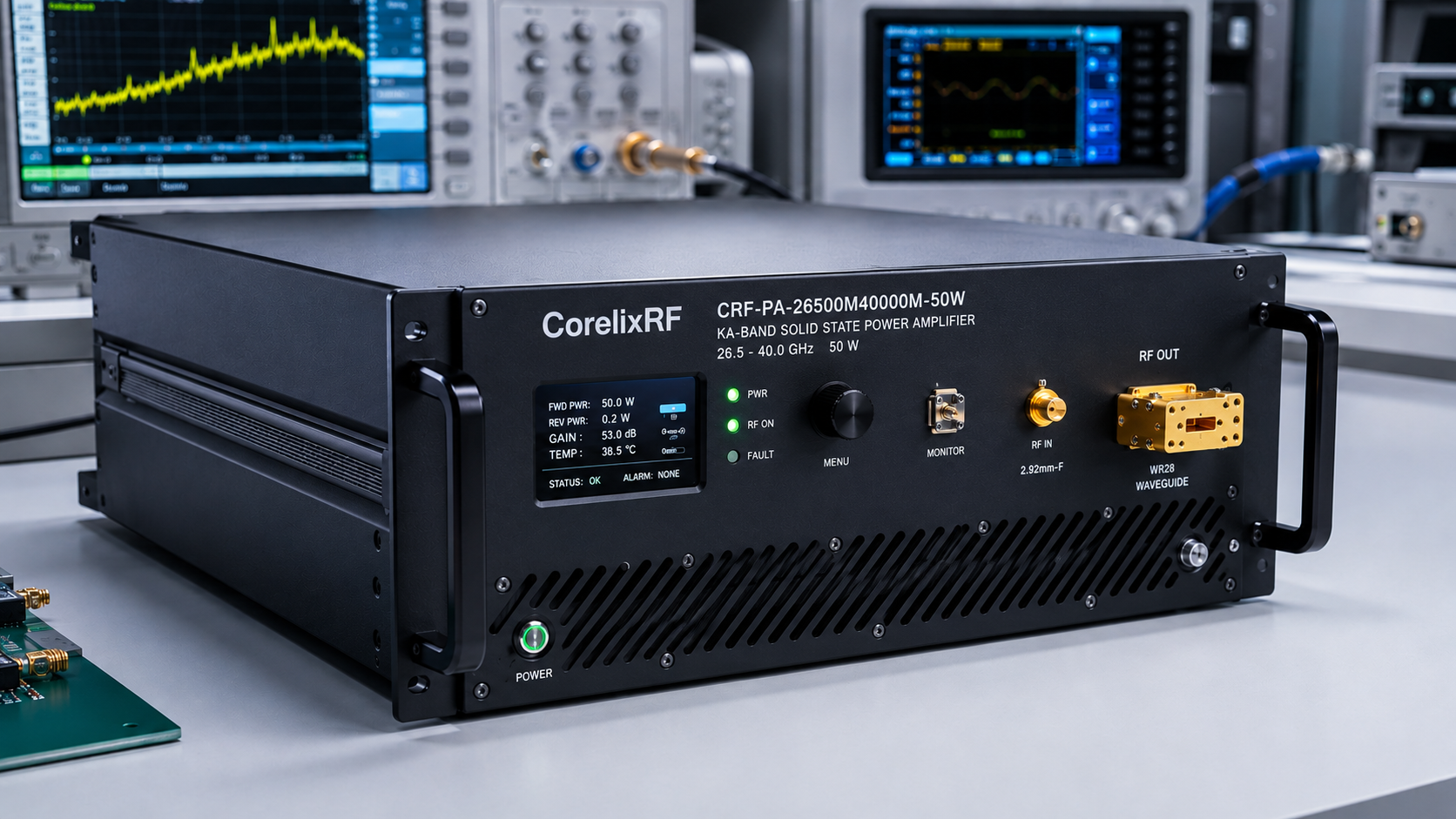
A ka band power amplifier is often evaluated at the connector and waveguide level before it is evaluated as a catalog line item. At 26.5 GHz to 40 GHz, small mechanical and RF transition details can change the practical test result. The CorelixRF CRF-PA-26500M40000M-50W is a mmWave product anchor for this article, with 50 W saturated RF output power, 25 W minimum P1 output power, 47 dB minimum small-signal gain, -6 dB to +6 dB gain flatness, 2.92 mm-F input, WR28 output, and 2.92 mm-F coupler interface.
Technical Snapshot
- Frequency range: 26.5 GHz to 40 GHz.
- Output: 50 W saturated, 25 W minimum P1.
- Control: Ethernet and GPIB.
- Power: AC 220 V, up to 1400 W input.
- Mechanical: 480 x 432 x 177 mm, 23 kg maximum.
- Cooling: forced air.
- Protection: over-temperature, high-VSWR, over-drive, over-voltage, and over-current functions.
Why WR28 Output Changes the Conversation
WR28 output is not just a connector note. It affects waveguide routing, fixture position, coupler strategy, calibration access, and mechanical support. A Ka-band amplifier should be reviewed with the waveguide path, measurement reference plane, and mounting constraints already in mind.
Measurement Planning
At mmWave frequencies, define the output reference plane before discussing pass/fail criteria. Is power required at the amplifier output, after a waveguide run, at a coupler, or at the device input? The answer changes how much margin is needed and what test data should be requested.
Protection and Monitoring
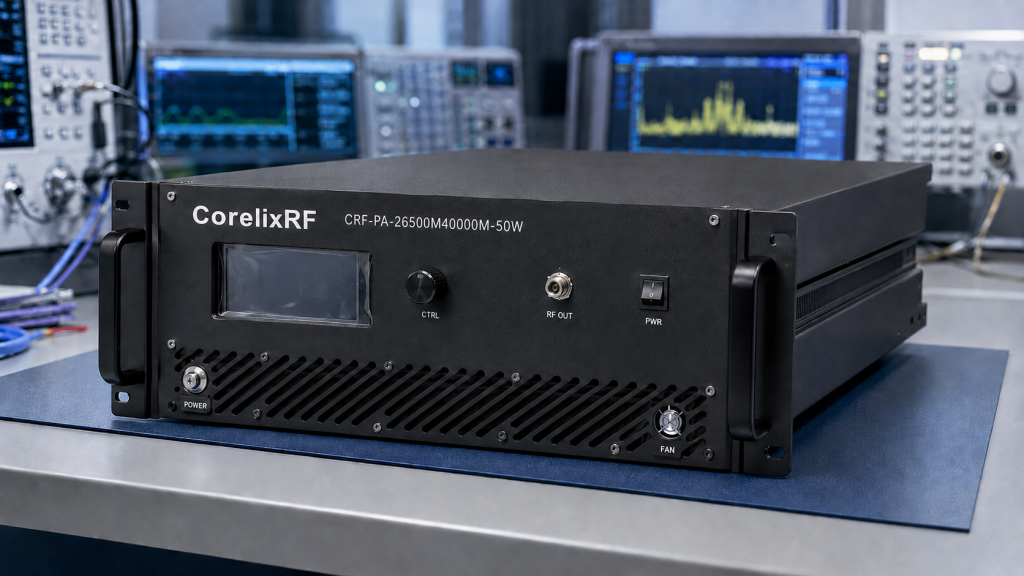
The source data lists a 75 °C over-temperature threshold and 4:1 high-VSWR protection threshold, along with forward/reverse power monitoring. These details are important because high-frequency fixtures can create mismatch conditions that are not obvious from a simplified block diagram.
Related Planning Paths
For lower microwave work, compare CorelixRF’s 6-18 GHz GaN RF amplifier reference. For projects below the Ka-band range, the 2-6 GHz RF power amplifier platform may be a closer starting point. For a project-specific Ka-band review, use the CorelixRF Contact page.
RFQ Information to Prepare
Send the exact frequency span, output reference plane, waveform, required P1 or saturated power target, input drive level, waveguide layout, coupler needs, control preference, cooling limits, rack constraints, and documentation requirements. If acceptance testing must include harmonics or spurious limits, state the measurement bandwidth and method.
Fixture and Waveguide Review
For Ka-band systems, fixture planning should happen early because WR28 output, coupler access, waveguide length, bends, and mechanical support all affect the usable test setup. The amplifier may meet the electrical requirement, but a poorly supported waveguide path can make calibration difficult or introduce repeatability problems. Share the proposed waveguide layout, mounting orientation, and available clearance when requesting review.
The CRF-PA-26500M40000M-50W also includes a 2.92 mm-F coupler interface, which can help teams plan monitoring and measurement. The RFQ should state whether forward and reverse power monitoring are required continuously, during setup only, or as part of an automated safety process. At mmWave frequencies, those details matter because access points are harder to add after the mechanical design is complete.
Thermal and Protection Review
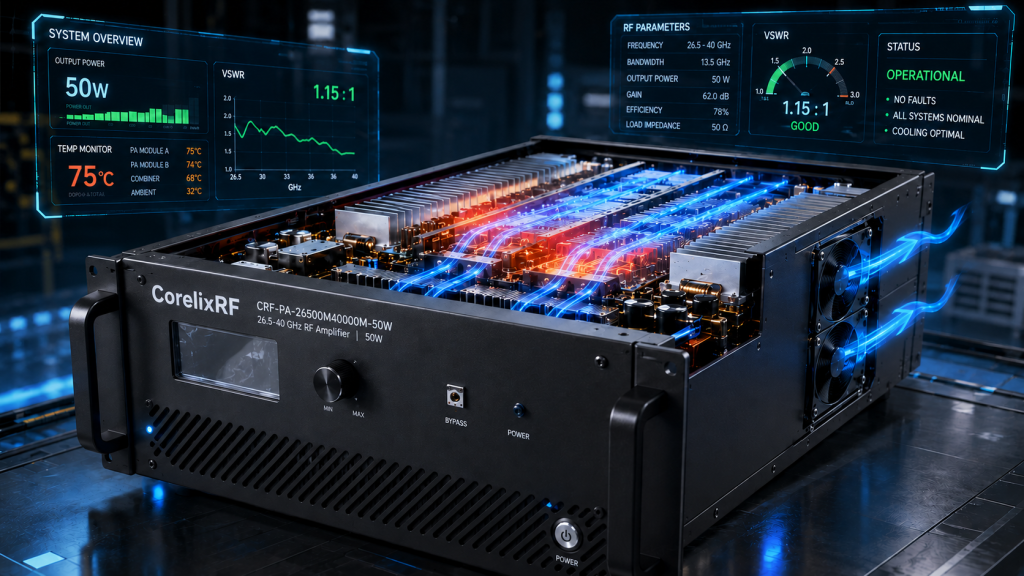
Forced-air cooling, 1400 W input limit, high-VSWR protection, and over-temperature thresholds should be reviewed against the actual rack or bench environment. If the amplifier is installed near other heat-producing instruments, verify that intake air temperature remains within limits. If the DUT or fixture can create mismatch, define how the system will respond before high power is applied. These planning steps are often more important than choosing between two similar output power classes.
Data to Request With the Quotation
For a Ka-band quotation, ask which performance data can be supplied for project review: output power over frequency, gain over frequency, harmonic and spurious test conditions, coupler details, protection thresholds, control interface notes, and mechanical drawings. The CRF-PA-26500M40000M-50W includes enough high-frequency detail to begin this conversation, but the final documentation package should match the buyer’s validation method.
Also identify whether the amplifier will be used by RF engineers, production technicians, or automated software. Operator profile changes the preferred controls and safety indicators. A lab engineering setup may need flexible access to data, while a production-style bench may need simplified remote commands and clear alarm behavior. These requirements should be stated before final configuration.
Why Early Mechanical Review Saves Time
Ka-band projects are sensitive to late mechanical changes. A small movement in waveguide routing can affect access to couplers, calibration ports, supports, and thermal airflow. Provide CAD constraints, rack position, waveguide direction, and service clearance during the first review. This lets CorelixRF evaluate whether the standard mechanical configuration is suitable or whether a project-specific layout should be discussed before quotation.
Summary for Ka-Band Buyers
For Ka-band power amplifier projects, provide more than a frequency and wattage target. Include WR28 routing, coupler needs, calibration method, protection expectations, software interface, and mechanical constraints. These details help determine whether the CRF-PA-26500M40000M-50W is the right fit or whether a related Ka-band configuration should be reviewed.
Early review prevents avoidable redesign.
FAQ
Why is WR28 important for a Ka band power amplifier?
WR28 defines the waveguide output path and affects fixture, calibration, and mechanical planning.
What output power does this model provide?
The datasheet lists 50 W saturated RF output power and 25 W minimum P1 output power.
What control interfaces are listed?
Ethernet and GPIB are listed for this configuration.
Can CorelixRF review custom Ka-band fixtures?
Yes. Provide waveguide, coupler, cooling, rack, and test data requirements for review.