
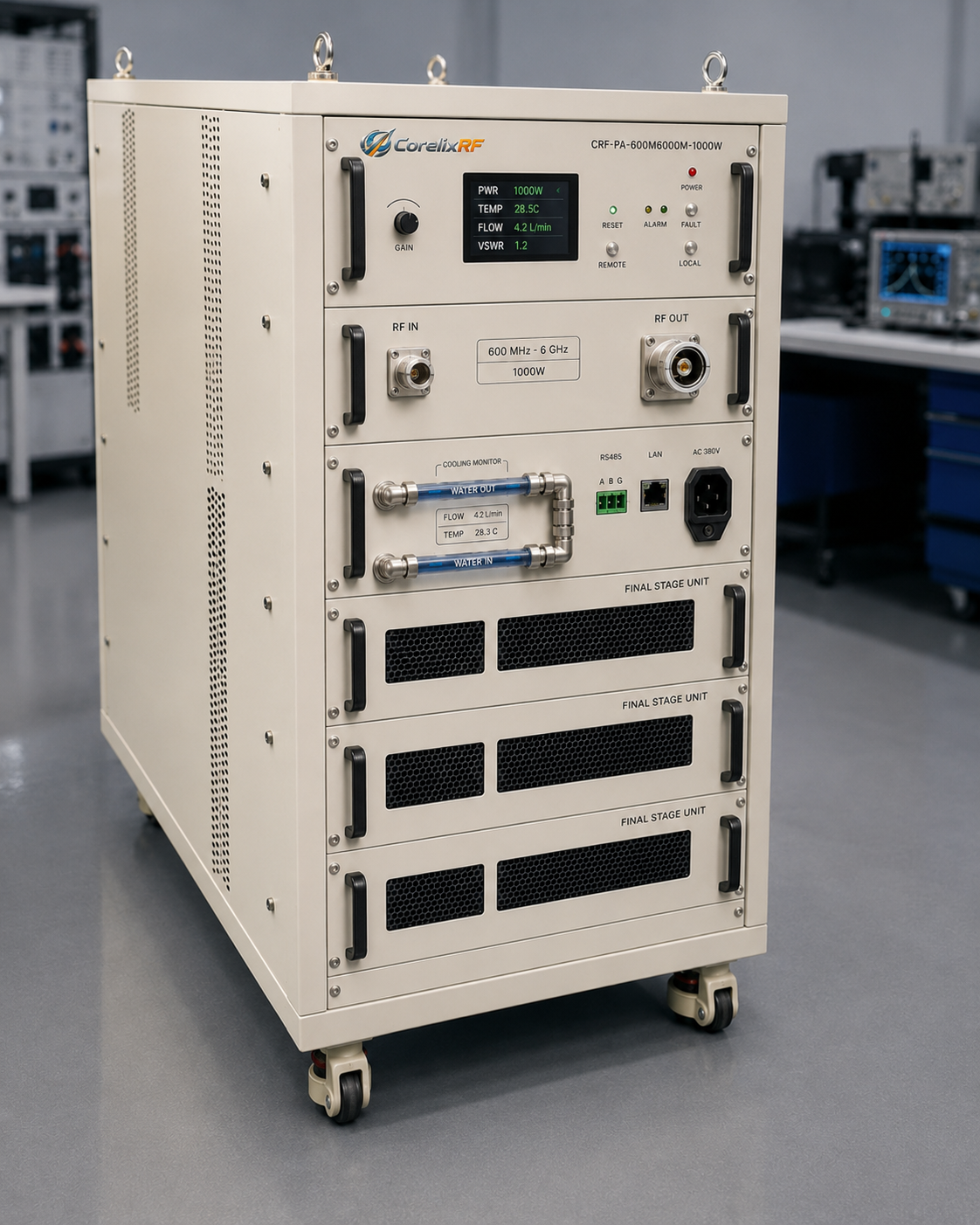
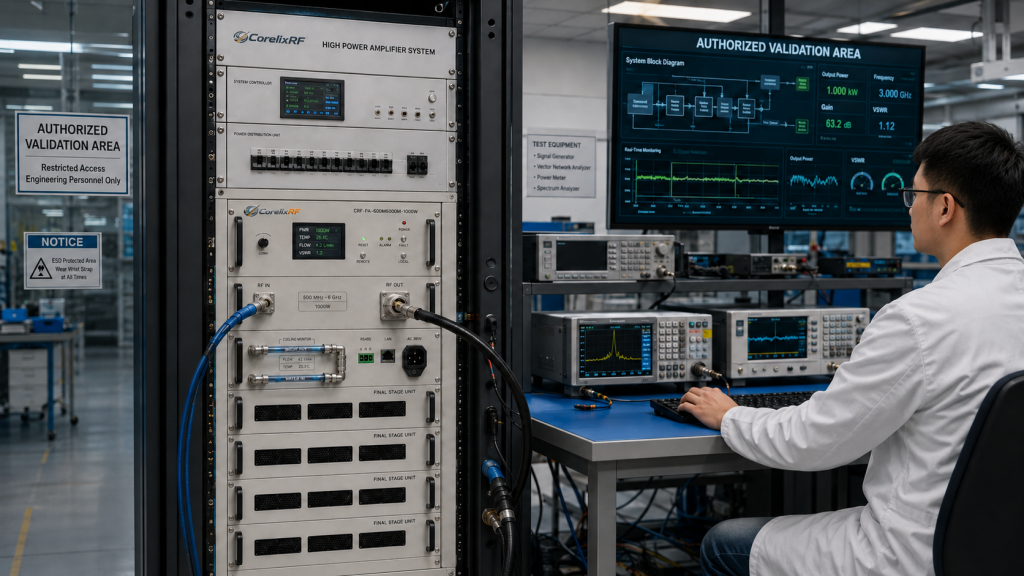
A defence RF power amplifier requirement should be documented as a controlled engineering and procurement specification. This article is limited to authorized defence laboratory validation, system integration review, and procurement planning. It does not provide tactics, operational interference steps, or deployment instructions.
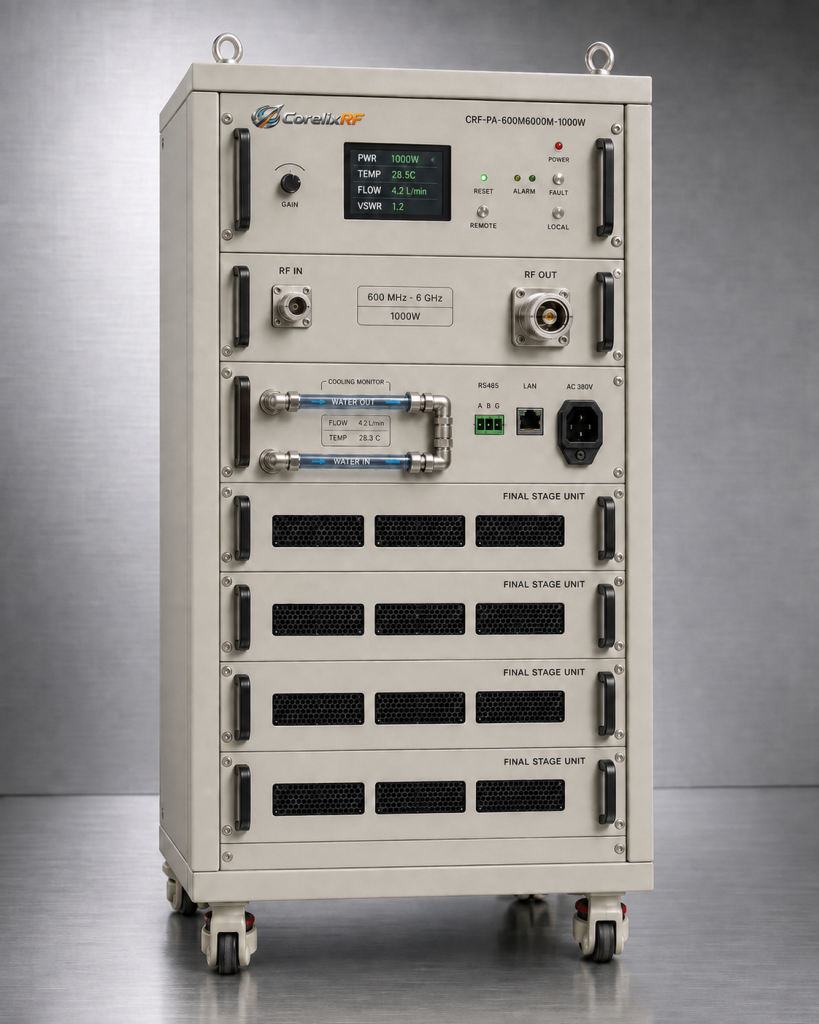
The CorelixRF CRF-PA-600M6000M-1000W is a broadband high-power reference model for this requirements brief. The datasheet lists 600 MHz to 6 GHz coverage, 1000 W rated output power, 63 dB minimum small-signal gain, -5 dB to +5 dB gain flatness, N-Female input, 7/16 output, RS485 / LAN control, AC 380 V input, liquid cooling, and project-specific mechanical configuration.
Requirement 1: Authorized Operating Context
Define the authorized user, test location, regulatory boundary, operating procedure, and safety controls. For sensitive RF systems, the procurement file should explain the lawful engineering purpose before it describes hardware.
Requirement 2: Broadband Frequency and Power
The 600 MHz to 6 GHz range supports broad validation work, but the final power requirement should be stated at a reference plane. Amplifier output, antenna input, fixture input, and device-under-test input can all be different points with different loss budgets.
Requirement 3: Cooling and Infrastructure
At 1000 W rated output power, liquid cooling and AC 380 V input are major infrastructure decisions. Confirm coolant capacity, electrical supply, floor or cabinet constraints, service access, grounding, cable paths, and environmental limits before model selection.
Requirement 4: Monitoring and Protection
The datasheet references temperature monitoring, current monitoring, alarm and fault protection, over-temperature protection, over-drive protection, over-voltage protection, VSWR protection, and optional LAN remote monitoring. These features should be mapped to the user’s test procedure and acceptance criteria.
Requirement 5: Documentation Package
For defence procurement, request final mechanical drawings, test data, control protocol details, configuration notes, and any project-specific regulatory documentation that applies. CorelixRF’s RF power amplifier resources and Contact page are the appropriate starting points for controlled review.
Adjacent Product Paths
If the project needs lower power or narrower frequency range, compare the UHF RF amplifier and 2-6 GHz RF power amplifier pages. If pulse behavior dominates the requirement, review pulsed RF amplifier options.
Infrastructure Readiness Review
A high-power broadband amplifier should not be quoted without an infrastructure readiness review. For CRF-PA-600M6000M-1000W, the buyer should confirm liquid cooling capacity, AC 380 V availability, grounding, installation space, cable path, coolant service access, and alarm handling. If the amplifier will be installed in a larger validation system, include a block diagram that shows source, driver, filters, couplers, switches, loads, antennas, and monitoring points.
Acceptance Criteria
Acceptance criteria should be written in engineering terms. Define the required frequency span, output power reference plane, gain flatness expectation, maximum input drive, harmonic and spurious review method, control interface behavior, alarm reporting, and documentation package. If the project requires specific environmental, regulatory, or internal quality records, state those requirements before final model selection.
Procurement Risk Controls
Procurement risk is reduced when the RFQ separates confirmed requirements from open questions. Confirmed requirements might include 600 MHz to 6 GHz coverage, 1000 W rated output power, liquid cooling, and RS485 / LAN control. Open questions might include cabinet dimensions, coolant interface, software protocol, acceptance data format, or site-specific safety procedures. Listing both categories lets CorelixRF respond with a practical project review instead of a generic quote.
Review Meeting Agenda
A useful review meeting for a defence RF power amplifier should cover mission-neutral engineering details: authorized use case, frequency span, output reference plane, waveform, duty cycle, cooling, site power, load path, monitoring, software control, mechanical limits, and documentation. Keep the discussion focused on validation requirements and safety controls. Avoid vague operational language that does not help engineers size the amplifier.
For CRF-PA-600M6000M-1000W, the meeting should specifically address liquid cooling, project-specific mechanical form, AC 380 V input, 7/16 output connector, and VSWR protection. If any of these items conflict with the installation site, identify the conflict early so a different CorelixRF configuration can be reviewed.
Why Requirement Traceability Matters
Requirement traceability helps procurement, engineering, and safety reviewers understand why each amplifier feature is needed. Link frequency range to the validation plan, output power to the calibrated reference plane, cooling to the expected operating duration, and monitoring to the safety process. This prevents the amplifier from being evaluated as a generic high-power device and instead ties it to a controlled, auditable engineering requirement.
Summary for Procurement Teams
A defence RF power amplifier inquiry should be specific, authorized, and traceable. Provide the validation purpose, required band, output reference plane, waveform, cooling infrastructure, monitoring expectations, and documentation package. This allows CorelixRF to review the amplifier as an engineering system component rather than a generic high-power RF source.
For high-power broadband validation, teams should also identify spare cooling capacity, expected operating schedule, maintenance access, and the person responsible for approving configuration changes. These administrative details may seem separate from RF design, but they directly affect whether the amplifier can be operated consistently and safely after installation.
FAQ
Is this article about operational defence use?
No. It is limited to authorized engineering, laboratory validation, and procurement planning.
What makes CRF-PA-600M6000M-1000W relevant?
It combines 600 MHz to 6 GHz coverage, 1000 W rated output power, liquid cooling, and RS485 / LAN control.
What should a procurement team send?
Send frequency range, output reference plane, waveform, duty cycle, infrastructure limits, control needs, cooling, and documentation requirements.
Can CorelixRF review project-specific configurations?
Yes. Mechanical, cooling, monitoring, and control details can be reviewed by project.