
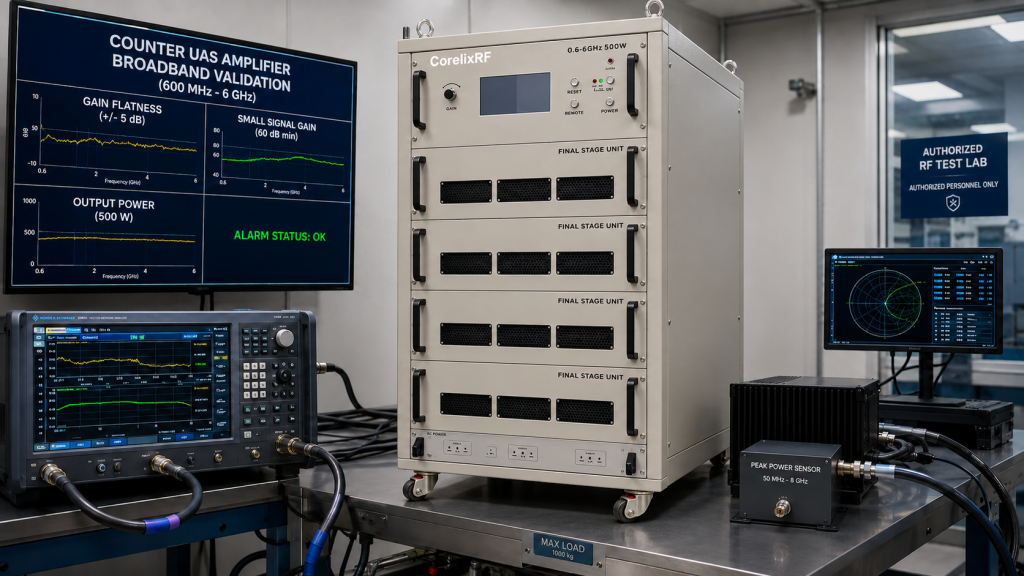
Counter UAS amplifiers should be discussed only in lawful, authorized engineering contexts. This article focuses on controlled RF test ranges, procurement review, and laboratory validation. It does not provide deployment tactics, interference procedures, target selection guidance, or instructions for unlawful RF disruption.
For authorized range planning, the CorelixRF CRF-PA-600M6000M-500W is a relevant broadband product anchor. It covers 600 MHz to 6 GHz with 500 W rated output power, 60 dB minimum small-signal gain, -5 dB to +5 dB gain flatness, N-Female input, 7/16 output, RS485 / LAN control, AC 380 V input, liquid cooling, and a cabinet form factor. Start from CorelixRF’s RF power amplifier overview or contact CorelixRF for a controlled project review.
Integration Gate 1: Authorization and Use Case
The first gate is not technical. Define who is authorized to run the test, where the test occurs, what regulatory approvals apply, and what safety boundaries govern RF operation. The amplifier should be treated as part of a documented range system, not as a standalone field device.
Integration Gate 2: Frequency and Power Budget
The 600 MHz to 6 GHz range can overlap many test assets, antennas, filters, couplers, and loads. A 500 W amplifier requires careful accounting for cable loss, antenna gain, fixture loss, mismatch risk, and monitoring. The required power should be stated at the correct reference plane, not just at the amplifier connector.
Integration Gate 3: Cooling and Cabinet Planning
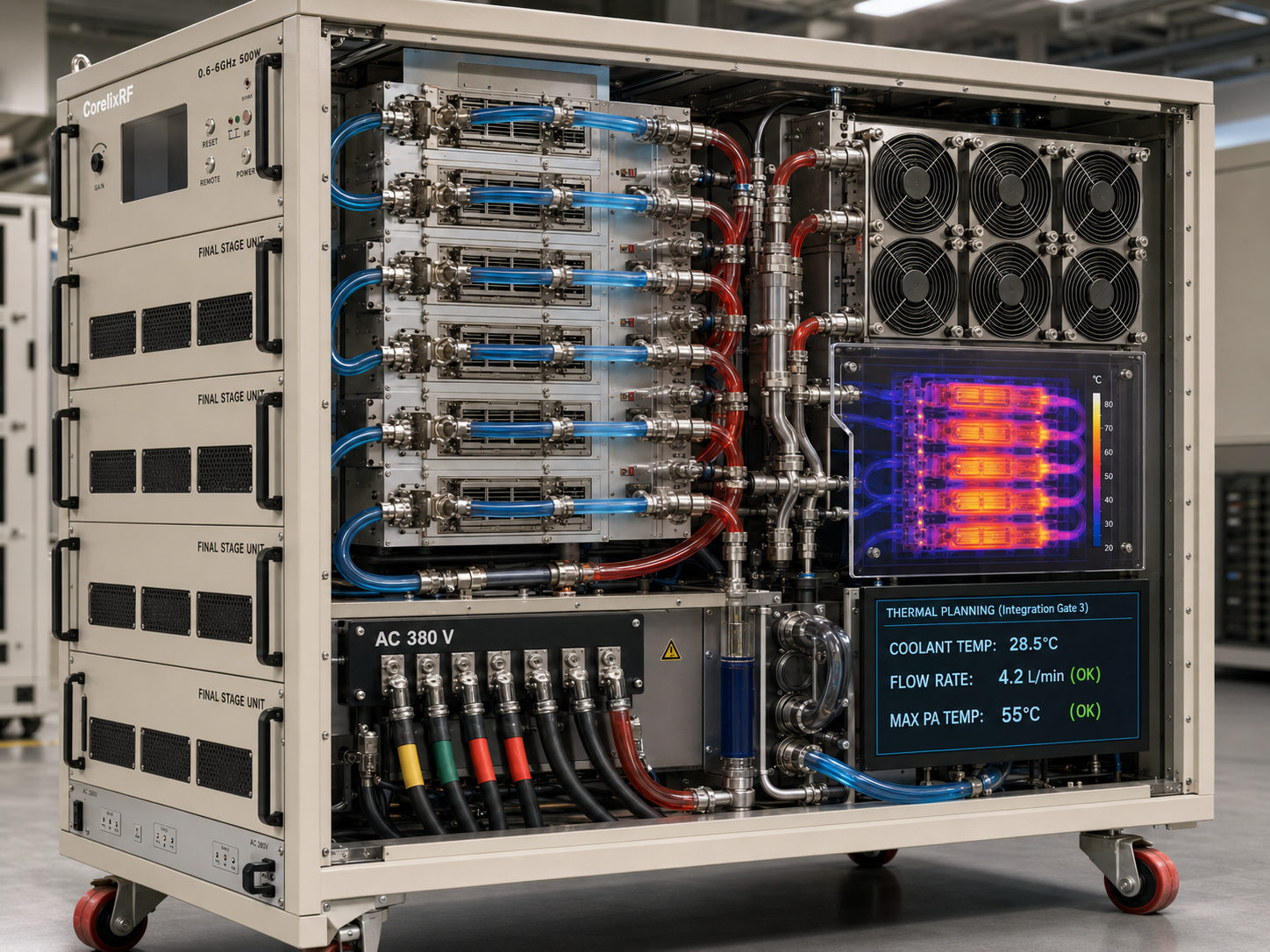
The CRF-PA-600M6000M-500W uses liquid cooling and a cabinet size of 900 x 565 x 1300 mm. Before selection, confirm coolant availability, service clearance, AC 380 V capacity, rack or cabinet placement, cable routing, and emergency access. Thermal planning is a core requirement for high-power broadband RF systems.
Integration Gate 4: Monitoring and Control
RS485 / LAN control supports integration into a controlled test bench. The datasheet also references temperature monitoring, current monitoring, alarm and fault protection, over-temperature protection, over-drive protection, over-voltage protection, VSWR protection, and optional forward/reverse power monitoring. These functions should be included in the test plan.
Related CorelixRF Pages
For lower-power or narrower work, compare the UHF RF amplifier page and 2-6 GHz RF power amplifier platform. For peak-power work, review pulsed RF amplifier options. For custom range requirements, use the CorelixRF Contact page.
RFQ Checklist
- Authorized test location and regulatory context.
- Frequency range and output reference plane.
- Waveform, duty condition, and source drive level.
- Load condition, antenna/coupler/filter path, and mismatch risk.
- Cooling, cabinet, AC power, and control interface requirements.
- Documentation, test data, and acceptance criteria.
Range Documentation Package
A controlled range should maintain a documentation package that includes authorization boundaries, personnel roles, amplifier configuration, antenna or load setup, RF path diagram, emergency stop process, and post-test review steps. The CRF-PA-600M6000M-500W is a high-power cabinet amplifier, so the document should also identify who is allowed to enable RF output, who monitors cooling, and what alarm states require shutdown. This keeps the amplifier review tied to lawful engineering controls instead of vague product interest.
For procurement teams, the most useful information is often operational context rather than a single requested model number. State whether the system is for component validation, range instrumentation, RF chain qualification, or training equipment verification. Provide the expected waveform type, average operating time, load or antenna path, and whether forward/reverse power monitoring is required for every run. These details help determine if the 500 W cabinet configuration is suitable or if a different power level, cooling approach, or mechanical layout should be reviewed.
Risk Items to Resolve Before RFQ
Resolve cooling infrastructure, AC 380 V availability, cabinet placement, safe load handling, reflected power limits, and software control expectations before final quotation. If any of these remain unknown, identify them as open items instead of forcing assumptions into the RFQ. A clear open-item list is more useful than an overconfident specification because it lets the engineering team review the actual risk.
How to Compare Candidate Amplifiers
Compare candidate amplifiers by band coverage, rated output power, gain, thermal system, control interface, protection behavior, and documentation support. For counter UAS amplifiers in authorized test environments, the comparison should also include how the amplifier will be disabled, who can command RF output, and how test records are stored. These governance details help separate a professional validation system from an unsafe hardware-only purchase.
The CRF-PA-600M6000M-500W is strong where broadband coverage and high RF output are both needed, but it is not automatically the best answer for every range. Some projects may need lower power, a rack-mount form factor, pulsed operation, or a narrower band. Treat the 500 W model as the anchor for review, then let the complete range requirement determine the final configuration.
Final Pre-Test Walkthrough
Before energizing the amplifier, run a pre-test walkthrough that confirms RF output is disabled, coolant is active, the load or antenna path is correct, personnel are clear of restricted areas, monitoring is visible, and the shutdown process is understood. This walkthrough should be documented as part of the controlled range procedure.
FAQ
Are counter UAS amplifiers discussed here as operational equipment?
No. This article is limited to authorized RF engineering and controlled test range review.
Why use a 600 MHz to 6 GHz amplifier?
It supports broadband laboratory review where one RF power stage must cover multiple bands under controlled conditions.
What makes the 500 W cabinet configuration important?
Cooling, AC power, cabinet clearance, monitoring, and load protection become primary integration issues at this power level.
Can CorelixRF review custom control needs?
Yes. Project-specific control and monitoring requirements can be reviewed where applicable.