
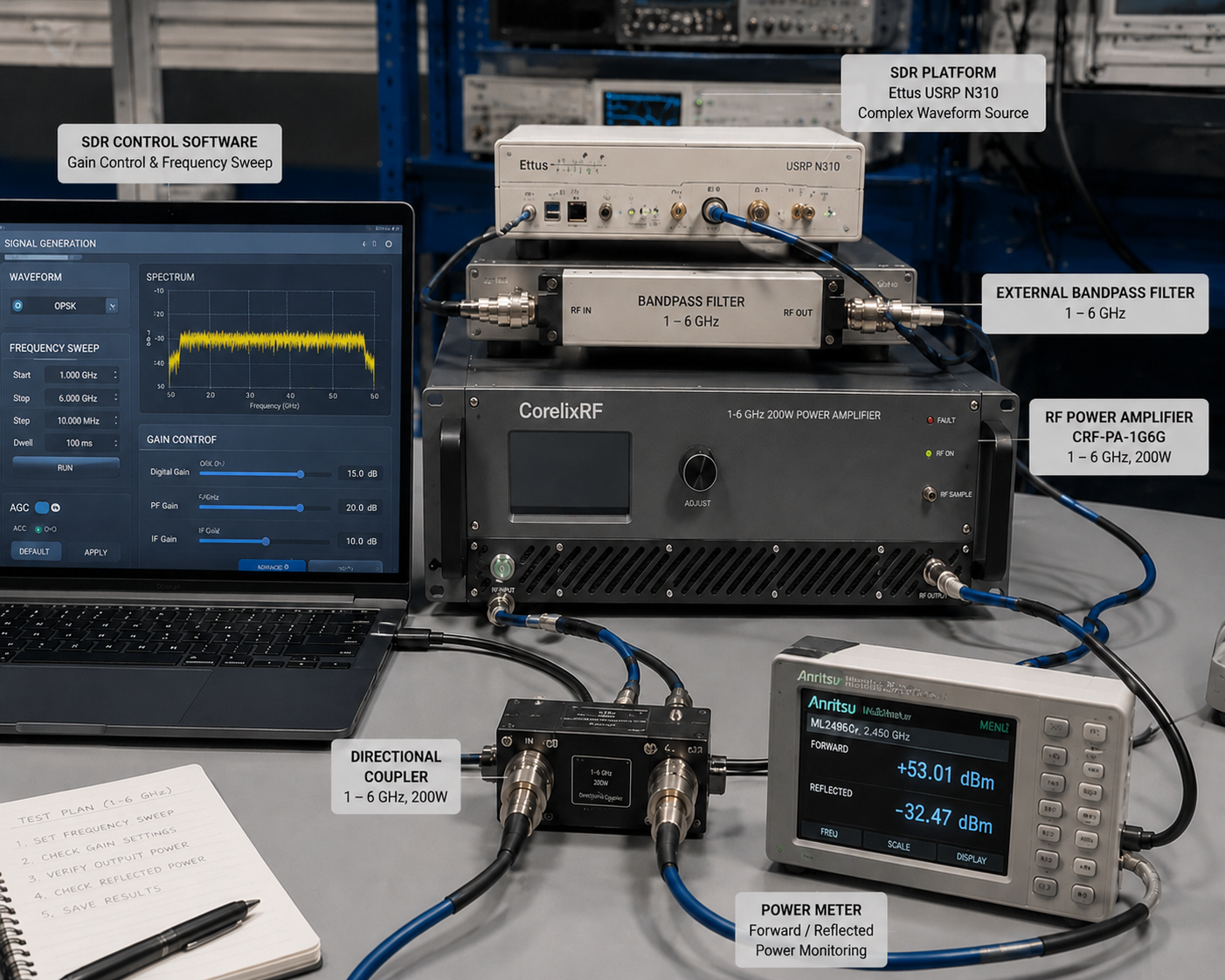
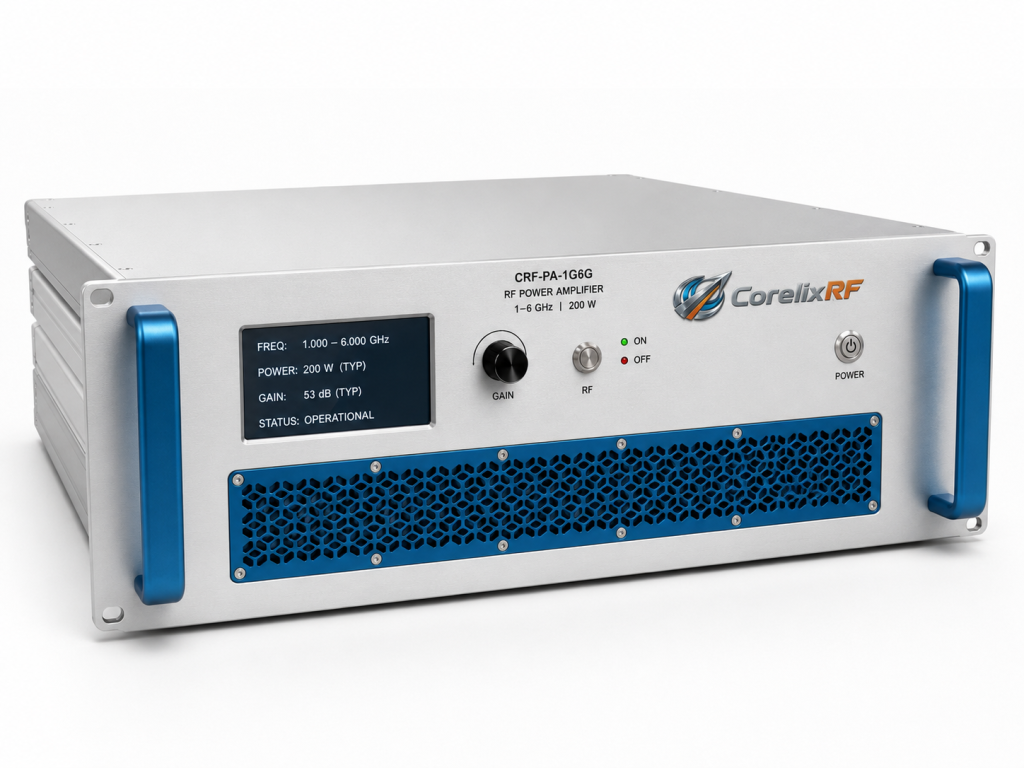
A 1-6 GHz 200 W RF power amplifier is often requested for EMC, wireless, and SDR-related work, but the real application is usually a complete high-power RF chain. The amplifier is only one element between a low-level signal source and a measured effect at an antenna, device, or chamber reference point. If the rest of the chain is not planned, the amplifier can be blamed for problems caused by antennas, cables, field probes, filtering, or unsafe operating assumptions.
The 1-6 GHz range is attractive because it covers many practical RF systems: L-band, S-band, C-band, wireless test bands, broadband SDR experiments, and many radiated immunity or pre-compliance setups. A 200 W class solid state amplifier gives engineers power margin, but power margin must be used carefully. More RF power does not automatically mean a better test. It means the system has more energy available, so control and safety become more important.
For EMC-related work, the key output is often field strength, not amplifier wattage. Field strength depends on antenna gain, distance, chamber behavior, cable loss, modulation, frequency, and how the field is monitored. A 200 W amplifier may be necessary for one setup and excessive for another. The correct specification begins with the field or load requirement, then works backward through the antenna and RF path to determine amplifier output.
SDR applications create a different challenge. Many SDR platforms are flexible but low power. Engineers may use them to generate waveforms across a broad frequency range, then amplify those signals for system-level testing. Before connecting an SDR to a high-power amplifier, the team should define filtering, maximum drive level, gain control, out-of-band emission control, and emergency shutdown behavior. A flexible source can create flexible mistakes if the chain is not constrained.
Filtering is especially important. SDR outputs, mixers, and wideband sources may produce harmonics or spurious content that should not be amplified. A 1-6 GHz amplifier will raise the desired signal, but it can also raise unwanted signals that enter its passband. The system should include appropriate filtering and spectrum checks before high-power operation.
Cable and component ratings must also be reviewed. A 200 W RF chain can exceed the safe limits of small attenuators, adapters, switches, couplers, loads, and antennas. Engineers should not assume that every component with the right connector is rated for the power, frequency, and duty cycle. The weakest component in the path often defines the real safe operating limit.
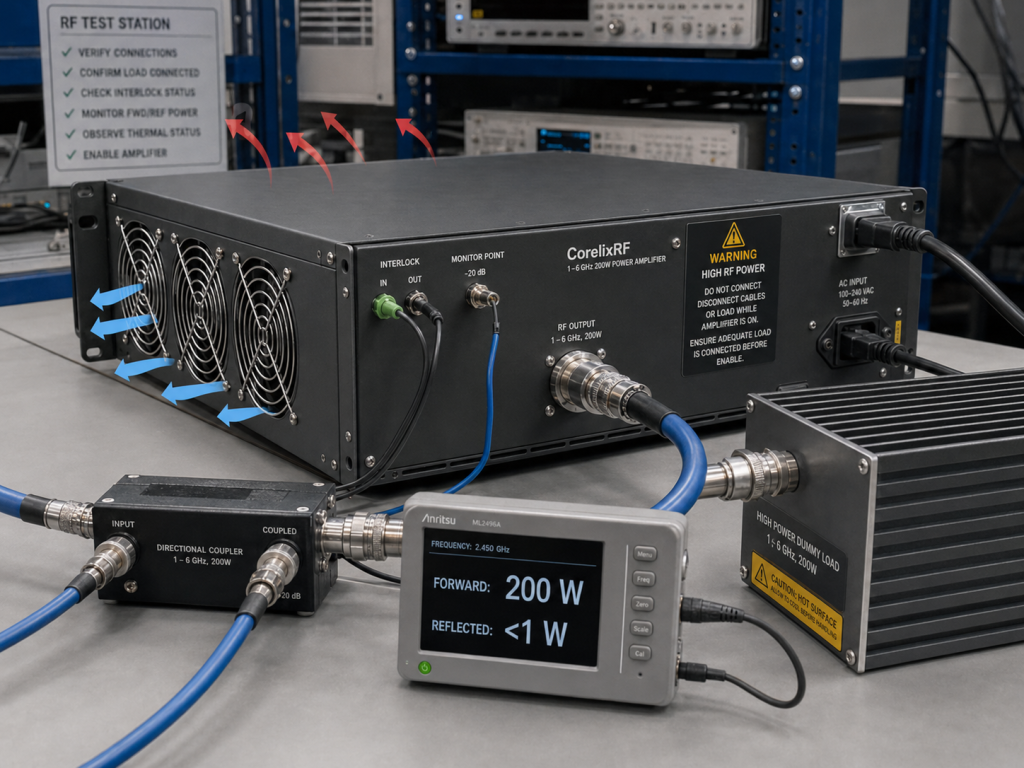
Thermal planning is another part of the system. Long EMC sweeps, repeated SDR tests, or production-style validation can keep the amplifier active for extended periods. The installation should provide airflow, clear exhaust paths, and a stable ambient environment. If the amplifier is placed in a rack with other heat-producing instruments, the rack design should be part of the review.
Protection strategy should include reflected power and load mismatch. Antennas are not perfect across 1-6 GHz, and test fixtures can be connected incorrectly. The amplifier and the system should be prepared for bad matches, disconnected loads, operator error, and unexpected DUT behavior. External couplers, power meters, interlocks, and written procedures can be just as important as built-in protection features.
CorelixRF can help review the amplifier requirement when the user provides the complete chain: signal source, frequency range, waveform, required field or load power, antenna or DUT details, cable length, expected losses, duty cycle, cooling constraints, and safety requirements. This turns the conversation from “Do we need 200 W?” into “What does the system need to do safely and repeatably?”
A 1-6 GHz 200 W amplifier is a strong tool for EMC and broadband test work, but it should be treated with the respect of a high-power RF subsystem. The best installations are not the ones with the largest wattage on paper. They are the ones where source control, filtering, monitoring, thermal design, and operator procedure work together.