
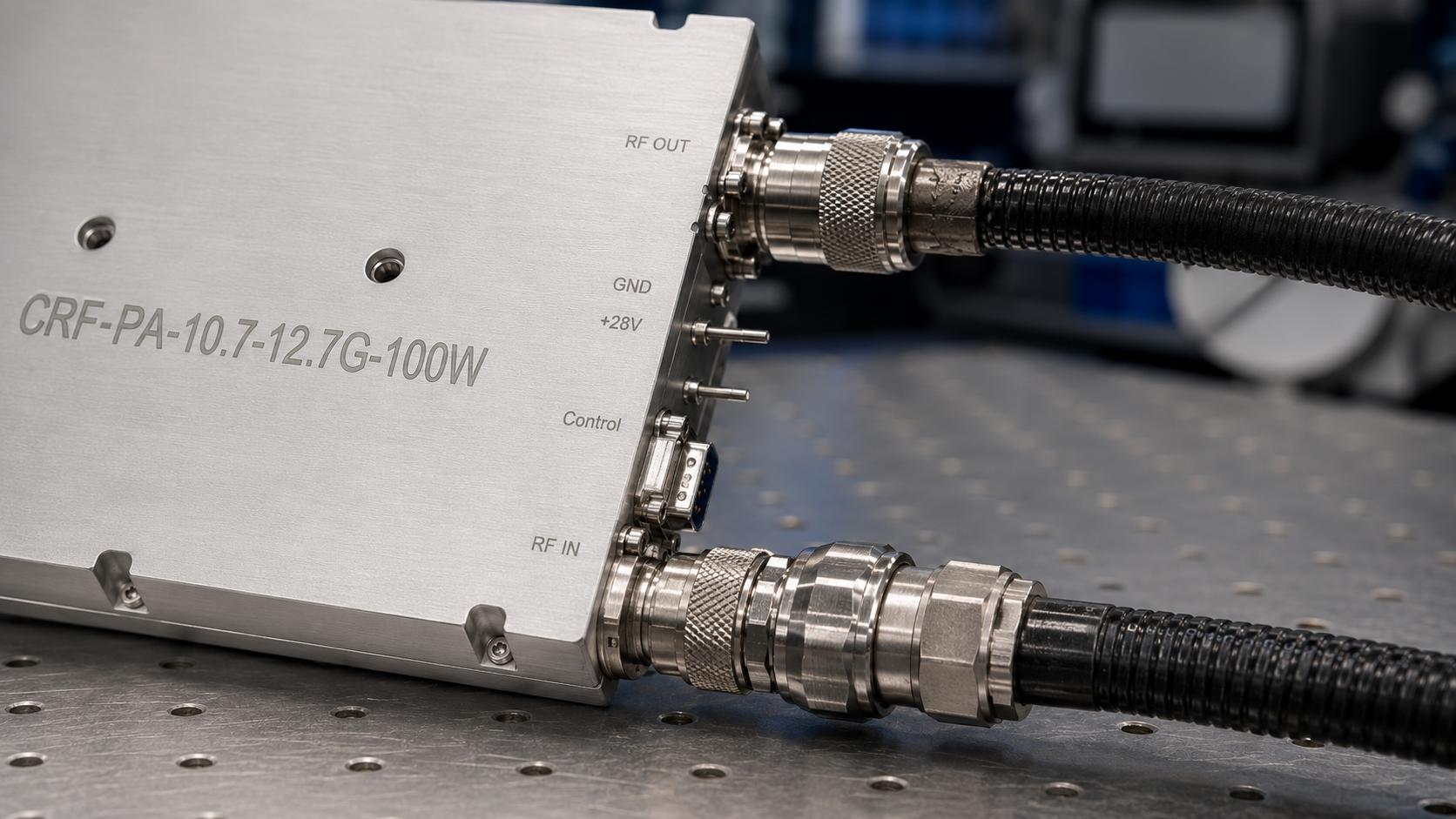
A 10.7-12.7 GHz 100 W RF amplifier is a focused microwave power stage for engineers working near the upper X-band and lower Ku-band region. It is easy to describe the requirement as “100 watts at 11 or 12 GHz,” but that leaves out the questions that matter most in satellite communication and microwave link testing: waveform quality, linearity, backoff, calibration, and whether the delivered signal still represents the intended operating condition.
This frequency window can support satellite communications labs, converter testing, antenna feed evaluation, receiver stress testing, and microwave subsystem validation. Compared with a very wideband amplifier, a 10.7-12.7 GHz design is useful when the program has a defined band and needs power concentrated there. The narrower range can simplify the selection discussion, but it does not remove the need to understand how the amplifier will be used.
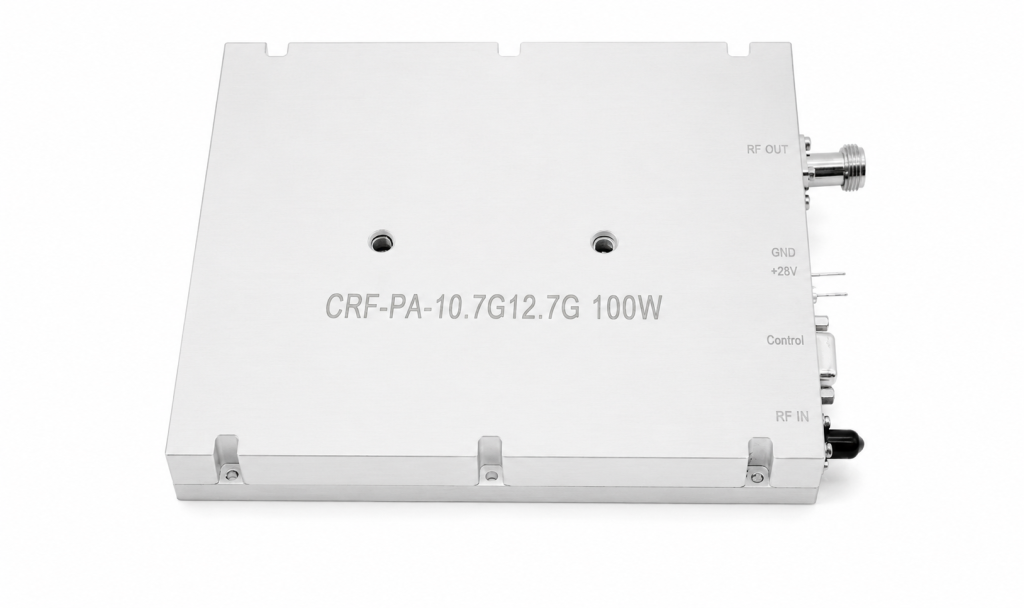
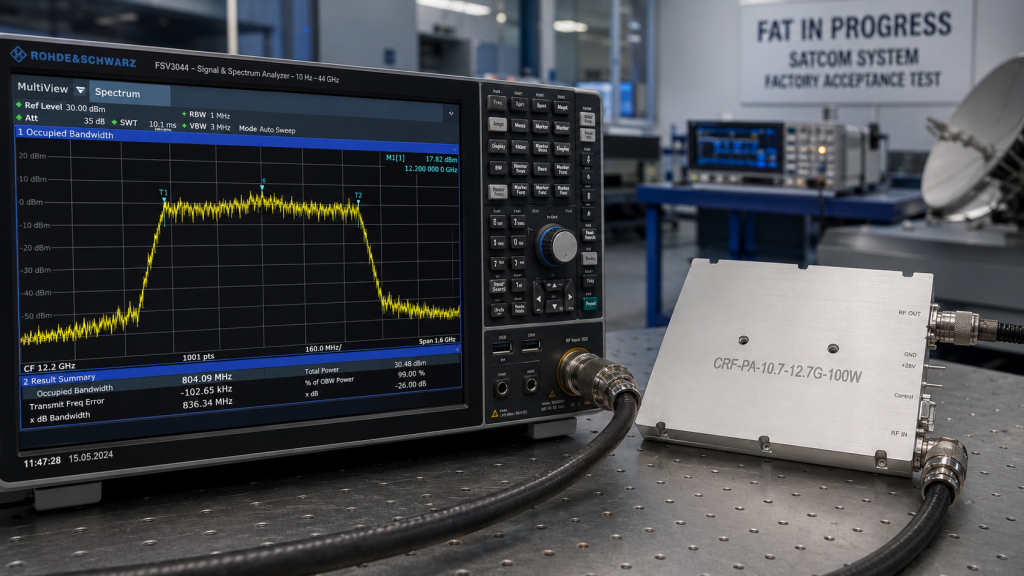
For communication waveforms, maximum output power is not always the operating point. Modulated signals can have high peak-to-average ratios, and an amplifier driven too close to compression may degrade EVM, spectral regrowth, or adjacent-channel behavior. If the test is meant to represent a real communication link, the amplifier may need to operate with output backoff. That means a 100 W class amplifier might be selected not because the normal waveform uses 100 W continuously, but because the system needs headroom.
This is one of the biggest differences between CW power testing and communication signal testing. In a CW test, engineers may focus on output level, gain, stability, and thermal behavior. In a modulated test, they must also care about waveform integrity. The RFQ should include modulation type, bandwidth, peak-to-average ratio if known, required linearity, and whether the amplifier will be used for stress testing or realistic link simulation.
The delivered-power calculation still matters. Cables, switches, couplers, filters, and adapters create loss between the amplifier and the reference plane. At 10.7-12.7 GHz, this loss may be manageable, but it is not zero. If the test setup includes a long cable run to an antenna feed or chamber, the amplifier output should be chosen after calculating the real power at the target point.
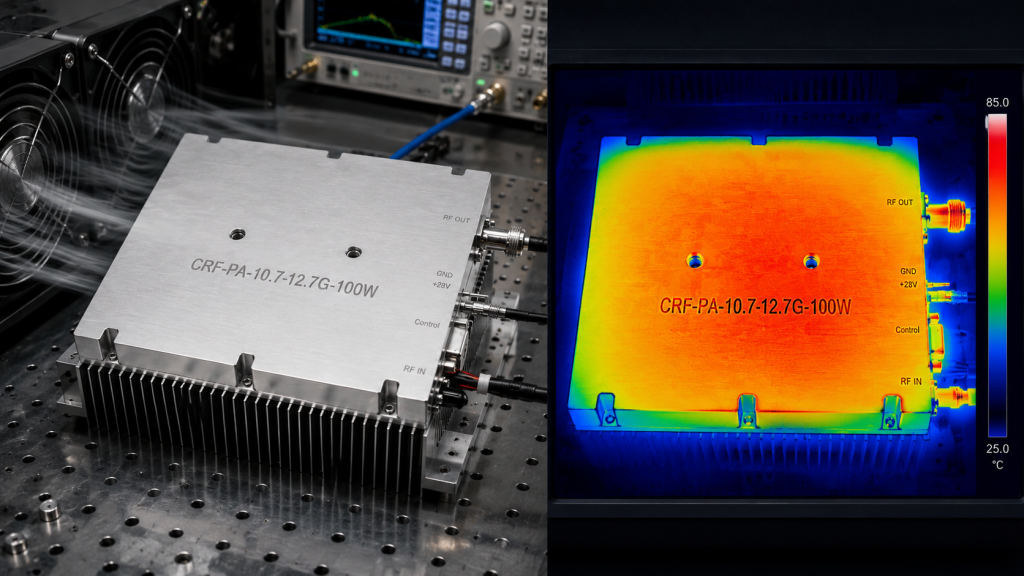
Thermal stability is important for long communication tests. A satellite link simulation or receiver evaluation may run for extended periods while engineers observe performance over temperature, frequency, or waveform changes. If amplifier temperature changes cause gain drift, the test may become harder to interpret. Good airflow, stable mounting, and documented warm-up or operating procedures help keep results consistent.
Connector and fixture quality also influence repeatability. A 10.7-12.7 GHz bench can still suffer from loose adapters, worn connectors, excessive adapter stacks, and inconsistent cable routing. These problems may appear as ripple, unexpected loss, or measurement variation. The amplifier should be installed as part of a controlled microwave path, not as a portable item constantly reconnected without inspection.
For satellite and Ku-band work, protection planning should include mismatch risk. Antenna feeds, filters, waveguide transitions, and development hardware may not present a perfect load. The system should define how reflected power is monitored, how the amplifier responds to faults, and what the operator should check before restarting a test.
CorelixRF can review a 10.7-12.7 GHz amplifier requirement more effectively when the request includes the signal type, target delivered power, normal operating output, required headroom, cable and fixture loss, cooling environment, connector preferences, and expected duty cycle. If the system needs linear operation, that should be stated clearly at the beginning.
The right 10.7-12.7 GHz 100 W amplifier is not chosen by wattage alone. It is chosen by the way the test signal must behave after amplification. For Ku-band and satellite-related work, power is useful only when it arrives at the reference plane with the waveform quality, stability, and repeatability that the test requires.