
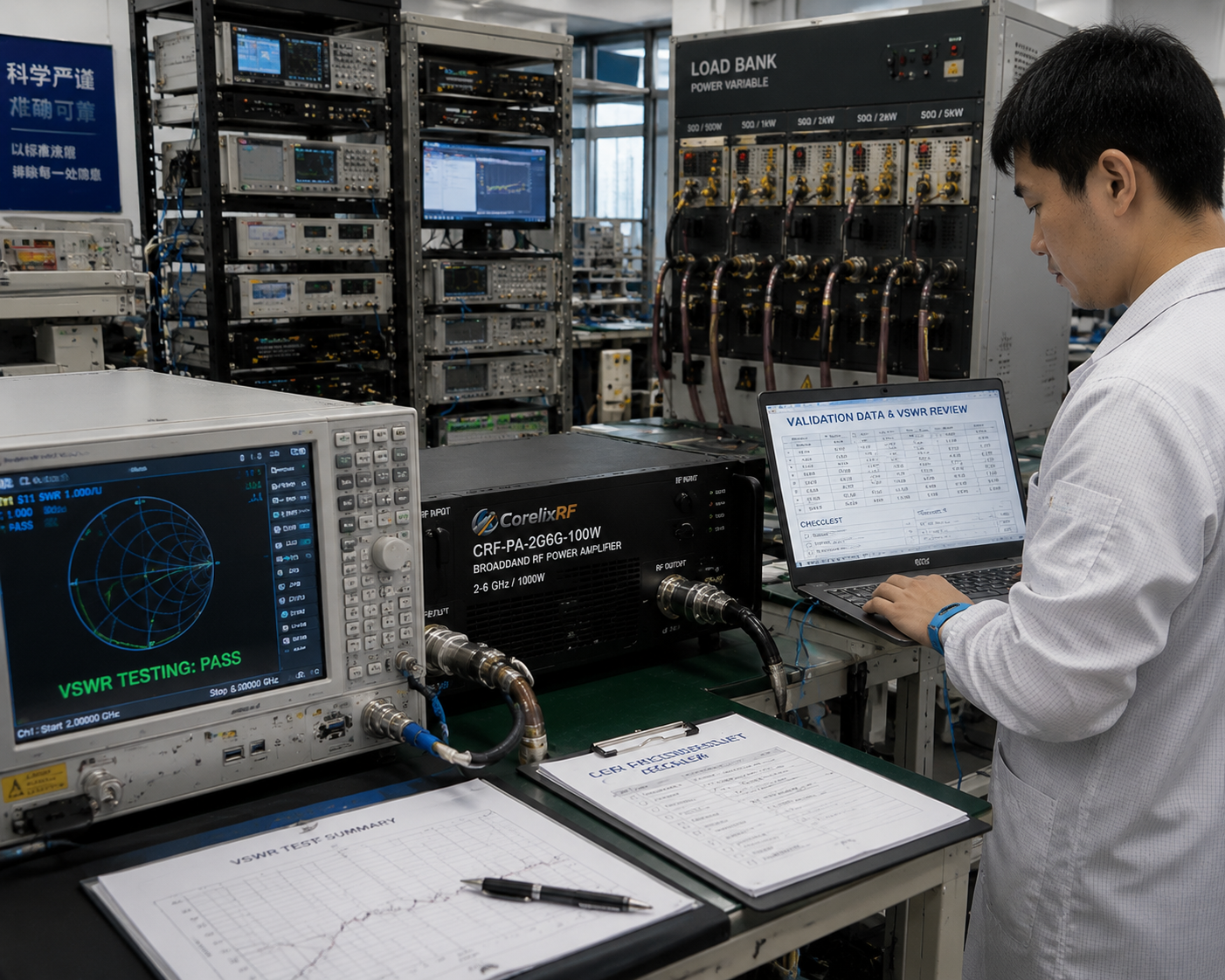
The phrase custom RF amplifier development usually appears when a standard platform is close, but not close enough. The project may need a modified frequency window, different output power, a specific connector arrangement, extra protection logic, a distinct control interface, or a packaging change that fits a real system rather than a catalog shelf. That is why content on this topic should speak to engineering preparation, not generic customization slogans.
CorelixRF’s custom RF development page is direct about this. It frames the work around custom frequency range, output power, mechanical format, RF connector, control interface, measured data requirements, and OEM RF chain integration. Just as important, it says the process should start from existing platforms where possible and then move into modification or custom review. That is a realistic and procurement-friendly approach.
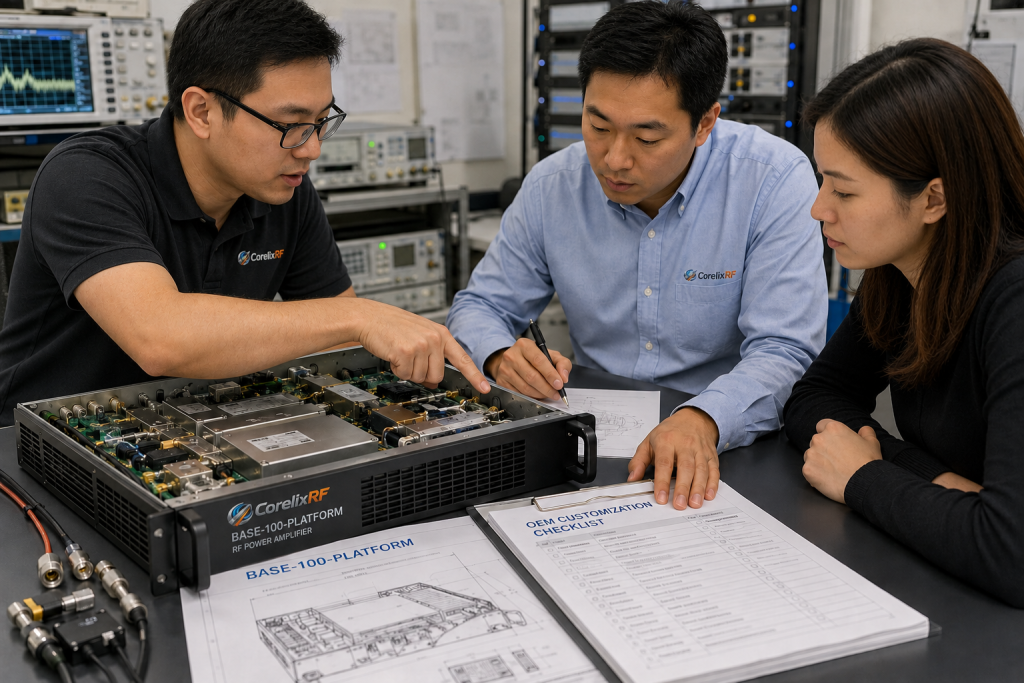
Start with the Nearest Standard Platform
Many teams treat “custom” as the starting point, but a better workflow is to first identify the nearest available platform. CorelixRF already organizes standard amplifier paths across 30-512 MHz, 300-1700 MHz, 2-6 GHz, and 6-18 GHz. Using that baseline helps define what truly needs to change.
This matters because the most efficient custom project is often platform-based rather than greenfield. Starting from an established amplifier family can simplify validation, shorten engineering loops, and reduce project uncertainty.
Define Frequency and Output Power Precisely
The first custom input is frequency range, but that does not simply mean the top and bottom numbers. The engineering team should also clarify:
- Whether the project needs full-band broadband behavior or a tighter sub-band
- How much power is required at the actual output point
- Whether the use case is CW, pulsed, sweep-based, or mixed
CorelixRF’s public pages consistently connect power with duty mode, cooling, and load condition. That is the right model. An amplifier that looks suitable at headline power may become the wrong fit once the real duty cycle and thermal environment are known.
Capture Interface and Mechanical Constraints Before RFQ
OEM projects fail late when electrical requirements are captured early but mechanical realities are left vague. The custom development page explicitly references mechanical formats, RF connectors, and control interfaces. Those are not secondary details. They shape enclosure design, cable routing, serviceability, and manufacturing repeatability.
Before contacting a supplier, the internal checklist should cover:
- RF connector type and placement
- DC input and power budget
- Control interface requirements
- Enclosure size or module outline
- Mounting orientation and cooling path
If the amplifier must live inside a broader RF front-end or signal transmission system, these constraints become even more important.
Review Load Conditions and Protection Strategy
Custom projects often involve less predictable loads than lab-only benches. The system may interact with antennas, switches, couplers, filters, or user-installed cables. That makes protection logic part of the functional requirement, not just a nice extra.
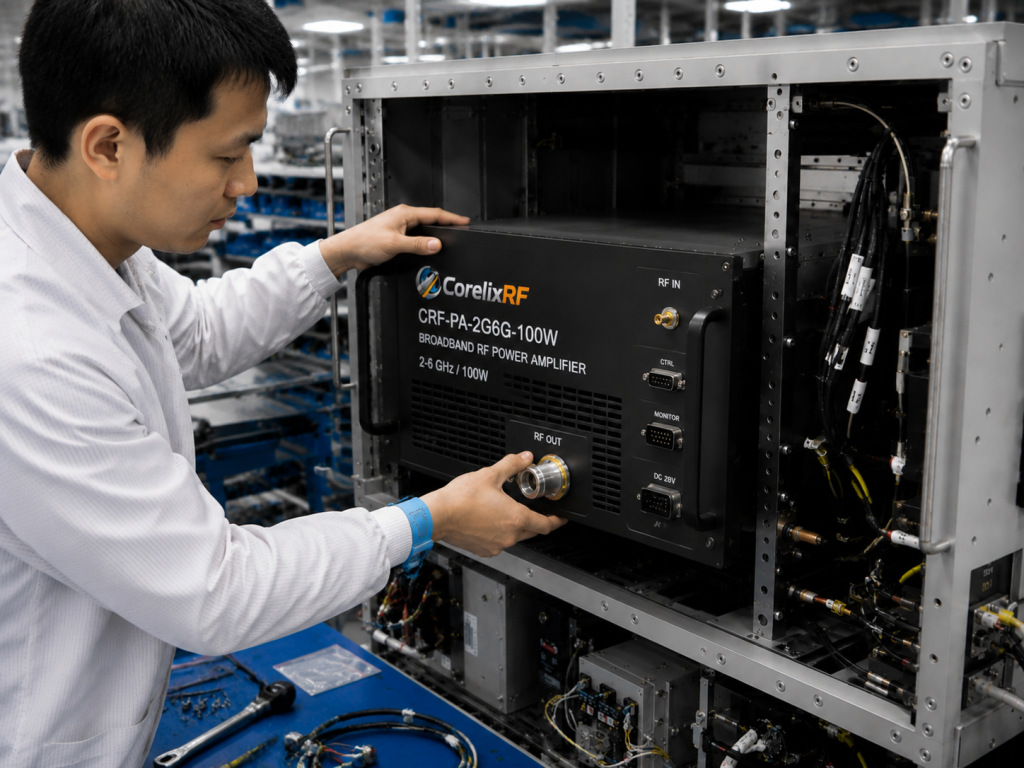
CorelixRF’s public content repeatedly references VSWR review, thermal design, measured data, and project-based engineering checks. For technical procurement teams, those signals matter because they indicate the supplier is thinking about integration risk instead of only module output.
At minimum, the requirement package should explain:
- Normal load condition
- Possible mismatch scenarios
- Continuous runtime expectations
- Thermal environment and airflow assumptions
Documentation Needs Should Be Declared Up Front
In many OEM projects, the commercial delay is not caused by hardware alone. It is caused by missing support documents for engineering sign-off, internal purchasing review, or program documentation. CorelixRF’s contact and custom pages both mention measured data and documentation availability. That is the correct angle for a high-intent article because it reflects how projects move through approval.
Useful pre-RFQ questions include:
- Is datasheet support required for the reviewed configuration?
- Are measured records needed before shipment?
- Does the buyer need inspection or validation documentation?
- Is there an NDA or controlled-document step in the process?
These questions help align engineering and procurement earlier.
Use the RF Configurator as a Qualification Shortcut
When a team already knows the custom project will require multiple parameters to be reviewed together, the RF Configurator and contact workflow become natural conversion paths. They allow the article to guide the reader toward structured requirement capture rather than a vague contact request.
That is especially useful for searchers looking for a custom RF amplifier because the search intent usually includes project qualification, not only product discovery.
A Stronger Way to Frame Custom RF Content
The best-performing article angle is not “we can customize anything.” It is “here is how to prepare a custom RF amplifier project so the engineering review is faster and the recommendation is more reliable.” That aligns with how CorelixRF publicly positions itself as a factory-direct engineering and manufacturing source rather than a generic reseller.
FAQ
When should a team choose custom RF amplifier development instead of a standard model?
Choose a custom path when a standard platform cannot meet the required band, power, interface, connector, mechanical, cooling, or integration constraints without modification.
Why start from an existing platform?
A platform-based custom path is usually faster and lower risk because part of the electrical and manufacturing baseline is already established.
What information speeds up a custom RF review?
Frequency range, output power, operating mode, connector type, cooling method, control interface, mechanical envelope, and documentation expectations all help speed the review.
Is custom RF only about electrical performance?
No. Mechanical integration, thermal behavior, interfaces, protection, and documentation are often just as important as RF output.