
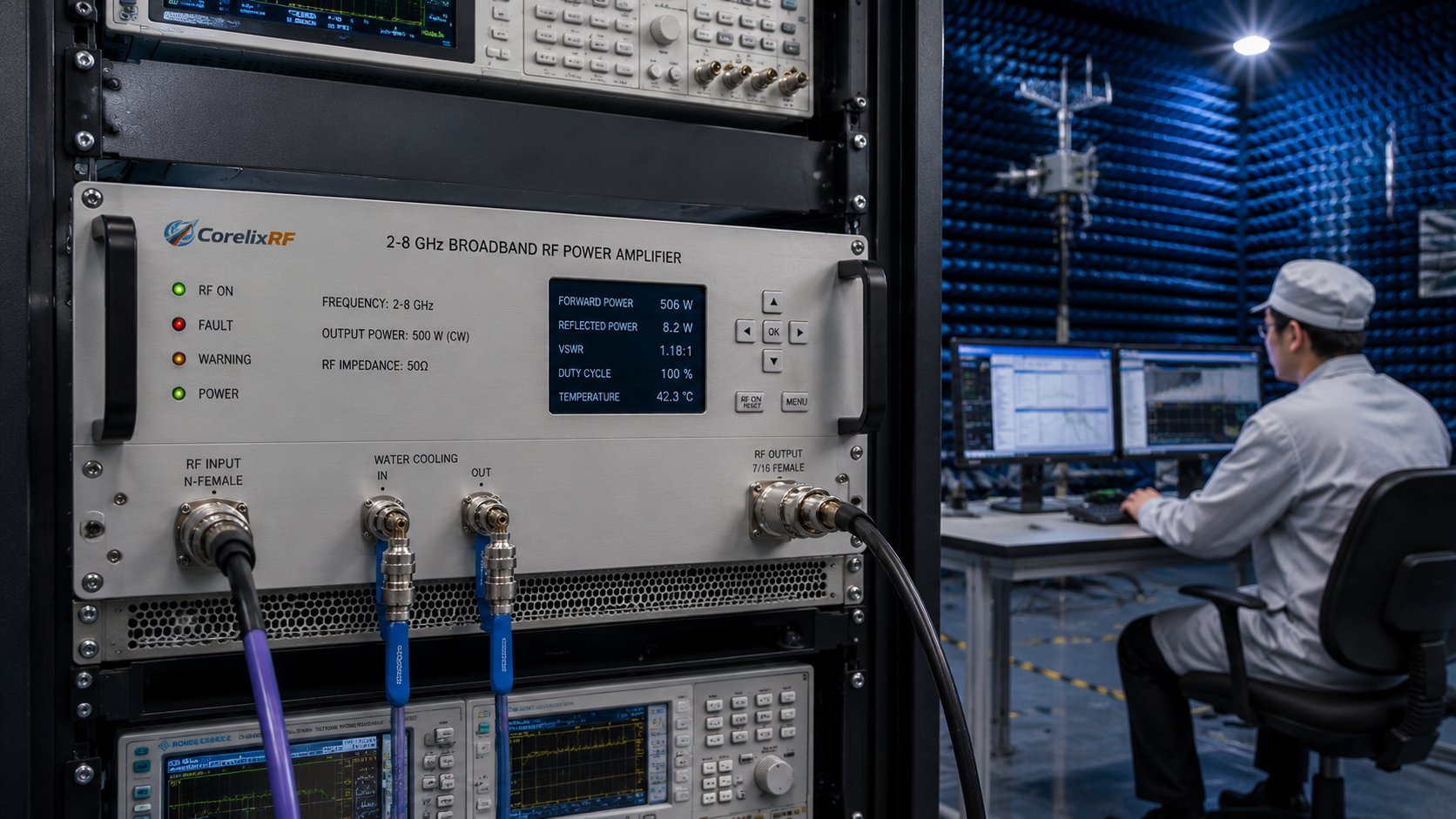
A 2-8 GHz 500 W broadband RF amplifier sits in a demanding part of the test rack. It must cover multiple microwave bands without forcing the engineer to swap narrowband hardware, yet it also has to manage thermal load, reflected power events, remote control, gain control, and repeatable output behavior. CorelixRF’s CRF-PA-2000M8000M-500W is specified as a GaN solid-state RF power amplifier platform covering 2,000 to 8,000 MHz with 500 W rated output power, 57 dB minimum small-signal gain, water cooling, RS485/LAN control, and optional forward/reverse power monitoring.
For teams comparing a broadband RF power amplifier against a bank of narrower modules, this frequency range is attractive because it spans common S-band and C-band test windows while reaching into upper microwave lab work. The engineering question is not simply whether the amplifier can make power. The real question is whether the amplifier, cooling loop, cabling, control software, safety logic, and acceptance test plan are aligned before the unit is built into a larger system.
Where a 2-8 GHz 500 W Broadband RF Amplifier Fits
A 2-8 GHz amplifier is useful when a test bench needs continuous coverage across wide RF plans. Typical project discussions include test and measurement instrumentation, communication system validation, RF interference or EW system-level testing, and aerospace control environments. In each case, a single high-power wideband platform can simplify switching, reduce system complexity, and make repeatable test procedures easier to document.
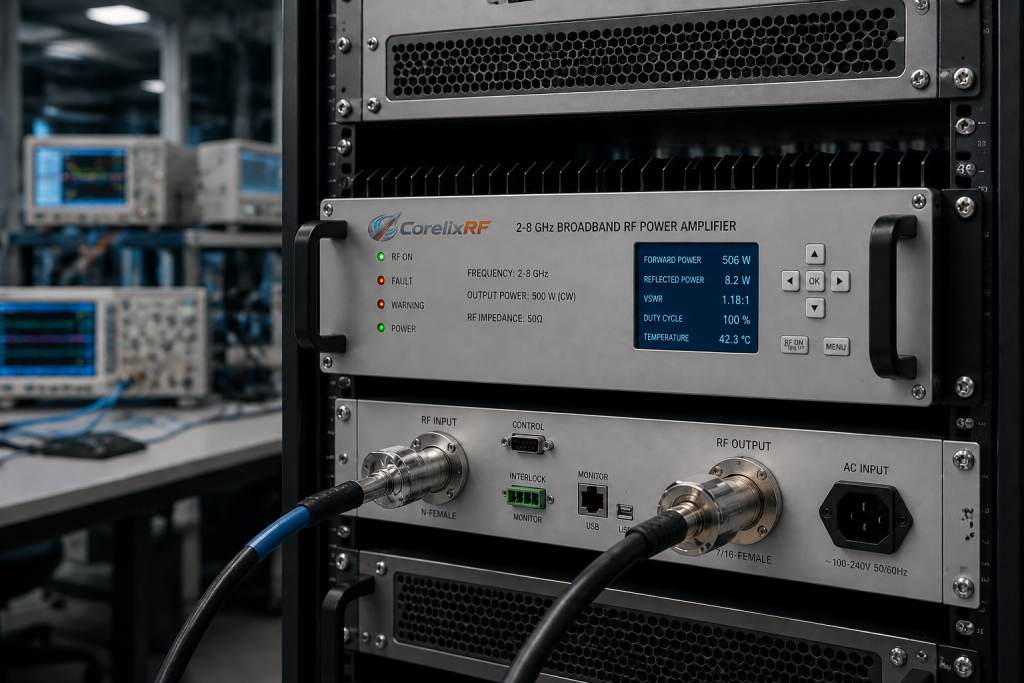
The CorelixRF source specification lists N-Female input and 7/16 output connectors, AC 220 V input power, 0 to +50 C operating temperature, and a water-cooled configuration. Those details matter early. A 500 W RF output stage is not a drop-in accessory. It changes the rack thermal budget, the interlock plan, the RF load specification, and the way the operator handles mismatches or open-load risks.
Key Electrical Specifications to Confirm
The published configuration states 500 W rated output power across 2,000-8,000 MHz, 57 dB minimum gain, -4 to +4 dB small-signal gain flatness, up to 20 dB gain control range, 50 ohm input impedance with 2:1 input VSWR, 0 dBm maximum input power, -15 dBc harmonics, and -60 dBc spurious performance. These are the numbers that should drive the system-level review.
Engineers should translate those values into operating margins. For example, 57 dB gain means a low-level source can drive meaningful output, so source leveling and input protection deserve attention. A 20 dB gain control range helps when the same amplifier is used across different bands or test levels. Gain flatness should be reviewed against the required field strength, antenna factor, cable loss, coupler loss, and calibration method.
Thermal and Cooling Integration
The specification calls for water cooling. That decision is practical at this power level, but it creates integration responsibilities. The cooling loop should be designed before mechanical packaging is finalized. Flow rate, coolant temperature, hose routing, quick-disconnect access, leak detection, service clearance, and alarms should all be part of the project review.
Water cooling can help maintain stability during long test sequences, but only if the cooling system is treated as part of the RF system rather than as a utility afterthought. If a chamber, mobile platform, or shielded enclosure is involved, the thermal design should include pressure drop, environmental temperature, and maintenance access. For high duty operation, ask CorelixRF to review the planned load profile before finalizing the amplifier configuration.
Control, Monitoring, and Protection
The CRF-PA-2000M8000M-500W source data lists RS485/LAN control, real-time temperature monitoring, real-time current monitoring, optional forward/reverse power monitoring, optional input power detection, and alarm/fault protection functions. These features are important for unattended or semi-automated test systems.
A strong integration plan defines what the host controller does when alarms appear. It should not only log the fault. It should place the signal source, RF switch matrix, load, cooling system, and amplifier into a known state. A custom RF amplifier review should therefore cover control protocol, alarm outputs, interlocks, remote enable/disable behavior, and the timing relationship between source output and PA enable.
Acceptance Test Checklist
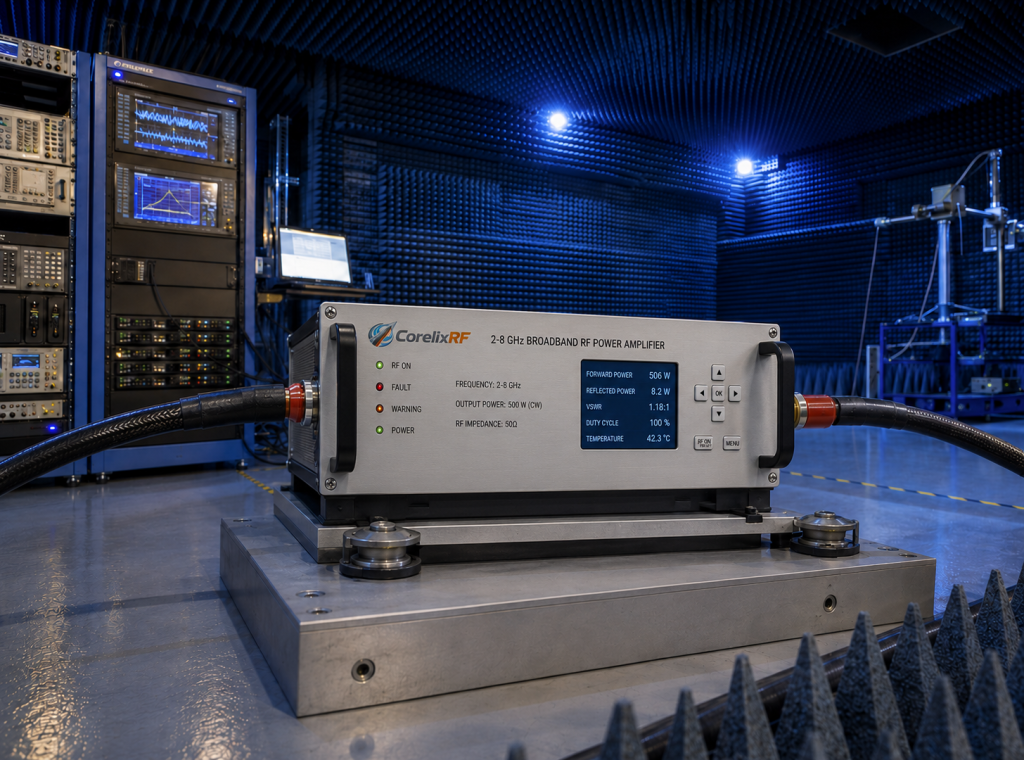
Before procurement, define acceptance criteria in measurable language. Recommended checks include output power at representative frequency points, gain flatness across the band, gain control response, spurious and harmonic behavior, cooling performance at expected operating duration, alarm response, remote interface verification, and reflected power behavior using the approved test fixture. Keep the test plan consistent with the 50 ohm operating environment in the source specification.
A 2-8 GHz 500 W system also needs compatible cables, couplers, loads, attenuators, and measurement equipment. The amplifier can only perform as well as the RF path around it. Connector transitions should be minimized and rated for the planned power. Any adapter used during acceptance testing should be documented so later field measurements are comparable.
When to Request a Project Review
Request a review when the amplifier will be used near rated power, installed in a custom rack, connected to a nonstandard load, controlled by automated software, or placed in an environment with strict thermal limits. Provide the frequency plan, waveform type, duty cycle or operating duration, expected output level, input drive source, cooling conditions, load VSWR expectations, and required monitoring signals.
CorelixRF can then align the GaN SSPA configuration, control options, and project documentation with the actual use case instead of treating the amplifier as a generic catalog block.
FAQ
Is this 2-8 GHz 500 W amplifier air cooled or water cooled?
The referenced CRF-PA-2000M8000M-500W configuration is specified as water cooled.
What control interfaces are listed for the amplifier?
The source specification lists RS485 / LAN control, with optional project-specific control support.
What applications are appropriate for this amplifier class?
The source data mentions test and measurement instrumentation, communication systems, RF interference / EW system-level testing, and aerospace control systems.
Does the specification include monitoring functions?
Yes. It lists real-time temperature and current monitoring, with optional forward/reverse power monitoring and input power detection.