
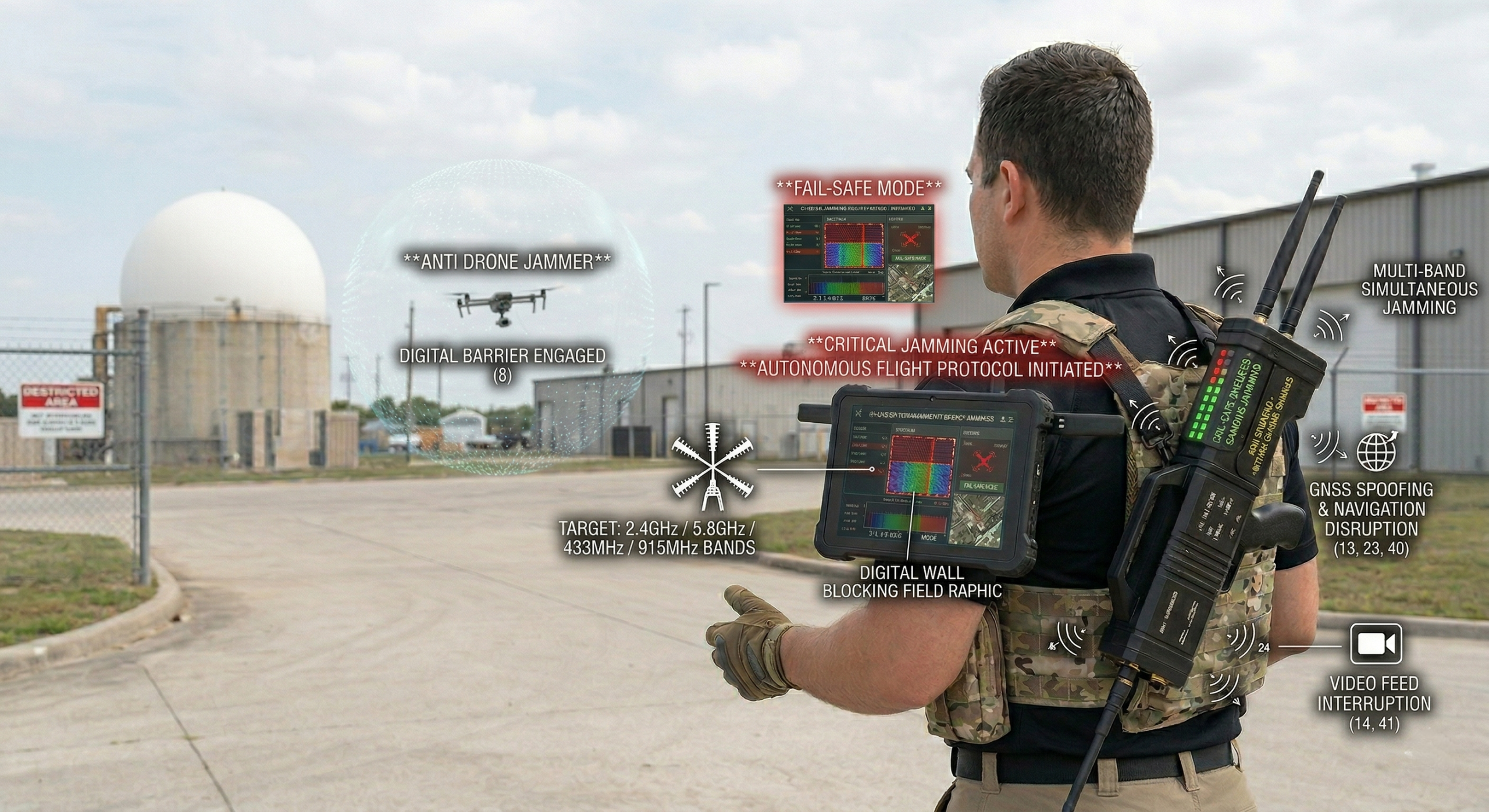
You are walking through a private outdoor event or a secure facility when a stray drone suddenly appears overhead, buzzing like a mechanical hornet. It lingers, its camera lens pointing directly at your sensitive operations or private guests, and you realize your privacy is being stripped away in real-time. This intrusive presence creates a sense of helplessness because standard security measures cannot stop an object flying sixty feet in the air. Here’s the deal: a portable anti drone jammer provides the immediate defensive shield you need to reclaim your airspace. This professional guide details how mobile jamming technology neutralizes aerial threats to ensure your operational security remains uncompromised.
1. What is the fundamental purpose of an anti drone jammer?
An anti drone jammer is a specialized electronic device designed to disrupt the communication frequencies between a remote pilot and an unmanned aerial vehicle (UAV). When these signals are interrupted, the drone typically enters a fail-safe mode, either landing immediately or returning to its original takeoff point. This technology acts as a digital wall, preventing unauthorized surveillance or physical intrusion in restricted zones.
How does signal disruption protect you?
The jamming process involves emitting a high-power radio frequency signal that mimics the same frequency used by the drone’s control system. You might be wondering how this affects the drone’s behavior without causing a crash. Most modern systems target the 2.4GHz and 5.8GHz bands, effectively “deafening” the drone’s receiver so it can no longer hear commands.
- Frequency Blocking: Neutralizes the 2.4GHz and 5.8GHz control links.
- GPS Spoofing: Prevents the drone from knowing its geographical coordinates.
- Video Feed Interruption: Stops the real-time transmission of data to the pilot.
Key Takeaway: Understanding the core function of jammers allows security teams to deploy them effectively against unwanted aerial observation.
| Feature | Solid Rubber Compression | LSR Molding |
| Material State | High-viscosity solid | Two-part liquid |
| Cycle Time | Longer (minutes) | Shorter (seconds) |
| Precision | Standard | Extremely High |
This data confirms that choosing the right technology depends entirely on the required precision of the drone-blocking hardware.
2. How do portable anti drone jammer systems operate in the field?
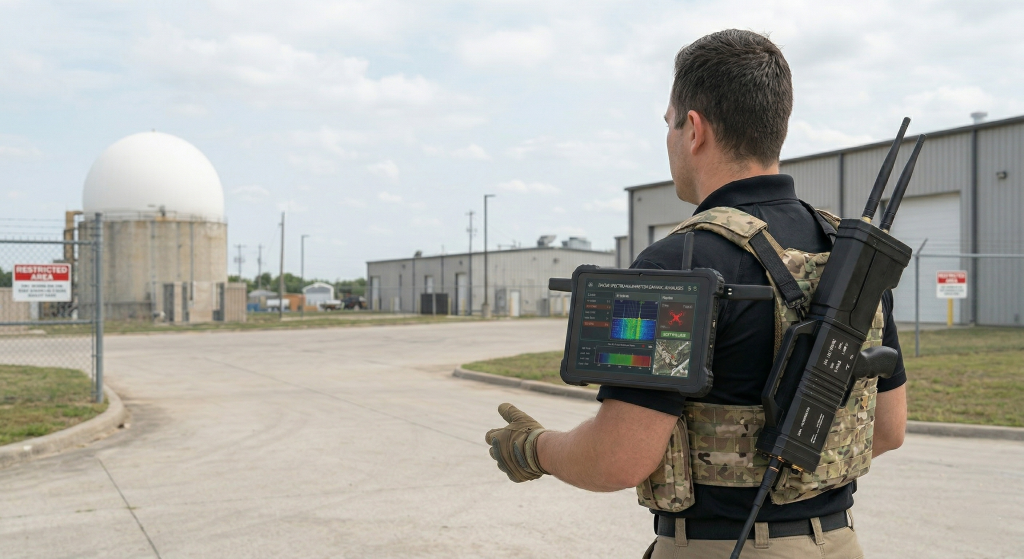
A portable anti drone jammer operates by projecting a directional cone of electromagnetic energy toward a flying target to break its link with the controller. Unlike stationary units, these mobile devices allow the operator to move freely and respond to threats from any angle. Wait, there’s more: the effectiveness of the device depends largely on the distance between the jammer, the drone, and the operator.
Can a single device block multiple frequencies?
Most high-end portable units are multi-band, meaning they can target several communication channels simultaneously to ensure the drone cannot hop to a clear frequency. It gets better: advanced models also include GNSS jamming to prevent the drone from using satellite navigation for autonomous flight.
- Directional Antennas: Focused energy prevents interference with nearby friendly electronics.
- Battery Portability: Internal power sources allow for hours of active standby.
- Trigger Activation: Simple point-and-shoot mechanics for rapid response.
Key Takeaway: Portability ensures that security personnel can neutralize threats across large perimeters without being tethered to a power grid.
| Component | Standard Model | Professional Model |
| Effective Range | 500 meters | 2,000 meters |
| Battery Life | 1 Hour | 3+ Hours |
| Weight | 5 kg | 3 kg (Carbon Fiber) |
The comparison above illustrates that professional-grade mobility is defined by the balance of range and weight.
3. Why is frequency range vital for an anti drone jammer?
The frequency range of an anti drone jammer determines which types of drones it can successfully neutralize during a security breach. Because commercial drones utilize a variety of bands for control, telemetry, and video, a jammer must be versatile enough to cover the entire spectrum. Believe it or not, failing to cover just one frequency can leave a gap that a sophisticated pilot could exploit.
What are the common bands used by drones?
Most consumer drones rely on the ISM bands, but specialized industrial drones might use lower frequencies for longer range. The real story is that as drone technology evolves, jammers must also expand their reach to include newer, less common communication channels.
- 2.4 GHz: The most common frequency for residential and toy drones.
- 5.8 GHz: Used for high-definition video transmission and fast control links.
- 433 MHz / 915 MHz: Often used for long-range telemetry in DIY or custom drones.
Key Takeaway: Selecting a device with wide-band coverage ensures you are protected against both hobbyist and professional-grade aerial threats.
| Frequency Band | Primary Use | Impact of Jamming |
| 1.5 GHz | GPS/GLONASS | Loss of navigation and stability |
| 2.4 GHz | Remote Control | Complete loss of pilot command |
| 5.8 GHz | Video/Data | Pilot loses visual feedback |
Comprehensive frequency coverage is the only way to ensure a drone is completely disabled rather than just partially hindered.
4. Is the use of an anti drone jammer legal for everyone?
Using an anti drone jammer is subject to strict regulatory frameworks that vary significantly from one country to another. In many regions, these devices are restricted to government, military, or law enforcement use due to the risk of interfering with legitimate communications. But here’s the kicker: unauthorized use can lead to heavy fines or legal action if it disrupts public infrastructure or emergency services.
Who is authorized to deploy this technology?
Typically, authorized users include airport security, prison guards, and executive protection details for high-profile events. What’s the catch? Even if you own private property, you must ensure that your local laws permit the use of RF interference devices before purchasing.
- Government Approval: Often requires specific licensing or departmental oversight.
- Restricted Zones: Usage is generally limited to the immediate vicinity of the protected asset.
- Safety Protocols: Operators must be trained to avoid interfering with manned aircraft communications.
Key Takeaway: Always consult with legal counsel or local authorities to ensure your signal disruption activities comply with national telecommunications laws.
| User Category | Permission Level | Typical Use Case |
| Military | Full Authorization | Combat Zone / Base Protection |
| Private Citizen | Highly Restricted | Generally Prohibited |
| Security Firms | Conditional | Event Security / VIP Protection |
Navigating the legal landscape is the first step before integrating jamming hardware into your security protocol.
5. What are the key benefits of a portable anti drone jammer?
A portable anti drone jammer offers unparalleled flexibility for security teams who need to protect shifting perimeters or mobile assets. Unlike fixed installations, which can be expensive and stationary, a mobile unit allows you to bring the defense directly to the threat. Ready for the good part? These devices are often designed to look and handle like standard equipment, requiring minimal training for experienced security staff.
How does portability improve response times?
When a drone is spotted, every second counts, and having a device that can be deployed from a vehicle or a backpack is a massive advantage. This is where it gets interesting: the ability to move toward the drone reduces the power required to break the link, making the jamming more effective.
- Rapid Deployment: Can be active and targeting a drone in under ten seconds.
- Tactical Mobility: Allows the user to follow the drone’s flight path to maintain a lock.
- Low Infrastructure Cost: No need for permanent mounting or extensive wiring.
Key Takeaway: The agility of mobile jammers makes them the most practical choice for dynamic environments like festivals or VIP motorcades.
| Factor | Fixed Jammer | Portable Jammer |
| Installation | Permanent / High Cost | None / Immediate |
| Coverage | 360 Degrees (Static) | Directional (Follows Target) |
| Versatility | Low | High |
This table shows that while fixed systems cover a wide area, portable systems provide the precision and movement needed for active threats.
6. How do you choose the right anti drone jammer for your needs?
Selecting the appropriate anti drone jammer requires a deep analysis of your specific threat environment and the types of UAVs you are likely to encounter. Not all jammers are created equal; some specialize in long-range detection while others focus on high-power disruption of specific bands. Think about it: a prison facility has very different needs compared to an executive protecting a yacht.
What specifications should you prioritize?
The most important factors are effective range, battery life, and the number of supported frequency bands. You might be wondering if a higher price always means better protection, but often, the best value comes from a device tailored specifically to your local drone regulations and common threats.
- Power Output: Determines how far the jamming signal can travel against the pilot’s link.
- Cooling Systems: High-power units generate heat and require robust fans for continuous use.
- Ergonomics: The device should be easy to aim and hold for several minutes at a time.
Key Takeaway: By matching the jammer’s specs to your site’s topography, you ensure maximum protection without overpaying for unnecessary features.
| Specification | Entry Level | Industrial Grade |
| Number of Bands | 3 Bands | 6+ Bands |
| Cooling | Passive | Active Fan System |
| Housing | Plastic | Military-grade Aluminum |
The disparity in build quality highlights why industrial-grade hardware is necessary for consistent performance in harsh environments.
7. What are the limitations of an anti drone jammer?
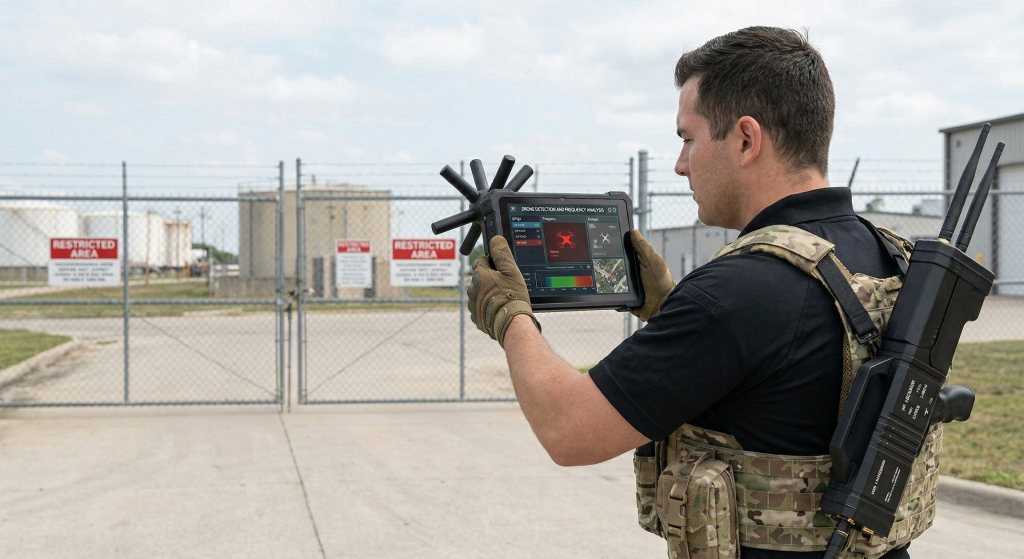
Even the most powerful anti drone jammer has specific limitations that you must understand to avoid a false sense of security. Environmental factors such as heavy rain, physical obstacles like buildings, and even electromagnetic interference from nearby towers can reduce effectiveness. Let’s face it: technology is not a magic wand, and it works best when integrated into a multi-layered security strategy.
Can a drone bypass a jammer?
Some advanced drones are programmed to switch to autonomous “pre-planned” flight paths if they lose their radio link. The bottom line is that jammers that only target control frequencies might be useless against a drone flying entirely on internal GPS waypoints without a pilot.
- Line of Sight: Signal blockage occurs if a building or hill is between the jammer and the drone.
- Frequency Hopping: Some drones can rapidly change channels to find a gap in the jamming signal.
- Autonomous Flight: Drones using optical flow or pre-set paths don’t need a radio link to finish a mission.
Key Takeaway: Recognizing these limitations allows you to combine jamming with physical barriers or detection software for a more complete defense.
| Limitation | Cause | Potential Solution |
| Signal Attenuation | Rain / Fog | Increase Power Output |
| Dead Zones | Concrete Structures | Deploy Multiple Units |
| Inertial Navigation | Internal Sensors | Use Physical Interception |
Understanding these constraints is vital for developing a realistic security protocol that doesn’t fail under pressure.
8. How does weather affect an anti drone jammer?
Atmospheric conditions can significantly impact the performance and reliability of an anti drone jammer during outdoor operations. High humidity, heavy rain, and extreme temperatures can all degrade the radio frequency signal as it travels through the air. The truth is that water molecules in the air absorb RF energy, which can cut your effective jamming range in half.
Does heat impact the electronics?
Electronic components inside the jammer can overheat if used continuously in direct sunlight or high-temperature climates. Here is the deal: professional units include thermal sensors that may throttle power to prevent permanent damage to the circuitry.
- Signal Absorption: Raindrops scatter and weaken high-frequency waves (5.8GHz).
- Battery Performance: Cold weather drastically reduces the runtime of lithium-polymer batteries.
- Condensation: Moving a device from a cold car to a humid outdoor area can cause internal shorts.
Key Takeaway: Operators should always account for weather-related range reduction when planning their defensive perimeter.
| Weather Condition | Impact Level | Effect on Jamming |
| Clear Sky | None | Maximum Range / Efficiency |
| Heavy Rain | High | Significant Signal Scattering |
| Extreme Heat | Medium | Potential Thermal Shutdown |
This data emphasizes the need for climate-controlled storage and careful monitoring during field use in adverse conditions.
9. What is the future of anti drone jammer technology?
As UAVs become more intelligent and harder to detect, the technology behind the anti drone jammer is evolving toward artificial intelligence and automated targeting. Future systems will likely integrate high-resolution cameras and thermal imaging to automatically lock onto drones. The best part? These systems will be able to identify the specific make and model of a drone to apply the most effective jamming signature.
Will jammers become more compact?
Miniaturization of RF components is allowing for even smaller, lighter devices that can be integrated into standard security uniforms. Keep an eye out for “smart” jammers that can distinguish between a friendly drone and an enemy one based on encrypted ID tags.
- AI Target Recognition: Software that identifies drones by their shape and flight pattern.
- Directed Energy: Using more focused beams to avoid any collateral interference.
- Networked Defense: Multiple jammers talking to each other to create a wide-area “no-fly” bubble.
Key Takeaway: Staying informed about technological shifts ensures your security infrastructure remains effective against the next generation of aerial threats.
| Trend | Benefit | Timeline |
| AI Integration | Reduced Human Error | 1-3 Years |
| Miniaturization | Better Portability | Currently Evolving |
| Friend/Foe ID | Safer Operations | 2-5 Years |
The future points toward smarter, more autonomous systems that require less manual intervention from the operator.
10. How to maintain your anti drone jammer for peak performance?
To ensure your anti drone jammer works when you need it most, a strict maintenance schedule must be followed by your technical team. Because these are precision electronic instruments, dust, moisture, and battery degradation are your primary enemies. Check this out: most failures occur because of neglected batteries or damaged antenna connectors that haven’t been inspected in months.
What are the common maintenance steps?
You should regularly cycle the batteries and check for any signs of swelling or reduced capacity. The kicker is that even if you don’t use the device, the firmware should be updated to ensure it recognizes the newest drone frequency hopping patterns.
- Antenna Care: Ensure connectors are tight and free of corrosion or debris.
- Battery Cycling: Charge and discharge the unit every 30 days to maintain cell health.
- Firmware Updates: Install the latest software to combat new drone communication protocols.
Key Takeaway: Consistent maintenance transforms a piece of hardware into a reliable life-saving tool during a security crisis.
| Task | Frequency | Objective |
| Visual Inspection | Weekly | Check for physical damage |
| Battery Test | Monthly | Verify full runtime capacity |
| System Update | Quarterly | Improve frequency targeting |
Following this schedule ensures that when a threat appears, your equipment will respond with maximum power and precision.
Conclusion
Securing your airspace requires more than just vigilance; it demands the right technological edge to neutralize modern threats. We have explored how a portable anti drone jammer provides the mobility, frequency coverage, and immediate response needed to protect sensitive areas from unauthorized UAVs. By understanding the legalities, technical specs, and maintenance needs, you can build a robust defense that keeps your operations private. Don’t wait for a security breach to realize you are vulnerable to aerial intrusion. Contact us today to discover how our advanced RF solutions can safeguard your perimeter and provide the peace of mind you deserve. Our mission is to provide professional-grade protection that evolves as quickly as the threats you face.
Frequently Asked Questions (FAQ)
Q1: Can I legally use a drone jammer on my private property?
No, in most countries, including the US and UK, signal jamming is strictly regulated and often illegal for private citizens. Even on private land, these devices can interfere with public communication networks, so you should consult with local authorities before purchase.
Q2: How does a jammer handle a drone that has no pilot?
It depends on the drone’s programming. If you use a jammer that blocks GPS/GNSS signals, an autonomous drone may lose its way and land, but some advanced models use visual sensors to continue their flight path.
Q3: Can a jammer cause a drone to fall out of the sky and hurt someone?
Most modern commercial drones are designed with safety features that trigger a slow descent or a “return to home” function when they lose their signal. However, there is always a small risk of mechanical failure if the signal loss is sudden and the drone is low on power.
Q4: What is the average range of a portable jammer?
Typically, a handheld portable unit can reach between 500 meters and 2 kilometers depending on the power output and the surrounding environment. Obstacles like hills and buildings will significantly reduce this effective distance.
Q5: How do I know if my jammer is working against a specific drone?
You will usually see the drone stop in mid-air, start to wobble, or begin a slow descent. On professional models, there may also be a signal indicator that shows when a successful link-break has occurred on the targeted frequency.
Authorized RF engineering and compliance review
For regulated RF systems, this page should be used as an engineering and compliance review path, not as a public deployment checklist. CorelixRF starts with authorization status, operating region, frequency plan, output limit, antenna interface, safety controls, thermal limits and acceptance documents.
- RFQ checklist – send the data buyers usually forget, including band, power, duty cycle, interface and test standard
- delivery documentation – check what documents can support incoming inspection, FAT review and long-term maintenance
- quality and certification review – review the quality and compliance evidence before the project moves into procurement
- RF front-end platform – compare the RF chain as a system instead of selecting one isolated module
- RF configurator – turn frequency, power, thermal and interface requirements into a first configuration brief
- case studies – review similar engineering paths before sending an RFQ
- engineering contact – send the application notes, block diagram or target specification to engineering sales
This keeps the discussion inside lawful, authorized RF programs while still giving procurement teams a clear way to request amplifier, antenna, SDR source, documentation and factory review.
GNSS and RF Interference Review Path
For authorized security, test or integration programs, use this article as a compliance-first planning reference rather than an operating instruction. The practical next step is to review the RF chain as an engineered system: source, amplifier, antenna, control interface, load condition, thermal margin and acceptance evidence.
- Review RF front-end platform architecture when the project combines signal source, amplifier, antenna and control logic.
- Compare RF power amplifier platforms for band, output power, duty cycle, cooling and protection behavior.
- Match RF antenna platforms to coverage pattern, gain, connector, VSWR and installation limits.
- Prepare an RFQ checklist before requesting datasheets, test data or a factory engineering review.
Send your RF system requirements to CorelixRF engineering for a compliance-aware review path.