

A Solid State Power Amplifier is a high-performance electronic device that uses semiconductor technology to increase the power of radio frequency (RF) signals for transmission. Engineers and system integrators frequently face significant challenges with legacy vacuum-tube systems, which are prone to sudden failure and require expensive, frequent maintenance. These high-voltage components often lead to system instability and operational downtime, agitating the risks associated with mission-critical communication links. You can overcome these reliability hurdles by transitioning to a modern Solid State Power Amplifier designed for maximum efficiency and longevity.
1. What exactly is a Solid State Power Amplifier?
A Solid State Power Amplifier is a specialized RF component that utilizes transistors, typically made of Gallium Nitride (GaN) or Gallium Arsenide (GaAs), to amplify signals. This solid-state architecture eliminates the need for fragile vacuum tubes and the high-voltage power supplies they require. By exploring the Solid State Power Amplifier catalog, you can find solutions tailored for specific frequency and power requirements.
Understanding Semiconductor Architecture
The internal design of these amplifiers relies on the movement of electrons through solid crystalline materials rather than a vacuum. This physics-based approach allows for much higher durability and a significantly smaller physical footprint in system racks.
- GaN transistors for high power density.
- GaAs transistors for superior high-frequency gain.
- LDMOS for cost-effective lower-frequency bands.
Think about this for a moment.
Key Takeaway:
Solid-state design replaces mechanical fragility with semiconductor-grade reliability and efficiency.
| Feature | Solid State Benefit |
|---|---|
| Material | GaN / GaAs Semiconductors |
| Durability | High vibration resistance |
| Maintenance | Minimal periodic service required |
The shift toward semiconductor materials ensures that your RF chain remains operational even under extreme environmental stress.
2. How do SSPAs differ from traditional TWTAs?
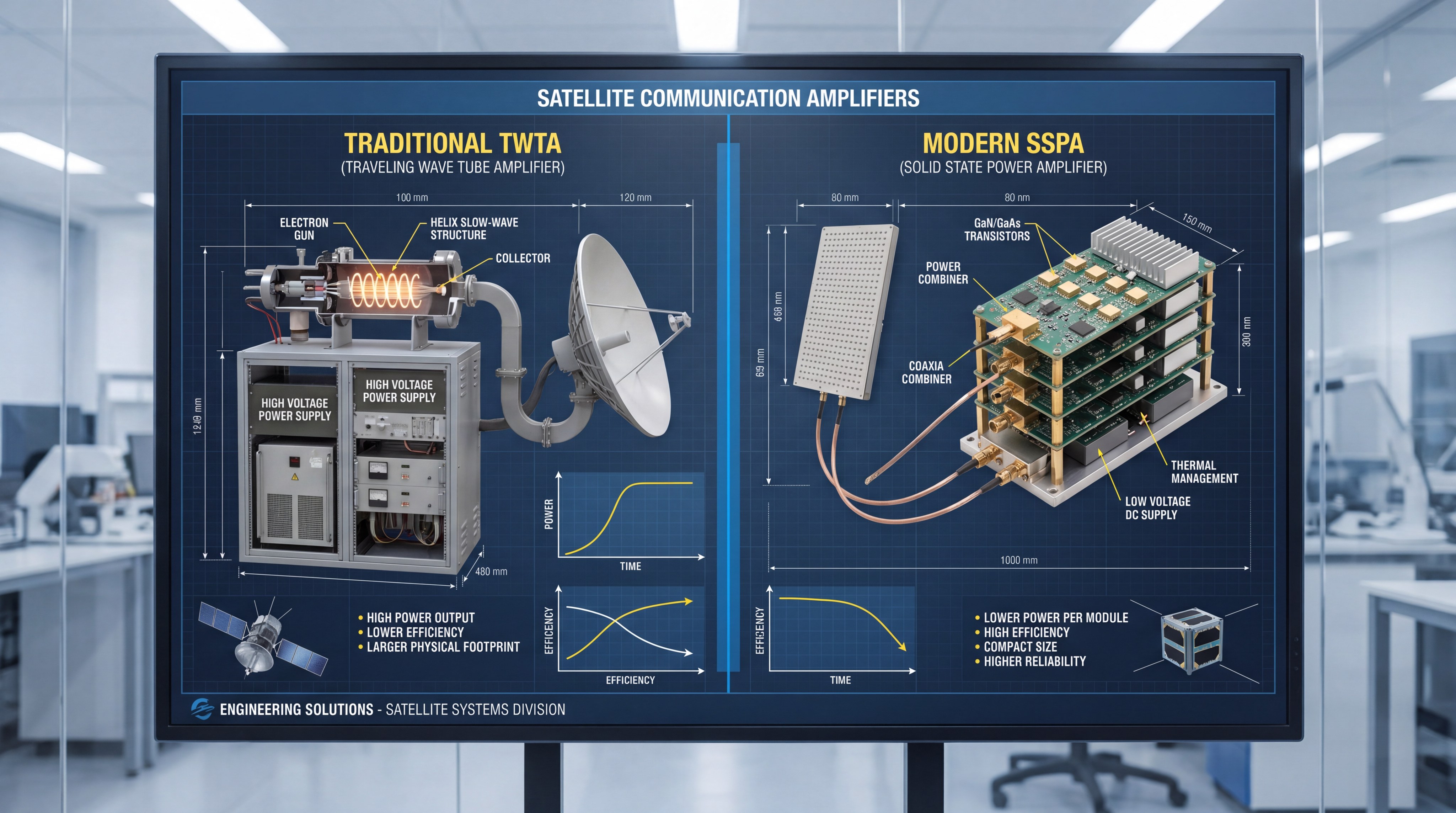
A Solid State Power Amplifier differs from a Traveling Wave Tube Amplifier (TWTA) by using modular transistors instead of a single vacuum tube to generate power. While TWTAs are known for high output, they suffer from a “single point of failure” risk that can leave an entire station offline instantly. Modern solid-state units provide a much more stable alternative with a predictable lifecycle.
Reliability and Failure Mode Comparison
The most significant difference lies in how these devices fail; SSPAs exhibit “graceful degradation” where the failure of one transistor module only slightly reduces total output. In contrast, a TWTA failure is usually catastrophic and requires a complete replacement of the vacuum tube.
- SSPAs lack limited-life cathodes.
- TWTAs require dangerous high-voltage power.
- Modular designs allow for field-serviceable parts.
Here is the deal.
Key Takeaway:
SSPAs offer superior operational uptime through modular redundancy and low-voltage operation.
| Metric | TWTA (Vacuum Tube) | SSPA (Solid State) |
|---|---|---|
| Lifespan | 3 – 5 Years | 10 – 15+ Years |
| Failure Mode | Sudden/Catastrophic | Graceful/Modular |
| Operating Voltage | Thousands of Volts | Less than 50 Volts |
Analysis shows that while TWTAs may offer high raw power, the total cost of ownership is significantly lower for solid-state units.
3. What are the primary benefits of using SSPAs?
A Solid State Power Amplifier provides exceptional signal linearity and instantaneous “on” capability, making it the superior choice for modern digital modulation. Unlike tube-based systems that require long warm-up periods, solid-state technology is ready for action the moment power is applied. You can review the full range of benefits on the Solid State Power Amplifier technical specifications page.
Superior Linearity and Signal Integrity
High linearity ensures that the output signal is a precise, undistorted replica of the input, which is critical for 5G and satellite data links. This prevents signal “bleeding” into adjacent channels and ensures the highest possible data throughput for your network.
- Better Error Vector Magnitude (EVM).
- Lower intermodulation distortion levels.
- Stable performance across wide bandwidths.
But that is not all.
Key Takeaway:
SSPAs enable higher data rates and cleaner spectrum usage through advanced semiconductor linearity.
| Benefit | Impact on System |
|---|---|
| Zero Warm-up | Instant emergency response |
| High Linearity | Clearer data transmission |
| Stability | Reliable gain across temperatures |
The ability to maintain signal purity at high power levels is why solid-state tech has become the standard for modern communications.
4. Where are these amplifiers typically deployed?
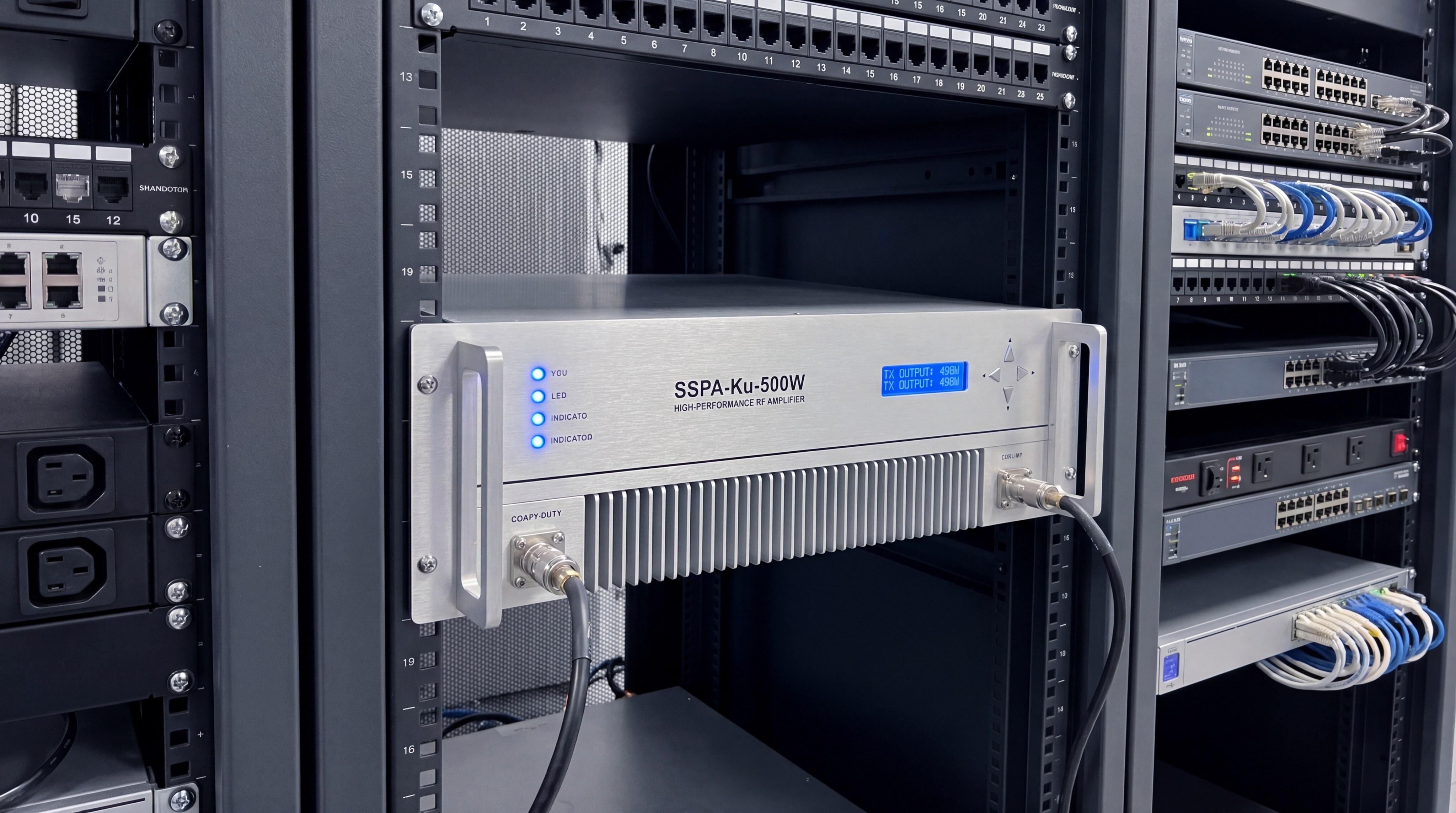
A Solid State Power Amplifier is commonly deployed in satellite ground stations, defense radar arrays, and mobile communication hubs where reliability is paramount. Their rugged construction allows them to function perfectly in harsh outdoor environments or high-vibration mobile platforms.
Satellite Ground Stations and Defense
In SATCOM, these amplifiers drive the uplink signal to orbit with consistent power and precision. For defense applications, their fast switching speeds and reliability are essential for mission-critical radar and electronic warfare systems.
- Satellite uplink transmitters (BUC).
- Phased array radar systems.
- Electronic jamming and countermeasures.
It gets even better.
Key Takeaway:
The versatility of SSPAs makes them suitable for everything from deep space communication to tactical battlefield radios.
| Industry | Primary Usage |
|---|---|
| SATCOM | Ground-to-satellite uplink |
| Defense | Active radar detection |
| Telecomm | High-speed data backhaul |
Deploying solid-state technology in these sectors ensures that critical data reaches its destination without interruption.
5. Why is GaN technology important for amplifiers?
A Solid State Power Amplifier built with Gallium Nitride (GaN) provides significantly higher power density and thermal efficiency than traditional silicon. This allows for the creation of ultra-compact amplifiers that can produce hundreds of watts of power from a small footprint. Check our Solid State Power Amplifier section for specific GaN-based high-frequency modules.
High Power Density and Efficiency
GaN technology allows transistors to operate at much higher temperatures and voltages than previous semiconductor generations. This results in a smaller cooling system requirement and a more energy-efficient overall RF front end.
- Reduced overall system weight.
- Lower power consumption for the same RF output.
- Enhanced reliability at high operating temperatures.
Wait, there’s more.
Key Takeaway:
GaN is the leading material choice for achieving high-power output in miniaturized amplifier housings.
| Material | Power Density | Thermal Conductivity |
|---|---|---|
| GaAs | Moderate | Good |
| GaN | Very High | Excellent |
Utilizing GaN-based amplifiers allows you to reduce rack space and cooling costs simultaneously.
6. What performance metrics matter for RF systems?
A Solid State Power Amplifier must be evaluated based on Gain, P1dB compression, and the Third-Order Intercept (IP3) point. These metrics define how much power the unit can deliver before it begins to distort the signal, which is critical for system planning.
Understanding Critical RF Specifications
The 1dB compression point (P1dB) indicates the power level where the amplifier starts to lose its linear relationship between input and output. Selecting an amplifier with sufficient headroom above your operating level is vital for signal clarity.
- Gain flatness across the frequency band.
- Saturated power output (PSAT).
- Harmonic and spurious emission levels.
Let’s dig deeper.
Key Takeaway:
Accurate measurement of P1dB and IP3 is essential for preventing signal distortion in high-capacity links.
| Metric | Significance |
|---|---|
| Gain | Signal amplification strength |
| P1dB | Limit of linear operation |
| IP3 | Indicator of distortion levels |
Carefully matching these metrics to your specific waveform ensures that your transmission meets all spectral masks and regulatory requirements.
7. How does power combining work in SSPA design?
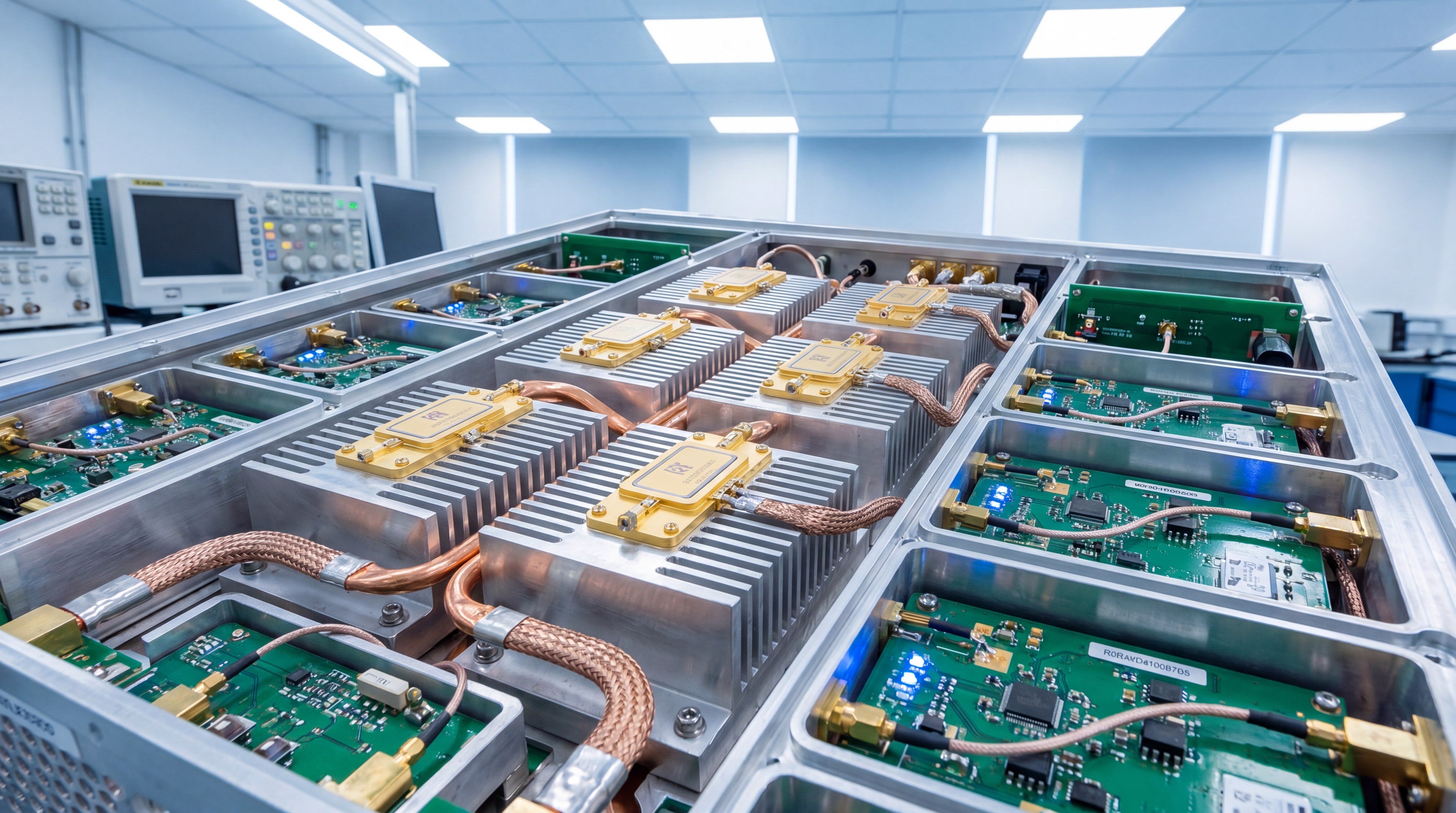
A Solid State Power Amplifier achieves high-power output by summing the signals of multiple individual transistor modules using specialized combining networks. This modularity is a core strength of solid-state design, providing inherent redundancy that single-tube systems cannot match. You can see these architectures in our Solid State Power Amplifier custom engineering section.
Modular Scaling and System Redundancy
By using corporate or radial combiners, engineers can combine the power of eight, sixteen, or more modules to reach kilowatt levels. If one module fails, the system continues to operate at a slightly reduced power level, preventing a total network outage.
- Corporate combining for high efficiency.
- Radial combining for compact designs.
- Hot-swappable module capabilities.
The best part?
Key Takeaway:
Power combining allows for scalable RF output while providing a safety net against total system failure.
| Method | Scaling Efficiency | Redundancy Level |
|---|---|---|
| Corporate | High | Excellent |
| Radial | Good | Moderate |
This architectural approach makes it possible to replace vacuum tubes in even the most demanding high-power applications.
8. Is thermal management critical for SSPA units?
A Solid State Power Amplifier generates heat that must be moved away from the semiconductor junctions to prevent premature failure. While SSPAs are more efficient than tubes, managing the waste heat of a 500W unit still requires advanced thermal engineering.
Cooling Strategies for High Power
Medium-power units often use forced air cooling with high-fin-density heat sinks to dissipate heat. For ultra-high-power applications, liquid cooling systems are used to maintain a stable operating temperature and maximize component life.
- Forced air cooling for standard racks.
- Liquid cold plates for high-density arrays.
- Internal temperature monitoring sensors.
As it turns out.
Key Takeaway:
Proper cooling is the single most important factor in ensuring the 15-year lifespan of an SSPA.
| Cooling Type | Power Range | Environment |
|---|---|---|
| Air Cooled | Up to 400W | Indoor / Outdoor |
| Liquid Cooled | 1kW and above | High-Density Lab |
Investing in a unit with robust thermal protection circuits will safeguard your hardware during unexpected heat waves or fan failures.
9. Can SSPAs support high-frequency applications?
A Solid State Power Amplifier is now capable of supporting frequencies well into the Ka-band and beyond, thanks to advancements in GaAs and GaN on silicon carbide. This has enabled the proliferation of high-speed satellite internet and advanced millimeter-wave radar. Our Solid State Power Amplifier test lab validates these performance standards for the latest mmWave systems.
Ka-Band and Millimeter-Wave Performance
Advancements in micro-assembly have allowed for higher gain and power at frequencies once reserved only for TWTAs. Modern SSPAs provide the precision needed for the narrow beams used in high-frequency satellite communication.
- Support for 27.5 GHz to 31.0 GHz (Ka).
- High gain at V-band and E-band.
- Precision phase and amplitude control.
You might be wondering.
Key Takeaway:
Solid-state technology has successfully crossed the frequency barrier, providing high power at millimeter-wave bands.
| Band | Frequency Range | Application |
|---|---|---|
| Ku-Band | 12 – 18 GHz | Direct Broadcast |
| Ka-Band | 26 – 40 GHz | High-Speed Data |
As demand for bandwidth grows, the ability of SSPAs to operate at higher frequencies becomes even more critical for global connectivity.
10. What is the future of SSPA technology?
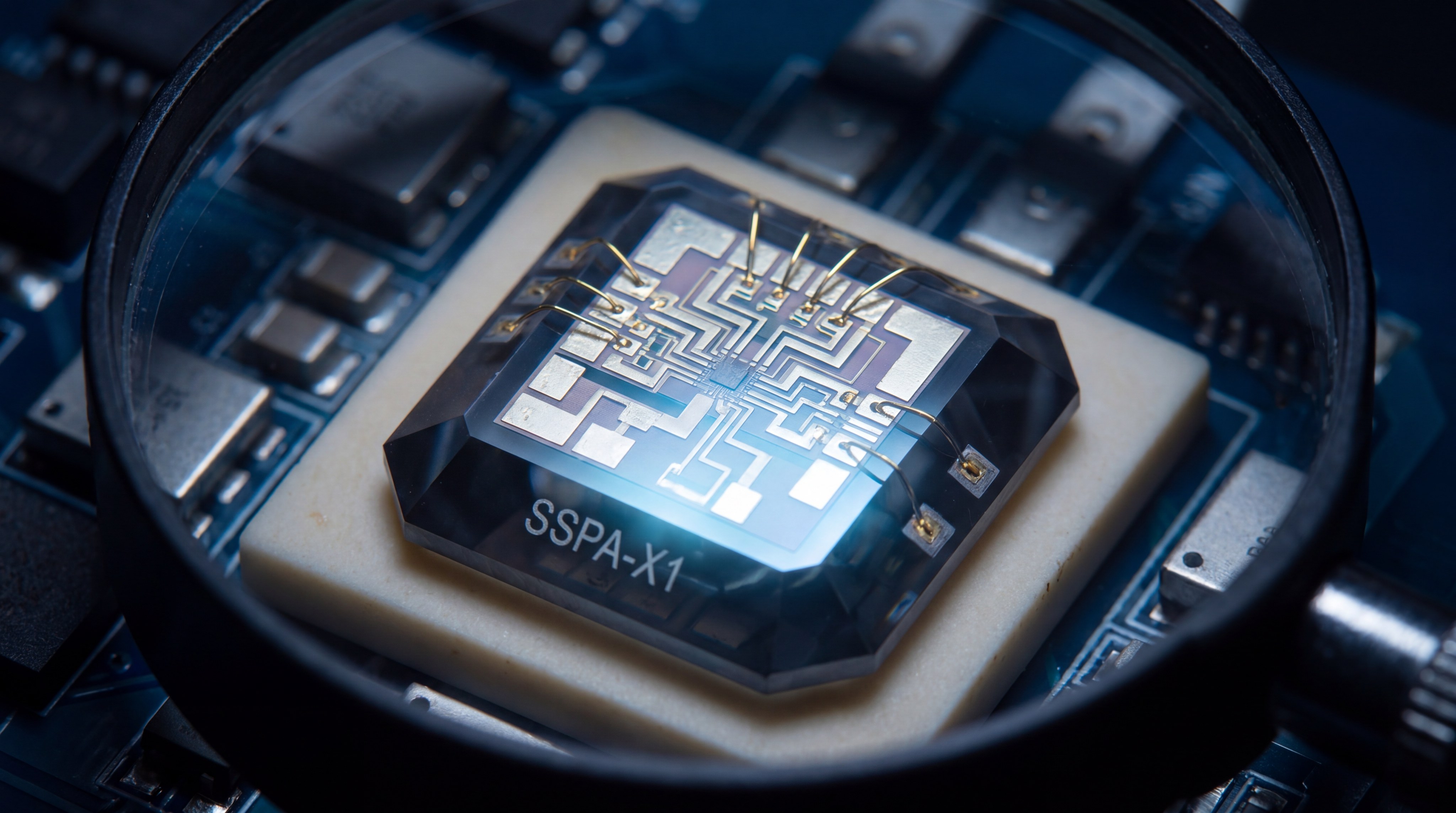
A Solid State Power Amplifier will continue to evolve through the adoption of new materials like GaN-on-Diamond and more integrated “system-on-a-chip” designs. These innovations will further push the boundaries of what is possible in terms of power density and intelligent control.
Innovation in Materials and Integration
Future units will feature AI-driven thermal management and real-time adaptive linearization, allowing the amplifier to optimize itself for the specific signal it is transmitting. This will result in even higher efficiencies and lower operating costs for service providers.
- GaN-on-Diamond for 3x heat dissipation.
- Integrated digital pre-distortion (DPD).
- Intelligent remote health monitoring.
Keep an eye on this.
Key Takeaway:
The roadmap for SSPA technology ensures that it will remain the cornerstone of the RF industry for the foreseeable future.
| Emerging Tech | Key Benefit | Timeline |
|---|---|---|
| GaN on Diamond | Extreme cooling | Near Future |
| AI Optimization | Auto-tuning gain | Emerging |
The integration of smarter monitoring tools will make future RF systems more autonomous and resilient than ever before.
Conclusion: Securing Your RF Infrastructure
The decision to implement a Solid State Power Amplifier is a commitment to long-term reliability, signal purity, and reduced operational costs. By moving away from outdated vacuum-tube technology, you are future-proofing your RF systems and ensuring that your communication links remain stable under the most demanding conditions. Our vision is to empower every technical team with the most advanced semiconductor solutions available today.
If you are ready to optimize your network with the latest in amplification technology, contact us today to discuss your specific project requirements with our engineering team.
FAQ: Common Questions About SSPA
- Can I replace my existing TWTA with an SSPA without redesigning my entire rack?
Yes. Most modern SSPAs are designed to fit standard rack configurations, though you should verify cooling and power requirements first. - How do I determine if GaN or GaAs is the better material for my specific frequency?
Judgment required. Generally, GaN is better for high power and thermal efficiency, while GaAs is often preferred for lower power and extreme high-frequency precision. - Can I use an SSPA for pulsed radar applications as effectively as continuous wave?
Absolutely. SSPAs excel in pulsed modes because they can be switched on and off nearly instantaneously with high pulse fidelity. - How do I monitor the health of an SSPA that is deployed at a remote, unmanned site?
Remotely. Most high-quality amplifiers include Ethernet or serial interfaces that allow for real-time monitoring of temperature, power, and current. - Can I scale the power of my system later if my bandwidth requirements increase?
Yes. Because of their modular nature, many solid-state systems allow you to add more modules or combine additional units to increase total output.