
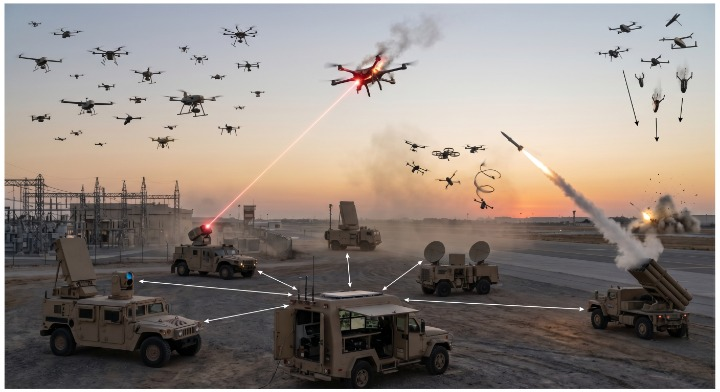
Modern counter-drone technologies provide a comprehensive multi-layered defense system designed to detect, track, and neutralize unmanned aerial threats across diverse operational environments. You are currently operating in a period where low-cost unmanned systems have fundamentally changed the risk profile of critical infrastructure and military installations. The accessibility of these platforms creates a persistent vulnerability, as even basic commercial units can be weaponized to exploit gaps in traditional radar and perimeter security. Implementing Counter-drone solutions ensures you regain control over your airspace by integrating advanced sensing and varied effectors into a singular, dominant defense architecture.
Why are counter-drone threats evolving so rapidly?
Threats are evolving because of the rapid democratization and miniaturization of high-performance flight controllers and communication modules. Counter-drone strategies must now account for the proliferation of dual-use technologies that allow hobbyist platforms to perform military-grade surveillance. You are seeing a shift where decentralized manufacturing and open-source software enable adversaries to update their flight patterns and frequency-hopping protocols in real-time. This rapid iteration cycle forces you to move away from static defense measures toward software-defined systems that can be updated as quickly as the threats they face.
Are commercial drones becoming tactical weapons?
You are now facing a landscape where off-the-shelf technology is being repurposed for sophisticated surveillance and kinetic strikes. Because these systems are small and maneuverable, they can bypass traditional security perimeters with ease. These platforms often utilize encrypted command links and advanced GPS-denied navigation, making them difficult to intercept with standard electronic countermeasures. You must recognize that the low cost of these units allows adversaries to treat them as expendable assets, increasing the frequency and daring of their incursions.
Think about this:
- Democratized access to high-payload carbon fiber frames.
- Integration of thermal imaging and high-zoom optical sensors.
- Utilization of frequency-hopping spread spectrum (FHSS) for resilience.
- Long-range telemetry links extending operational reach.
Why are swarms harder to defeat than single units?
When you encounter a swarm, the sheer volume of targets can saturate your existing defense systems. Coordinating a response against dozens of simultaneous threats requires advanced automation that manual operators simply cannot match. You must address the fact that swarm intelligence allows individual units to communicate and redistribute tasks if one member is neutralized. This collective behavior creates a resilient “mesh” of threats that can overwhelm a single-point defense through sheer numerical superiority and coordinated approach vectors.
Key Takeaway: Modern threats utilize volume and agility to overwhelm traditional defenses, necessitating a shift toward automated and scalable response systems.
| Threat Category | Evolution Driver | Security Impact |
|---|---|---|
| Commercial Units | Mass Market Availability | Low Entry Barrier |
| Tactical Swarms | Autonomous Coordination | Saturation of Defenses |
| Hardened Links | Encryption & FHSS | Electronic Jamming Resistance |
The evolution of unmanned systems represents a move toward high-volume, low-cost tactical superiority.
How do you detect small, maneuverable targets?
You detect these targets by utilizing high-frequency radar systems and electro-optical sensors that provide high-fidelity tracking of low-RCS (Radar Cross Section) objects. Counter-drone detection requires a shift from traditional wide-area surveillance to high-resolution, short-range tracking. You need to identify objects that are often no larger than a bird but move with the distinctive velocity and heat signature of a powered motor. Modern sensor fusion combines radar, radio frequency (RF) scanning, and thermal imaging to create a high-confidence track for every object in your airspace.
Why is AESA technology vital for sharp resolution?
You need Active Electronically Scanned Array (AESA) technology to maintain a persistent watch over the horizon. This allows you to track multiple agile targets simultaneously without losing the precision required for fire control. By electronically steering multiple radar beams, you eliminate the latency associated with traditional rotating antennas. [Image: RF Power Amplifier Module] This capability is essential when you are defending against fast-moving threats that change altitude and heading rapidly.
Here is the deal:
- Digital beamforming for multi-target tracking.
- High probability of intercept for low-power signals.
- Enhanced resilience against electronic jamming.
- Compact form factors for mobile deployment.
Can Ku-band radars track small, agile systems?
Operating in the Ku-band provides you with the high-resolution imagery necessary to identify small drones at long distances. You can distinguish between birds and hostile unmanned systems, ensuring your response is always proportional and effective. The shorter wavelength of the Ku-band is particularly effective at reflecting off the small surfaces of plastic and carbon fiber drones. This high-frequency approach ensures that you have a clear, actionable picture of the tactical environment even in cluttered urban settings.
Key Takeaway: Precision detection is the prerequisite for any successful engagement, relying on high-frequency radar and electronic beam steering to maintain target lock.
| Sensor Type | Primary Advantage | Tactical Use Case |
|---|---|---|
| AESA Radar | Multi-target tracking | Swarm surveillance |
| Ku-Band | High resolution | Small object identification |
| RF Scanner | Passive detection | Locating operator signals |
Superior detection capabilities form the foundation of a proactive airspace defense strategy.
What are the non-kinetic counter-drone options?
Non-kinetic options utilize electromagnetic energy and protocol manipulation to disable a target’s communication or navigation without the use of physical projectiles. Counter-drone operations in sensitive environments benefit from these methods because they minimize the risk of secondary damage to surrounding infrastructure. You can selectively target the control link of a specific unit or create a wide-area denial zone to prevent any unauthorized flight within a protected perimeter. These systems are inherently flexible, allowing you to escalate from simple warnings to total electronic neutralization as the threat level increases.
How do invisible effects neutralize electronics?
You can use non-kinetic methods to disrupt a target’s internal circuitry or communication links without using physical projectiles. These “invisible” attacks allow you to clear the airspace effectively while significantly reducing the risk of falling debris. By injecting noise into the drone’s receiver or spoofing its GPS coordinates, you can force the system to land or return to its point of origin. This capability gives you a “soft-kill” option that is both discreet and highly effective against the majority of commercial and tactical systems.
Here is why that matters:
- Zero collateral damage in urban environments.
- Indiscriminate defense against multiple signal types.
- Low visual and acoustic signature during operation.
- Ability to capture intact systems for forensic analysis.
Can non-kinetic tools reduce collateral damage?
When you operate in urban or sensitive environments, non-kinetic effectors are your safest bet. They neutralize the threat instantly, ensuring that you protect your assets without causing unintended harm to surrounding infrastructure or personnel. You can deploy these systems at airports, stadiums, or government buildings where the use of traditional munitions would be restricted or dangerous. This approach allows you to maintain security without escalating the conflict or endangering the very public spaces you are tasked with protecting.
Key Takeaway: Non-kinetic solutions offer a surgical and low-risk method for neutralizing threats in complex environments where collateral damage must be avoided.
| Method | Primary Effect | Risk Level |
|---|---|---|
| RF Jamming | Signal disruption | Very Low |
| GPS Spoofing | Navigation hijacking | Low |
| Protocol Manipulation | Forced landing | Minimal |
Non-kinetic interventions provide a necessary middle ground between passive monitoring and physical destruction.
When is a kinetic response the right choice?
A kinetic response is the right choice when you face high-speed, hardened, or autonomous threats that cannot be deterred by electronic interference. Counter-drone kinetic effectors provide a “hard-kill” guarantee, physically destroying the airframe to ensure the threat is completely removed from the sky. You must employ these systems when the risk of a successful strike outweighs the potential for collateral damage or when dealing with systems that lack a remote control link. Kinetic options serve as the final, decisive layer of protection in any comprehensive airspace defense architecture.
What role do short-range interceptors play?
You utilize kinetic interceptors when a “hard-kill” is necessary to completely destroy a high-speed or hardened target. These systems provide the physical force needed to ensure a threat is eliminated before it reaches your inner perimeter. Interceptors can be launched from ground stations or mobile platforms, providing you with a rapid-reaction capability that follows the target until impact. This physical destruction is the only way to neutralize certain kamikaze-style drones designed to function even after losing their data link.
Consider the following:
- High-velocity impact for total airframe destruction.
- Effective against drones with shielded electronics.
- Autonomous guidance for high-precision strikes.
- Rapid deployment for time-critical engagements.
When do missiles provide the best hard-kill?
You will find that missiles are most effective against sophisticated drones operating at varying altitudes and ranges. They offer a reliable, proven method to neutralize threats that might be resistant to electronic interference or those operating beyond the reach of directed energy. Missiles provide the longest engagement range, allowing you to intercept threats while they are still several kilometers away from your primary assets. This “stand-off” capability is vital for protecting large-scale installations and frontline military units from coordinated aerial attacks.
Key Takeaway: Kinetic solutions remain the ultimate insurance policy for airspace security, providing a guaranteed neutralization of hardened or autonomous threats.
| Kinetic Tool | Range | Tactical Purpose |
|---|---|---|
| Interceptors | Short to Medium | Precision hard-kill |
| Missiles | Extended | Long-range interception |
| Guided Munitions | Medium | High-value target destruction |
Physical destruction is often the only way to ensure the total neutralization of advanced adversary systems.
How do counter-drone lasers destroy targets?
Lasers destroy targets by focusing high-intensity light on a specific structural component until the material fails or internal electronics are incapacitated. Counter-drone directed energy weapons offer a virtually infinite magazine and a speed-of-light engagement capability that is unmatched by traditional weapons. You can track and engage multiple targets in rapid succession, as the system does not require the reloading of physical ammunition. This makes lasers an ideal choice for defending against repeated incursions or small swarms that would otherwise deplete your stock of kinetic interceptors.
How does concentrated light burn through airframes?
You can employ high-energy lasers to focus particles of light onto a specific point of a drone until it fails structurally. [Image: Futuristic Laser Defense Turret] This method provides you with an “infinite magazine” as long as you have a stable power source. The beam travels at the speed of light, meaning there is no lead-time required for targeting, even against the most maneuverable platforms. You can choose to target the drone’s optics to “blind” it or focus on the motor housings to cause a catastrophic mechanical failure.
It gets even better:
- Zero cost-per-shot besides electricity consumption.
- Highly precise targeting with minimal beam divergence.
- Silent operation for covert or sensitive deployments.
- Scalable effect from sensor disruption to physical burn.
What power levels are needed for laser defense?
You must scale your laser power from 10 kilowatts to 50 kilowatts depending on the target’s size, distance, and material composition. This scalability ensures you can handle everything from small reconnaissance drones to larger, weaponized platforms. Lower power settings are often sufficient to disrupt sensitive optical sensors at long ranges, while higher power is needed to penetrate the composite skins of military-grade systems. Modern power management systems allow you to maintain these energy levels even on mobile platforms, providing you with a persistent and lethal defense capability.
Key Takeaway: Directed energy provides a sustainable and high-precision method for neutralizing threats at the speed of light with minimal logistical burden.
| Power Level | Target Effect | Ideal Distance |
|---|---|---|
| 10 kW | Optical disruption | Long Range |
| 30 kW | Structural failure | Medium Range |
| 50 kW+ | Catastrophic destruction | Short Range |
Laser technology offers a revolutionary cost-per-kill ratio for long-term airspace protection.
Can electronic warfare disable a drone swarm?
Electronic warfare is exceptionally effective at disabling swarms because it can project broad-spectrum interference that affects every unit within a specific area simultaneously. Counter-drone high-power microwave (HPM) systems send bursts of energy that fry the sensitive semiconductors inside the drone’s flight controller. This allows you to neutralize dozens of targets in a single pulse, rather than engaging them one by one. By attacking the electronic foundation of the swarm, you exploit its reliance on communication and sensor feedback to function as a cohesive unit.
Can high-power microwaves fry internal circuits?
You use high-powered microwaves to send a burst of energy that overwhelms the electronic components of a drone. This is particularly effective against swarms, as one burst can disable multiple targets within its wide field of effect. Unlike jamming, which only disrupts the signal, HPM causes physical damage to the drone’s circuitry, rendering it permanently inoperable. [Image: Mobile Electronic Warfare] This “area-denial” capability is your best defense when faced with a massive, coordinated attack that seeks to saturate your defenses.
Here is the deal:
- Instantaneous neutralization of unshielded electronics.
- Wide-angle beam for area coverage.
- Effective against both controlled and autonomous drones.
- Non-lethal to humans when properly directed.
Why is reusability key for microwave systems?
You benefit from the fact that many microwave-based effectors are recoverable and redeployable without the need for traditional ammunition logistical chains. This lowers your total cost per engagement, making it a sustainable strategy for long-term defense against high-frequency threats. You can fire thousands of pulses with a single system, provided you have a robust power generation capability. This reusability is a strategic advantage when defending against adversaries who utilize low-cost drones to attempt to drain your high-value defensive resources.
Key Takeaway: Electronic warfare offers a scalable and cost-effective solution for neutralizing massed drone threats through area-of-effect engagement.
| Feature | Microwave (HPM) | Traditional Jamming |
|---|---|---|
| Target Impact | Permanent electronic failure | Temporary link loss |
| Coverage | Wide-area pulse | Directional or broad |
| Reusability | High (Infinite cycles) | High |
The ability to neutralize entire formations simultaneously is a critical requirement for modern drone defense.
Why is multi-layered defense essential today?
Multi-layered defense is essential because no single sensor or effector can counter every possible unmanned threat across all environmental conditions. Counter-drone architectures must integrate long-range radar, passive RF sensors, and optical cameras to ensure total situational awareness. By layering your defenses, you create a “depth of field” that allows you to engage threats at the most effective range using the most appropriate tool. This redundancy is what protects you from a single point of failure and ensures that a threat bypassed by one system is caught by the next.
How do sensors and effectors work together?
You cannot rely on a single technology; instead, you must integrate radars, lasers, and missiles into a unified and responsive network. This “layered” approach ensures that if a threat bypasses one system, another is ready to intercept it immediately. Sensors provide the initial detection and hand off the tracking data to the command center, which then selects the most efficient effector based on the target’s distance and behavior. [Image: C2 Operations Center] This synergy between different technologies is what allows for a 100% interception rate in high-stress scenarios.
The bottom line?
- Redundant sensing eliminates blind spots.
- Optimized effector selection saves resources.
- Unified command structure reduces response time.
- Scalable architecture grows with the threat.
Why is fire control integration critical?
You need a central command and control (C2) system to manage the flow of data from your sensors to your weapons. This integration allows you to make split-second decisions that are backed by real-time intelligence and automated risk assessment. Without a centralized C2, you risk duplication of effort or, worse, missing a target due to fragmented information. A unified fire control system ensures that every sensor is talking to every effector, creating a cohesive and impenetrable dome of protection over your designated area.
Key Takeaway: Integration and redundancy are the differences between a reactive defense and a proactive, impenetrable airspace security strategy.
| Layer | Component | Function |
|---|---|---|
| Detection | AESA Radar / RF Scanning | Early warning and ID |
| Decision | C2 Software / AI | Threat prioritization |
| Engagement | Lasers / Microwaves / Missiles | Neutralization |
A networked approach ensures that your defense remains resilient even if individual components are compromised.
How does AI improve engagement precision?
AI improves precision by automating the identification and tracking processes, allowing the system to distinguish between harmless objects and genuine threats in milliseconds. Counter-drone systems equipped with machine learning can analyze the flight patterns and electromagnetic signatures of incoming targets to determine their likely intent. This reduces the pressure on your human operators, who can focus on high-level decision-making while the AI handles the repetitive tasks of target acquisition. Automation is the only way to effectively manage the complexity of modern, multi-axis drone attacks.
Can AI speed up the kill chain process?
You can use artificial intelligence to automate the detection, identification, and tracking of hostile drones without human intervention. This reduces the cognitive load on your operators and significantly shortens the time between detection and neutralization. In a scenario where seconds matter, an AI-driven system can lock onto a target and prepare an effector for engagement before a human could even process the alarm. This speed is critical for defending against high-velocity threats or sudden, close-range launches.
Look at these advantages:
- Automated target recognition (ATR) for high accuracy.
- Real-time trajectory prediction for lead-fire accuracy.
- Elimination of human hesitation in critical moments.
- Continuous learning from every engagement.
How does automation handle swarm threats?
When you face a swarm, AI can prioritize targets based on their level of threat and assign the most appropriate effector for each. This ensures your resources are used efficiently and that no single target is overlooked in the chaos of a massed attack. The system can simultaneously track dozens of objects and coordinate multiple effectors, such as directing a microwave burst at the center of the swarm while using a laser to pick off the outliers. This level of coordination is beyond the capability of any manual control system, making AI an essential component of modern defense.
Key Takeaway: Artificial intelligence provides the speed and coordination necessary to defeat complex, multi-target threats with maximum efficiency.
| AI Capability | Defense Benefit |
|---|---|
| Pattern Recognition | Faster threat identification |
| Resource Allocation | Optimized ammunition usage |
| Swarm Analysis | Coordination of multi-target response |
The integration of AI transforms a collection of sensors into a truly intelligent and adaptive defense system.
Is counter-drone defense cost-effective?
Counter-drone defense is cost-effective when you consider the value of the assets being protected versus the relatively low cost of modern non-kinetic effectors. You must evaluate the investment not just as a capital expense, but as an insurance policy against catastrophic operational disruptions. By utilizing reusable technologies like lasers and microwaves, the cost-per-engagement drops to pennies, especially when compared to the price of a sophisticated missile or the value of the infrastructure you are defending. A proactive investment in these technologies prevents the massive financial and strategic losses associated with a successful drone strike.
Are interceptors cheaper than the assets they protect?
You must weigh the cost of a counter-measure against the potentially catastrophic loss of the high-value asset you are defending. Investing in sophisticated technology often proves to be the most economical choice over time, especially when defending multi-million dollar aircraft or power grids. While a single interceptor might be expensive, it is a fraction of the cost of the damage a single weaponized drone could inflict on a critical target. This economic reality makes a robust defense system a logical and necessary part of any security budget.
You might be wondering:
- What is the replacement cost of your primary asset?
- How much does operational downtime cost per hour?
- What is the value of your personnel’s safety?
- Can you afford the reputational damage of a security breach?
How does recovery impact total cost of ownership?
By utilizing reusable non-kinetic systems, you drastically reduce your expenditure on ammunition and disposables. This allows you to maintain a high state of readiness without the logistical burden of constant replenishment and the high costs associated with physical munitions. A laser or microwave system can be used indefinitely as long as it has a power source, making it far more economical for long-term perimeter defense than systems that rely on one-time-use interceptors. This shift toward reusable tech is the key to making advanced defense sustainable for both military and commercial organizations.
Key Takeaway: Reusability and smart resource allocation are the twin pillars of a cost-effective and sustainable airspace defense strategy.
| System Type | Initial Investment | Cost Per Shot |
|---|---|---|
| Kinetic Missiles | High | Very High |
| Directed Energy | Medium-High | Extremely Low |
| Electronic Warfare | Medium | Low |
Investing in reusable technology significantly reduces the long-term financial burden of maintaining a secure perimeter.
What is the future of counter-drone technology?
The future of counter-drone technology lies in the development of fully autonomous, mobile, and highly integrated systems that can anticipate threats before they arrive. You will see a shift toward decentralized defense networks where mobile units collaborate to protect large geographic areas without a central fixed site. Innovations in power density and AI will allow for more compact and powerful effectors to be mounted on standard tactical vehicles or even other drones. This evolution is necessary to keep pace with an adversary that is constantly finding new ways to exploit the third dimension of the battlefield.
Will autonomy define the next generation of defense?
You will see a shift toward fully autonomous systems that can patrol, detect, and engage threats without human intervention. This evolution will be necessary to stay ahead of increasingly intelligent and autonomous adversary drones that operate faster than human reaction times. Future systems will utilize “on-the-edge” processing, allowing individual defense units to make complex tactical decisions locally while still contributing to the overall situational awareness of the network. This level of autonomy will be the only way to maintain a persistent and effective defense in a world of high-speed, AI-driven threats.
Future trends to watch:
- Fully autonomous interceptor drones for air-to-air defense.
- Compact, mobile directed energy weapons on light vehicles.
- Globalized C2 networks sharing threat data in real-time.
- Integration of quantum-resistant encryption for all links.
What innovations are coming to airspace security?
You should expect advancements in power density for directed energy and more compact, mobile radar systems. These innovations will allow you to deploy high-tier defense capabilities in even the most remote or temporary locations, ensuring your protection is as mobile as your operations. New materials and cooling technologies will enable lasers to fire more frequently and for longer durations without overheating. As these technologies mature, they will become more accessible, allowing a wider range of organizations to secure their airspace with the same level of sophistication as a Tier-1 military force.
Key Takeaway: The future of defense lies in the seamless integration of speed, autonomy, and mobile power to stay ahead of an ever-evolving threat landscape.
| Innovation | Operational Benefit |
|---|---|
| High-Density Power | Longer laser engagement times |
| Decentralized C2 | More resilient defense network |
| Autonomous Patrols | Reduced manpower requirements |
Staying ahead of the curve requires a commitment to adopting the next generation of autonomous and directed energy solutions.
*
Frequently Asked Questions
- Can I integrate these systems with my existing security infrastructure?
Yes, because modern solutions are designed with open architectures and standard protocols to ensure they can communicate seamlessly with your current sensors and command platforms. - What’s the best way to defend against a drone swarm?
The most effective method is a combination of high-powered microwaves for wide-area denial and precision radars for identifying individual high-threat targets within the mass. - How do I know if a kinetic or non-kinetic response is better?
You should choose non-kinetic options for urban or sensitive areas to minimize collateral damage, while reserving kinetic responses for hardened or high-speed threats where a “hard-kill” is mandatory for safety. - Can I deploy a laser weapon system on a standard mobile vehicle?
Yes, because current technology has been miniaturized and optimized for power efficiency, allowing you to bring high-energy directed defense to the front lines on tactical platforms. - How much training is required to operate an AI-driven counter-drone system?
Minimal training is required because the AI handles the majority of the complex tracking and identification tasks, allowing your operators to focus on making the final engagement decisions.
Conclusion
Securing your airspace against modern unmanned threats requires a sophisticated, multi-layered approach that integrates the latest in sensing, AI, and varied effectors. As threats evolve from single units to autonomous swarms, your defense strategy must be equally agile and integrated to prevent operational disruptions. We are committed to providing the advanced technical foundations necessary for total airspace dominance and the protection of your most critical assets. To secure your perimeter against tomorrow’s unmanned threats and implement a future-proof defense, contact us today to speak with an expert and begin building your comprehensive security solution.