
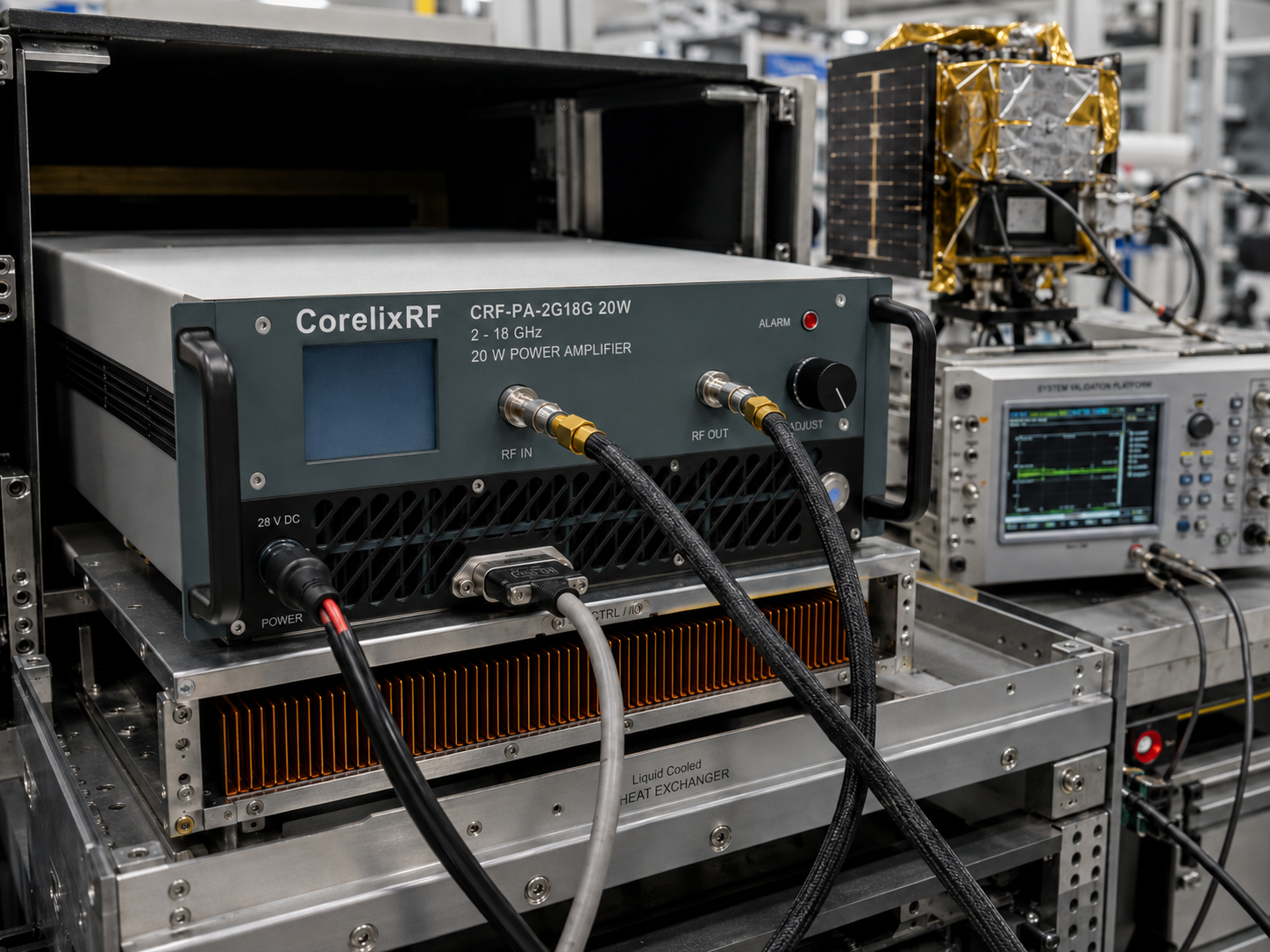
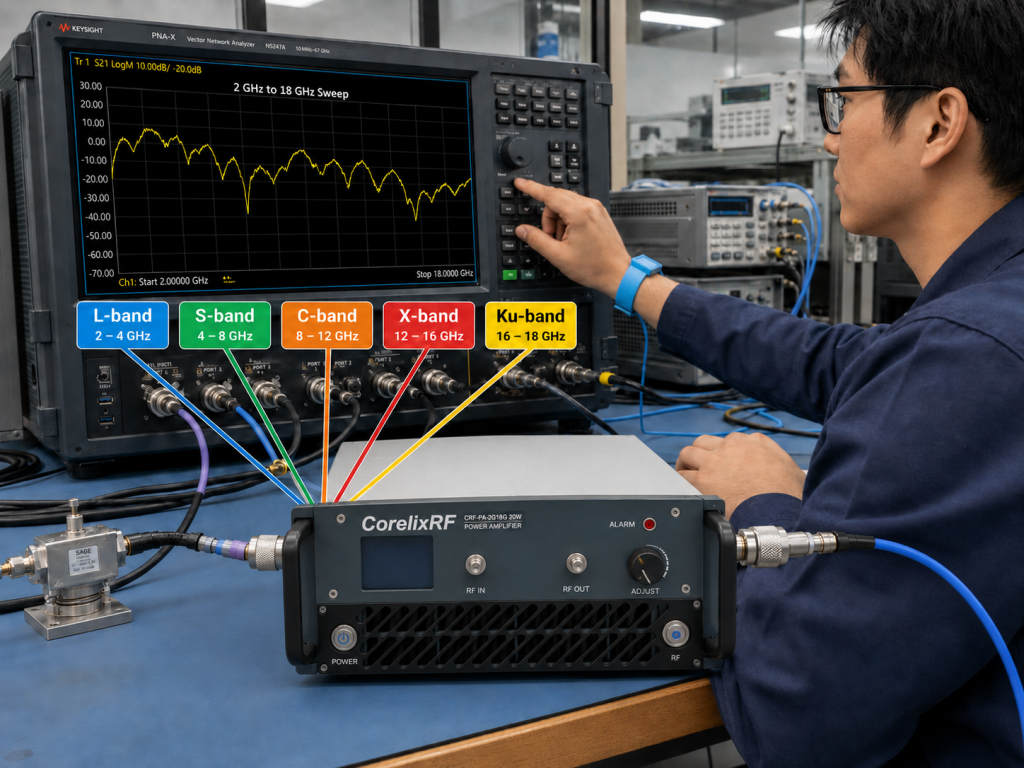
A 2-18 GHz broadband RF power amplifier is often selected when engineers need one amplifier platform to cover multiple microwave test bands without changing hardware for every frequency segment. For RF test benches, communication system validation, EMC-related setups, and broadband integration projects, this frequency range is especially useful because it spans many common L, S, C, X, and Ku-band test requirements.
The challenge is that not every 2-18 GHz amplifier is suitable for the same job. Output power, gain flatness, connectors, control interface, cooling, protection functions, and mechanical size all affect whether the amplifier will operate reliably in a real system. This guide explains the key selection factors using the CorelixRF CRF-PA-2000M18000M-20W as a practical example of a compact GaN solid-state power amplifier platform.
What Is a 2-18 GHz Broadband RF Power Amplifier?
A 2-18 GHz broadband RF power amplifier is designed to amplify RF signals across a continuous microwave frequency range from 2 GHz to 18 GHz. Instead of using multiple narrowband amplifiers, engineers can use one wideband SSPA to support different test frequencies, modulation conditions, and system configurations.
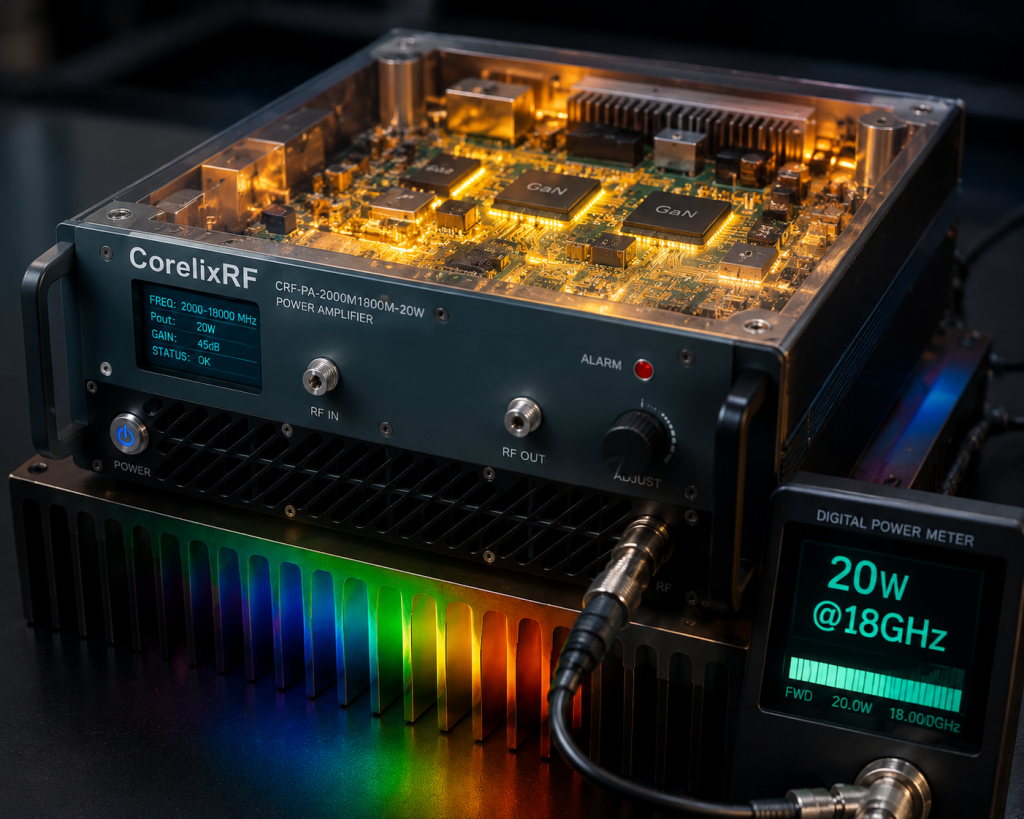
The CorelixRF CRF-PA-2000M18000M-20W operates from 2 GHz to 18 GHz with 20 W rated output power. It is based on GaN solid-state technology and provides a minimum small-signal gain of 43 dB. This makes it suitable for broadband RF systems where stable power delivery, compact size, and integration-ready monitoring functions are important.
Why 20 W Output Power Matters
Output power is one of the first parameters engineers compare, but it should never be reviewed alone. A 20 W RF amplifier can be useful for laboratory testing, communication system validation, RF interference system-level testing, and integration platforms where moderate power is required across a wide frequency span.
For a 2-18 GHz broadband RF power amplifier, engineers should confirm whether the rated output power applies across the full frequency band or only at selected points. They should also review the test conditions, input drive level, operating temperature, cooling requirements, and load conditions.
The CRF-PA-2000M18000M-20W is specified as a 20 W solid-state RF output power module with a 2-18 GHz operating range. For project review, final test data should be checked against the intended waveform, duty cycle, and environmental conditions.
Gain and Gain Flatness Across 2-18 GHz
Gain is important because it determines how much input signal is required to reach the desired output power. The CRF-PA-2000M18000M-20W provides 43 dB minimum small-signal gain, which helps reduce the drive power required from the signal source.
Gain flatness is equally important in wideband systems. If gain changes too much across frequency, the output power may vary from band to band. This can affect measurement repeatability and system calibration. The specified small-signal gain flatness for this amplifier is -5 dB to +5 dB, giving engineers a useful reference when planning broadband test setups.
GaN SSPA Design for Wideband RF Systems
GaN technology is widely used in modern RF power amplifier platforms because it supports high power density, efficiency, and rugged RF performance. For broadband amplifier designs, GaN can help deliver reliable output power in a compact mechanical structure.
The CRF-PA-2000M18000M-20W is built as a GaN SSPA platform. It includes temperature and current diagnostics, alarm protection functions, and a project-ready control interface. These features are valuable when the amplifier needs to be integrated into a larger RF system instead of being used only as a standalone lab device.
Key Integration Factors: Connectors, Control, and Cooling
A broadband RF amplifier should be reviewed as a system component, not just a power device. RF connectors, control interface, supply voltage, size, and cooling method all affect installation.
The CRF-PA-2000M18000M-20W uses SMA-F input and output connectors. The control interface is a 7W2 rectangular connector, and the amplifier operates from a 28 V DC supply. Its mechanical size is 200 x 100 x 23 mm, with a weight of approximately 1 kg.
Cooling should be reviewed carefully. This model requires an external heatsink, which means system designers should plan thermal paths, airflow, mounting surface, and operating temperature margin before finalizing the enclosure.
Protection and Monitoring Features to Review
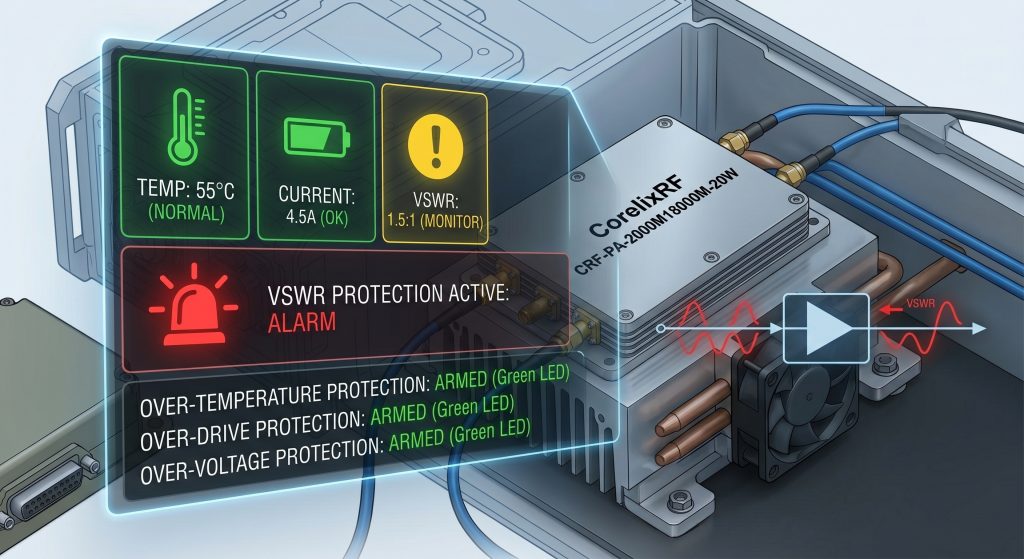
Protection features are especially important in broadband RF systems because load mismatch, incorrect drive level, thermal buildup, or integration errors can damage the amplifier or reduce reliability.
The CRF-PA-2000M18000M-20W includes real-time temperature monitoring, real-time current monitoring, alarm and fault protection, over-temperature protection, over-drive protection, over-voltage protection, and VSWR protection with alarm functions. Optional forward and reverse power monitoring may also be available depending on project requirements.
These functions help integrators build safer RF systems and make troubleshooting easier during testing.
Common Applications
A 2-18 GHz broadband RF power amplifier can be used in several engineering environments:
Test and measurement instrumentation where engineers need wideband signal amplification across multiple microwave bands.
Communication systems where RF chains must be validated under different operating frequencies.
RF interference system-level testing where broadband coverage and repeatable power output are required.
Aerospace control and validation systems where compact solid-state RF modules may be integrated into custom platforms.
Because application conditions vary, engineers should share frequency range, output power target, waveform type, duty cycle, mechanical limits, cooling method, and control interface requirements before selecting the final amplifier configuration.
RF Amplifier Selection Checklist
Before requesting a quotation or technical review, prepare the following information:
Target operating frequency range.
Required output power across the full band.
CW or pulsed operating mode.
Input signal level and modulation type.
Gain and gain flatness expectations.
Cooling method and available mounting space.
Control interface requirements.
Load VSWR and protection requirements.
Environmental and documentation requirements.
Providing these details early helps reduce engineering risk and ensures the amplifier is reviewed against real operating conditions.
Conclusion
A 2-18 GHz broadband RF power amplifier is a practical choice for engineers who need wide microwave coverage in a compact RF system. The CorelixRF CRF-PA-2000M18000M-20W combines 2-18 GHz frequency coverage, 20 W rated output power, 43 dB minimum gain, GaN SSPA technology, SMA-F RF connectors, 28 V DC operation, monitoring functions, and built-in protection features.
For the best project outcome, engineers should evaluate output power, gain flatness, thermal design, control interface, and protection requirements together instead of selecting by frequency and wattage alone.
Contact CorelixRF with your frequency range, output power target, waveform type, duty cycle, cooling method, and mechanical constraints for a project-specific RF amplifier review.
FAQ
What is the main keyword for this article?
The main keyword is 2-18 GHz broadband RF power amplifier.
What is a 2-18 GHz broadband RF power amplifier used for?
It is used for RF test systems, communication validation, broadband microwave testing, EMC-related setups, and system-level RF integration.
Why is GaN technology used in broadband RF amplifiers?
GaN technology supports high power density, efficiency, and reliable RF performance in compact solid-state amplifier platforms.
Does a 20 W 2-18 GHz amplifier need external cooling?
Yes, the CRF-PA-2000M18000M-20W requires an external heatsink, so thermal design should be reviewed during system integration.
What information should engineers provide before ordering?
Engineers should provide frequency range, output power, waveform type, duty cycle, input level, cooling method, control interface, mechanical limits, and protection requirements.
Convert the amplifier article into a test-system RFQ
For a 2-18 GHz or wideband amplifier project, buyers usually need more than a headline power number. Ask our engineers to check frequency coverage, saturated and linear output power, gain flatness, harmonics, control interface, cooling limits, mismatch protection and required test curves before you lock the RFQ.
Recommended next step: send the target band, output power, duty cycle, load condition, control interface, cooling limit and required FAT documents. CorelixRF can map this 2-18 GHz broadband RF power amplifier selection requirement to a standard platform or a controlled customization path.