
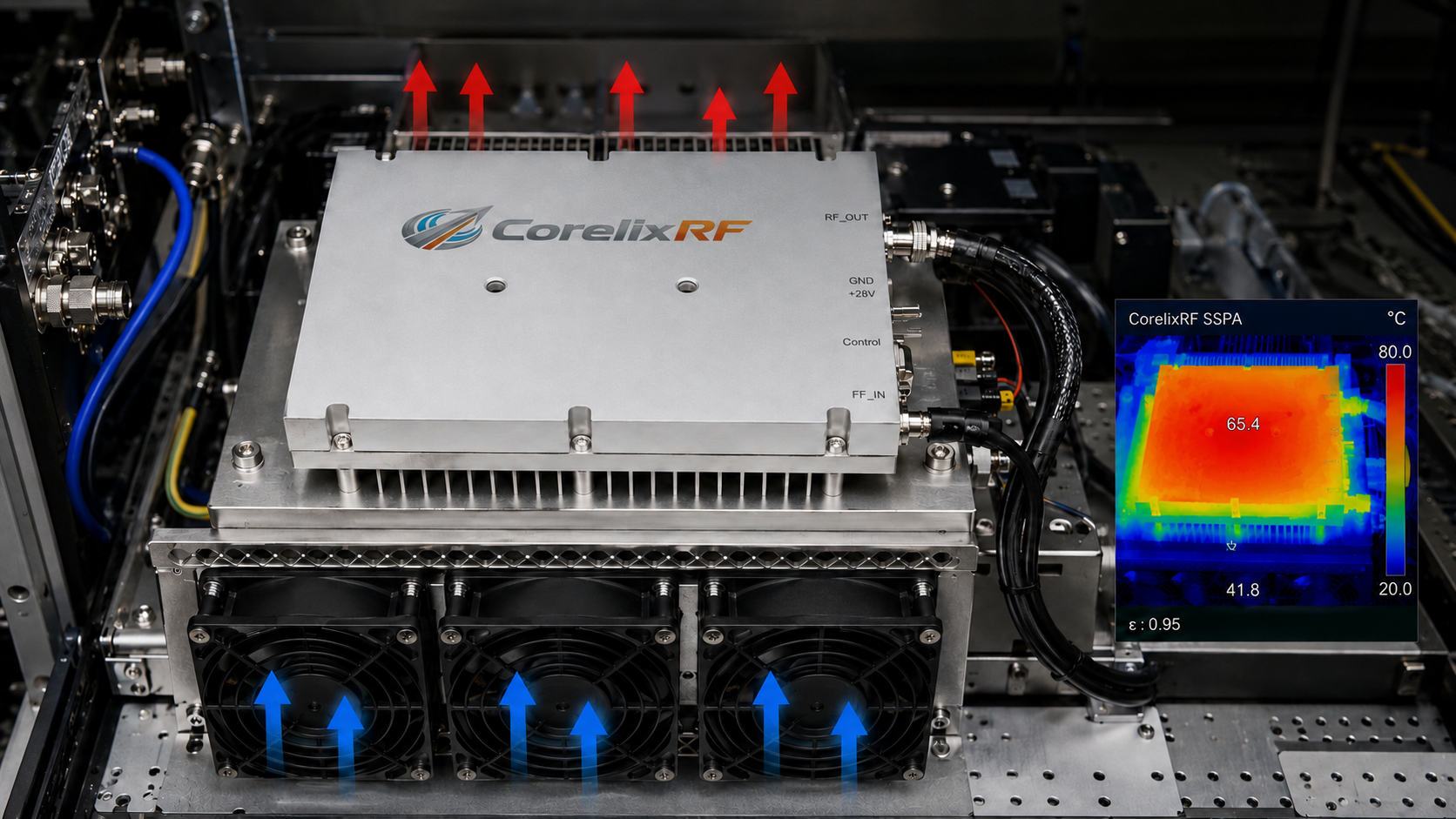
A solid-state RF amplifier is often chosen because it offers repeatable RF output, no tube replacement, practical control options, and a compact path for modern RF systems. But choosing the right solid-state RF amplifier still requires more than reading a wattage number from a product table. Engineers need to connect the amplifier specification with frequency coverage, gain, drive level, operating mode, load behavior, thermal design, connector path, and the final application.
CorelixRF’s RF power amplifier platforms include VHF/UHF, wideband, microwave, pulsed, EMC, and custom RF amplifier options. The starting point is the amplifier family at CorelixRF, but the final choice should be based on the real system requirement rather than the broadest or highest-power model available.
Frequency Coverage Comes First
A solid-state RF amplifier should be selected around the actual operating band. If the project is VHF/UHF communication or low-frequency lab testing, a 30-512 MHz amplifier path may be more relevant than a microwave power amplifier. If the project covers UAV, SDR, or multi-band communication work, a 300-1700 MHz or 300-2700 MHz wideband RF amplifier may be a better fit. If the project moves into microwave test, 2-6 GHz, 6-18 GHz, or 18-40 GHz platforms become more appropriate.
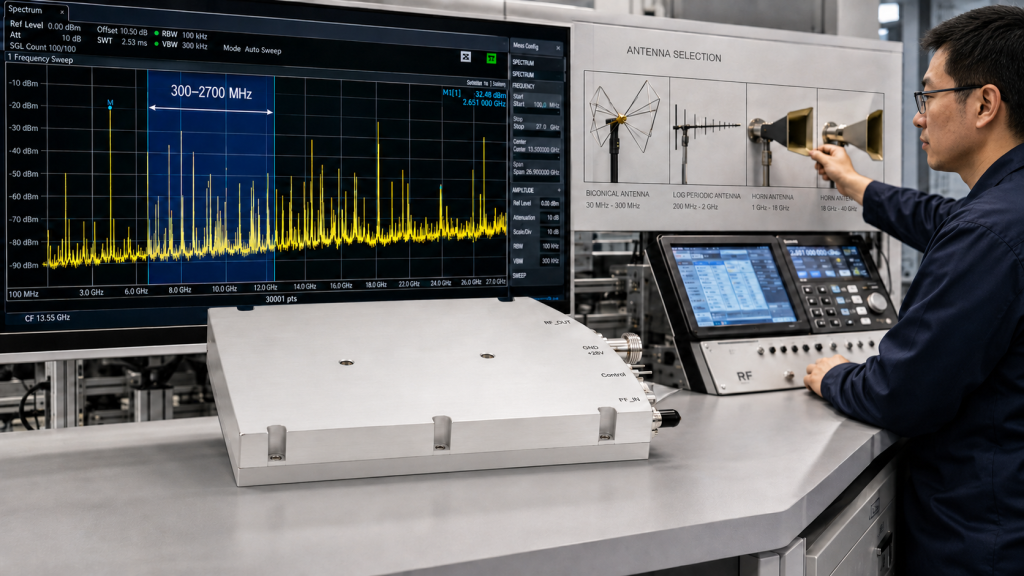
The goal is not simply to cover every possible frequency. The goal is to cover the needed frequency range with enough gain, power, flatness, cooling, and connector suitability for the system.
Output Power Should Be Defined Carefully
Output power should be defined at the point where it matters. In a laboratory system, that may be the DUT input. In a communication system, it may be the antenna feed. In an EMC setup, it may be the injection device or chamber path. In a radar or pulsed system, it may be peak power at a specific point in the RF chain.
Losses between the amplifier and the test point can be significant. Cable length, adapters, couplers, filters, switches, and fixtures all reduce delivered power. For a high power RF amplifier, the difference between connector output and load power can decide whether the chosen model is sufficient.
Understand Gain and Drive Requirements
Gain defines how much the amplifier increases the input signal, but gain cannot be reviewed by itself. The source must be able to provide the required input drive without exceeding safe limits. Signal generators, SDRs, transceivers, and upconverters can all have different output behavior across frequency.
If the amplifier will be used with an SDR, engineers should confirm source output power across the band, waveform type, filtering needs, expected linearity, and duty cycle. A solid-state RF amplifier can work well in SDR systems, but the chain must be reviewed as a complete RF path.
CW, Pulsed, and Modulated Operation
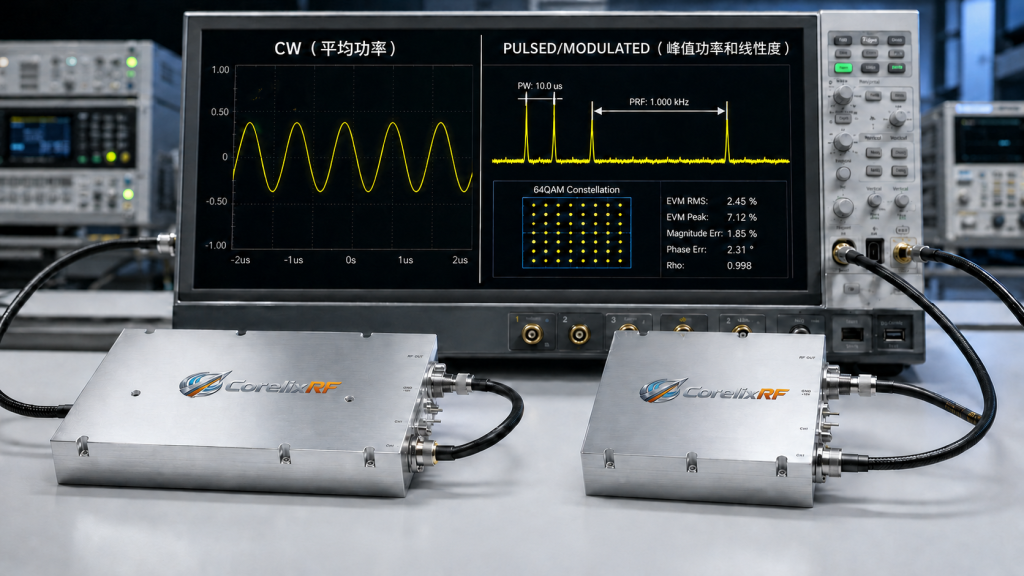
Operating mode changes amplifier selection. A CW amplifier is normally reviewed around continuous output, average power, and steady thermal behavior. A pulsed amplifier must be reviewed around peak power, pulse width, PRF, duty cycle, rise/fall expectations, timing, and average heat load.
Modulated communication signals add another layer. If the waveform requires linear amplification, the selection should include gain compression, distortion tolerance, and available output backoff. A high power RF amplifier that meets a saturated wattage number may not be the right amplifier for a linear communication waveform.
Thermal and Mechanical Fit
Solid-state does not mean heat-free. The amplifier still needs correct cooling, airflow, mounting, and current supply. Engineers should review the supply voltage, current draw, heat sink or fan requirement, ambient condition, installation orientation, connector access, and service clearance.
For OEM integration, these details should be discussed early. A product that works on an open bench may need layout changes before it works inside a rack, enclosure, mobile platform, or aerospace subsystem.
When Standard Models Are Enough
A standard solid-state RF amplifier is often the fastest path when the published frequency range, power class, connectors, and operating mode fit the application. For example, a VHF/UHF project may start from the 30-512 MHz page, while a lower/mid-band wideband project may start from 300-1700 MHz or 300-2700 MHz. A microwave power amplifier project may start from 2-6 GHz, 6-18 GHz, or 18-40 GHz.
When Custom RF Amplifiers Are Better
A custom RF amplifier should be considered when the application needs a special frequency window, mechanical format, control interface, monitoring output, connector arrangement, pulse format, cooling path, or documentation package. Custom does not always mean the project is unusual; it often means the amplifier must fit a real system rather than a general lab setup.
Application Pages and Internal Linking
Technical content should not send every keyword to the home page. A page about solid state RF amplifier selection should link naturally to RF power amplifier products, wideband RF amplifier families, microwave power amplifier ranges, and the contact page for custom requirements. Application content should also connect back to relevant product pages for EMC, radar, communication, lab testing, and aerospace use cases when those pages exist.
FAQ
What is a solid-state RF amplifier?
A solid-state RF amplifier uses semiconductor devices to increase RF signal power. It is commonly used in communication, testing, EMC, radar, aerospace, and laboratory systems.
How do I choose the correct solid-state RF amplifier?
Start with frequency range, output power at the load, gain, input drive, operating mode, duty cycle, cooling, connector type, and application requirements.
Is a solid-state RF amplifier suitable for high power applications?
Yes, but high power RF amplifier projects require careful thermal, supply, connector, load, and protection review.
When should I ask for a custom RF amplifier?
Ask for a custom review when standard frequency, power, mechanical, control, or cooling options do not match the project.
CTA: Contact CorelixRF to choose a solid-state RF amplifier for your system.