
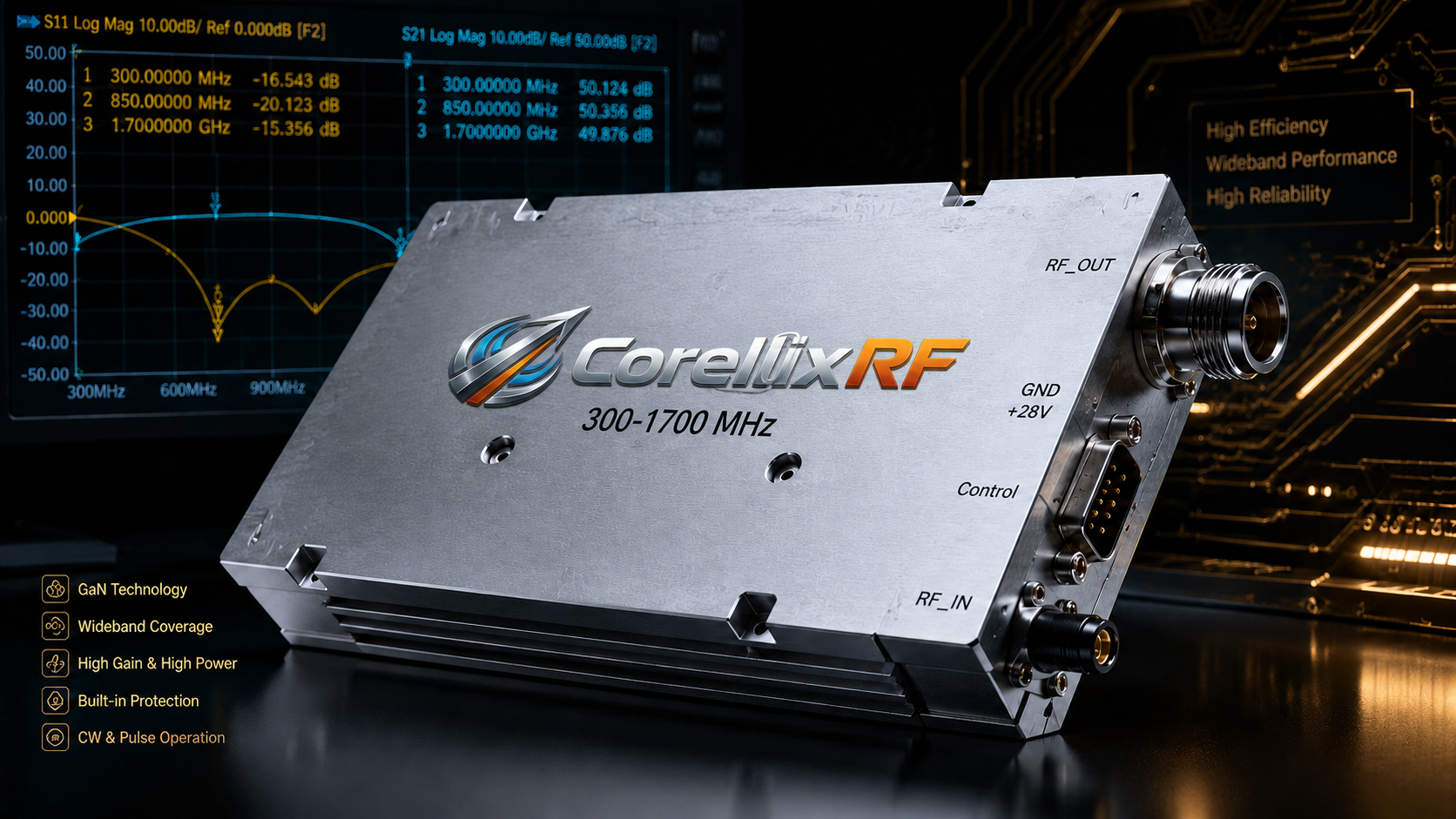
A 300-1700 MHz RF amplifier is a useful middle ground for RF teams working with UAV-related links, multi-band communications, SDR chains, and broadband field or lab systems. It reaches below the common cellular/L-band discussion and extends high enough to support many agile or multi-band RF projects without immediately moving into microwave amplifier territory.
CorelixRF positions its 300-1700 MHz amplifier family for UAV, multi-band communication, and SDR integration work. Public product navigation also places it alongside 30-512 MHz and 300-2700 MHz options, which helps buyers compare whether they need tighter mid-band coverage or a wider operating span.
Why 300-1700 MHz Is a Practical Mid-Band Window
Many RF systems do not need full 30-512 MHz VHF/UHF coverage or 2-6 GHz microwave coverage. They need a strong mid-band RF power stage that can support multiple operating points, field test scenarios, or SDR-controlled signal paths. A 300-1700 MHz amplifier can reduce the number of amplifier swaps in a multi-band bench while keeping the integration review more focused than a very wide platform.
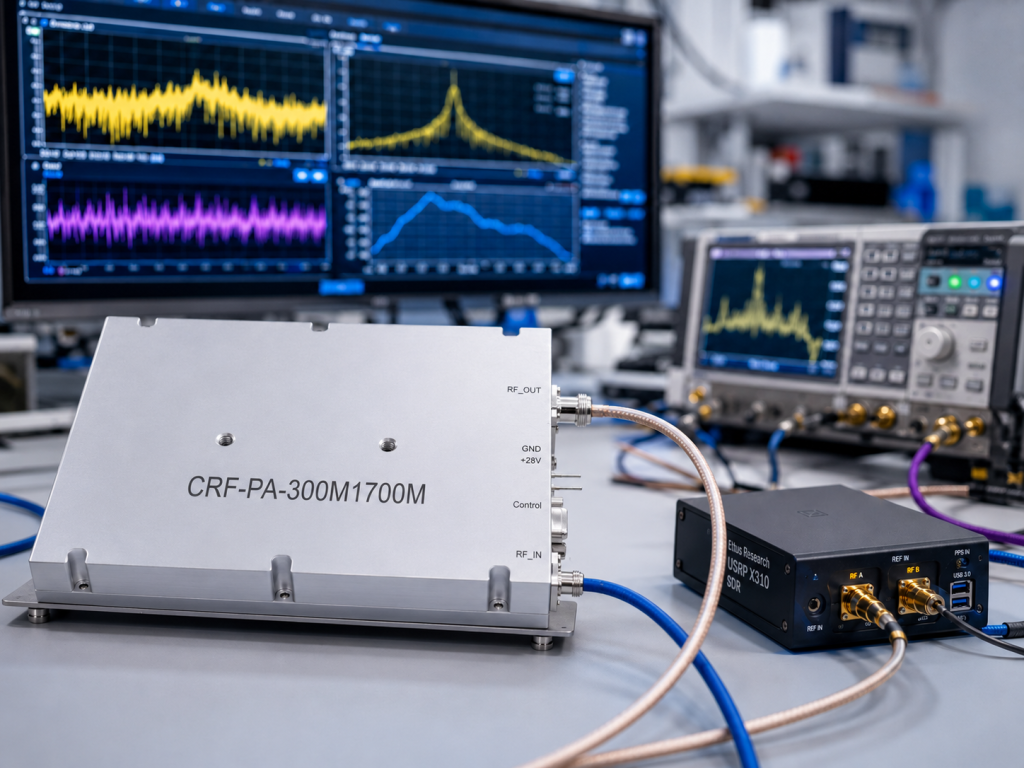
The application fit should be defined by the actual signal plan. UAV-related RF links may value compact integration, DC supply simplicity, and thermal behavior. SDR systems may value gain consistency and input drive tolerance. Multi-band communication systems may need repeatable output across several channels rather than maximum power at one point.
Matching the Amplifier to SDR Drive Levels
SDR chains can create selection mistakes because their output level may vary with frequency, waveform, and configuration. Before choosing a 300-1700 MHz power class, engineers should measure or estimate available RF drive across the intended band. Then they should compare that with the amplifier gain and required output at the system load.
This review should include waveform type, duty cycle, linearity expectation, filtering, cable loss, and load mismatch. If the amplifier is used after an SDR source module, CorelixRF’s broader SDR and RF amplifier discussion can help frame the chain as a system, not a pile of unrelated RF blocks.
UAV and Mobile Platform Constraints
For UAV-related or mobile RF platforms, size and current draw can matter as much as output wattage. A higher-power amplifier may increase link margin, but it also increases heat and supply demand. In compact systems, the practical amplifier is the one that fits the power, thermal, and mechanical envelope while still meeting RF output requirements.
Designers should confirm DC input, maximum current, mounting surface, airflow, connector orientation, cable strain relief, and whether the amplifier needs enable control or monitoring. These details should be submitted with the RFQ rather than solved after the quote.
When to Choose 300-2700 MHz Instead
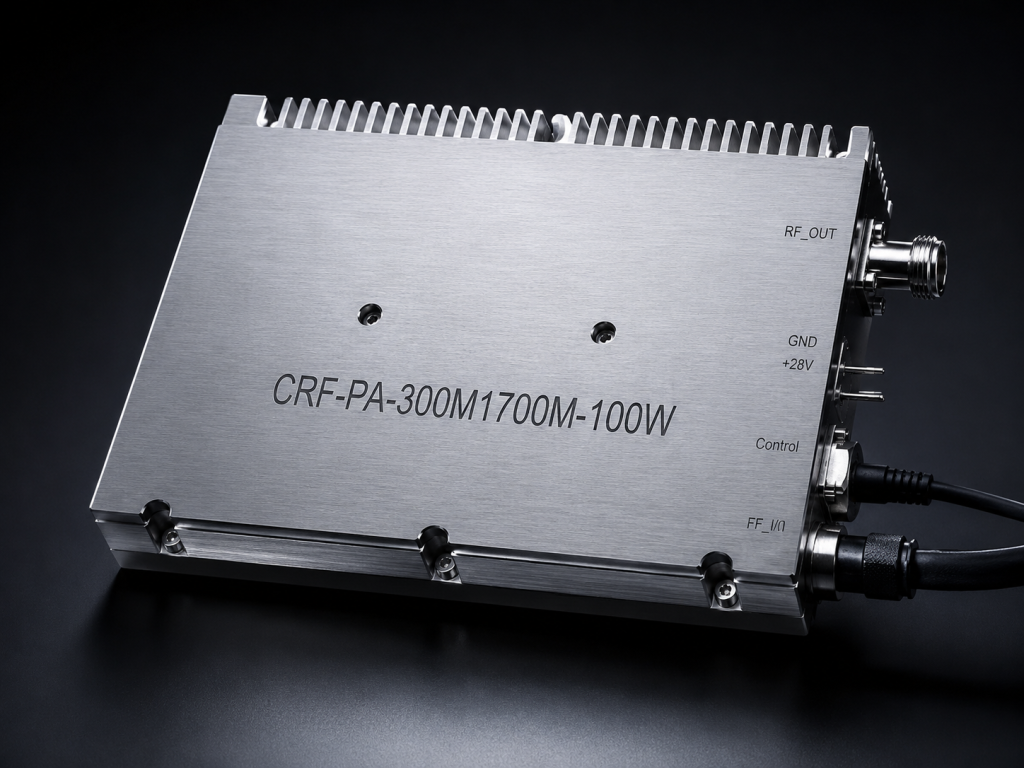
If the project requires broader upper-frequency coverage, CorelixRF’s 300-2700 MHz RF amplifier path may be more appropriate. The tradeoff is simple: 300-1700 MHz is cleaner when the upper band stops around that region; 300-2700 MHz is better when the system must cover a wider multi-band span.
If neither standard window is ideal, a custom RF amplifier review can define the actual operating band, output class, connector, control, and enclosure requirements.
FAQ
What is a 300-1700 MHz RF amplifier used for?
It is used for UAV-related RF systems, multi-band communications, SDR amplification, field testing, and OEM RF subsystem integration.
Is 300-1700 MHz better than 300-2700 MHz?
It is better when the project does not need the extra upper-frequency range. Choose 300-2700 MHz when wider coverage is required.
What matters most for SDR integration?
Available drive level, waveform type, gain, filtering, duty cycle, thermal behavior, and load condition should be reviewed together.
Can CorelixRF support custom mid-band requirements?
Yes. Custom frequency windows, mechanical requirements, connectors, and control interfaces can be reviewed through the engineering inquiry path.