
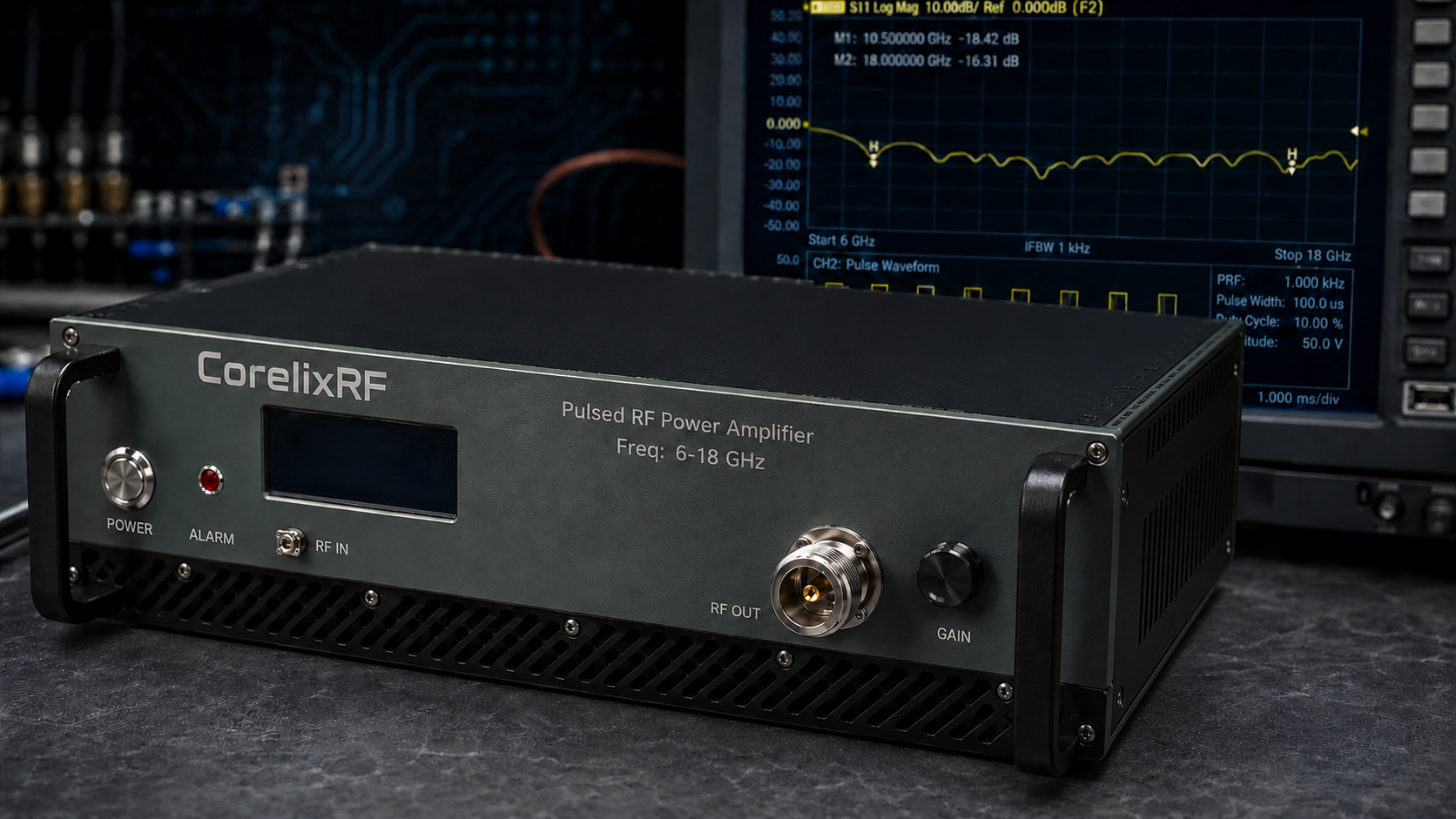
A pulsed RF power amplifier cannot be specified responsibly with only frequency and output power. Pulse width, duty cycle, pulse repetition frequency, peak power, average power, cooling, protection, input drive, timing, and load condition all affect the final amplifier design. That is why pulsed amplifier topics should be written as engineering guides, not just product blurbs.
CorelixRF’s amplifier platform page identifies pulsed RF amplifiers as a project-based path for peak-power-oriented operation, pulse mode support, and application-specific development. It also notes representative X-band pulse delivery records. Buyers should treat that as an invitation for technical intake, not as a reason to assume every pulsed requirement is automatically covered by a standard model.
Start With the Pulse Format
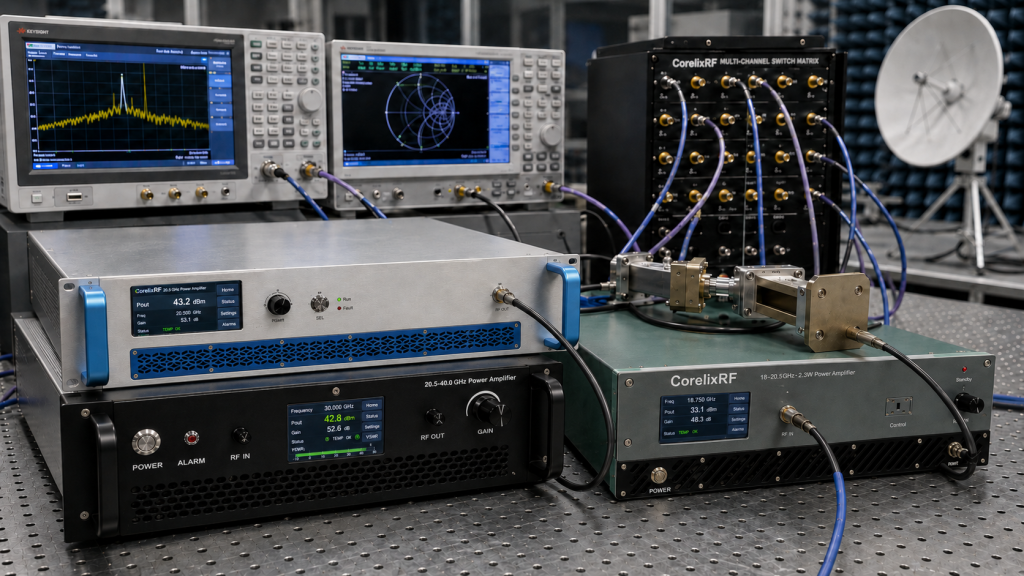
The first RFQ item is the pulse format. Engineers should provide pulse width, PRF, duty cycle, burst structure, and whether timing control comes from the source, external trigger, or system controller. A 1 kW peak requirement at low duty cycle is not thermally equivalent to a different pulse structure with the same peak number.
If the customer only provides “peak power,” the amplifier team still cannot confirm average dissipation, power supply sizing, protection strategy, or cooling method. Pulse data is not optional; it is the operating condition.
Frequency Range and Bandwidth
The frequency requirement should include exact operating points or the required bandwidth. A pulsed amplifier for one narrow X-band channel may be reviewed differently from a broadband pulsed amplifier that must support multiple channels. If the requirement overlaps a standard microwave range, CorelixRF’s 6-18 GHz amplifier or 18-40 GHz amplifier pages can provide useful context, but pulsed operation still needs project review.
For lower-frequency pulsed systems, the broader RF power amplifier platform page and 30-512 MHz amplifier path help frame the available standard families before custom pulse details are added.
Peak Power Versus Average Power
Peak power is the number people remember. Average power is often the number that decides thermal design. Both matter. The amplifier supplier needs to know required peak output, average power, pulse width, PRF, duty cycle, expected run time, ambient condition, and enclosure airflow. Without those details, cooling and reliability cannot be evaluated correctly.
The same applies to input drive. A pulsed source may have different drive behavior from a CW generator. Engineers should specify source output level, waveform quality, rise/fall expectations if relevant, and whether any external blanking, gating, or sequencing is required.
Protection, Load Condition, and Interlocks
Pulsed RF systems may operate into antennas, fixtures, test loads, or changing RF paths. Load mismatch can affect reflected power and protection design. The RFQ should describe the expected load, VSWR environment, switch matrix, cable path, and whether the system requires interlock logic.
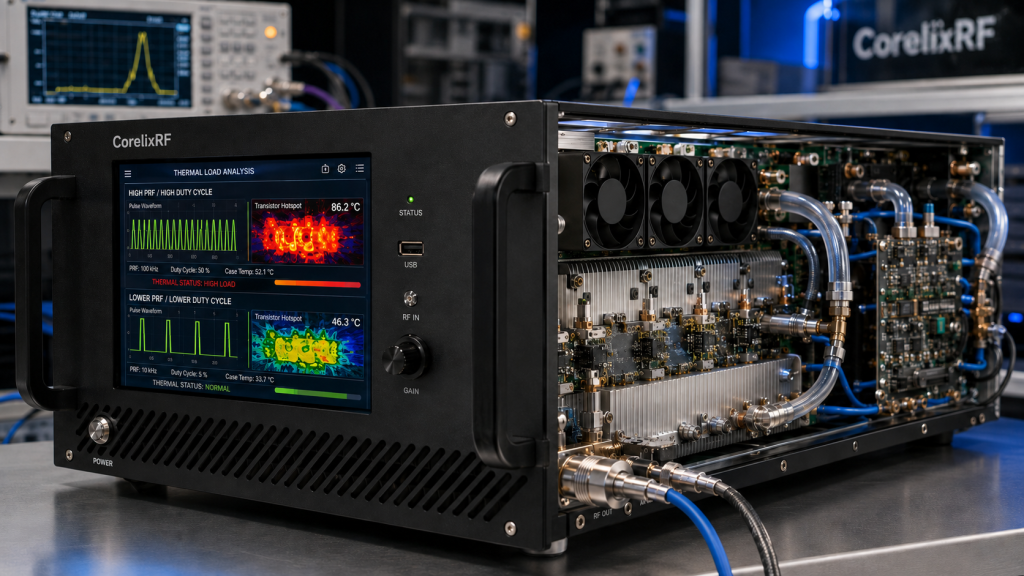
For OEM systems, add connector preference, control interface, monitor outputs, mechanical envelope, supply voltage, current limits, and documentation requirements. These inputs help CorelixRF decide whether a modified standard path or full custom amplifier review is appropriate.
FAQ
What information is required for a pulsed RF power amplifier RFQ?
Provide frequency range, peak power, average power, pulse width, PRF, duty cycle, source drive, load condition, cooling limits, control interface, and mechanical constraints.
Why is duty cycle important?
Duty cycle affects average power dissipation, heat load, power supply sizing, and reliability. Peak power alone is not enough.
Can a CW amplifier be used for pulsed operation?
Only after engineering review. Pulse mode may require different biasing, protection, timing, thermal, or control behavior.
Does CorelixRF support custom pulsed amplifiers?
CorelixRF lists pulsed RF amplifiers as a project-based path and can review pulse-specific operating requirements through its engineering inquiry process.