
Why Use a Portable Drone Jammer for Emergency UAV Control?
You must use a portable drone jammer for emergency UAV control because it provides immediate, mobile, and absolute disruption of rogue drone signals before they can compromise your secure airspace. Imagine you are overseeing the security of a critical infrastructure facility, and a completely unidentified drone breaches the perimeter. Your traditional cameras can see it, but they cannot stop it; your security personnel are grounded, watching helplessly as the drone hovers near sensitive assets. This agonizing vulnerability leaves your operations exposed to corporate espionage, sabotage, or worse. The ultimate answer is deploying a Drone Jammer, which instantly severs the intruder’s communication links, drops the threat from the sky, and restores absolute control over your environment.
What Triggers the Need for a Drone Jammer?
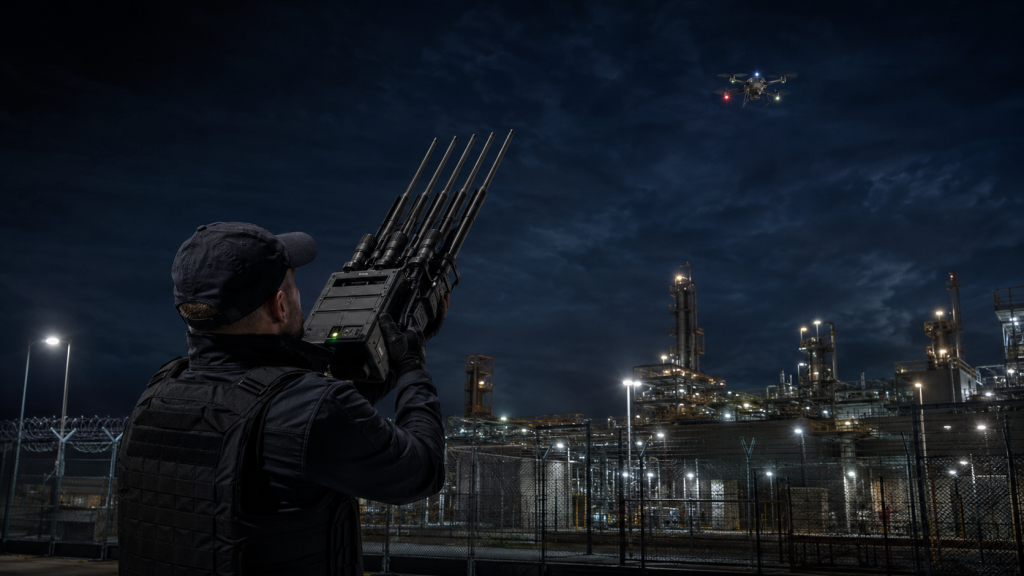
![Photorealistic image of a security guard identifying a rogue drone threat over a critical infrastructure facility, 16:9 ratio, dark industrial style]
The urgent need for a Drone Jammer arises when unauthorized UAVs breach secure airspace and demand instant neutralization. You face escalating threats where standard security measures fail against agile airborne surveillance.
When a rogue UAV breaches your facility, every second counts. Traditional defense tools are too slow, leaving your critical assets completely exposed to the sky above.
Why Are Traditional Defenses Failing?
Older security systems simply cannot detect or track small, fast-moving drones effectively. You need an agile solution that adapts instantly to unexpected aerial incursions.
Here is the undeniable truth:
- Standard cameras lack upward tracking capabilities.
- Guards cannot physically intercept high-altitude aerial targets.
- Legacy radars frequently confuse drones with local wildlife.
What Makes Portable Jammers Superior?
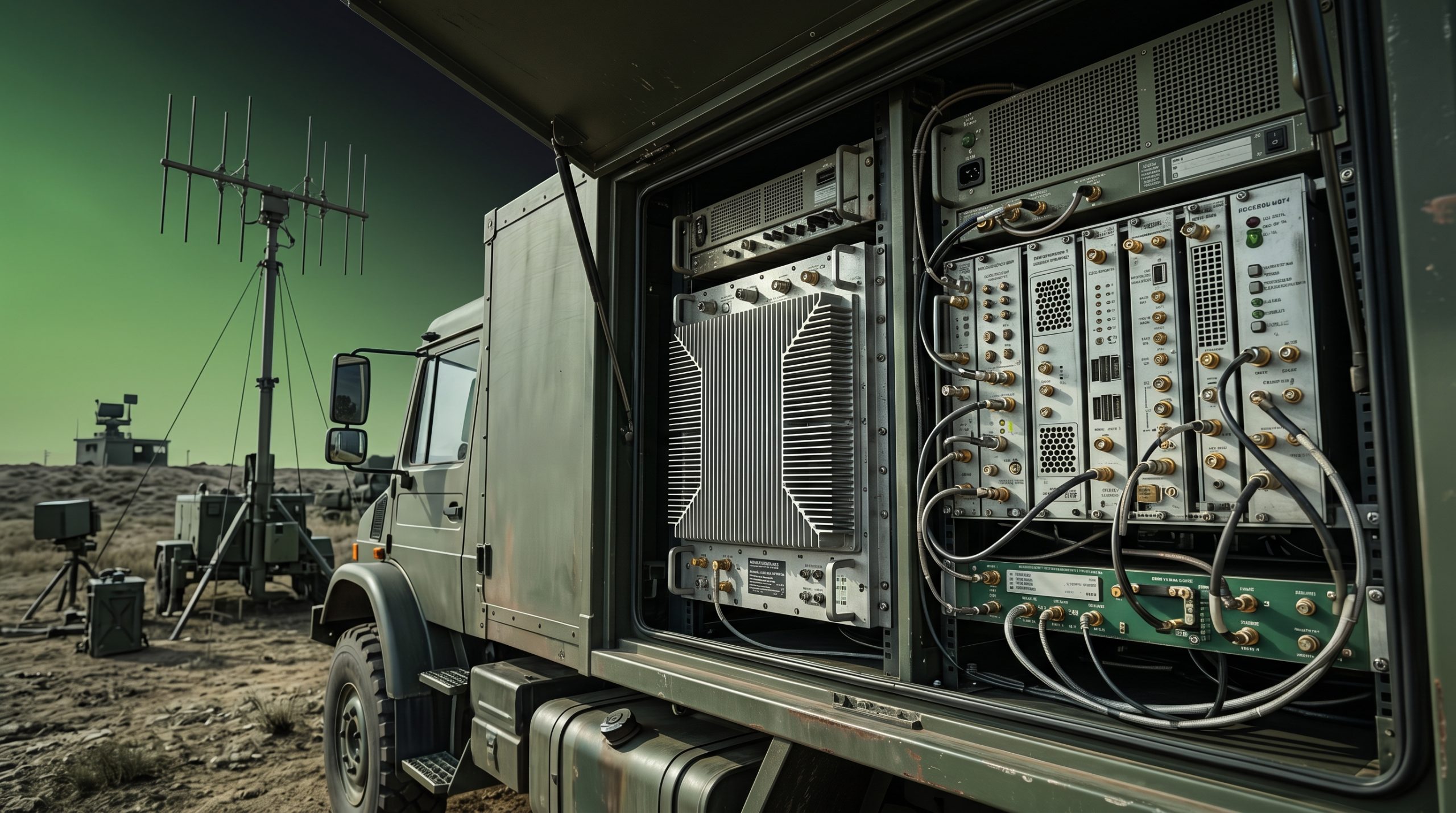
Portable units grant you the mobility to respond wherever the threat emerges on your site. They serve as military-grade full-band RF chain solutions that travel with your security team.
Our platforms provide 30MHz–6GHz continuous coverage to ensure absolute airspace dominance.
Key Takeaway: A portable system transforms your reactive security posture into an active, impenetrable defense shield.
| Defense Type | Response Speed | Mobility | Target Precision |
| Legacy Cameras | Slow | Fixed | Low |
| Portable Jammers | Instant | High | High |
The data clearly shows that portable RF solutions drastically outperform legacy systems in immediate threat neutralization.
How Does a Portable Drone Jammer Function?
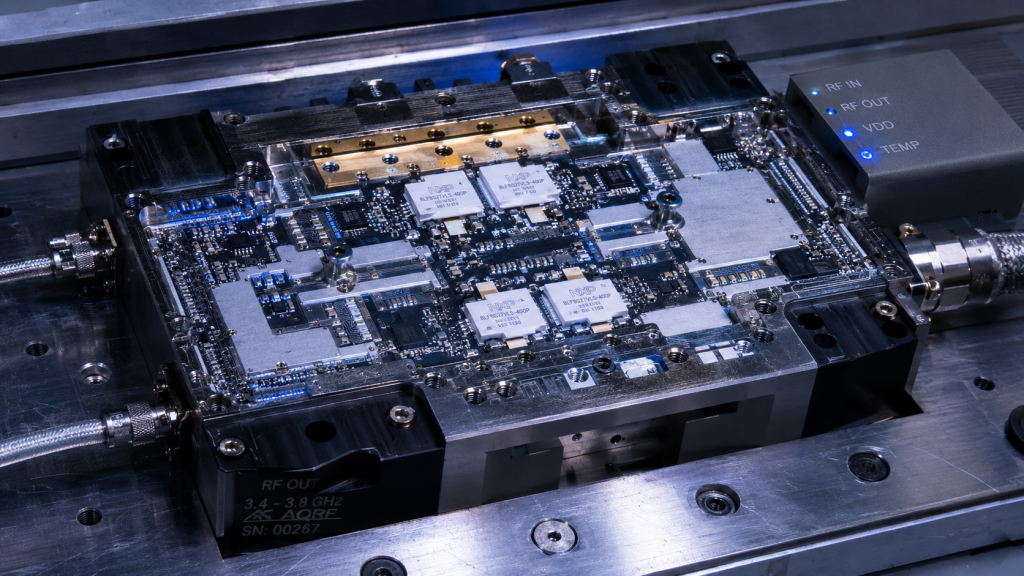
![Photorealistic image of the internal PCB and RF components of a drone jammer, glowing with deep blue industrial lights, 16:9 ratio]
A Drone Jammer functions by emitting high-power RF signals that overpower and sever the communication link between the UAV and its operator. This sudden loss of data forces the drone into a pre-programmed safety mode, usually landing safely or returning to its origin.
You must rely on equipment that delivers absolute frequency dominance. Emitting a stronger, cleaner signal is the only way to hijack the electromagnetic environment.
How Does Signal Disruption Work?
The core mechanism involves blasting high-density noise across the specific bands utilized by UAV control protocols.
But wait, there is more to it:
- It blocks GPS/GNSS navigation signals completely.
- It severs 2.4GHz and 5.8GHz video feeds.
- It disables 433MHz and 900MHz telemetry links.
Can It Handle Complex Frequencies?
Yes, modern units utilize an SDR digital signal source to provide intelligent, real-time frequency control. They seamlessly adapt to real-time frequency hopping utilized by advanced drones.
This ensures that even customized drone protocols are effectively neutralized before they cause harm.
Key Takeaway: Understanding the RF disruption process allows you to deploy counter-measures with surgical precision and confidence.
| Feature | Standard Jammer | SDR Digital Source |
| Frequency Control | Fixed | Intelligent |
| Hopping Support | No | Yes |
Intelligent SDR components provide vastly superior adaptability against evolving and unpredictable drone communication protocols.
Can a Drone Jammer Stop Swarm Attacks Fast?
![Photorealistic image of multiple drones hovering in the sky being hit by invisible RF waves, 16:9 ratio]
Yes, a powerful Drone Jammer can instantly neutralize drone swarms by broadcasting a wideband interference field that affects all incoming units simultaneously. You do not need to target each drone individually when fighting off a coordinated group.
This massive blanket coverage is vital when defending against multi-vector aerial attacks. It shuts down the entire swarm’s mesh network instantly.
Why Is Wideband Coverage Essential?
Swarm attacks often utilize multiple frequency bands to avoid single-point jamming efforts. You must disrupt all active communication channels at the exact same time.
Consider this critical point:
- Swarms rely heavily on inter-drone communication.
- Wideband fields instantly break their internal mesh networks.
- Simultaneous multi-band output stops the entire group in its tracks.
How Much Power is Required?
To stop a swarm, you need high-efficiency GaN power amplifiers to push the signal far and wide. These premium components provide 30W–200W configurable output to ensure massive area coverage.
With ≥15% power headroom, your system will not fail or throttle down when you need it most.
Key Takeaway: Wideband high-power amplifiers are your ultimate, non-negotiable defense against coordinated UAV swarm tactics.
| Threat Type | Required Output | Component Needed |
| Single Drone | Standard | Silicon Amp |
| Swarm Attack | High Power | GaN Power Amp |
High-power GaN components are an absolute necessity for establishing the wideband fields required to defeat modern drone swarms.
Why Choose GaN Tech for Your Drone Jammer?
![Photorealistic 16:9 chart showing the RF power output efficiency of GaN amplifiers vs traditional silicon over a 30MHz-6GHz spectrum, dark industrial aesthetic]
You should choose GaN technology for your Drone Jammer because it offers superior thermal efficiency and sustained high-power output without degradation. Gallium Nitride (GaN) fundamentally outperforms legacy silicon components in high-stress RF applications.
When critical infrastructure is on the line, you cannot afford equipment that overheats and fails. GaN ensures your defense remains absolute.
What Are the Thermal Advantages?
GaN handles extreme heat vastly better than silicon, preventing thermal throttling during extended jamming operations.
Here is what you need to know:
- GaN maintains stable power under extreme stress.
- It allows for a more compact aluminum heat-sink integrated design.
- Heat dissipation is incredibly rapid and highly efficient.
Does GaN Improve Signal Quality?
Absolutely, it ensures extreme signal clarity and consistency across the entire operating spectrum. It effectively guarantees <1.5dB gain flatness.
These GaN systems are strictly built for extreme environments. They are designed for sustained output without power degradation.
Key Takeaway: Integrating GaN technology guarantees that your jamming equipment remains potent, reliable, and thermally stable during prolonged engagements.
| Material | Thermal Efficiency | Sustained Output |
| Silicon | Moderate | Degrades under heat |
| GaN | Exceptional | 100% Stable |
Gallium Nitride clearly provides the thermal stability and output consistency required for military-grade RF applications.
Are Portable Drone Jammers Truly Effective?
![Photorealistic image of a soldier operating a backpack drone jammer in a harsh desert environment, 16:9 ratio]
Yes, a portable Drone Jammer is incredibly effective because it brings military-grade RF capabilities directly to the frontline exactly when needed. You can establish a secure no-fly zone anywhere within a matter of seconds.
Their true effectiveness lies in their perfect combination of high output power and tactical, rapid mobility.
How Do We Prove Their Reliability?
True effectiveness is validated through brutal, unforgiving hardware testing. We proudly employ a rigorous 46-step military-grade quality protocol.
Consider the rigor of our phase 3 extreme stress & environmental testing:
- Systems undergo severe thermal cycling.
- We perform rigorous vibration testing on all units.
- Every single unit passes final aging verification.
What Do the Lab Results Say?
Our advanced testing laboratory scientifically verifies every engineering specification. Equipment is strictly tested to MIL-STD-810 precision.
This guarantees that the jammer performs exactly as advertised when deployed in the field.
Key Takeaway: Exhaustive military-standard testing is the only way to guarantee a portable jammer’s operational effectiveness in real-world crises.
| Test Phase | Focus Area | Result Guarantee |
| Thermal Cycling | Temperature extremes | Zero thermal failure rate |
| Vibration Test | Transport durability | Component stability |
Exhaustive laboratory testing directly translates to unwavering, unyielding reliability when deploying tactical RF equipment.
What Frequencies Will a Drone Jammer Block?
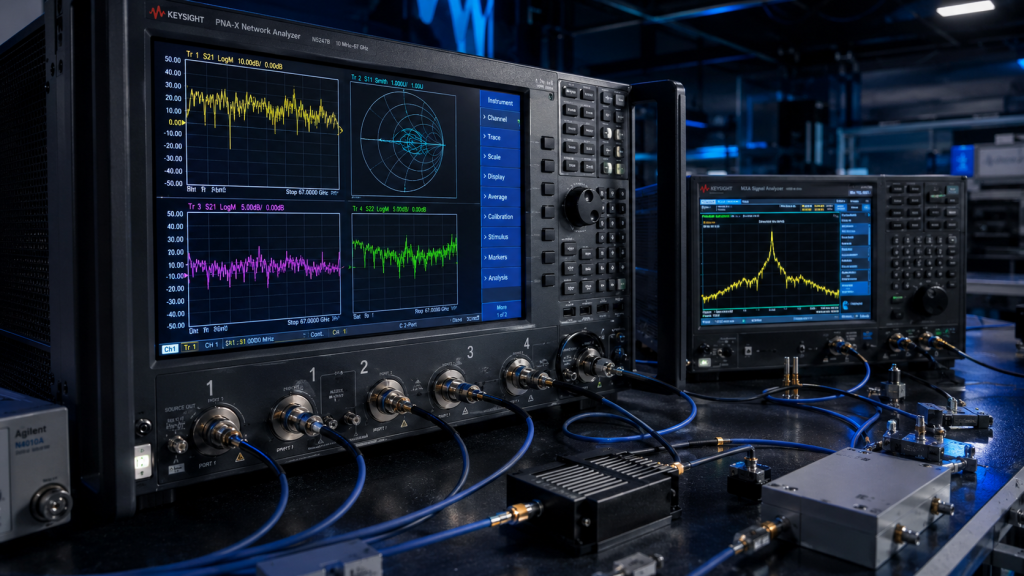
![Photorealistic image of a vector network analyzer screen showing successful signal disruption across multiple RF bands, 16:9 ratio, dark industrial aesthetic]
A professional Drone Jammer will block the entire 30MHz–6000MHz frequency range, covering everything from basic remote telemetry to advanced video links. You must fiercely deny every possible communication channel a UAV could potentially use.
Operating on a narrow, restricted band leaves your airspace completely vulnerable to modified drones. Full spectrum dominance is required.
Which Specific Bands Are Targeted?
The system must aggressively attack both commercial and proprietary bands used by malicious UAV operators.
Look at the critical frequencies neutralized:
- 433MHz and 900MHz for long-range remote control.
- 1.2GHz and 1.5GHz for GNSS/GPS spatial navigation.
- 2.4GHz and 5.8GHz for high-definition video streams.
Can It Adapt to New Threats?
Yes, thanks to intelligent multi-waveform support including CW, LFM, GNSS, and OFDM. The onboard SDR digital signal source makes this rapid adaptation possible.
This adaptive signal control is vital for neutralizing targets in complex electromagnetic environments.
Key Takeaway: Full-spectrum continuous coverage ensures no rogue drone can slip through your defensive net using alternative frequencies.
| Frequency Band | UAV Function | Jamming Impact |
| 1.5GHz | Navigation | Drone loses location |
| 5.8GHz | Video Feed | Operator goes blind |
Comprehensive frequency disruption completely eliminates all command and control capabilities, rendering the intruding drone inert.
How to Deploy a Drone Jammer in Emergencies?
![Photorealistic image of a rapid response security team deploying a portable drone jammer at an outdoor event, 16:9 ratio]
Deploying a Drone Jammer in an emergency requires simply powering on the unit and aiming its directional antennas directly toward the suspected airborne threat. You can establish an active, powerful RF shield in less than ten seconds.
Speed of deployment is the primary tactical advantage of highly portable anti-drone systems.
What Are the Tactical Steps?
Proper tactical deployment ensures maximum signal coverage and operator safety during a high-stress event.
Here is the step-by-step reality:
- Identify the general direction of the hostile UAV.
- Activate the wideband GaN hardware modules.
- Sweep the sky smoothly to break the drone’s signal lock.
Is It Suitable for Various Scenarios?
Absolutely, these agile units are trusted by global defense & system integrators across the world. They are highly perfect for airports, border protection, and critical infrastructure.
Their integrated RF jamming modules allow for seamless, immediate tactical deployment.
Key Takeaway: The ultimate simplicity of activating a portable jammer allows any security personnel to respond instantly to aerial threats.
| Scenario | Deployment Speed | Defensive Outcome |
| Airport Security | < 10 Seconds | Prevents flight delays |
| Border Control | < 10 Seconds | Stops contraband drops |
Rapid deployment capabilities make portable RF solutions practically indispensable for time-sensitive security emergencies.
Does Weather Affect Drone Jammer Operations?
![Photorealistic image of a rugged drone jammer operating flawlessly in heavy rain and fog, 16:9 ratio, industrial aesthetic]
No, severe weather does not degrade the performance of a military-grade Drone Jammer, as they are securely sealed and thermally optimized for harsh environmental conditions. You need equipment that aggressively fights through rain, snow, and extreme heat.
Commercial-grade electronics easily fail outdoors, but professional RF engineering thrives in the worst conditions.

How Does the Hardware Survive?
The core hardware is protected by specialized engineering coatings and robust enclosures that keep environmental hazards completely out.
Pay attention to these critical protective measures:
- Conformal coating heavily protects the internal PCBA.
- The aluminum heat-sink design aggressively repels water.
- PCB cleaning & baking prevents internal moisture buildup.
Will Temperature Drops Ruin the Output?
No, the robust GaN platform ensures that RF output remains perfectly stable. Our stringent temperature chamber testing thoroughly proves this capability.
Whether deployed in a freezing desert night or a humid jungle, the signal stays unyieldingly strong.
Key Takeaway: Investing in deeply weather-hardened RF equipment ensures your airspace remains secure regardless of environmental challenges.
| Weather Condition | Protection Method | Performance Impact |
| Heavy Rain | Conformal Coating | Zero Degradation |
| Extreme Heat | Aluminum Heat-Sink | Zero Degradation |
Environmental hardware hardening ensures that your defensive capabilities are never once compromised by unpredictable weather patterns.
Is a Custom Drone Jammer Better for Defense?
![Photorealistic image of RF engineers designing a custom anti-drone module on a digital blueprint, 16:9 ratio, high-tech vibe]
Yes, a custom Drone Jammer is significantly better because it is explicitly tailored to the unique frequency threats and environmental demands of your specific facility. You gain a massive tactical advantage by dictating the exact hardware specifications you require.
Off-the-shelf solutions frequently lack the specialized power required for unique or evolving drone threats.
What Can Be Customized?
Custom manufacturing allows you to surgically fine-tune every aspect of the RF chain to perfectly match your operational needs.
Here is what you can explicitly dictate:
- Precise frequency band customization.
- Exact power level customization.
- Interface protocol design for seamless system integration.
Who Builds These Custom Units?
You need a manufacturing partner with incredibly deep engineering resources. We operate with 100+ RF Engineers inside a massive 3000㎡ R&D Center.
Our expert team handles everything from initial prototype to final mass production.
Key Takeaway: Custom RF engineering guarantees that your anti-drone system perfectly aligns with your specific security infrastructure needs.
| Customization | Standard Unit | Custom Unit |
| Frequency Bands | Fixed | Tailored to threat |
| Output Power | Pre-set | Optimized for range |
Engineering-driven manufacturing customization provides a bespoke defense mechanism that generic market alternatives simply cannot match.
How to Maintain Your Portable Drone Jammer?
![Photorealistic image of a technician running diagnostics on a drone jammer using a spectrum analyzer, 16:9 ratio, dark industrial style]
Maintaining your Drone Jammer involves routine visual inspections, battery cycling, and occasional RF output verification using basic diagnostic lab tools. You must treat this powerful equipment with the exact same care as a precision firearm.
Proper, consistent maintenance guarantees the unit will activate flawlessly during a high-stakes crisis.
What Are the Daily Checks?
Daily maintenance is remarkably simple but absolutely critical for long-term operational readiness.
Never ignore these basic steps:
- Inspect high-frequency interfaces for any debris.
- Check the aluminum cooling fins for blockages.
- Constantly verify the battery charge status.
Do I Need Advanced Calibration?
Occasionally, yes, you do. You can easily use a spectrum analyzer to verify the output power remains absolutely optimal.
Because our specialized units undergo extreme stress testing, actual field degradation is exceptionally rare.
Key Takeaway: Consistent, basic maintenance ensures your RF hardware investment remains a reliable, dominant force for years to come.
| Maintenance Task | Frequency | Purpose |
| Interface Check | Daily | Prevent signal loss |
| Output Verification | Annually | Ensure peak power |
Routine maintenance and periodic technical diagnostics are fundamentally essential for sustaining the military-grade reliability of your equipment.
When an unauthorized UAV violates your airspace, hesitation is not an option. Throughout this guide, we have demonstrated how portable RF disruption technology neutralizes complex aerial threats instantly, providing the wideband, high-power coverage necessary to secure your critical operations. We proudly manufacture the core modules powering modern counter-drone and electronic warfare systems, delivering the exact engineering precision you need to establish absolute frequency dominance. If you are ready to upgrade your security infrastructure with military-grade RF solutions, please contact us today to start your custom project. CorelixRF remains committed to “Engineering Truth,” providing unyielding, battle-tested defense platforms for an increasingly hostile sky.
Frequently Asked Questions
Can I legally operate a portable drone jammer anywhere?
No, you cannot. Operating RF disruption equipment is heavily regulated by federal and local communications authorities. You must possess specific military, law enforcement, or critical infrastructure authorization to deploy these high-power systems legally.
What’s the best frequency to target for civilian drones?
The 2.4GHz and 5.8GHz bands are the absolute best targets. Yes, because almost all commercial and prosumer UAVs rely heavily on these specific frequencies for remote control and high-definition video transmission.
How do I know if the jammer output is safe for my operators?
It is completely safe when deployed correctly. Our designs incorporate highly directional antennas that push the aggressive RF energy forward, creating a safe operational zone directly behind the unit where the operator stands.
Can I integrate a portable unit into an existing radar system?
Yes, you absolutely can. Our SDR digital signal source and RS422 control interfaces allow for seamless, rapid integration with external detection radars for automated, system-level optimization.
Authorized RF engineering and compliance review
For regulated RF systems, this page should be used as an engineering and compliance review path, not as a public deployment checklist. CorelixRF starts with authorization status, operating region, frequency plan, output limit, antenna interface, safety controls, thermal limits and acceptance documents.
- RFQ checklist – send the data buyers usually forget, including band, power, duty cycle, interface and test standard
- delivery documentation – check what documents can support incoming inspection, FAT review and long-term maintenance
- quality and certification review – review the quality and compliance evidence before the project moves into procurement
- RF front-end platform – compare the RF chain as a system instead of selecting one isolated module
- RF configurator – turn frequency, power, thermal and interface requirements into a first configuration brief
- case studies – review similar engineering paths before sending an RFQ
- engineering contact – send the application notes, block diagram or target specification to engineering sales
This keeps the discussion inside lawful, authorized RF programs while still giving procurement teams a clear way to request amplifier, antenna, SDR source, documentation and factory review.
Portable RF Platform Review Path
For authorized portable C-UAS RF programs, map mobility, battery, thermal and enclosure limits to RF power amplifier sizing, RF front-end protection and antenna/load interface planning. Send operating bands, duty cycle, power targets, cooling method, VSWR exposure and factory-test requirements through the RF inquiry form.