
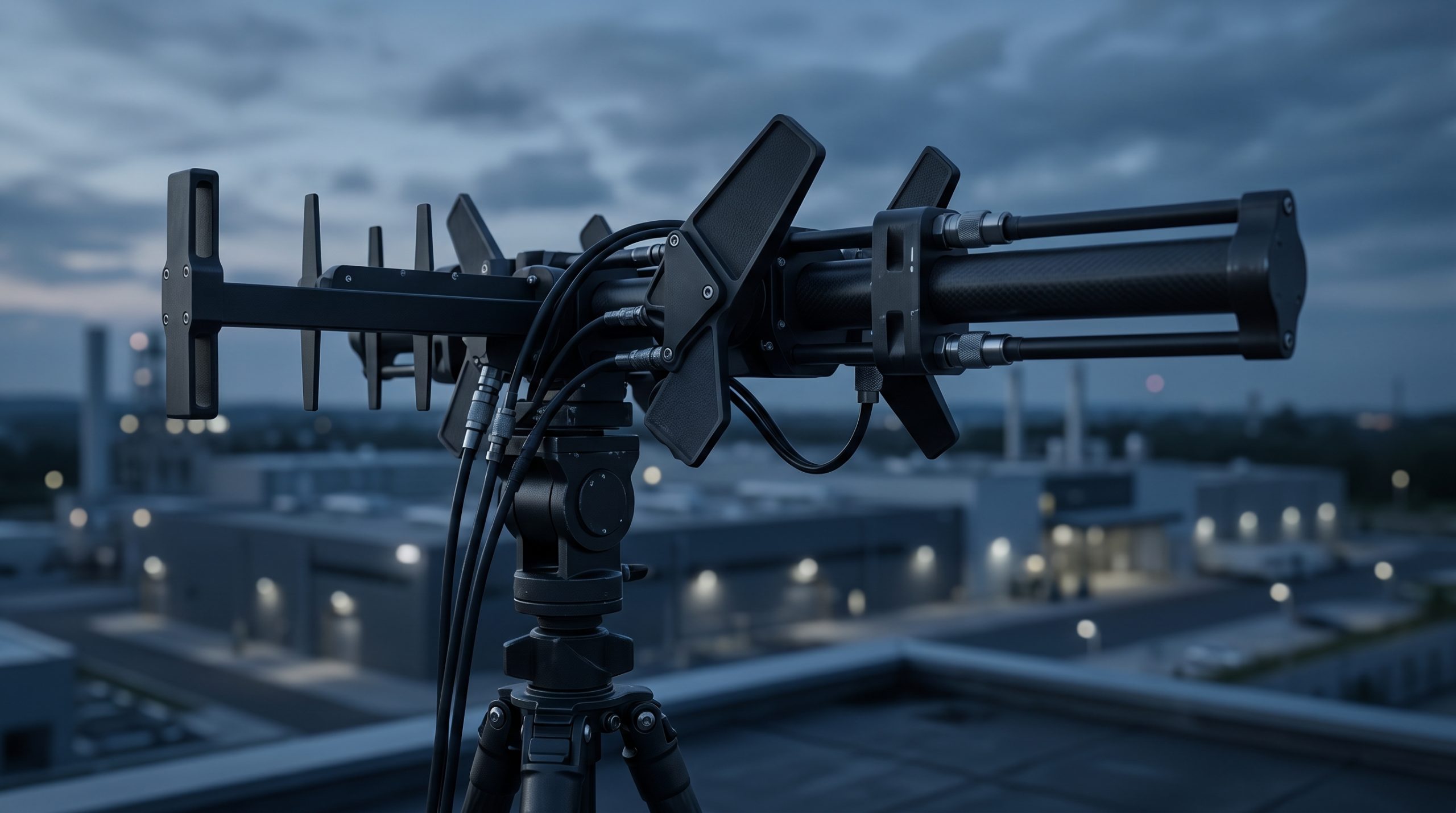
A directional antenna focuses radio frequency energy precisely toward a specific target, dramatically increasing defensive countermeasure effectiveness. Imagine guarding a military base where rogue UAVs constantly probe perimeter defenses. Blanket frequency disruption often causes severe collateral damage across friendly communication networks. You need a targeted approach. Integrating a precise Drone Jammer solves this exact vulnerability instantly. Channeling high-power output narrowly lets operators neutralize airborne threats without compromising local operations. This focused methodology represents an engineering truth for modern electronic warfare.
What Are Directional Antennas in Drone Jammers?
Directional antennas are specialized transmitting components designed explicitly for concentrating electromagnetic power along a singular path. Within a modern Drone Jammer, these elements replace inefficient omnidirectional radiating nodes. Restricting radiation patterns helps engineers achieve superior range capability. They guarantee peak defensive responses during critical security events.
Defining the Core Component
Here is the deal… Focusing RF output requires precise geometric designs. Parabolic dishes or Yagi structures shape outgoing waves effectively. This structural geometry eliminates backward energy leakage completely. Your defensive array becomes highly efficient against hostile incursions.
- High-gain characteristics amplify targeted signal strength massively.
- Narrow beamwidths minimize surrounding spectrum interference seamlessly.
- Structural durability withstands severe environmental stress constantly.
The Evolution of Signal Targeting
Historically, defensive networks relied on broad-spectrum broadcasting techniques. Those legacy methods wasted immense amounts of transmitted power. What is the real story? Modern combat scenarios demand surgical electronic countermeasures. Contemporary engineering leverages advanced materials for superior directivity.
- Gallium Nitride substrates enable higher power density.
- Phased array configurations offer rapid beam steering.
- Integrated heat-sinks maintain continuous thermal equilibrium.
Key Takeaway: Upgrading legacy systems with focused transmitting arrays drastically multiplies defensive reach and operational reliability.
| Feature | Legacy Omnidirectional | Modern Directional |
| Signal Focus | 360-Degree Spread | Narrow Beam Path |
| Power Efficiency | Extremely Low | Exceptionally High |
| Collateral Impact | Severe Disruption | Minimal Interference |
Analyzing this comparison reveals how focused radiation heavily outperforms broad-spectrum broadcasting during tactical deployments.
How Do Directional Antennas Focus RF Power?
These components focus radio frequency energy by utilizing specifically shaped conductive elements that reflect outgoing waves into a narrow corridor. Any standard Drone Jammer relies on this physical phenomenon for maximizing transmission intensity. Reflectors block rearward propagation while directors guide forward energy efficiently. This process multiplies effective radiated power without requiring larger amplifiers.
Concentrating Electromagnetic Energy
Ready for the good part? Physical dimensions directly dictate wave behavior across specified spectrums. Engineers calculate exact spacing between metallic elements. This calculation aligns electromagnetic phases perfectly. Constructive interference builds massive frontal signal peaks.
- Precise spacing coordinates overlapping wave crests.
- Conductive backplates reflect stray rearward emissions.
- Calibrated lengths resonate at targeted frequencies.
Maximizing Signal-to-Noise Ratios
Targeted emissions naturally reduce background static reception. This is where it gets interesting… A concentrated beam cuts through atmospheric noise easily. Receiving modules process cleaner feedback loops rapidly. Your system interprets incoming threats with exceptional clarity.
- Directionality rejects off-axis ambient noise.
- Focused reception clarifies distant hostile signatures.
- Clean signal paths accelerate digital processing.
Key Takeaway: Harnessing phase alignment principles allows defensive operators a massive tactical advantage over scattered transmitting methodologies.
| Parameter | Broad Beam Array | Focused Beam Array |
| Phase Alignment | Dispersed | Highly Coordinated |
| Noise Rejection | Poor | Exceptional |
| Frontal Gain | Baseline | Multiplied |
Reviewing these physics metrics explains why concentrated wave propagation dominates modern electronic defense strategies.
Why Is Target Precision Critical for Aerial Defense?
Target precision prevents accidental communication blackouts across friendly infrastructure zones during active countermeasures. Operating a military-grade Drone Jammer requires surgical accuracy. Broadcasting interference randomly disables nearby civilian Wi-Fi or medical networks. Pinpointing hostile targets neutralizes threats responsibly.
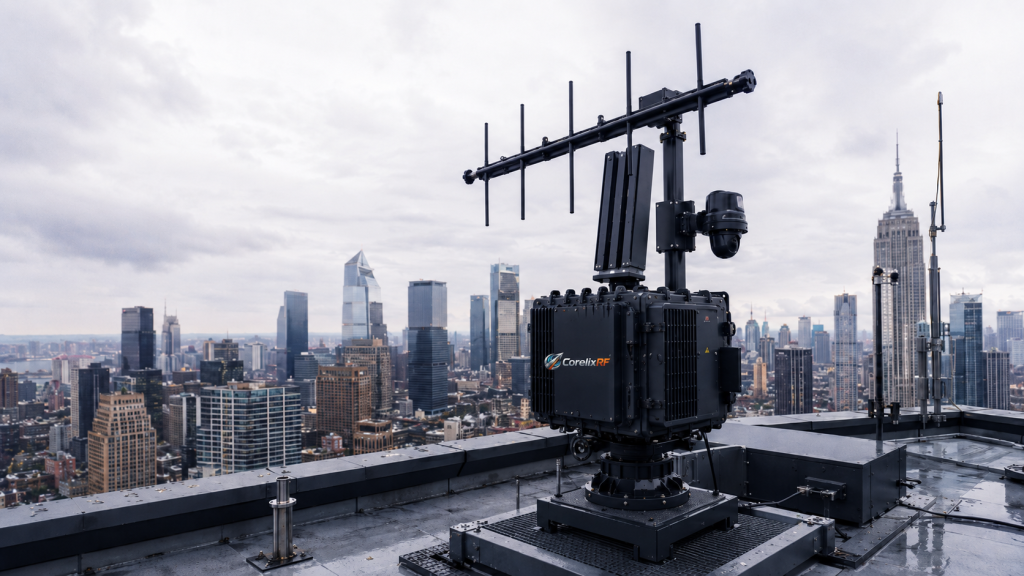
Mitigating Collateral Interference
You might be wondering… How do facilities remain operational under attack? Narrow beam paths restrict jamming frequencies tightly. Only the immediate threat vector experiences electromagnetic suppression. Surrounding airspace remains entirely clear for authorized flight paths.
- Surgical targeting protects civilian navigation bands.
- Narrow radiation limits geographic disruption zones.
- Focused outputs avoid triggering regulatory alarms.
Safeguarding Critical Infrastructure
Power grids require continuous wireless monitoring protocols. Here is the kicker… A poorly configured defense grid damages internal telemetry systems. Focused transmission models shield these necessary internal pathways. Your facility stays totally secure and fully functional.
- Isolated beams preserve local SCADA networks.
- Precision targeting secures sensitive server communications.
- Guided energy avoids physical structural reflections.
Key Takeaway: Implementing surgical RF targeting guarantees facility safety while actively destroying unauthorized aerial intrusions.
| Impact Area | Unfocused Jamming | Precision Targeting |
| Friendly Comms | High Disruption | Zero Interference |
| Regulatory Risk | Severe | Minimal |
| Defense Efficacy | Diluted | Concentrated |
Evaluating operational impact proves surgical targeting remains necessary for protecting complex industrial or military environments.
Can Directional Antennas Increase Jamming Range?
Directional antennas dramatically extend operational reach by condensing available amplifier output into a tightly bound forward beam. A well-configured Drone Jammer pushes disruptive signals kilometers further than traditional setups. This concentrated push defeats distant command links easily. Operators detect and neutralize threats long before visual confirmation.
Multiplying Effective Radiated Power
Truth be told… Amplification alone cannot defeat distant adversaries efficiently. Antenna gain acts as a passive multiplier. Pushing 50 watts through a high-gain panel yields massive equivalent radiated power. This efficiency saves tremendous electrical resources.
- High-gain panels multiply baseline amplifier outputs.
- Concentrated energy bridges massive geographic distances.
- Passive amplification requires zero additional electricity.
Pushing Beyond Omnidirectional Limits
Standard antennas scatter power into empty sky. Look at it this way… Wasting energy upwards serves no tactical purpose. Focusing that same energy horizontally creates an impenetrable barrier. Your defensive perimeter expands outward dramatically.
- Horizontal focusing creates distant protective walls.
- Suppressed vertical radiation conserves valuable energy.
- Extended range allows earlier threat interception.
Key Takeaway: Condensing RF output through specialized geometric structures multiplies effective range without requiring larger internal power supplies.
| Metric | Standard Configuration | High-Gain Setup |
| Effective Range | 1x Baseline | 3x to 5x Baseline |
| Power Draw | High | Conserved |
| Threat Intercept | Close Proximity | Long Distance |
Comparing range multipliers demonstrates the massive strategic advantage gained by focusing transmission power horizontally.
What Frequencies Do Directional Antennas Cover?
These specialized arrays cover everything from low-band 30MHz tactical radios up to 6GHz millimeter-wave spectrums. An advanced Drone Jammer frequently incorporates multi-band directional panels. Wideband continuous coverage defeats commercial and military control links simultaneously. Engineering custom frequency responses requires sophisticated mechanical tuning.
Navigating Wideband Spectrums
Here is the secret… Modern aerial threats utilize dynamic frequency hopping algorithms. Broadband directional models sweep these varied bands effortlessly. Log-periodic designs accommodate multiple wavelengths simultaneously. This versatility counters rapidly shifting hostile protocols.
- Log-periodic structures support extreme frequency agility.
- Continuous spectrum coverage blocks hopping algorithms.
- Multi-band resonance eliminates hardware switching delays.
Adapting to Multi-Band Requirements
A single threat might utilize GPS, Wi-Fi, and custom RF links. Make no mistake… Your defense must match all incoming frequencies. Dual-polarized panels handle complex signal environments seamlessly. Operators maintain total spectrum dominance continuously.
- Dual polarization disrupts complex communication links.
- Integrated feeds manage multiple frequency inputs.
- Customized tuning addresses specific regional threats.
Key Takeaway: Deploying wideband directional hardware guarantees continuous defense against highly adaptable aerial threats utilizing sophisticated frequency-hopping technologies.
| Frequency Band | Threat Type | Antenna Suitability |
| 433 MHz – 900 MHz | Custom Military | Excellent |
| 1.5 GHz (GNSS) | Navigation | Outstanding |
| 2.4 GHz – 5.8 GHz | Commercial Wi-Fi | Peak Performance |
Mapping threat frequencies confirms wideband hardware remains mandatory for total airspace security protocols.
How Do They Support Electronic Warfare Tactics?
Directional arrays empower electronic warfare units to execute precise signal denial missions without revealing geographic coordinates. Deploying a tactical Drone Jammer enables covert operational superiority. Focused beams reduce enemy triangulation probability massively. Command centers retain stealth while aggressively suppressing hostile communications.
Empowering Counter-Drone Operations
Think about this… Stealth remains a primary tactical advantage. Emitting omnidirectional signals broadcasts your exact location instantly. Narrow beam execution masks your origin point effectively. Your team executes countermeasures securely.
- Narrow emissions frustrate hostile direction-finding tools.
- Covert operations maintain necessary element of surprise.
- Targeted jamming isolates specific enemy squadrons.
Supporting Tactical Mobility
Mobile infantry units require lightweight defensive systems. It gets better… Compact directional panels mount easily on vehicles. Rapid deployment capability protects moving convoys effortlessly. Strategic flexibility increases mission success rates massively.
- Vehicle-mounted arrays provide mobile defense umbrellas.
- Lightweight construction reduces tactical transport burdens.
- Rapid deployment secures temporary operating bases.
Key Takeaway: Integrating focused transmission hardware elevates mobile electronic warfare capabilities by balancing aggressive signal denial with absolute operational stealth.
| Tactic | Broad Emission | Targeted Emission |
| Stealth Capability | Compromised | Maintained |
| Mobility | Cumbersome | Agile |
| Target Isolation | Impossible | Highly Accurate |
Reviewing tactical applications proves emission control directly influences battlefield survivability and mission success.
Are Directional Antennas Effective in Urban Areas?
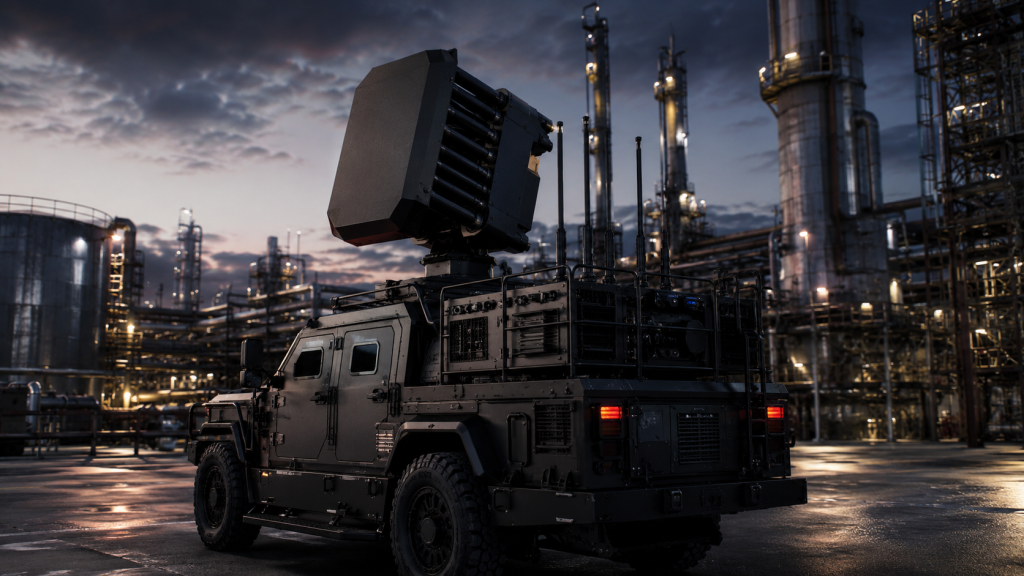
Directional antennas excel in urban environments by actively suppressing signal multipath reflections caused by dense concrete structures. Operating a standard Drone Jammer within a city normally creates chaotic RF echoing. Concentrated beams penetrate narrow street corridors precisely. This clean signal propagation defeats threats hiding among buildings.
Overcoming Signal Multipath Effects
You see… City landscapes bounce radio waves unpredictably. This bouncing creates dead zones and signal nulls. A focused transmission cuts a direct line through obstacles. The wave reaches its destination intact.
- Concentrated beams minimize structural wave bouncing.
- Direct line-of-sight targeting overcomes urban dead zones.
- Reduced reflections clarify target tracking data.
Penetrating Dense RF Environments
Metropolitan zones suffer from extreme electromagnetic pollution. But here is the catch… Your defensive signal must overpower thousands of civilian routers. High-gain directional power slices through this background noise. Your countermeasures strike the hostile receiver directly.
- High-gain beams overpower dense civilian interference.
- Focused delivery guarantees receiver saturation.
- Targeted application avoids disrupting nearby apartments.
Key Takeaway: Utilizing high-gain focused transmission remains the only reliable method for executing electronic countermeasures within heavily populated metropolitan districts.
| Environment Factor | Omnidirectional | Directional |
| Multipath Echo | Severe | Minimal |
| Noise Penetration | Weak | Strong |
| Urban Efficacy | Poor | Exceptional |
Analyzing urban physics clearly shows concentrated beam delivery overcomes severe structural metropolitan obstacles.
What Makes GaN Integration Necessary for Antennas?
Gallium Nitride components allow directional antennas to process incredibly high power levels without suffering catastrophic thermal degradation. A modern Drone Jammer utilizes GaN technology like the CRF-PA-30M512M-30W module for sustained maximum output. Older silicon modules melt under similar continuous stress. This advanced material guarantees uninterrupted defensive operations.
Enabling High-Power Amplification
Why does this matter? Pushing watts through tight beamwidths generates massive heat. GaN handles this thermal load gracefully. Amplifiers operate at peak efficiency indefinitely. Your facility remains protected around the clock.
- GaN substrates tolerate extreme operational temperatures.
- High power density shrinks overall system footprints.
- Superior efficiency reduces electrical grid consumption.
Sustaining Thermal Stability
Overheating destroys delicate RF electronics rapidly. The truth is… A failed amplifier leaves airspace completely defenseless. Integrated aluminum heat-sinks paired with GaN guarantee survivability. Hardware endures harsh desert climates seamlessly.
- Thermal stability prevents sudden transmission failures.
- Continuous operation secures airspace without interruption.
- Ruggedized components survive brutal military deployments.
Key Takeaway: Merging GaN amplification with focused antenna geometry creates an indestructible defensive perimeter capable of running continuously under extreme stress.
| Material Type | Thermal Tolerance | Power Density |
| Traditional Silicon | Low | Limited |
| LDMOS | Moderate | Average |
| Gallium Nitride | Extreme | Maximum |
Evaluating material properties confirms Gallium Nitride as a mandatory foundation for building reliable high-power electronic defense systems.
How Should You Choose a Proper Antenna System?
Choosing a proper system requires matching specific frequency targets, required beamwidths, and geographic deployment conditions perfectly. A custom-built Drone Jammer necessitates highly engineered radiating elements. Off-the-shelf commercial products fail under rigorous military testing protocols. You must collaborate with experienced RF manufacturers directly.
Evaluating Gain and Beamwidth
Here is a pro tip… Higher gain means tighter beams. A 15dBi panel shoots far but covers a narrow angle. You must balance distance with sector coverage. Multiple overlapping panels often provide the best solution.
- Sector arrays provide 360-degree coverage using focused beams.
- Calibrated gain matches specific geographic perimeter sizes.
- Calculated beamwidths eliminate blind spots efficiently.
Matching System Architecture
Antennas must sync with underlying digital signal sources flawlessly. Consider this… Mismatched impedance causes dangerous power reflections. These reflections destroy internal amplifier modules instantly. Proper engineering aligns every single chain component.
- Impedance matching prevents destructive power blowback.
- Interface compatibility guarantees smooth digital control.
- Unified architecture maximizes total system efficacy.
Key Takeaway: Partnering with a dedicated RF engineering manufacturer guarantees your selected transmission hardware aligns perfectly with your specific tactical requirements.
| Selection Criteria | Commercial Grade | Military Grade |
| Impedance Matching | Approximate | Exacting |
| Beam Customization | Fixed | Highly Configurable |
| System Integration | Basic | Flawless |
Comparing sourcing options highlights the absolute necessity of selecting custom-engineered hardware for serious security applications.
What Does Future Directional Technology Look Like?
Future directional technology relies heavily on active electronically scanned arrays capable of tracking multiple targets simultaneously without moving parts. Tomorrow’s Drone Jammer will dynamically reshape its radiation pattern microsecond by microsecond. Mechanical rotation motors will become entirely obsolete. Defense systems will anticipate and neutralize swarms autonomously.
Advancing Smart Beamforming
Imagine the possibilities… Software-defined radios control individual radiating elements digitally. This creates instantaneous beam steering. Multiple hostile targets receive dedicated jamming beams simultaneously. Your airspace becomes an impenetrable fortress.
- Digital steering eliminates slow mechanical rotation times.
- Simultaneous tracking engages massive drone swarms effectively.
- Artificial intelligence optimizes beam distribution instantly.
Embracing Next-Gen RF Integration
Miniaturization continues shrinking heavy defense equipment. The bottom line is… Portable systems will soon rival massive fixed installations. Advanced metamaterials manipulate electromagnetic waves in unprecedented ways. Security teams will deploy ultimate protection anywhere globally.
- Metamaterial lenses focus energy more efficiently.
- Miniaturized hardware increases tactical deployment speed.
- Integrated AI predicts threat flight trajectories accurately.
Key Takeaway: Transitioning toward software-defined beamforming technologies promises absolute superiority over increasingly complex and numerous aerial robotic threats.
| Technology Era | Steering Method | Target Engagement |
| Current Gen | Mechanical Motors | Single / Sequential |
| Next Gen | Active Electronic | Simultaneous Swarm |
| Future Gen | AI Metamaterial | Predictive Autonomous |
Forecasting technological trajectories proves active electronic beamforming represents the ultimate evolution of tactical frequency control.
Final Thoughts
Surgical RF targeting permanently resolves the critical vulnerability of collateral spectrum damage during active defensive operations. Concentrating amplifier power lets facility commanders neutralize unauthorized aerial threats without crippling their own local communication networks. CorelixRF engineers manufacture industrial-grade full-band GaN solutions explicitly designed for extreme environments. We build the physical foundation of modern electronic warfare architecture. Protect your critical infrastructure with uncompromising engineering truth; contact us today for a technical consultation.
Frequently Asked Questions
Q1: Can I integrate a directional antenna into my existing anti-UAV system?
Yes, you can easily retrofit existing systems. Upgrading legacy hardware requires verifying impedance matching and connection interfaces. Directional panels replace older omnidirectional rods seamlessly.
Q2: What’s the best frequency range for targeting commercial quadcopters?
The 2.4 GHz and 5.8 GHz bands remain primary targets. Most commercial robotic platforms utilize these specific consumer frequencies for control. Jamming these exact wavelengths severs operator control links instantly.
Q3: How do I know if I need a high-gain panel or a sector array?
Assess your geographic perimeter requirements first. High-gain panels excel at long-distance narrow corridor protection. Sector arrays work best for establishing complete 360-degree secure zones.
Q4: Will a focused beam cause permanent damage to a captured UAV?
No, radio frequency disruption rarely damages internal physical hardware. The focused wave simply overwhelms receiving antennas with digital noise. Once the signal ceases, the robotic unit regains standard operational functionality.
Q5: Can I operate these high-power modules during heavy rainstorms?
Absolutely, professional military-grade hardware withstands severe weather conditions. Precision fiberglass radomes protect delicate internal conductive elements entirely. Quality manufacturing prevents water intrusion and maintains continuous defensive capabilities.
Authorized RF engineering and compliance review
For regulated RF systems, this page should be used as an engineering and compliance review path, not as a public deployment checklist. CorelixRF starts with authorization status, operating region, frequency plan, output limit, antenna interface, safety controls, thermal limits and acceptance documents.
- RFQ checklist – send the data buyers usually forget, including band, power, duty cycle, interface and test standard
- delivery documentation – check what documents can support incoming inspection, FAT review and long-term maintenance
- quality and certification review – review the quality and compliance evidence before the project moves into procurement
- RF front-end platform – compare the RF chain as a system instead of selecting one isolated module
- RF configurator – turn frequency, power, thermal and interface requirements into a first configuration brief
- case studies – review similar engineering paths before sending an RFQ
- engineering contact – send the application notes, block diagram or target specification to engineering sales
This keeps the discussion inside lawful, authorized RF programs while still giving procurement teams a clear way to request amplifier, antenna, SDR source, documentation and factory review.
Move from antenna theory to a matched RF project
Directional antenna selection is only one part of a reliable RF chain. For a real project, match antenna gain, beamwidth, polarization, connector layout, amplifier output power, cable loss and environmental protection before purchasing hardware.
- RF antenna product options for directional, sector and custom RF coverage
- Custom RF antenna engineering when standard gain, housing or connector layouts do not fit
- RF power amplifier families to match antenna gain, cable loss and required field strength
- Ask CorelixRF to review the antenna and amplifier chain before final RFQ