
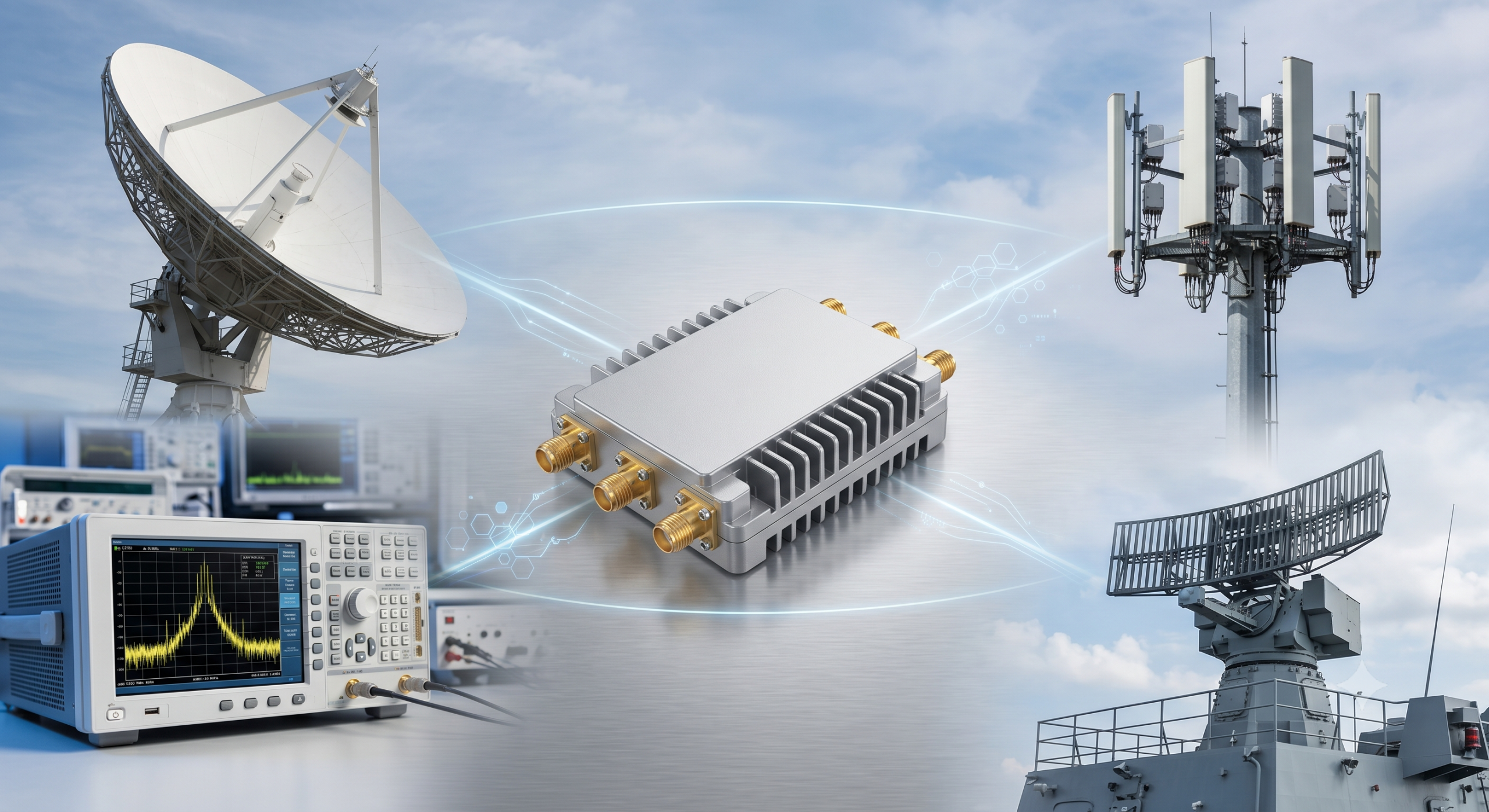
The primary difference between RF amplifier types lies in their optimization for specific performance parameters such as noise figure, peak power output, linearity, or frequency bandwidth. Imagine you are in the final stages of a critical defense project, but your system fails its signal-to-noise ratio requirements due to unexpected signal degradation. This technical bottleneck agitates the entire design cycle, threatening to cause expensive delays and compromise mission-critical reliability. Choosing the correct RF Amplifier from an expert partner is the definitive solution to these integration challenges; you can contact us to find the perfect match for your specific application.
What Are the Core Roles of a Broadband RF Amplifier?
Broadband amplifiers provide moderate gain across a wide frequency spectrum while maintaining a relatively low noise figure. Selecting this RF Amplifier type is common for systems requiring multi-band coverage without switching between different hardware modules.
Balancing Moderate Gain with Low Noise Figures?
These amplifiers are designed to handle signals across several octaves with consistent performance. By utilizing our Standard Platforms, you can achieve rapid project entry without custom development cycles.
- Support for wideband UAV communication.
- SDR-based signal processing.
- Laboratory test environments.
- Broadband interference mitigation.
But that’s not all… these modules are also engineered for thermal stability across the entire band.
Key Takeaway: Broadband amplifiers offer the most versatility for multi-frequency environments, allowing you to simplify your bill of materials by using one unit for multiple bands.
| Feature | Specification | Benefit |
|---|---|---|
| Bandwidth | Multi-Octave | Simplifies system design |
| Gain | Moderate (15-30 dB) | Stable signal boosting |
| Noise Figure | Low to Moderate | Preserves signal integrity |
This specific architecture allows for the following performance breakdown:
How Do Gain Block Amplifiers Strengthen Your System?
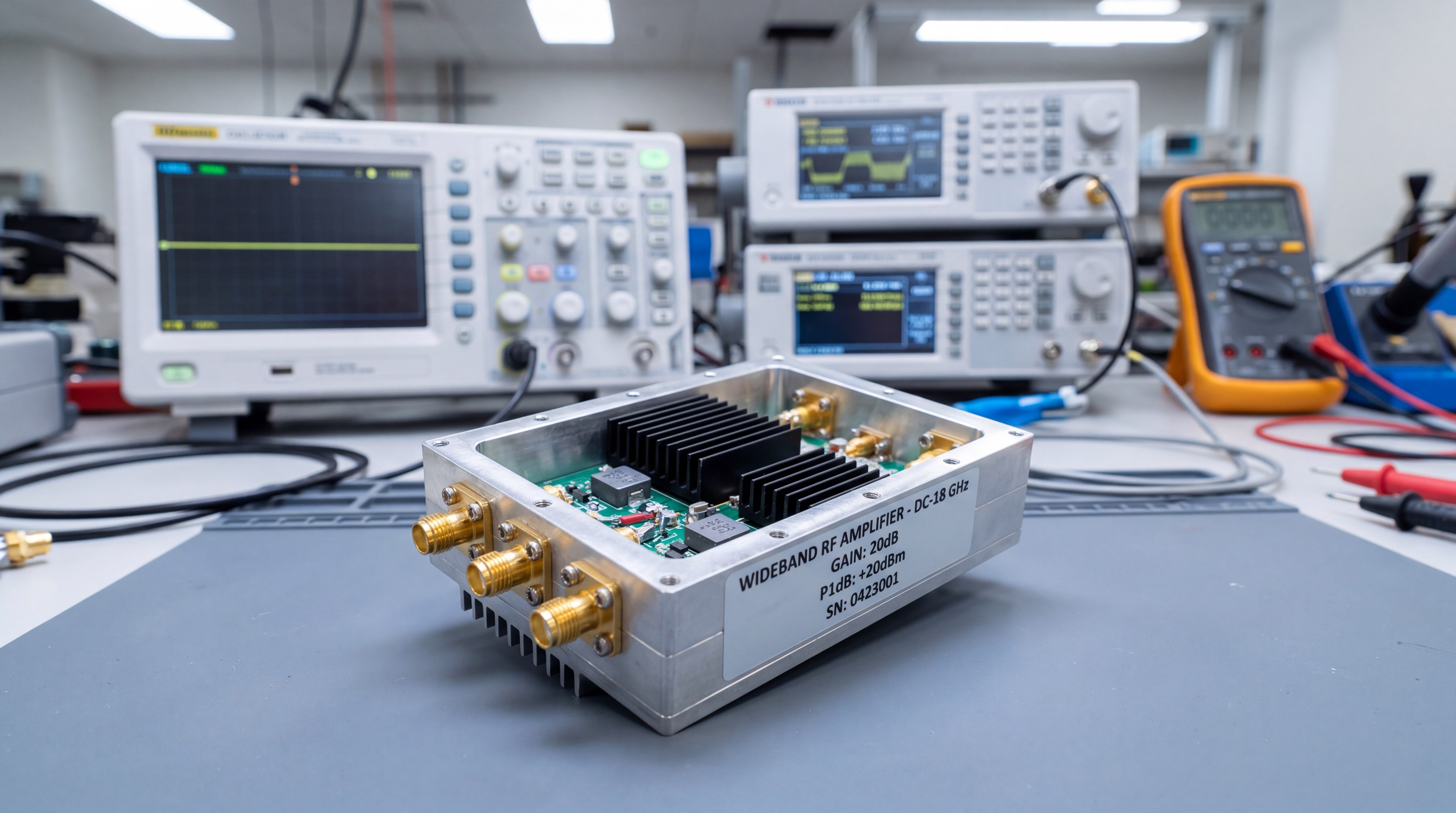
Gain block amplifiers provide high, fixed gain with an integrated matching network for general-purpose signal boosting in various transmitter and receiver stages. An RF Amplifier of this type is typically used in the intermediate frequency (IF) or microwave stages where a simple power boost is required.
Versatile Performance for IF and Microwave Stages?
Gain blocks are often internally matched to 50 ohms, making them exceptionally easy to integrate into existing RF chains. They are favored by engineers who need a “drop-in” solution to overcome trace losses or filter insertion losses.
- Internal 50-ohm matching.
- High gain density.
- Compact form factors.
- Single-supply operation.
Here is the kicker: despite their simplicity, gain blocks are essential for maintaining the link budget in complex microwave subsystems.
Key Takeaway: Using gain blocks reduces the need for external matching components, which saves you valuable PCB space and reduces the risk of impedance mismatches.
| Feature | Specification | Benefit |
|---|---|---|
| Integration | Internally Matched | Easy “drop-in” use |
| Gain | High / Fixed | Reliable signal strength |
| Size | Compact | Saves board space |
The following table summarizes the primary metrics for gain block selection:
Why Use Log Amplifiers for Non-Linear Signal Processing?
Log amplifiers convert the natural logarithm of an input signal’s power into a proportional output voltage to enable wide dynamic range processing. This RF Amplifier type is indispensable when you are dealing with signals that vary by several orders of magnitude in power.
Converting Natural Logs into Precise Output Voltage?
These components are typically used for power measurement and signal detection across a wide range of input levels. They help you visualize or process compressed signals that would otherwise saturate standard linear circuits.
- Wide dynamic range (up to 90 dB).
- RSSSI (Received Signal Strength Indicator) apps.
- Radar return signal processing.
- Optical fiber power monitoring.
Believe it or not, these amplifiers provide the necessary compression to prevent data loss in highly volatile signal environments.
Key Takeaway: Log amplifiers are your best choice for measuring signal strength accurately without the risk of clipping or saturating your measurement hardware.
| Feature | Specification | Benefit |
|---|---|---|
| Curve | Logarithmic | High dynamic range |
| Output | Voltage Proportional | Simple data conversion |
| Usage | Power Detection | Precise signal monitoring |
Review the logarithmic relationship performance in the analysis lead-in below:

Are Variable Gain Amplifiers the Key to Signal Control?
Variable gain amplifiers (VGAs) allow you to dynamically adjust the signal level, often acting as the primary control element in an automated signal chain. Every modern communication RF Amplifier system relies on some form of gain control to handle varying distance and environmental conditions.
Closed-Loop Circuits for Consistent Power Levels?
VGAs are often used in conjunction with feedback loops to maintain a constant output power level regardless of the input fluctuations. This ensures that your digitizers and mixers always operate at their optimal power levels.
- Voltage-controlled gain.
- Digital control options (DVGA).
- Automatic Gain Control (AGC) loops.
- Temperature compensation stages.
Wait, there’s more: the ability to programmatically adjust gain allows your system to adapt to atmospheric changes in real-time.
Key Takeaway: Selecting a VGA gives you the flexibility to tune your system performance on the fly, ensuring maximum signal quality under changing field conditions.
| Feature | Specification | Benefit |
|---|---|---|
| Control | Adjustable | Real-time adaptation |
| Stability | AGC Compatible | Constant signal levels |
| Precision | Fine Resolution | Optimized signal paths |
Consistent power levels lead to the following system-level advantages:
When Should You Prioritize Low Noise Amplifiers?
You should prioritize low noise amplifiers (LNAs) when you need to amplify weak incoming signals without introducing significant thermal noise. In any receiver-side RF Amplifier application, the LNA is the most critical component for determining the sensitivity of your entire system.
Amplifying Weak Signals Without Adding Interference?
The LNA is typically placed at the very front end of the antenna to set the noise figure for the entire receive chain. By minimizing the noise added at this stage, you maximize the overall signal-to-noise ratio (SNR) for the following processing units.
- Ultra-low noise figures (< 1 dB).
- High sensitivity for weak signals.
- Antenna-mounted options.
- Phase noise minimization.
The truth is, without a high-quality LNA, even the most powerful digital signal processor cannot recover data from a noisy background.
Key Takeaway: Investing in a superior LNA directly improves the range and reliability of your receiver, allowing you to capture signals that would otherwise be lost.
| Feature | Specification | Benefit |
|---|---|---|
| Noise Figure | Minimum (< 2 dB) | Maximizes sensitivity |
| Placement | Front-End | Optimizes SNR |
| Signal Level | Low Power | Safe for weak inputs |
Receiver performance metrics are heavily influenced by the LNA characteristics:
Can Power Amplifiers Handle High-Intensity Transmissions?
Power amplifiers (PAs) are the workhorses of the transmit chain, designed to boost signals to the high wattage levels required for long-range transmission. A high-wattage RF Amplifier must manage heat and power consumption while delivering maximum output to the antenna.
Coaxial vs. Waveguide: Matching Power to Frequency?
As frequency and power levels increase, the physical interface of the PA often shifts from coaxial connectors to waveguides. For specialized needs, you can explore High Frequency Amplifiers that support programs from 18 GHz up to 110 GHz.
- High output power (up to kW levels).
- Thermal management integration.
- Efficiency optimization (GaN/GaAs).
- VSWR protection circuitry.
Make no mistake: the power amplifier is the most energy-intensive part of your RF system and requires careful thermal design.
Key Takeaway: Choosing a PA with high efficiency and robust protection ensures your transmitter can operate continuously without thermal failure or damage from antenna reflections.
| Feature | Specification | Benefit |
|---|---|---|
| Power | High (Watts to kW) | Long-range transmission |
| Interface | Coax or Waveguide | Supports high frequency |
| Durability | VSWR Protected | Prevents hardware damage |
The following data outlines the power capabilities for various transmission modes:
What Makes Linear Amplifiers Essential for Data Integrity?
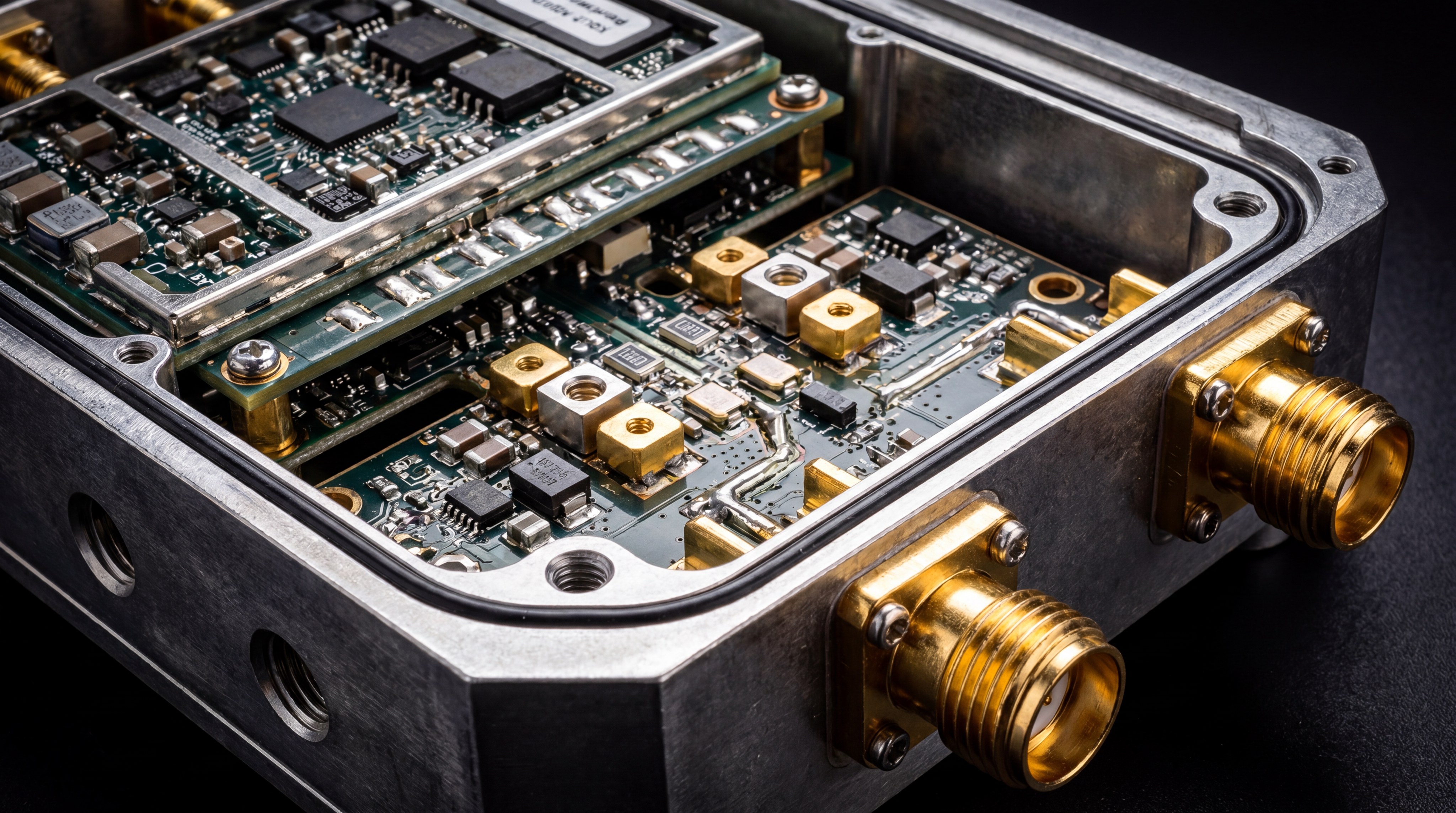
Linear amplifiers are essential because they maintain a proportional relationship between input and output, which is critical for complex modulation schemes. Using a linear RF Amplifier prevents the introduction of intermodulation distortion (IMD) that can corrupt high-bandwidth data streams.
Maintaining Proportional Input-Output Relationships?
When your system uses 64-QAM or 256-QAM, any non-linearity in the amplifier will cause the constellation points to smear. You should explore Custom RF Amplifier Solutions if your project requires ultra-high linearity at specific power levels.
- High Third-Order Intercept (IP3).
- Low Harmonic Distortion.
- Maintains waveform fidelity.
- Optimized for digital signals.
It gets even better: linear amplifiers allow you to pack more data into the same frequency band by reducing spectral regrowth.
Key Takeaway: High linearity is the key to maintaining data integrity and maximizing the throughput of modern digital communication links.
| Feature | Specification | Benefit |
|---|---|---|
| Linearity | High IP3 / P1dB | Clean data transmission |
| Modulation | Supports QAM/OFDM | High-speed throughput |
| Spectrum | Low Out-of-Band | Minimizes interference |
The impact of linearity on signal purity is detailed in the table below:
How Do Bi-directional Amplifiers Extend Network Reach?
Bi-directional amplifiers (BDAs) extend network reach by combining transmit and receive paths into a single hardware unit. This RF Amplifier type acts as an intermediate node, receiving a weak signal from one direction and boosting it for retransmission to another.
Acting as Intermediate Nodes for Distant Locations?
BDAs are commonly used in in-building wireless systems or underground tunnels where traditional signals cannot penetrate. They allow you to maintain a seamless communication link across vast or obstructed areas without installing new base stations.
- Integrated duplexers.
- Simultaneous TX/RX paths.
- High-gain signal boost.
- Automatic leveling control.
But that’s not all… modern BDAs also include noise-blanking technology to ensure only valid signals are amplified.
Key Takeaway: Using a BDA is the most cost-effective way to eliminate dead zones in your facility or coverage area without major infrastructure changes.
| Feature | Specification | Benefit |
|---|---|---|
| Path | Dual (TX & RX) | Complete coverage |
| Reach | Extended | Fills signal dead zones |
| Setup | Node-Based | Simplifies deployment |
Coverage expansion benefits are further illustrated in this summary:
Why Are Hi-Rel Amplifiers Vital for Defense Missions?
Hi-Rel amplifiers are vital for defense missions because they are built to survive extreme mechanical stress and electromagnetic interference. A high-reliability RF Amplifier undergoes rigorous testing to ensure it will not fail during a critical mission in a harsh environment.
Meeting Rigorous Aerospace and Automotive Standards?
These amplifiers often meet MIL-STD or automotive-grade requirements for temperature cycling, vibration, and shock. They provide you with the peace of mind that your hardware will function in the desert, the arctic, or at high altitudes.
- Extended temperature range.
- Shock and vibration testing.
- Hermetic sealing options.
- Long-term MTTF ratings.
The bottom line is: when failure is not an option, Hi-Rel components are the only logical choice for your hardware stack.
Key Takeaway: Choosing Hi-Rel amplifiers reduces the risk of field failures, significantly lowering your long-term maintenance and replacement costs.
| Feature | Specification | Benefit |
|---|---|---|
| Standards | MIL-STD / GJB | Mission-critical safety |
| Environment | Extreme Tolerance | Operates anywhere |
| Lifespan | High MTTF | Reliable long-term use |
Reliability metrics for mission-critical deployments include:

What Advantages Do Pulsed RF Amplifiers Offer in Radar?
Pulsed RF amplifiers offer the advantage of delivering extremely high peak power while maintaining a low average power consumption. This specialized RF Amplifier is designed for short-burst duty cycles common in radar and electronic warfare simulations.
Delivering High Peak Power for Complex Simulations?
Pulsed amplifiers allow for higher resolution in radar systems by enabling very short, high-intensity pulses that can detect smaller targets. You can find specialized Pulsed RF Amplifiers designed for radar and EM environment simulation within our advanced product line.
- High peak-to-average power ratio.
- Fast rise and fall times.
- Controlled duty cycles.
- Optimized for radar pulses.
Here is the kicker: pulsed operation allows the amplifier to run much cooler than a continuous-wave unit of the same peak power.
Key Takeaway: Pulsed amplifiers give you the high-intensity power needed for radar without the massive cooling and power infrastructure required by CW systems.
| Feature | Specification | Benefit |
|---|---|---|
| Duty Cycle | Short Burst | High peak efficiency |
| Power | High Peak Wattage | Sharp target resolution |
| Thermal | Pulsed Cooling | Reduced heat sink size |
The table below highlights the performance advantages of pulsed over continuous architectures:
Conclusion: Mastering Your RF Chain Selection
Understanding the functional distinctions between broadband, low noise, and power amplifiers is the first step toward system optimization. This article has detailed how selecting the right RF Amplifier type directly impacts your system’s range, data integrity, and mission success. At CorelixRF, our vision is to bridge the gap between complex engineering requirements and factory-direct manufacturing excellence, providing unit-level test data to ensure your integration starts with a proven baseline. To finalize your technical path and secure the high-performance hardware your project demands, contact us today.
Frequently Asked Questions
Can I use a broadband amplifier as a power amplifier?
Concise Judgment: Usually not, as broadband amplifiers lack the high-wattage output and thermal protection required for high-intensity transmissions. They are better suited for moderate gain across wide frequencies rather than raw power delivery.
What’s the best amplifier for a receiver front-end?
Concise Judgment: A Low Noise Amplifier (LNA) is definitively the best choice. It provides the necessary gain for weak incoming signals while maintaining the lowest possible noise figure to maximize sensitivity.
How do I know if I need a linear amplifier?
Concise Judgment: You need a linear amplifier if your system uses complex modulation schemes like QAM or OFDM. These signals require a proportional input-output relationship to prevent intermodulation distortion and data corruption.
Can I control the gain of my amplifier remotely?
Concise Judgment: Yes, provided you select a Variable Gain Amplifier (VGA) with digital or voltage-controlled inputs. These allow you to adjust the signal level programmatically as part of an automated control loop.
What’s the best way to handle high-power radar pulses?
Concise Judgment: A Pulsed RF Amplifier is the superior choice for radar. It is specifically designed to deliver high peak power in short bursts, offering better resolution and thermal management than standard CW amplifiers.