
Selecting the wrong component for your signal chain can lead to unexpected signal distortion, hardware failure, or costly system redesigns late in the development cycle. Imagine finishing your RF design only to find that the amplifier generates excessive heat or compresses the signal during a critical transmission, rendering the entire system non-compliant. This guide provides a systematic technical framework for specifying an RF Power Amplifier, ensuring your hardware meets performance, reliability, and budgetary requirements from the start.
To specify an amplifier correctly, you must define the operating frequency range, required gain, linearity requirements, and power efficiency metrics tailored to your application. A high-performance RF Power Amplifier is the heart of modern communication systems, providing the necessary signal boost for everything from satellite links to mobile base stations. By following a structured approach to technical specifications, you can avoid common pitfalls and ensure seamless integration into your radio frequency architecture.
Use these amplifier specs in an RFQ checklist
When specifications move from evaluation to purchasing, CorelixRF can review frequency band, output power, gain flatness, harmonic limits, VSWR protection, control interface and FAT evidence as one RFQ package.
1. What frequency range do you really need?
Specifying the frequency range requires defining the lower and upper operational limits of your signal to avoid out-of-band issues. When you choose an RF Power Amplifier, the operating bandwidth determines whether the component can handle your specific carrier frequencies effectively. You must distinguish between narrowband applications that focus on a single frequency and broadband designs that cover multiple octaves.
How do you define the operating bandwidth?
You define operating bandwidth by identifying the spectrum your signal occupies at any given moment. Selecting a bandwidth that is too wide can actually degrade other performance metrics like noise figure and power efficiency.
But here is the kicker:
- Narrowband amps offer higher efficiency.
- Broadband designs provide more versatility.
- Instantaneous bandwidth determines data throughput.
- Frequency limits must include guard bands.
Can you mix different band types?
You generally cannot mix different band types because the internal matching networks are optimized for specific impedance values across a set range. Using an amplifier outside its designated band can lead to high reflections and potential hardware damage.
You might be wondering:
- AM bands differ significantly from FM.
- Broadband SDR Signal Sources require wide matching.
- Multi-octave designs require specialized architectures.
- Improper frequency matching causes signal loss.
Key Takeaway: Defining Frequency Constraints
Accurately defining your frequency limits ensures the amplifier operates within its most efficient and stable region.
| Parameter | Description | Typical Requirement |
|---|---|---|
| Lower Frequency | The minimum operational limit | Hz / MHz / GHz |
| Upper Frequency | The maximum operational limit | Hz / MHz / GHz |
| Instantaneous Bandwidth | The width the amp covers at once | % or MHz |
The analysis shows that selecting the narrowest possible frequency range for your application maximizes power added efficiency and reduces system noise.
2. How much Gain is required for your signal chain?
Determining the required gain involves calculating the link budget needed to boost your input signal to the target output level. Your RF Power Amplifier should typically provide between 10 dB and 30 dB of amplification to ensure robust signal transmission without overloading subsequent stages. You must balance the need for signal strength with the risk of overwhelming the receiver or causing system oscillation.
What is the ideal power boost?
The ideal power boost is the specific decibel increase required to bring your input signal up to its desired transmission level. You should aim for a gain level that keeps your signal well above the noise floor while remaining within the linear region.
It gets better:
- Gain flatness prevents signal distortion.
- Input power levels dictate gain requirements.
- Target output power must be sustainable.
- Cascaded stages require careful gain distribution.
What are the risks of excessive Gain?
The risks of excessive gain include signal saturation, increased harmonic distortion, and even physical damage to the amplifier or antenna components. If you exceed a 100 dB gain threshold, you run a significant risk of internal feedback and system instability.
But here is the kicker:
- Saturation leads to non-linear behavior.
- High gain increases thermal dissipation needs.
- Oscillations can destroy sensitive front-ends.
- Attenuators may be needed to manage levels.
Key Takeaway: Optimizing the Gain Profile
Balancing gain requirements with thermal and linearity limits is essential for maintaining signal integrity throughout the RF chain.
| Component | Metric | Risk Factor |
|---|---|---|
| Pre-Amplifier | Low Noise / Moderate Gain | Signal Saturation |
| Power Stage | High Gain / High Power | Thermal Dissipation |
This specification matrix indicates that gain must be distributed carefully across stages to prevent early saturation and manage heat effectively.
3. Is the amplifier’s Linearity sufficient for your modulation?
Linearity is the measure of how accurately the amplifier reproduces the input signal shape at the output without adding unwanted distortion. For any RF Power Amplifier, linearity is critical when using complex modulation schemes like QAM or OFDM. High linearity ensures that the spectral mask remains within regulatory limits and that data error rates stay low.
How do you measure signal accuracy?
You measure signal accuracy by evaluating parameters like the 1dB compression point (P1dB) and the third-order intercept point (IP3). These metrics tell you at what point the amplifier begins to deviate from its ideal linear behavior.
You might be wondering:
- P1dB indicates the onset of saturation.
- IP3 measures intermodulation distortion levels.
- Linearity is often expressed as a percentage.
- High IP3 values enable cleaner signals.
How does distortion affect communication quality?
Distortion negatively affects communication quality by introducing bit errors and expanding the signal’s occupied bandwidth into adjacent channels. If your linearity is poor, you will likely experience high Error Vector Magnitude (EVM) and poor system performance.
But wait, there’s more:
- Harmonics can interfere with other users.
- In-band distortion ruins data packets.
- Regulators mandate strict spectral purity.
- Linearization techniques can improve performance.
Key Takeaway: Prioritizing Linear Performance
Ensuring high linearity is the most effective way to maintain high data rates and regulatory compliance in modern wireless systems.
| Metric | Purpose | Ideal State |
|---|---|---|
| P1dB | 1dB Compression Point | Higher is more linear |
| IP3 | Third-Order Intercept | 10dB above P1dB |
Analysis of these metrics reveals that maintaining a 10dB margin between P1dB and IP3 is a standard benchmark for high-fidelity communication.
4. Which Power Type fits your modulation scheme?
Choosing the correct power architecture involves matching the amplifier’s internal circuitry to the peak-to-average power ratio (PAPR) of your signal. Your RF Power Amplifier can be designed as a linear, logarithmic, or exponential type depending on how you need to manipulate the signal strength. Each architecture offers unique trade-offs between signal shape retention and power efficiency.
What are the differences between Linear and Logarithmic Amps?
Linear amplifiers focus on increasing power without altering the signal shape, making them ideal for standard communication protocols. In contrast, specialized architectures like those used in Millimeter-Wave Platforms may employ different scaling to handle high-frequency dynamics.
It gets better:
- Linear amps preserve phase and amplitude.
- Logarithmic amps scale signals for detection.
- Exponential amps can compress dynamic ranges.
- Choosing wrongly leads to data corruption.
How do you choose based on signal dynamics?
You choose based on signal dynamics by analyzing the modulation’s peak power requirements versus its average power levels. High PAPR signals require amplifiers with significant headroom to prevent “clipping” during peak transmission moments.
Think about this for a second:
- Radar signals often require pulsed power.
- Cellular signals demand high linearity.
- Efficiency drops as headroom increases.
- Digital pre-distortion can mitigate clipping.
Key Takeaway: Matching Architecture to Signal
Matching the amplifier architecture to the specific modulation type is critical for achieving the best balance of efficiency and signal purity.
| Amp Type | Primary Use Case | Signal Shape Retention |
|---|---|---|
| Linear | Standard Communications | High |
| Logarithmic | Specialized Signaling | Modified |
The comparison suggests that linear architectures remain the gold standard for most data-driven RF applications where wave shape integrity is paramount.
5. How quiet must the Noise Figure be?
Noise figure is a measure of how much noise the amplifier itself adds to the signal as it passes through the circuitry. For an RF Power Amplifier, a lower noise figure means the system is more sensitive and can detect weaker incoming signals. This specification is most critical in the first stage of a receiver where signal levels are at their lowest.
How does Noise Figure impact the overall system?
The noise figure directly impacts the overall system by determining the maximum distance a signal can travel before becoming unreadable. You want the quietest possible amplifier to ensure that the Signal-to-Noise Ratio (SNR) remains as high as possible.
You might be wondering:
- High noise obscures weak signals.
- Lower NF equals higher sensitivity.
- Thermal noise is a fundamental limit.
- Gain helps overcome subsequent noise.
Where in the chain is noise most critical?
Noise is most critical at the very beginning of the signal chain, often referred to as the Low Noise Amplifier (LNA) stage. If you introduce noise early, no amount of subsequent gain can remove it from the signal.
But here is the kicker:
- First-stage NF dominates the chain.
- Connectors and cables add to the noise.
- Cooling can sometimes reduce noise levels.
- Trade-offs exist between NF and power.
Key Takeaway: Noise Management
Prioritizing a low noise figure in the early stages of your design is the most effective way to improve overall system sensitivity.
| Application | Required NF | System Impact |
|---|---|---|
| Receiver | < 2 dB | Increased sensitivity |
| Transmitter | < 6 dB | Reduced interference |
Detailed analysis indicates that receiver sensitivity is exponentially improved by every decibel reduction in the initial stage’s noise figure.
6. How flat is the Frequency Response?
Frequency response refers to how consistently the amplifier provides gain across its entire operating bandwidth. You need your RF Power Amplifier to have a “flat” response, meaning it amplifies all frequencies within the band by the same amount. If the response is uneven, some parts of your signal will be boosted more than others, leading to distortion.
How do you manage gain variation across the band?
You manage gain variation by specifying a gain flatness tolerance, typically expressed in plus or minus decibels across the frequency range. High-quality amplifiers use internal compensation circuits to ensure that the gain remains stable even as the frequency changes.
It gets better:
- Flatness prevents frequency-dependent errors.
- Ripple should be kept under 1 dB.
- Calibration can correct minor variations.
- Temperature shifts can affect flatness.
When should you use High-Pass or Low-Pass filters?
You should use filters when you need to prevent unwanted out-of-band signals from entering or leaving your amplifier. For example, EMC Amplifiers often utilize filtering to ensure they only interact with the intended test frequencies.
You might be wondering:
- Low-pass filters block high frequencies.
- High-pass filters block low-end noise.
- Bandpass filters isolate the signal.
- Filters can introduce insertion loss.
Key Takeaway: Achieving a Flat Response
Specifying tight gain flatness and appropriate filtering ensures that your signal remains uniform and free from external interference.
| Spec | Tolerance | Context |
|---|---|---|
| Gain Flatness | +/- 1.0 dB | Broadband performance |
| Filter Type | High/Low/Bandpass | Out-of-band rejection |
The data confirms that gain flatness within +/- 1.0 dB is necessary for maintaining the integrity of wideband digital signals.
7. What are the Efficiency and Thermal requirements?
Efficiency measures how much of the DC power consumed by the amplifier is actually converted into useful RF output power. Your RF Power Amplifier must be efficient to minimize heat generation and reduce the operating costs of your system. In many applications, the thermal management of the device is the primary factor limiting its physical size and power output.
How do you calculate Power Added Efficiency (PAE)?
You calculate PAE by subtracting the input RF power from the output RF power and dividing the result by the DC power consumed. This metric gives you a clear picture of how much energy is being wasted as heat during operation.
Think about this for a second:
- Higher PAE reduces cooling costs.
- Battery-powered systems require high PAE.
- Waste heat can damage internal circuits.
- PAE varies with the output power level.
How does size correlate with voltage and current?
Size correlates with voltage and current because higher power levels require larger components and more substantial heat sinks to dissipate the resulting thermal energy. If you need a compact design, you must prioritize higher efficiency to avoid the need for bulky fans or liquid cooling systems.
But wait, there’s more:
- Voltage limits determine maximum power.
- Current handling affects component size.
- Thermal vias help move heat away.
- Active cooling increases system complexity.
Key Takeaway: Maximizing Efficiency
Focusing on Power Added Efficiency is the most effective way to reduce the physical footprint and thermal load of your RF system.
| Efficiency % | Heat Profile | Size Requirement |
|---|---|---|
| < 30% | Very High | Large/Active Cooling |
| > 50% | Moderate | Compact/Passive |
Technical analysis suggests that amplifiers operating above 50% efficiency significantly reduce the need for active cooling and high-maintenance thermal solutions.
8. Is the amplifier intended for Pulsed or CW operation?
Determining whether you need Continuous Wave (CW) or pulsed operation depends entirely on the duty cycle of your intended application. An RF Power Amplifier designed for pulsed operation can often provide much higher peak power than a CW unit of the same size. However, pulsed amplifiers require specific internal protections to handle the rapid switching and high instantaneous current.
How do duty cycles change the specification?
Duty cycles change the specification by defining the ratio of “on” time to “off” time, which directly impacts the thermal stress on the component. If you use a pulsed amplifier for a CW application, it will likely overheat almost immediately due to insufficient thermal dissipation.
It gets better:
- CW requires constant heat removal.
- Pulsed modes allow for higher peaks.
- Duty cycle affects average power.
- Rise and fall times are critical.
Which applications require Pulsed Power?
Applications like radar and medical imaging require Pulsed RF Power Amplifiers to generate high-energy bursts while maintaining a low average thermal load. These systems rely on the ability to transmit significant power in very short durations followed by relatively long listening periods.
You might be wondering:
- Radar needs precise pulse shapes.
- Medical MRI uses pulsed sequences.
- Pulse width affects range resolution.
- Duty cycles are often less than 10%.
Key Takeaway: Pulse vs. CW Selection
Accurately matching the amplifier’s thermal design to your required duty cycle is essential to prevent hardware failure under high-stress conditions.
| Mode | Duty Cycle | Thermal Stress |
|---|---|---|
| CW | 100% | Constant/High |
| Pulsed | 1% – 10% | Intermittent/Peaked |
The comparison highlights that pulsed systems offer higher peak performance but require strict adherence to duty cycle limits to remain operational.
9. How will the amplifier integrate into the RF Front-End?
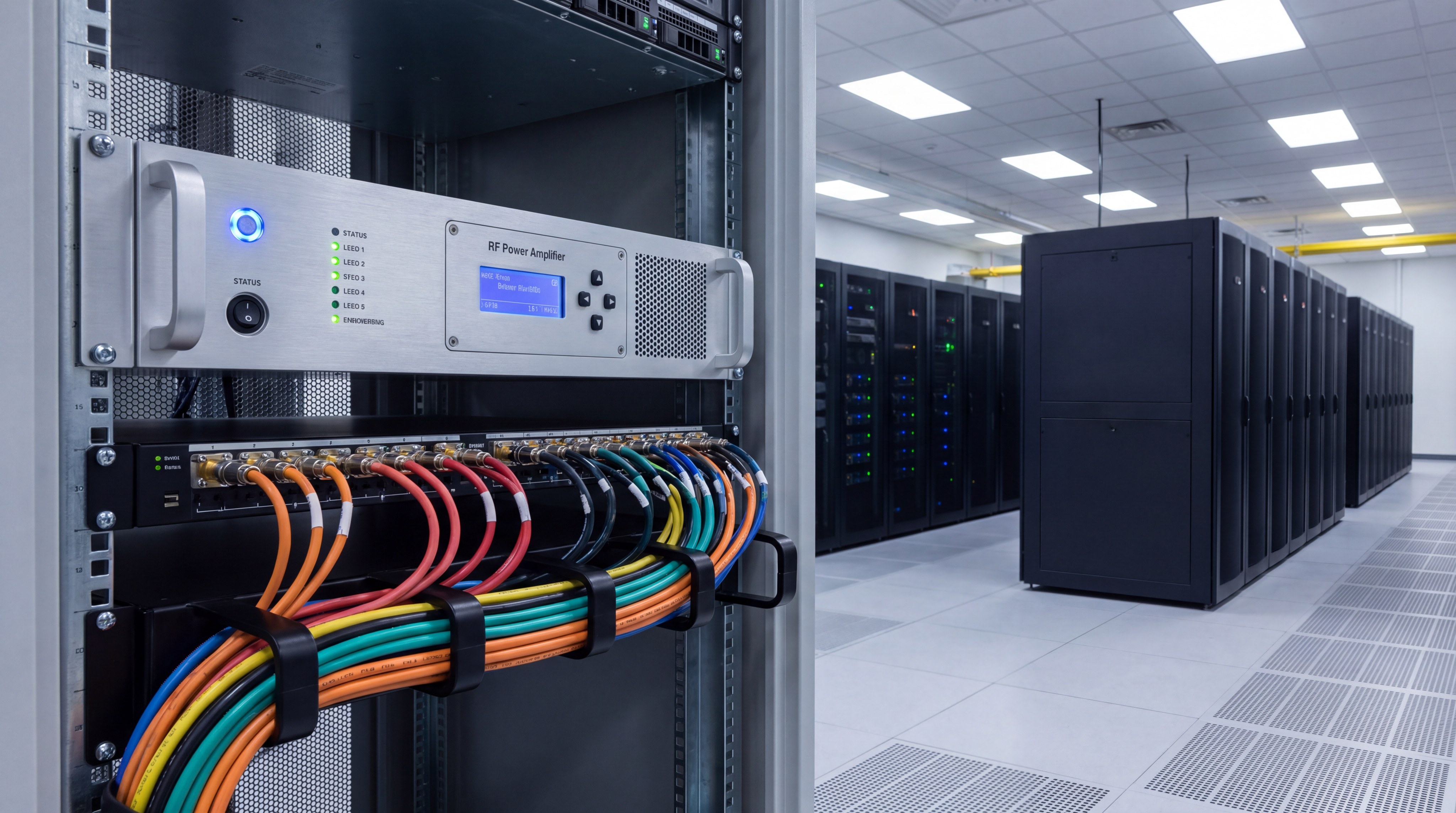
Integration involves matching the amplifier’s mechanical form factor, connector types, and electrical interfaces with the rest of your system hardware. Your RF Power Amplifier must be compatible with the existing signal chain, which usually requires a standard 50-ohm impedance match. Proper integration also means considering the housing, whether it needs to be a rack-mount unit, a benchtop device, or a small module.
What are the mechanical and interface constraints?
Mechanical constraints include the physical dimensions, mounting requirements, and the types of RF connectors (like SMA or N-type) used for input and output. You must also ensure that the RF Front-End Platforms you are using can provide the necessary DC power and control signals.
But wait, there’s more:
- SMA connectors are common for low power.
- N-type connectors handle higher energy.
- Rack units save space in lab environments.
- Module-level designs allow for portability.
Does the system require integrated switching?
Some systems require integrated switching to handle bi-directional signal paths, especially in sophisticated transceiver designs. If your application involves both transmitting and receiving, you may need an amplifier that includes internal PIN diode or relay switches to protect the sensitive receiver hardware.
You might be wondering:
- Switching speed affects latency.
- Isolation prevents receiver damage.
- Integrated paths simplify system design.
- Mismatch can cause signal reflection.
Key Takeaway: Integration and Packaging
A successful specification must account for the mechanical and electrical interfaces to ensure the amplifier fits seamlessly into the larger RF environment.
| Feature | Options | Consideration |
|---|---|---|
| Housing | Rack / Module | Space & Portability |
| I/O Connectors | SMA / N / 2.92mm | Frequency limit |
Analysis shows that early consideration of connector types and housing dimensions prevents costly mechanical rework during the final assembly phase.
10. Does the design meet EMC and Testing standards?
Final validation involves verifying that the amplifier meets all regulatory standards for electromagnetic compatibility and performs as expected under real-world conditions. You should work with an RF Testing and Validation Lab to ensure that your specified component remains stable even when subjected to high reflections or external interference. Compliance with these standards is often a legal requirement for commercial and industrial products.
How do you validate performance in a lab?
You validate performance by testing the amplifier across its full frequency range, power levels, and temperature variations using calibrated instruments. This process confirms that the gain, noise figure, and linearity meet the specifications you defined during the design phase.
It gets better:
- VNA tests confirm impedance matching.
- Spectrum analyzers check for harmonics.
- Thermal chambers test environmental limits.
- Power meters verify output accuracy.
What are the requirements for EMC Immunity?
EMC immunity requirements ensure that the amplifier does not malfunction when exposed to external electromagnetic fields and does not interfere with other nearby electronics. This is particularly important for amplifiers used in mission-critical environments where signal reliability is non-negotiable.
Let’s get down to brass tacks:
- Shielding prevents signal leakage.
- Filtering blocks unwanted interference.
- Robust designs handle high VSWR.
- Standards vary by industry and region.
Key Takeaway: Certification and Final Validation
Final lab validation is the only way to guarantee that your specified amplifier will perform reliably in its intended operational environment.
| Standard | Purpose | Requirement |
|---|---|---|
| EMC | Interference Testing | High robustness |
| VSWR | Reflection Handling | 3:1 or higher |
The summary of testing standards indicates that robustness against high VSWR is a primary indicator of long-term amplifier reliability in field applications.
Conclusion
Specifying an RF amplifier requires a deep understanding of your system’s frequency, power, and linearity needs. We have explored how to balance gain requirements with thermal efficiency and how to ensure your hardware integrates perfectly into your existing RF front-end. By following the systematic technical framework provided in this guide, you can solve the common problems of signal distortion, excessive heat, and spectral non-compliance. At CorelixRF, our vision is to provide engineers with the most reliable and high-performance RF components to power the next generation of communication technology. Whether you need a pulsed solution or a broadband platform, we are here to support your mission-critical designs. To get started on your next project or to request a custom configuration, contact us today and let our experts help you build a better signal chain.
RF Specification FAQ
Can I use a broadband amplifier for a narrowband application?
Yes, but you will likely sacrifice power added efficiency and may introduce more noise into your signal chain than a dedicated narrowband unit would.
What’s the best way to prevent amplifier overheating?
Directly monitor the PAE and ensure you have provided adequate heat sinking or active cooling based on the device’s thermal dissipation specs.
How do I know if my gain is too high?
Immediately check if your output signal is clipping or if your spectrum analyzer shows an increase in unwanted harmonics and intermodulation products.
Can I operate a pulsed amplifier in CW mode?
No, because pulsed amplifiers are not designed for the constant thermal load of CW operation and will almost certainly fail due to overheating.
What’s the best connector type for high-frequency GHz applications?
Generally, you should use SMA or 2.92mm connectors for frequencies up to 40 GHz to maintain proper impedance and minimize signal loss.