
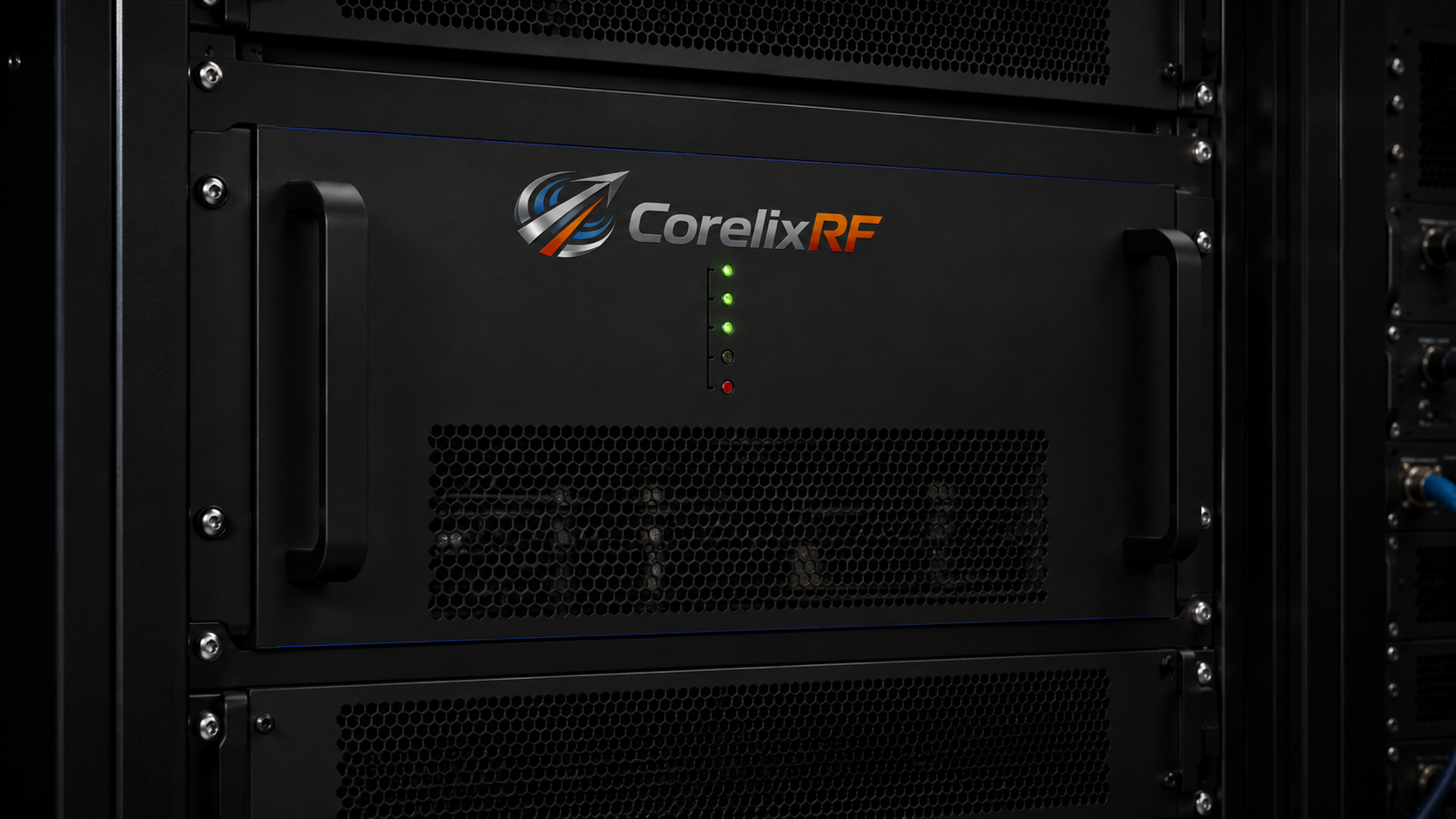
Relevant CorelixRF Products
| Product reference | Frequency range | Output power | Gain | Integration notes |
|---|---|---|---|---|
| CRF-PA-8000M18000M-3200W | 8-18 GHz | 3200 W | 63 dB min. | N-Female input, WRD650 waveguide output, RS485/LAN, air cooling |
Why High Power 8-18 GHz Systems Need Early Integration Review
An 8-18 GHz amplifier used at kilowatt-class output power is a system integration project, not a simple bench accessory. At these power levels, the RF output path, cooling plan, facility power, remote control, load protection, and acceptance-test method should be reviewed before the purchase order is finalized. A headline frequency range and wattage number cannot answer whether the finished system will be practical in a rack, chamber, or outdoor test environment.
CorelixRF source specifications list the CRF-PA-8000M18000M-3200W as a GaN solid-state RF power amplifier covering 8000 MHz to 18000 MHz with 3200 W rated output power and 63 dB minimum small-signal gain. The platform uses an N-Female input and WRD650 waveguide output, supports RS485/LAN control, operates from AC 380 V +/-10% at 50/60 Hz, and is described with air cooling. Monitoring and protection include real-time temperature monitoring, real-time current monitoring, optional forward/reverse power monitoring, optional LAN remote monitoring, over-temperature protection, over-drive protection, over-voltage protection, and VSWR protection/alarm functions.
Confirm the Required Delivered Power
The first checklist item is delivered power, not amplifier nameplate power. If the system includes switches, couplers, waveguide runs, attenuators, feedthroughs, or antennas, the output at the device under test can be meaningfully lower than the amplifier output. Engineers should define the required power at the load or field at the test point, then work backward through known losses.
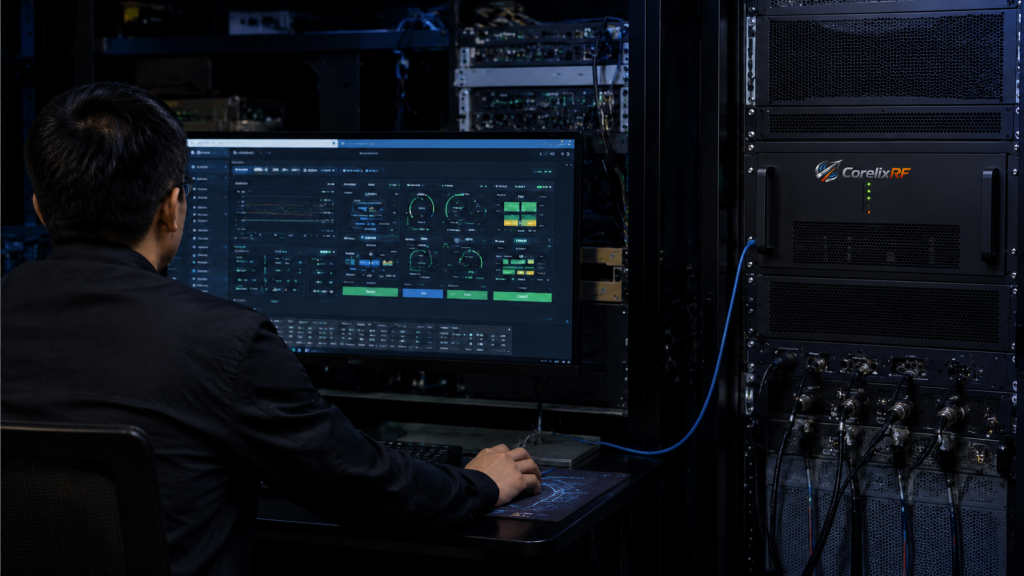
A high power RF amplifier with 3200 W rated output can provide substantial margin, but that margin should be allocated intentionally. Some margin goes to path loss, some to calibration uncertainty, some to aging, and some to operating safety. If the project requires continuous operation at the top of the band, the final test plan should confirm performance across the intended frequency points rather than relying only on a typical value.
Review Gain, Drive Level, and Leveling
The CorelixRF source data lists 63 dB minimum small-signal gain, gain flatness of -6 to +6 dB, and up to 20 dB gain control range. These values support integration with signal generators and automated leveling systems, but they also require clear drive-level limits. The listed maximum input power is 0 dBm. A test system should include software limits, RF-off sequencing, and operator procedures that prevent accidental overdrive.
Automated leveling is especially important when the system spans 8-18 GHz. Source output, cable loss, coupler response, and waveguide behavior can vary across the band. Engineers should decide whether the amplifier gain control, source power control, external attenuator, or test software will carry the correction workload.
Plan the WRD650 Output Path
The CRF-PA-8000M18000M-3200W lists a WRD650 waveguide RF output. That output choice should trigger a mechanical review. Confirm flange compatibility, waveguide routing, bend restrictions, coupler rating, load rating, pressure windows if any, and service access. If the amplifier is feeding an antenna or chamber path, the physical output location can define where the cabinet or rack must sit.
A GaN solid state power amplifier in this power class also needs a mismatch plan. VSWR alarms and reflected-power monitoring can protect the amplifier, but the system should still be designed to prevent avoidable mismatch conditions. Loads, antennas, and switches must be rated for the expected power and duty profile.
Cooling, Power, and Facility Readiness
The source data lists AC 380 V +/-10%, 50/60 Hz and air cooling. Facility readiness should be checked early: power service, grounding, airflow, heat rejection, acoustic limits, rack or cabinet access, and emergency shutdown procedures. A test lab may have enough electrical capacity on paper but insufficient airflow or service clearance in the actual room.
High-power SSPA platforms also benefit from clear maintenance boundaries. Operators should know how to respond to alarms, how to reset faults, what logs to capture, and when to stop testing. Integrators should document how the amplifier communicates over RS485 or LAN and which alarm states are visible to test software.
Use Cases and Boundaries
The source sheet identifies test and measurement instrumentation, communication systems, RF interference/EW system-level testing, and aerospace control systems as primary application areas. This supports a content angle around practical integration, but it does not justify unsupported claims about certifications, customer deployments, inventory, or guaranteed test outcomes. For SEO and engineering trust, the article should stay close to the specification: frequency, power, gain, connectors, cooling, control, protection, and project review process.
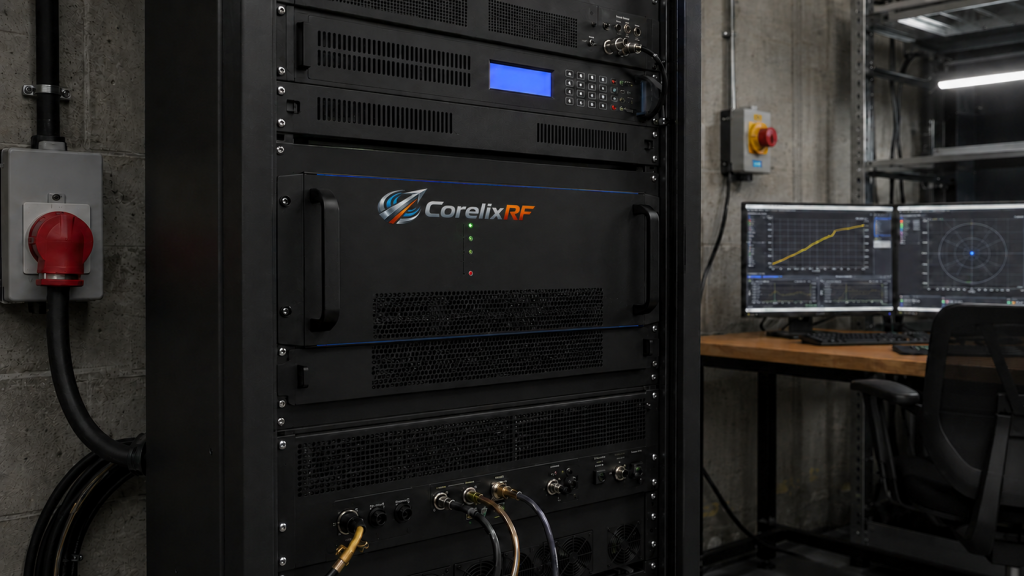
For adjacent designs, engineers can compare CorelixRF 6-18 GHz amplifier platforms or use the broader RF power amplifier category as the starting point. Projects that need custom RF amplifier review should provide the frequency plan, required delivered power, duty cycle, output interface, facility power, and control interface expectations.
FAQ
What is the focus keyword for this article?
The focus keyword is 8-18 GHz high power GaN SSPA.
What output connector is listed for the 3200 W platform?
The referenced source specification lists an N-Female RF input and WRD650 waveguide RF output.
What facility power should be reviewed?
The source specification lists AC 380 V +/-10%, 50/60 Hz. Final facility requirements should be confirmed for the project configuration.
Why is delivered power more important than nameplate power?
Because switches, couplers, waveguide runs, adapters, antennas, and loads can reduce the power available at the actual test point.
Can the amplifier support remote integration?
The source specification lists RS485/LAN control, with optional LAN remote monitoring depending on final configuration.