
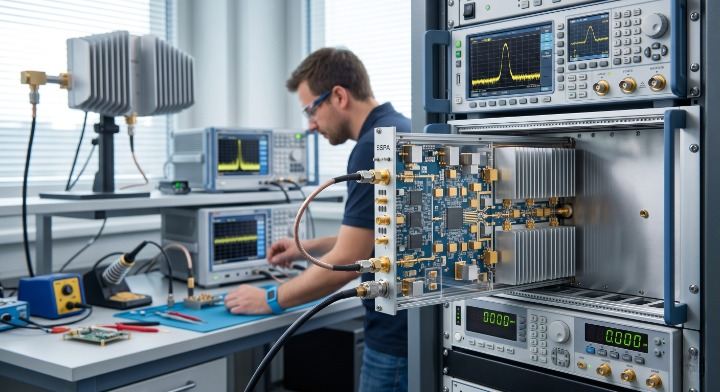
A Solid State Power Amplifier is a modular electronic device that utilizes semiconductor technology to increase the magnitude of an input signal’s power for driving a load. If you are struggling with bulky, fragile vacuum tube systems that constantly fail during critical transmissions, you are not alone. The high maintenance costs and physical footprint of legacy systems can drain your project’s budget and floor space. By integrating a Solid State Power Amplifier from CorelixRF, you gain a high-reliability, compact solution designed for the most demanding RF environments.
What is a Solid State Power Amplifier?
A Solid State Power Amplifier is an electronic component that uses transistors like GaN or GaAs to amplify RF signals to levels sufficient for driving antennas or other loads. You can think of it as the final stage in your transmission chain that converts low-power signals into high-energy waves. It operates without the need for high-voltage power supplies or heated filaments.
How does it differ from voltage amplifiers?
Think about it. While a voltage amplifier focuses on increasing signal amplitude, this device is specifically engineered to provide the current and power necessary to drive a physical load directly. You will find that these units act as the “muscle” of the RF system.
- Directly drives output loads like antennas.
- Handles high current levels for power conversion.
- Acts as the terminal block in the amplification chain.
Why are semiconductors the core of this technology?
Here is the deal: semiconductors allow for instantaneous signal response and extreme durability compared to old-fashioned glass tubes. Because there is no vacuum to maintain, you benefit from a significantly longer operational lifespan.
- Utilizes Silicon, GaAs, or GaN materials.
- Eliminates the “warm-up” time required by tubes.
- Provides a more linear response in high-frequency bands.
Key Takeaway: Solid State Power Amplifiers provide the necessary energy to drive RF loads using durable semiconductor components instead of fragile vacuum tubes.
How has SSPA technology evolved over time?
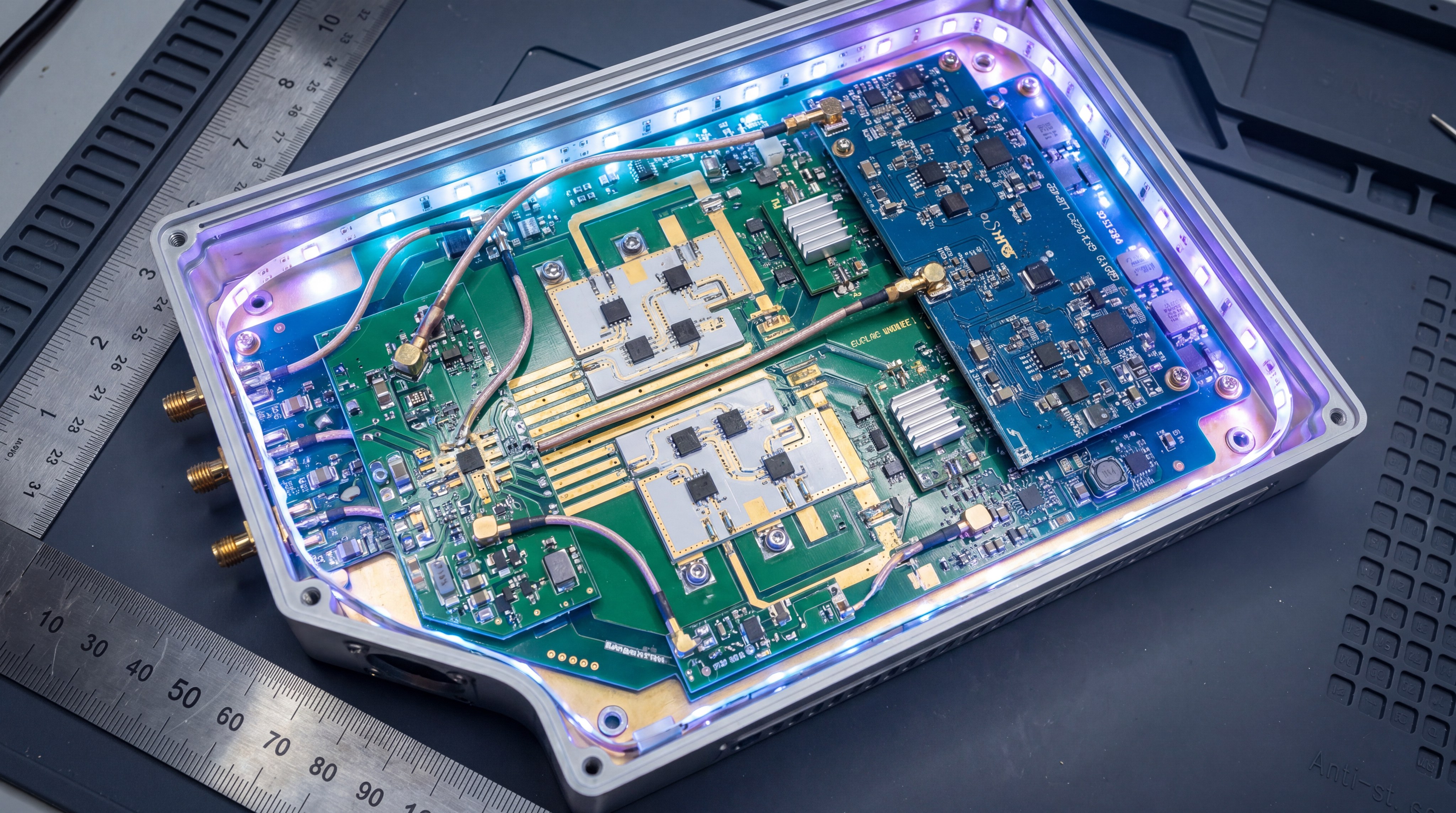
The Solid State Power Amplifier has evolved from early low-power silicon modules into high-efficiency Gallium Nitride (GaN) systems capable of multi-kilowatt outputs. You have likely noticed the industry shift toward the “semiconductor era” as tube technology becomes obsolete for modern bands. This evolution allows you to achieve much higher power density in smaller enclosures.
Why did it replace electron tube technology?
Look: the primary driver for this transition was the need for lower operating voltages and better thermal stability. You no longer have to manage the dangerous kilovolt levels associated with traveling wave tubes.
- Lower total cost of ownership over time.
- Significant reduction in physical weight and size.
- Higher tolerance for mechanical shock and vibration.
What role did GaN play in modern evolution?
It gets better. Gallium Nitride technology has pushed the boundaries of what you can achieve in terms of gain and power-added efficiency (PAE). Specifically, it allows your hardware to handle much higher temperatures and power densities.
- Superior thermal conductivity for heat dissipation.
- Higher breakdown voltage for increased power output.
- Compact die size for miniaturized module designs.
Key Takeaway: The transition to GaN-based semiconductors has made modern amplifiers more reliable, efficient, and physically smaller than legacy tube systems.
| Feature/Application | Details & Typical Ranges | Key Industry Benefit |
|---|---|---|
| Frequency Range | 4 kHz up to 170 GHz | Supports HF, VHF, UHF, and mmWave |
| Power Output | 20 W to 10 kW+ | Scalable from modules to systems |
| Efficiency | High (Semiconductor based) | Low operating voltage and heat waste |
Why choose a Solid State Power Amplifier?
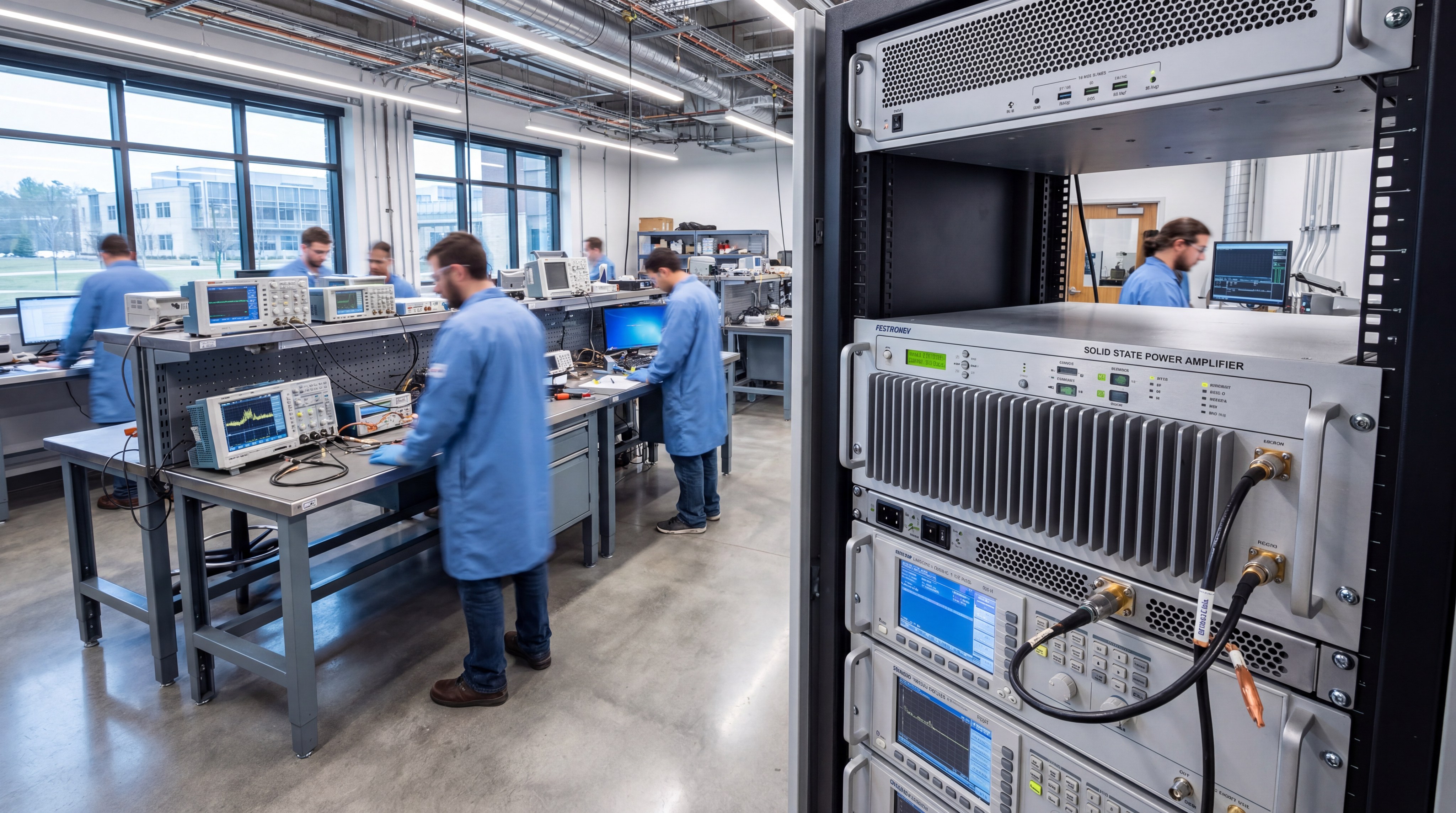
You should choose a Solid State Power Amplifier because it offers unmatched reliability, a compact form factor, and high operational efficiency for long-term deployments. When your project requires 24/7 operation in remote locations, these units ensure that your signal remains consistent without the risk of sudden tube burnout.
How do they improve overall system reliability?
The best part? Because these amplifiers use a distributed architecture, a single transistor failure doesn’t necessarily mean a total system blackout. You get a “graceful degradation” instead of a catastrophic failure.
- Redundant power-combining structures for safety.
- MTBF (Mean Time Between Failures) exceeding 100,000 hours.
- Solid-state design is immune to microphonic effects.
What are the efficiency and size benefits?
Let’s dive in. You can integrate these amplifiers into UAVs or small satellite ground terminals because they lack the heavy transformers and cooling systems needed for tubes. They consume less power and generate less waste heat for the same RF output.
- Modular designs fit into standard 19-inch racks.
- Lightweight enough for airborne and mobile platforms.
- Optimized for high Power-Added Efficiency (PAE).
Key Takeaway: B2B buyers prioritize these units for their long operational life, compact size, and fail-safe power combining architectures.
| Integration Aspect | SSPA Benefit | System Impact |
|---|---|---|
| Form Factor | Compact/Modular | Ease of integration in UAVs and racks |
| Maintenance | Minimal / No tube replacement | Lower long-term operational costs |
| Power Supply | Low voltage DC | Simplified power management units |
Which operating mode fits your RF project?
Selecting a Solid State Power Amplifier depends on whether your application requires a Continuous Wave (CW) or a Pulsed operating mode. You must match the duty cycle of your signal to the thermal and electrical capabilities of the amplifier’s internal circuitry. Choosing the wrong mode can lead to overheating or signal distortion.
When should you use pulsed power amplifiers?
Believe it or not, pulsed amplifiers are essential for radar and electromagnetic simulation where high peak power is needed for short durations. You get the benefit of massive bursts of energy without the thermal load of a constant signal.
- Ideal for radar and range-finding equipment.
- Supports duty cycles from 1% to 50% or more.
- Delivers tens of kilowatts in short bursts.
What are the requirements for CW operations?
Specifically: if you are running FM radio, satellite telemetry, or 5G communications, you need a Continuous Wave (CW) platform. Your hardware must be built with robust thermal management to handle the non-stop heat generation.
- Designed for constant, 100% duty cycle signals.
- Critical for data streaming and voice transmission.
- Requires advanced liquid or forced-air cooling.
Key Takeaway: Pulsed models are specialized for radar and high-peak simulations, while CW models are the industry standard for constant communication links.
| Mode Type | Typical Duty Cycle | Primary Application |
|---|---|---|
| Pulsed | 1% to 20% | Radar, EMC Pulse, Jamming |
| CW | 100% | SATCOM, 5G, FM Transmission |
| Hybrid | Variable | Advanced EW, Lab Testing |
How far does frequency and power coverage reach?
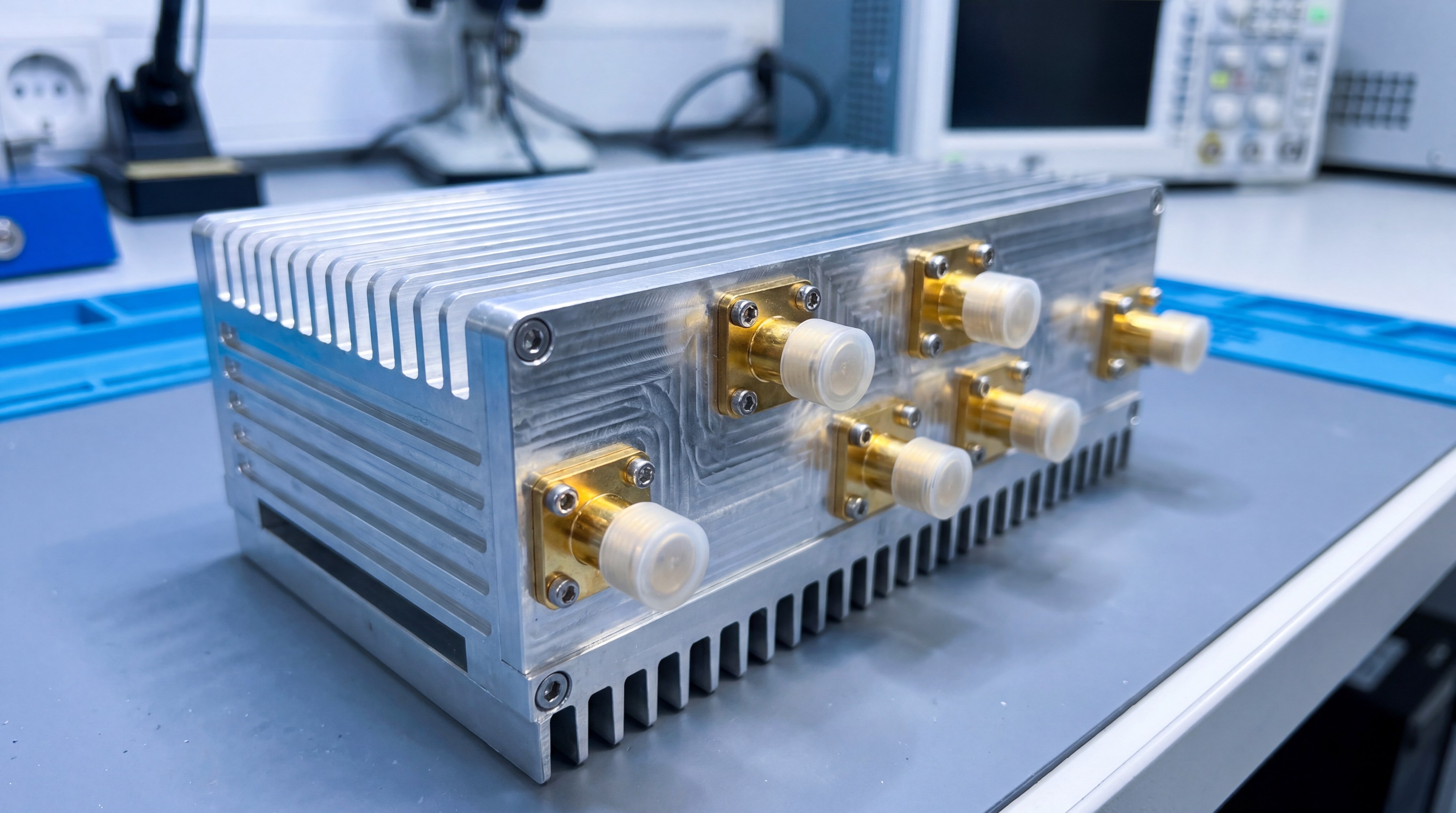
A Solid State Power Amplifier can now cover frequencies from 4 kHz up to 170 GHz, with power levels reaching over 10 kW in some configurations. You are no longer restricted to low frequencies; modern platforms easily handle everything from HF to V-band satellite requirements. This wide range ensures you can find a single manufacturer for all your RF chain needs.
Can SSPAs handle millimeter-wave frequencies?
But wait, there’s more. While millimeter-wave (mmWave) used to be the exclusive domain of tubes, modern solid-state modules now deliver high gain in the 18 GHz to 110 GHz range. You can achieve stable performance even at these extreme frequencies.
- Supports Ka, Q, and V-band satellite links.
- Excellent gain flatness across broadband ranges.
- Compact mmWave modules for terrestrial 5G.
What are the limits of high-power scaling?
The best part? By combining multiple SSPA modules in parallel, you can scale power outputs up to tens of kilowatts. You get a system that is far more manageable than a single massive tube unit.
- Scalable from 20 W modules to 10 kW systems.
- In-house power combining for low insertion loss.
- Rack-level integration for lab-grade power.
Key Takeaway: Modern SSPA platforms support a vast spectrum from kHz to mmWave, with scalable power levels that meet both module-level and system-level requirements.
| Coverage Area | Typical Specs | Example Application |
|---|---|---|
| Broadband | 30 MHz – 6 GHz | UAV Data Links, SDR platforms |
| High Frequency | 18 GHz – 40 GHz | Satellite Up-links (Ka-band) |
| High Power | Up to 10 kW+ | EMC Testing, Industrial Heating |
How does an SSPA support 5G and SATCOM?
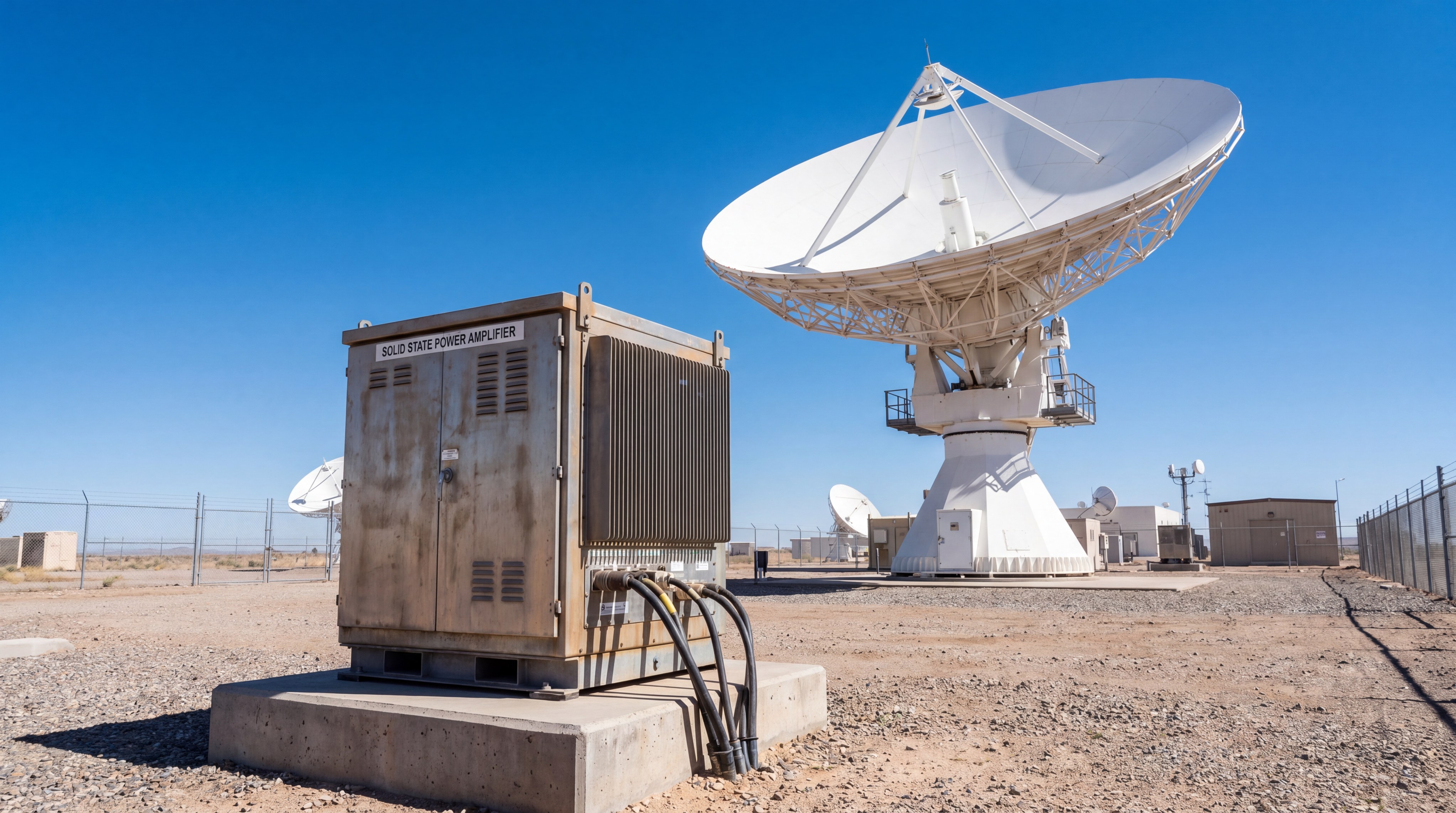
In the telecommunications sector, a Solid State Power Amplifier is the primary driver for signal reach, ensuring that modulated waves can travel long distances to antennas. You will find these units at the heart of 5G network validation and satellite ground stations (BUCs). They provide the gain and linearity required to transmit complex data without interference.
Why is gain flatness critical for 5G testing?
Look: when you are testing 5G protocols, any variation in gain across the frequency band can distort your data. You need a stable baseline to ensure that your network equipment is performing to spec.
- Maintains signal integrity across wide bandwidths.
- Essential for high-order modulation (like 256QAM).
- Reduces error vector magnitude (EVM) in tests.
How do SSPAs power satellite ground stations?
Specifically: Block Upconverters (BUCs) in satellite stations rely on these amplifiers to send signals up to orbiting platforms. You benefit from their ability to withstand harsh outdoor environments while maintaining a stable uplink.
- Handles S, X, Ku, and Ka bands.
- Compact enough for vehicle-mounted terminals.
- Weatherproofed for remote ground station use.
Key Takeaway: SSPA technology is the backbone of modern communications, providing the necessary linearity and power for 5G testing and global satellite links.
| Industry Sector | Typical Hardware | Critical Metric |
|---|---|---|
| 5G / Wireless | Broadband SSPA | Gain Flatness & Linearity |
| SATCOM | BUC / HPA Modules | Reliability & Thermal Control |
| UAV Comms | Lightweight Modules | Size, Weight, and Power (SWaP) |
Where are SSPAs used in EMC and defense?
In defense and laboratory environments, a Solid State Power Amplifier provides the high-power density needed for electronic countermeasures and electromagnetic compatibility (EMC) testing. You can use these units to simulate complex electromagnetic environments where multiple signals compete for bandwidth. They are rugged enough to be deployed in mobile jamming units or stationary lab racks.
How do they facilitate electronic jamming?
Think about it. To effectively jam a signal, you need an amplifier that can broadside a frequency range with high-intensity noise. You can count on these solid-state units to maintain high output without burning out under continuous stress.
- Rapid frequency hopping support.
- High-power density for effective range.
- Wideband coverage to counter diverse threats.
Why are vital for EMC simulation?
Specifically: laboratories use these amplifiers to test if electronic devices can survive interference from other equipment. You need a reliable source of RF energy that can be precisely controlled during the validation process.
- Produces repeatable high-intensity fields.
- Supports ISO and military compliance standards.
- Integrates with automated test software.
Key Takeaway: The reliability and high-power capability of SSPAs make them indispensable for electronic warfare, jamming, and rigorous EMC testing environments.
| Defense/EMC Use | Specific Need | Solution Feature |
|---|---|---|
| EW Jamming | High Power Density | GaN-based power combining |
| EMC Lab | Precision & Control | Digital interfaces & monitoring |
| Simulation | Broadband Coverage | 4 kHz to 110 GHz platforms |
What factors impact RF system integration?
Integrating a Solid State Power Amplifier requires you to balance thermal management, mechanical housing, and electrical interface constraints. You cannot simply plug a high-power module into any system without considering how the heat will be removed. Successful integration depends on matching the amplifier’s physical execution to your specific enclosure and load conditions.
Why is thermal management a top priority?
It gets better. Even though these units are efficient, the heat they do generate must be moved away from the semiconductor die to prevent damage. You must choose between air-cooled or liquid-cooled systems based on your power level.
- Forced air is common for low-to-mid power.
- Liquid cooling handles multi-kilowatt systems.
- Heatsink design impacts total module footprint.
How do custom interfaces improve performance?
Look: having a custom control interface allows you to monitor gain, temperature, and VSWR in real-time. You can protect your investment by setting automated shut-off thresholds if the system detects a mismatch.
- RS485, Ethernet, or TTL control options.
- Real-time telemetry for system health checks.
- Custom connector types (SMA, N-type, Waveguide).
Key Takeaway: Integration success is determined by how well you manage thermal loads and utilize digital interfaces for real-time monitoring and protection.
| Integration Factor | Consideration | Recommended Path |
|---|---|---|
| Cooling | Heat waste dissipation | Forced air or liquid plates |
| Interface | Monitoring & Protection | Ethernet / RS485 for telemetry |
| Connectors | Signal loss & VSWR | Precision matched SMA or N-type |
How is Solid State Power Amplifier quality verified?
Every Solid State Power Amplifier must undergo a rigorous 3-stage inspection process to ensure that the delivered unit matches the published specifications. You should demand unit-level test data, including output power, gain flatness, and VSWR protection, before any hardware reaches your bench. Quality management systems like ISO 9001 and GJB 9001C are the gold standard for reducing integration risks.
Why is unit-level test data essential?
The best part? When you receive a data log for the specific serial number you purchased, you can be confident in its performance. You won’t have to guess if the gain is flat across your operating band.
- Verified gain, power, and harmonics data.
- Individual test records for every unit.
- Eliminates “lot-sampling” uncertainty.
What do ISO 9001 and GJB 9001C signify?
Specifically: these certifications prove that the manufacturer follows a controlled engineering and production path. You are buying from a facility that prioritizes repeatability and traceability in its manufacturing chain.
- Standardized quality management systems.
- Defense-grade production standards.
- Traceability for all internal components.
Key Takeaway: Procurement teams must prioritize manufacturers with unit-level testing and certified quality systems to ensure consistent performance and reliability.
| Quality Standard | Meaning | Buyer Benefit |
|---|---|---|
| ISO 9001 | Quality Management System | Consistent production process |
| GJB 9001C | Defense Quality Standard | High reliability for mission-critical |
| Unit Test Data | Actual measured performance | Integration confidence & validation |
How to select the right SSPA manufacturer?
To select the right manufacturer for a Solid State Power Amplifier, you should prioritize those who offer factory-direct engineering support and a clear path from feasibility to delivery. You need more than just a catalog reseller; you need a partner who can review your frequency, power, and duty mode requirements. Seeking a manufacturer with in-house CNC and RF design capabilities will save you time and integration headaches.
What technical specs should you prioritize?
Believe it or not, focusing solely on price often leads to choosing an under-powered or poorly cooled unit. You must focus on gain flatness, VSWR protection, and thermal efficiency to ensure long-term success.
- Match frequency and power to the duty cycle.
- Check for comprehensive protection circuits.
- Request detailed datasheets before RFQ.
Why is factory-direct engineering support key?
Specifically: talking directly to an RF engineer allows you to customize the mechanical housing or control interface to fit your specific enclosure. You get faster response times and more accurate technical advice than you would from a distributor.
- Direct access to RF design teams.
- Custom OEM/ODM capability support.
- Faster lead times without markups.
Key Takeaway: Technical buyers should seek manufacturing partners who provide engineering reviews, unit-level data, and custom integration support rather than standard catalog sales.
| Selection Criteria | Importance | Why it Matters |
|---|---|---|
| Engineering Review | High | Ensures hardware fits real-world specs |
| Factory-Direct | High | Direct support and lower lead times |
| Customization | Medium | Tailored interfaces and form factors |
Frequently Asked Questions
Can I use a pulsed SSPA for continuous wave transmissions?
No, you should not use a pulsed amplifier for CW mode because its thermal management is typically not designed to handle the constant heat dissipation of a 100% duty cycle signal.
What’s the best way to cool a high-power SSPA system?
The best way depends on your power level; air-cooled systems are usually sufficient for low-to-mid power, while high-power systems (over 1 kW) typically require liquid cooling plates.
How does GaN technology benefit my RF project?
GaN technology provides higher power density and better efficiency than older silicon-based designs, allowing you to achieve more power in a much smaller physical footprint.
Why should I request unit-level test data?
You should request unit-level data because it provides the actual measured performance of your specific unit, ensuring it meets your gain and power requirements before you start integration.
Is it possible to customize the mechanical housing of an SSPA?
Yes, most factory-direct manufacturers like CorelixRF can customize the housing, connector types, and cooling interfaces to meet your specific OEM or project constraints.
Conclusion
Choosing a Solid State Power Amplifier is a strategic decision that directly impacts the reliability, efficiency, and success of your RF systems. Whether you are building 5G infrastructure, advanced satellite stations, or high-power EMC labs, the move toward semiconductor-based amplification is the standard for modern excellence. At CorelixRF, our vision is to empower your engineering projects with high-frequency coverage, multi-kilowatt power platforms, and factory-backed quality. If you are ready to move from technical requirements to a validated RF solution, we invite you to contact us today for a comprehensive engineering review.