
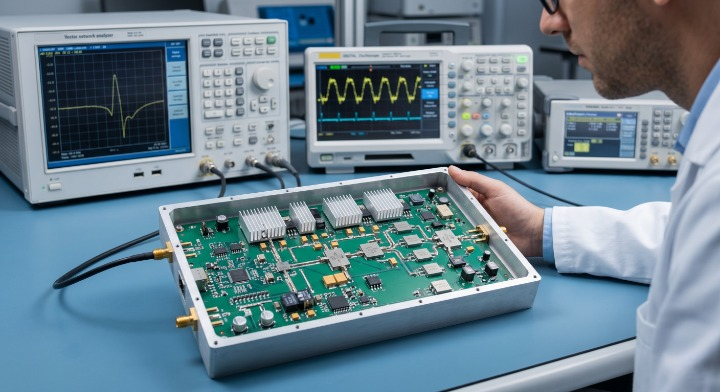
A Solid State Power Amplifier provides high-efficiency signal boosting using semiconductor technology to replace traditional vacuum tubes in critical RF missions. Imagine a defense radar system failing during a high-stakes reconnaissance mission because a legacy vacuum tube reached its end-of-life without warning. This unexpected downtime doesn’t just halt operations; it compromises safety and leads to massive logistical costs. By switching to solid-state architecture, you eliminate these catastrophic failures and ensure constant readiness in the field.
What defines a Solid State Power Amplifier?
A Solid State Power Amplifier is an electronic device that utilizes semiconductor transistors rather than vacuum tubes to amplify radio frequency signals. This modern approach relies on advanced materials to handle power conversion effectively across various bands.
The Shift from Vacuum Tubes to Transistors
Let’s break it down. When you move away from vacuum-based technology, you are choosing a system that does not require high-voltage power supplies or fragile glass envelopes. You gain a more ruggedized solution that can withstand physical shocks and extreme vibration.
- Gallium Nitride (GaN) Transistors
- Silicon Carbide (SiC) Substrates
- Integrated Control Circuitry
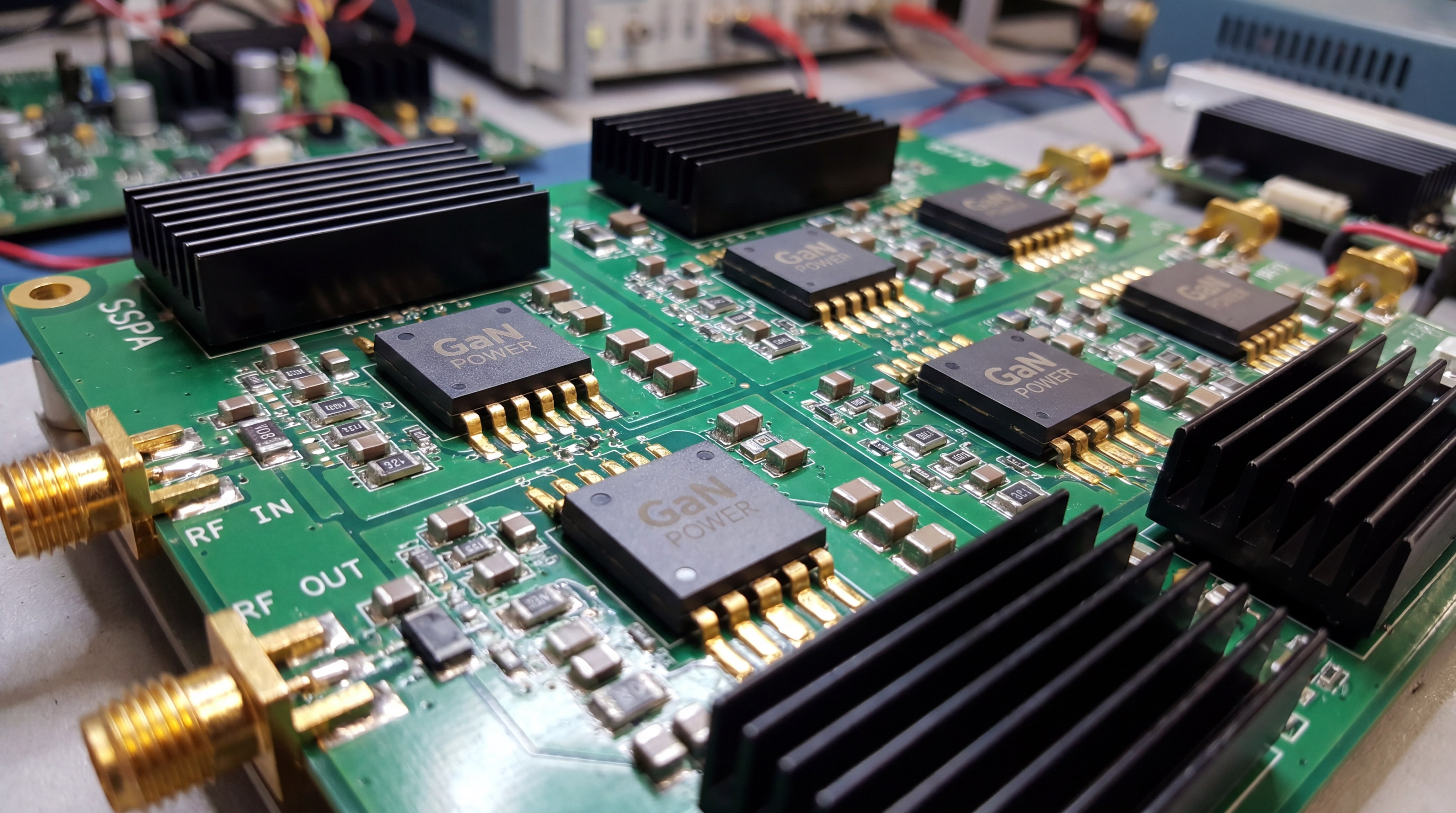
- High-Performance Heat Sinks
Core Architecture of Modern RF Amplification
Think about it. The internal structure of these devices is designed for maximum thermal efficiency and signal purity. You will find that the modular nature of these components allows for easier repairs and upgrades compared to legacy systems.
- Multi-stage gain blocks
- Thermal management modules
- Low-loss output combiners
- Digital monitoring interfaces
Key Takeaway: Adopting solid-state technology ensures your systems are more durable and easier to maintain over long-term deployments.
| Feature | Solid State Benefit |
|---|---|
| Component Type | Semiconductor Transistors |
| Durability | High shock resistance |
| Maintenance | Low (No consumable tubes) |
Integrating these units into your rack significantly reduces the risk of sudden mission-critical hardware failure.
Why choose SSPA over traditional TWTAs?
A Solid State Power Amplifier offers significantly higher reliability and a much longer operational life compared to Traveling Wave Tube Amplifiers (TWTAs). These systems are preferred because they do not have a “wear-out” mechanism like the cathodes found in tubes.
Superior Reliability and Component Longevity
Here is the kicker. While a tube might fail suddenly after a few thousand hours, a solid-state system can run for decades with minimal degradation. You won’t have to worry about the intensive warm-up periods that plague older technology.
- Zero warm-up time
- No high-voltage hazards
- High Mean Time Between Failures (MTBF)
- Stable performance over time
Compact Form Factor for Mobile Applications
But wait, there is more. Because these amplifiers are built on semiconductor wafers, they are much smaller and lighter than their vacuum-based counterparts. You can easily integrate them into mobile command centers or portable communication kits where space is at a premium.
- Weight reduction for transport
- Miniaturized circuitry
- Low profile housings
- Dense component packaging
Key Takeaway: The transition to solid-state hardware results in a smaller physical footprint and drastically reduced maintenance schedules.
| Metric | SSPA Advantage |
|---|---|
| Size | Ultra-compact and lightweight |
| Power Up | Instantaneous activation |
| Life Cycle | 100,000+ hours |
The reduction in physical volume allows for more complex multi-functional payloads in mobile RF units.

What are the key technical specifications?
Key specifications for a Solid State Power Amplifier include gain, output power, linearity, and operating frequency range. Understanding these metrics is essential for ensuring your signal remains clear even at the edge of your operational range.
Understanding Gain and Output Power Metrics
But that’s not all. When you evaluate an amplifier, you must look at the P1dB compression point to understand where the device begins to saturate. You need an amplifier that maintains high gain without distorting the underlying data stream.
- Gain (measured in dB)
- Saturated Output Power (Psat)
- Noise Figure
- Harmonics Suppression
Frequency Band Capabilities and Linearity
You might be wondering. Modern RF environments are crowded, so you require an amplifier that offers excellent linearity across its entire operating bandwidth. High-quality designs ensure that you avoid intermodulation distortion that can interfere with neighboring channels.
- Wideband frequency coverage
- Low intermodulation distortion
- Flat frequency response
- Phase stability metrics
Key Takeaway: Precise technical specifications allow you to tailor your RF link for maximum data throughput and signal clarity.
| Specification | Typical Value Range |
|---|---|
| Bandwidth | Multi-octave support |
| Gain Stability | +/- 1.5 dB |
| Operating Temp | -40°C to +85°C |
Rigorous testing of these specifications ensures the hardware survives the harshest electromagnetic environments.
How does SSPA enhance drone communications?
A Solid State Power Amplifier enhances drone systems by providing high-power transmission capabilities within a very low weight and power budget. This efficiency allows unmanned aerial vehicles to stay airborne longer while maintaining a secure data link.
Minimizing Payload for Airborne Systems
Think about it. Every gram of weight you save on an amplifier is a gram you can use for extra fuel or sensors. You can achieve high-wattage output without the heavy cooling systems required by older amplification methods.
- Reduced cooling requirements
- Low DC power consumption
- Lightweight aluminum housing
- Vibration-proof construction
Ensuring Signal Integrity in Hostile Environments
But wait, there is more. When your drone is operating in an environment with heavy interference, you need the raw power of a solid-state system to punch through the noise. You can rely on these modules to maintain a constant video feed even at extreme distances.
- High signal-to-noise ratio
- Robust link reliability
- Anti-jamming power levels
- Constant envelope modulation
Key Takeaway: SSPAs are the ideal choice for UAVs because they balance high output power with the strict weight constraints of flight.
| Benefit | Impact on UAV Operations |
|---|---|
| Weight | Increased flight endurance |
| Efficiency | Lower battery drain |
| Ruggedness | Survives high-G maneuvers |
The strategic use of lightweight amplifiers directly translates to longer mission durations and better intelligence gathering.
Where are SSPAs used in modern radar?
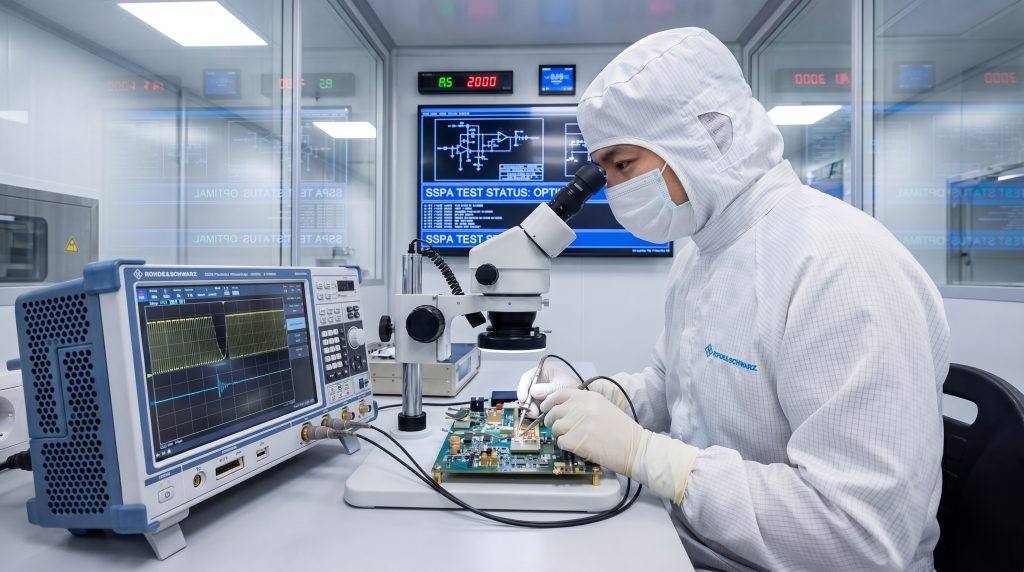
Modern radar systems utilize a Solid State Power Amplifier to achieve the precise pulse control and rapid frequency hopping required for stealth detection. These amplifiers are the backbone of Active Electronically Scanned Array (AESA) technology.
Precision Pulse Control and Linearity
Sound too good to be true? In a radar application, you need to be able to switch frequencies in nanoseconds to avoid jamming. The fast switching speeds of transistors allow you to generate complex waveforms that vacuum tubes simply cannot replicate.
- Rapid pulse modulation
- Frequency agility
- Low phase noise
- High duty cycle support
Multi-channel Integration and Scalability
You see. Because these amplifiers are so small, you can pack hundreds of them into a single radar face. This allows you to perform “graceful degradation,” where the loss of one module doesn’t mean the failure of the entire radar system.
- Modular array architecture
- Scalable power combining
- Parallel signal processing
- Redundant element design
Key Takeaway: The modularity of solid-state radar ensures that your defense systems remain operational even if individual components are damaged.
| Radar Type | SSPA Application |
|---|---|
| AESA | Individual element amplification |
| Weather Radar | Precise pulse shaping |
| SAR | High-resolution imaging |
Scalable architectures allow for cost-effective upgrades as mission requirements evolve over time.
What role does mmWave play in SSPA?
The role of mmWave in Solid State Power Amplifier design is to provide the massive bandwidth necessary for next-generation 5G and satellite communications. Operating at frequencies above 24 GHz allows you to transmit data at speeds that were previously impossible.
Scaling Power at Higher Frequencies
You might be wondering. How do we get enough power out of such tiny components at high frequencies? By utilizing Gallium Nitride on Silicon (GaN-on-Si), you can achieve high power density even in the millimeter-wave spectrum.
- 24 GHz to 110 GHz coverage
- High power density
- Integrated waveguide interfaces
- Wide modulation bandwidths
Future-Proofing 5G and SatCom Networks
But wait, there is more. As the world moves toward 6G and ubiquitous satellite internet, you will need amplifiers that can handle these complex high-frequency signals. You can future-proof your infrastructure by investing in mmWave-ready solid-state hardware today.
- Backhaul network support
- High-throughput satellite links
- Narrow beamforming capability
- Low-latency data paths
Key Takeaway: mmWave SSPAs provide the high-frequency backbone needed for the next decade of global telecommunications growth.
| Category | mmWave Specification |
|---|---|
| Frequency | Ka-Band, V-Band, W-Band |
| Application | SatCom / 5G Backhaul |
| Connector Type | WR-Standard Waveguide |
Transitioning to mmWave bands is necessary to satisfy the ever-growing demand for wireless data capacity.

Is SSPA more cost-effective in the long run?
A Solid State Power Amplifier is more cost-effective because it significantly reduces the total cost of ownership through energy efficiency and zero maintenance. While the upfront price might be higher, you save money by eliminating the need for periodic replacements.
Analyzing Total Cost of Ownership (TCO)
It gets even better. When you calculate the cost of cooling and the electricity required for a TWTA, the solid-state option usually pays for itself within a few years. You also avoid the expensive labor costs associated with recalibrating systems after a tube swap.
- Lower electricity bills
- Reduced HVAC cooling costs
- No spare parts inventory for tubes
- Faster deployment times
Eliminating Periodic Tube Replacements
Think about it. Vacuum tubes are essentially light bulbs that eventually burn out, requiring your team to go on-site for repairs. With a solid-state solution, you can install the unit and essentially forget about it for its entire service life.
- Eliminated repair travel costs
- Consistent system uptime
- Long-term asset stability
- Predictable operational budget
Key Takeaway: Investing in solid-state technology protects your budget from the recurring costs of hardware failure and manual labor.
| Cost Factor | SSPA Savings |
|---|---|
| Maintenance | Near-zero over 10 years |
| Energy | 30-50% more efficient |
| Downtime | Minimal mission interruptions |
Long-term financial planning should prioritize hardware that minimizes operational expenditures over the project’s life.
How do SSPAs integrate with antenna systems?
A Solid State Power Amplifier integrates with antenna systems by providing a matched impedance source that maximizes the power delivered to the radiating element. This synergy is critical for optimizing the Link Budget and achieving the desired Effective Isotropic Radiated Power (EIRP).
Optimizing Link Budget and EIRP
Why does this matter? If your amplifier and antenna are not perfectly matched, you lose power to reflections, which can actually damage your hardware. You need a system that offers high isolation and low VSWR to ensure every watt reaches its destination.
- Low Insertion Loss
- High Isolation
- Impedance Matching (50 Ohm)
- Phase Matching for Arrays
Directional Beamforming Applications
But wait, there is more. You can use multiple small amplifiers to drive individual elements in a phased array antenna. This gives you the ability to steer your radio beam electronically without ever moving the physical antenna structure.
- Digital phase shifting
- Electronic beam steering
- Adaptive nulling
- Focused signal delivery
Key Takeaway: Proper integration between the amplifier and antenna is the most effective way to increase your communication range.
| Parameter | Integration Goal |
|---|---|
| VSWR | Better than 1.5:1 |
| Connector | SMA / N-Type / Waveguide |
| Beamsteering | Electronic phase control |
Precise phase and amplitude control at the amplifier level is the secret to high-performance beamforming.
Can SSPAs handle low-frequency applications?
A Solid State Power Amplifier is highly effective for low-frequency applications such as VHF and UHF tactical radio networks. These devices provide unmatched stability and power density for sub-GHz communication systems.
VHF and UHF Band Performance Excellence
You see. Even at lower frequencies, the benefits of solid-state technology apply, including ruggedness and instant-on capability. You can use these amplifiers for everything from public safety broadcasts to military jamming systems.
- 30 MHz to 512 MHz range
- High power output (up to kW)
- Multi-mode modulation support
- Compact rack-mount designs
Versatility in Mobile Radio Networks
But wait, there is more. When you are deploying mobile radio stations, you need an amplifier that can handle various modulation types without overheating. You will find that modern solid-state designs are versatile enough to support voice, data, and video simultaneously.
- Flexible waveform support
- High dynamic range
- Continuous wave (CW) capability
- Interoperable frequency bands
Key Takeaway: Low-frequency SSPAs provide the reliability needed for mission-critical voice and data links in the field.
| Band | Frequency Range | Common Use |
|---|---|---|
| VHF | 30 – 300 MHz | Tactical Radio |
| UHF | 300 – 3000 MHz | Mobile Data |
| Sub-GHz | 30 – 1000 MHz | Jamming / EW |
The inherent stability of transistors makes them perfect for the varying signal conditions found in low-band operations.
What are the emerging trends in SSPA tech?
The emerging trends in Solid State Power Amplifier technology focus on the adoption of “Green RF” and the use of artificial intelligence for real-time thermal management. The industry is moving toward higher power densities that allow for even smaller devices.
The Transition to Gallium Nitride (GaN)
The bottom line? GaN is the future of RF power. You can now get more power out of a smaller chip than was ever possible with traditional silicon, which reduces the overall size of your system.
- Higher breakdown voltage
- Better thermal conductivity
- Increased power density
- Wider operational bandwidths
Green Energy and Sustainability Standards
Think about it. As data centers and communication hubs expand, reducing energy consumption is becoming a legal and ethical requirement. You can meet these new sustainability standards by using high-efficiency amplifiers that waste less energy as heat.
- Energy star compliance
- Carbon footprint reduction
- Smart biasing techniques
- Recyclable materials usage
Key Takeaway: Future-proofing your RF systems requires a move toward high-efficiency materials like GaN that support global sustainability goals.
| Trend | Market Impact |
|---|---|
| GaN-on-SiC | Extreme power density |
| AI-Biasing | Real-time efficiency tuning |
| Liquid Cooling | High-power industrial use |
Adopting these trends now ensures your infrastructure remains competitive and compliant with future regulations.
Conclusion
The evolution of RF technology has made the solid-state approach the only logical choice for professionals who value uptime and performance. From the depths of sub-GHz tactical radios to the cutting-edge of mmWave 5G networks, these systems offer a level of durability that legacy vacuum tubes simply cannot match. By prioritizing efficiency, weight reduction, and long-term cost savings, you are positioning your organization for success in an increasingly complex electromagnetic landscape.
Are you ready to revolutionize your RF infrastructure with the world’s most reliable amplification modules? We invite you to contact us today to discuss your custom project requirements. Our vision is to empower your mission with hardware that never sleeps and never fails, ensuring your signal stays strong no matter where the mission takes you.
Frequently Asked Questions (FAQ)
Can I replace my existing TWTA with an SSPA?
Yes, you can. Modern solid-state units are often designed as “drop-in” replacements with compatible interfaces and power requirements, though you should verify the cooling and gain specifications first.
What’s the best material for a high-frequency amplifier?
Gallium Nitride (GaN) is currently the gold standard. It offers superior power density and thermal properties compared to traditional LDMOS or Gallium Arsenide (GaAs) at higher frequencies.
How do I know if my amplifier is failing?
Check for a gradual drop in gain or an increase in the DC current draw. Unlike tubes which fail catastrophically, solid-state devices often show subtle performance shifts that give you plenty of time to plan a maintenance window.
Can I customize the frequency band of my SSPA?
Yes, most professional B2B providers offer customization for specific military or industrial bands. This ensures your amplifier is optimized for your exact operational window rather than a generic wideband range.
What’s the best way to cool a high-power SSPA?
For most applications, forced air cooling with high-performance heat sinks is sufficient. However, for ultra-high-power industrial or radar systems, liquid cooling plates may be used to maintain optimal junction temperatures.