
Authorized RF Review Boundary
Counter-UAS RF Antenna Alignment Review is maintained as a compliance-first engineering page. CorelixRF discusses regulated counter-UAS RF topics only for authorized programs with documented scope, lawful operating boundaries and buyer-side approval.
- RF front-end platform review for amplifier, antenna, source and control interfaces.
- Custom RF system review for enclosure, thermal, control and documentation needs.
- RFQ checklist for band, power, duty cycle, load, interface and acceptance inputs.
- Delivery documentation for inspection records, test curves and FAT-style evidence.
- Contact CorelixRF engineering sales with authorized project documents.
This page does not provide public deployment, evasion, interference, power-setting or bypass instructions. If a project cannot document legal authority, the correct next step is compliance review.
Primary Topic Hub and RFQ Path
This primary guide now consolidates related authorized C-UAS and RF safety review topics. Use it for lawful scope definition, RF interface review, documentation and factory RFQ preparation.
- How to Choose the Right Jammer Antenna for Drone Defense? – consolidated reference
For regulated counter-UAS or interference-adjacent topics, CorelixRF keeps the discussion at authorized RF engineering review, documentation, test evidence and procurement boundaries. This page does not provide public deployment, evasion or unlawful interference instructions.
- RFQ checklist – prepare band, power, duty cycle, interface, cooling and acceptance inputs.
- RF configurator – turn project requirements into a first engineering brief.
- Delivery documentation – align test curves, inspection records and FAT-style evidence.
- Case studies – review how CorelixRF frames RF problems for buyer decisions.
- Contact engineering sales – submit the documented scope for review.
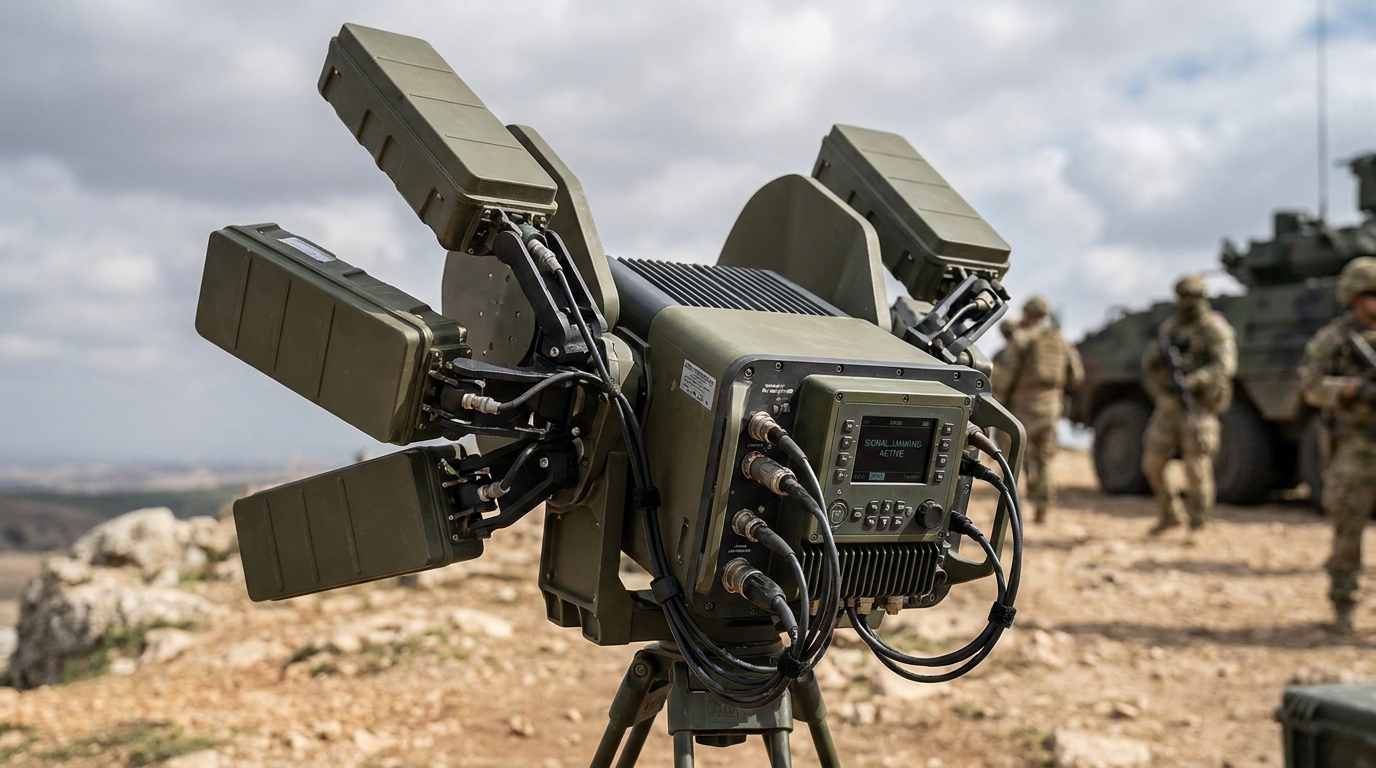
Security teams often find drones penetrating restricted zones despite high-power jamming equipment being active. This failure isn’t usually a lack of power; it’s a lack of precision, potentially leaving your critical infrastructure exposed to unauthorized surveillance or payload delivery. By mastering antenna angle and polarization, you can optimize your drone jammers to create an impenetrable RF shield.
Is antenna angle the hidden key to better drone interference?
Yes, antenna angle is a critical yet frequently overlooked variable that determines the success of drone disruption and signal clarity. If you ignore the geometric relationship between your jammer and the target, your hardware’s effective power drops significantly.
Why signal misalignment is a silent threat to your security
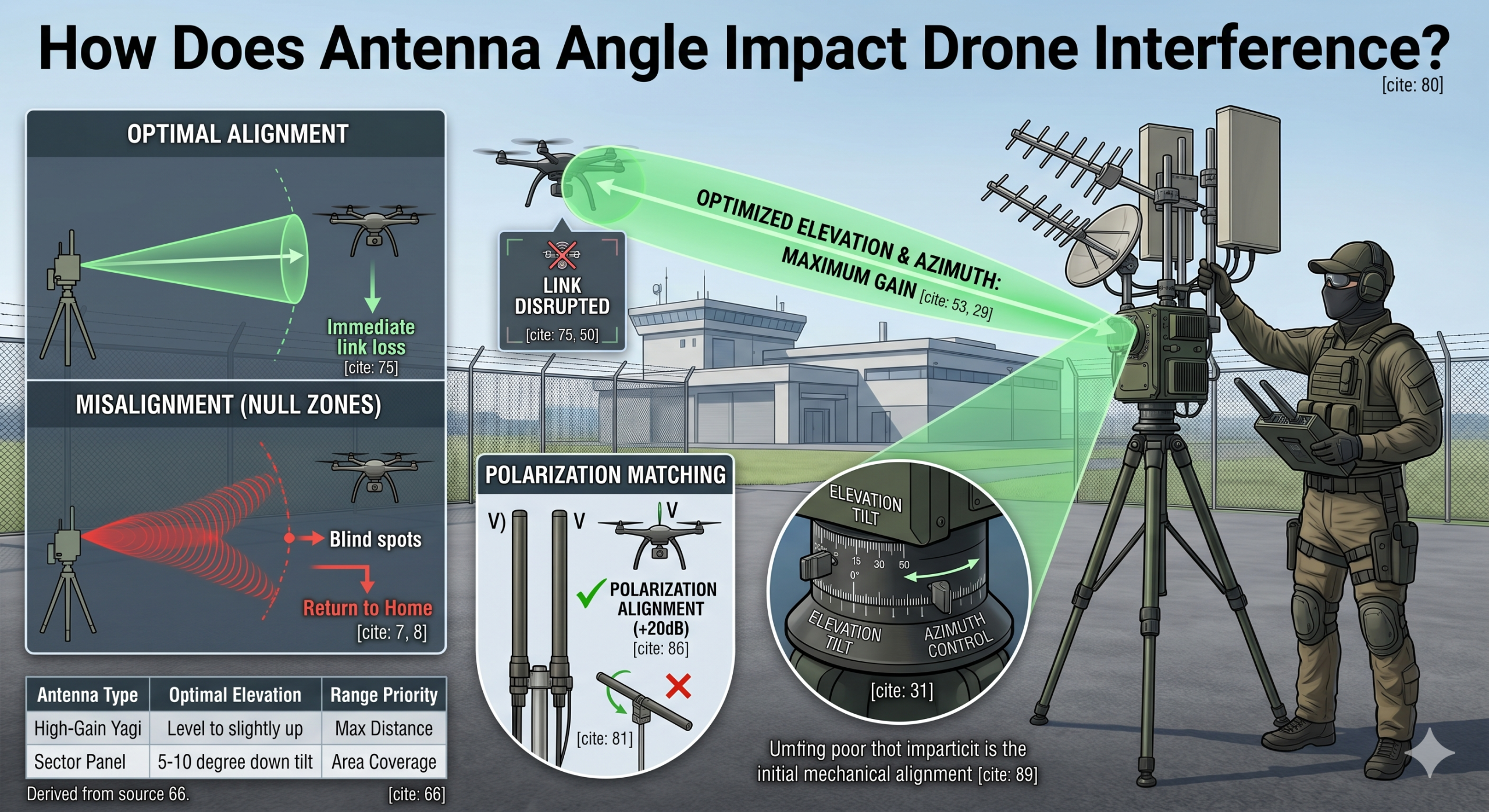
Misalignment creates “null zones” where your signal strength drops to near zero, allowing drones to fly through unprotected gaps. When you fail to account for the radiation pattern of your equipment, you risk leaving wide openings in your perimeter.
- Null zone vulnerability.
- Reduced effective range.
- Intermittent signal loss.
Look at it this way: even the most powerful transmitter is useless if the energy is pointed 20 degrees away from the threat.
Key Takeaway: Precision in antenna positioning is as vital as the signal power itself for maintaining a secure airspace.
What are the basics of drone antennas and signal propagation?
Antennas transmit radio frequency (RF) signals in specific geometric patterns that define where your interference is strongest. Most drone systems utilize 2.4 GHz and 5.8 GHz bands which travel in straight lines and are vulnerable to physical obstructions.
Understanding omnidirectional vs. directional radiation
Omnidirectional antennas spread signals in a 360-degree horizontal “donut” shape, while directional antennas focus energy into a narrow, high-gain beam. You must choose the right type based on whether you need a wide perimeter or long-distance corridor protection.
- Omnidirectional (Low gain, 360° coverage).
- Panel/Sector (Medium gain, wide sector).
- Yagi/Dish (High gain, narrow beam).
Think about this: “omnidirectional” does not mean uniform strength in all directions; it means strength is concentrated horizontally.
How frequency bands travel through complex airspaces
Higher frequencies like 5.8 GHz have shorter ranges and are more easily blocked by physical obstacles than the 2.4 GHz band. You should position your antennas higher to maintain a clear line-of-sight in urban or cluttered environments.
- Obstacle penetration capabilities.
- Line-of-sight (LOS) requirements.
- Atmospheric attenuation factors.
The bottom line? Your frequency choice dictates your placement strategy.
Key Takeaway: Matching antenna type and frequency to the operational environment is the first step in successful RF defense.
| Antenna Type | Best Use Case | Beam Width |
|---|---|---|
| Omnidirectional | 360-degree perimeter | Wide (Horizontal) |
| Directional | Long-range corridor | Narrow |
| Sector | High-density zones | Medium |
Why does orientation matter for drone jammers in the field?
Orientation determines the shape and reach of the interference zone, ensuring your drone jammers cover the intended altitude and distance. Small shifts in tilt or rotation can reshape the signal’s main lobe, creating blind spots that allow drones to bypass protection.
Reshaping the main lobe to eliminate security blind spots
Adjusting the tilt and azimuth allows you to shift the primary energy beam toward the likely flight path of an intruder. Even a 10-degree deviation can cause a 50% drop in signal density at the target’s receiver.
- Main lobe alignment.
- Azimuth control.
- Elevation tilt.
Here is the thing: a drone flying at 100 meters requires a different antenna elevation than one flying at 10 meters.
Managing side lobes and signal nulls for full coverage
Managing secondary energy beams and weak spots prevents “leaks” in your RF shield. You must identify where your antenna’s natural nulls are—typically directly above and below the vertical axis—to avoid pointing them at potential flight paths.
- Side lobe suppression.
- Null zone identification.
- Signal reflection management.
But wait, there’s more: reflections from nearby buildings can actually create “false” coverage zones that fail under pressure.
Key Takeaway: Proper orientation maximizes energy density where it is needed most, preventing drones from finding gaps in your defense.
| Orientation Factor | Impact on Signal | Mitigation Strategy |
|---|---|---|
| Elevation | Vertical coverage height | Tilt according to drone altitude |
| Azimuth | Horizontal sweep | Align with probable approach paths |
| Null Zones | Zero signal areas | Avoid pointing axis at targets |
How does signal direction influence drone control disruption?
Successful jamming relies on the jammer’s energy intersecting the drone’s control link with greater intensity than the remote controller. If your signal direction is off, the drone will maintain a clear link with its pilot, rendering your defense useless.
The geometry of link intersection between jammer and drone
To disrupt a drone, your interference signal must physically overlap the space where the drone’s internal antenna is receiving data. You must visualize the “link geometry” to ensure your beam intercepts the drone regardless of its orientation to the pilot.
- Link geometry analysis.
- Signal overlap requirements.
- Intercept point calculation.
The truth is: raw power fails without precise directional aiming.
Key Takeaway: Understanding the geometric relationship between the jammer, the drone, and the pilot is essential for link disruption.
| Disruption Factor | Requirement | Field Result |
|---|---|---|
| Signal Overlap | Intersect the control link | Successful link loss |
| Power Ratio | Jammer > Controller signal | Drone enters “Return to Home” |
| Directional Aim | Precise beam placement | Optimized energy use |
What is the optimal antenna angle for achieving maximum range?
There is no single “best” angle, as the optimal orientation depends on the antenna type, the drone’s altitude, and the surrounding terrain. To achieve maximum range, you must align the antenna’s highest gain region with the target’s flight path.
Balancing elevation and azimuth for long-distance defense
Achieving kilometers of protection requires fine-tuning the elevation (vertical angle) and azimuth (horizontal angle) to keep the drone within the narrowest part of the beam. You can consult RF signal propagation guides to understand how terrain affects these angles over long distances.
- Elevation/Azimuth balance.
- Long-range beam tracking.
- Terrain-aware positioning.
Here is a secret: most long-range failures are due to the beam being tilted too high, shooting over the drone’s head.
Choosing the right angle based on specific antenna types
Different antennas require different mounting strategies; for instance, a panel antenna may need a slight downward tilt to cover a wide approach area effectively. You must test your specific hardware at various angles to map the exact range limits.
- Panel antenna tilt.
- Yagi antenna aiming.
- Sector antenna stacking.
Keep this in mind: what works for a portable unit won’t work for a fixed-site installation.
Key Takeaway: Maximum range is achieved through empirical testing and matching your beam’s peak gain to the threat’s elevation.
| Antenna Type | Optimal Elevation | Range Priority |
|---|---|---|
| High-Gain Yagi | Level to slightly up | Max Distance |
| Sector Panel | 5-10 degree down tilt | Area Coverage |
| Omnidirectional | Perfectly vertical | 360-degree Close-in |
How can antenna angle either cause or mitigate interference?
Antenna angle is your primary tool for both creating interference for drones and preventing unwanted interference for your own nearby electronics. By carefully pointing your beams, you can isolate the drone’s frequency without disrupting local Wi-Fi or communication systems.
Identifying how signal attenuation occurs through misalignment
Signal attenuation happens when the peak of your radiation pattern misses the drone’s antenna, leading to a weak interference signal. You can mitigate this by ensuring that the polarization and angle of your antenna match the likely orientation of the drone’s receiver.
- Polarization alignment.
- Peak gain targeting.
- Side-lobe isolation.
The reality is: misalignment can reduce your effective jamming power by as much as 90%.
Key Takeaway: Strategic angling allows you to concentrate interference on the threat while protecting your own operational frequencies.
| Signal Condition | Angle Status | Result |
|---|---|---|
| Optimal Jamming | Perfectly aligned | Immediate link disruption |
| Partial Attenuation | 15-30 degrees off | Intermittent control lag |
| Full Signal Loss | Pointed at null zone | No interference effect |
What practical tips help optimize your jammer’s antenna angle?
Optimizing your setup requires a mix of technical knowledge and field testing to ensure your equipment is always at peak performance. You should always start with a baseline test to understand how your current environment impacts signal spread.

Matching polarization between your remote and the drone
Most drones use vertically polarized antennas, meaning your jammer antennas should also be oriented vertically for maximum power transfer. If you rotate your antenna 90 degrees (to horizontal), you could lose up to 20dB of signal strength.
- Vertical vs. Horizontal alignment.
- Polarization mismatch testing.
- Circular polarization benefits.
Don’t forget: even if you are pointed correctly, a polarization mismatch can ruin your range.
Key Takeaway: Always align your antenna’s physical orientation with the polarization of the target signal to ensure maximum energy coupling.
| Optimization Step | Action | Benefit |
|---|---|---|
| Polarization Match | Align antennas vertically | +20dB signal strength |
| Height Adjustment | Clear obstacles | Maintains Line-of-Sight |
| Angle Testing | Sweep area with drone | Identifies blind spots |
Can improper alignment ruin your anti-drone effectiveness?
Yes, improper alignment is one of the leading causes of system failure in the field, often resulting in drones bypassing your anti-drone system entirely. Even a high-end automated system can fail if the initial mechanical alignment is incorrect.
Maintaining mounts to prevent mechanical signal drift
In mobile or high-vibration environments, antenna mounts can loosen over time, causing your signal to “drift” away from the target zone. You must implement a regular maintenance schedule to ensure that all directional antennas remain locked at their calibrated angles.
- Mounting hardware checks.
- Vibration dampening.
- Calibration logging.
It gets worse: a mount that shifts just 2 degrees can move your beam’s center by 35 meters at a range of 1 kilometer.
Key Takeaway: Mechanical stability is just as important as electronic calibration for maintaining consistent airspace security.
| Failure Point | Cause | Result |
|---|---|---|
| Beam Drift | Loose mounting bolts | Blind spots in perimeter |
| Polarization Cross | Accidental rotation | Drastic range reduction |
| Elevation Error | Misjudged flight height | Signal passes under drone |
How does polarization mismatch impact jammer success?
Polarization mismatch occurs when the physical orientation of the jammer antenna does not match that of the drone’s antenna, leading to a massive loss in power transfer. This is why many tactical operators use cross-polarized or circularly polarized antennas to ensure coverage regardless of the drone’s bank angle.
Measuring signal coupling loss in cross-polarized links
When a vertically polarized signal hits a horizontally polarized antenna, the “coupling loss” can be so severe that the jammer appears to be turned off. You should use equipment designed to mitigate this, especially when dealing with racing drones or those performing agile maneuvers.
- Cross-polarization loss (dB).
- Drone banking impact.
- Multi-antenna diversity.
Think about this: as a drone turns, its polarization changes; your jammer must be able to handle this shift.
Key Takeaway: Using circularly polarized antennas or multi-antenna arrays can significantly reduce the risk of failure due to polarization mismatch.
| Polarization Type | Resilience | Energy Transfer |
|---|---|---|
| Linear (Matched) | Low | 100% |
| Linear (Mismatched) | None | < 1% |
| Circular | High | 50% (Constant) |
What are the most common questions about jammer antenna angles?
Navigating the complexities of RF interference requires ongoing education. If you are unsure about your specific requirements, it is best to contact us for a professional consultation tailored to your facility.
Frequently Asked Questions
Can I use different angles for different drone models?
Yes, since different drones have different antenna placements and flight characteristics, you should adjust your elevation and polarization to match the specific threats you expect to encounter.
What’s the best angle for low-altitude drone detection?
For low-altitude threats, a slight downward tilt on a directional antenna is often best to minimize ground reflections while maintaining a clear beam on the approach path.
How do I know if my antenna is pointed at a null zone?
You can use an RF signal analyzer or a test drone to measure RSSI; if the signal drops sharply despite being in close proximity, you are likely in a null zone and should adjust your tilt.
Will mounting jammers on vehicles require auto-leveling?
Yes, because vehicle tilt changes with terrain, an auto-leveling gimbal or mount is highly recommended to keep your antenna beams aimed correctly at the horizon or target altitude.
Can weather conditions change the required antenna angle?
While weather doesn’t change the physical angle, heavy rain or fog can attenuate signals, requiring you to tighten your beam or aim more precisely to maintain effective range.
Conclusion
Mastering the antenna angle is the difference between a reliable
Authorized C-UAS antenna-chain review
Keep C-UAS antenna alignment discussions inside authorized engineering review
Antenna alignment for C-UAS topics should stay compliance-aware. CorelixRF can review authorized antenna/load matching, amplifier-chain fit, thermal/protection limits and documentation requirements without publishing misuse instructions.
Frequency band, gain, polarization, beamwidth, connector, mounting position, handling and environmental limits.
Power level, cable loss, VSWR/load condition, protection behavior, duty cycle and integration constraints.
RFQ checklist, delivery records, test notes, case profiles and engineering review before final approval.