
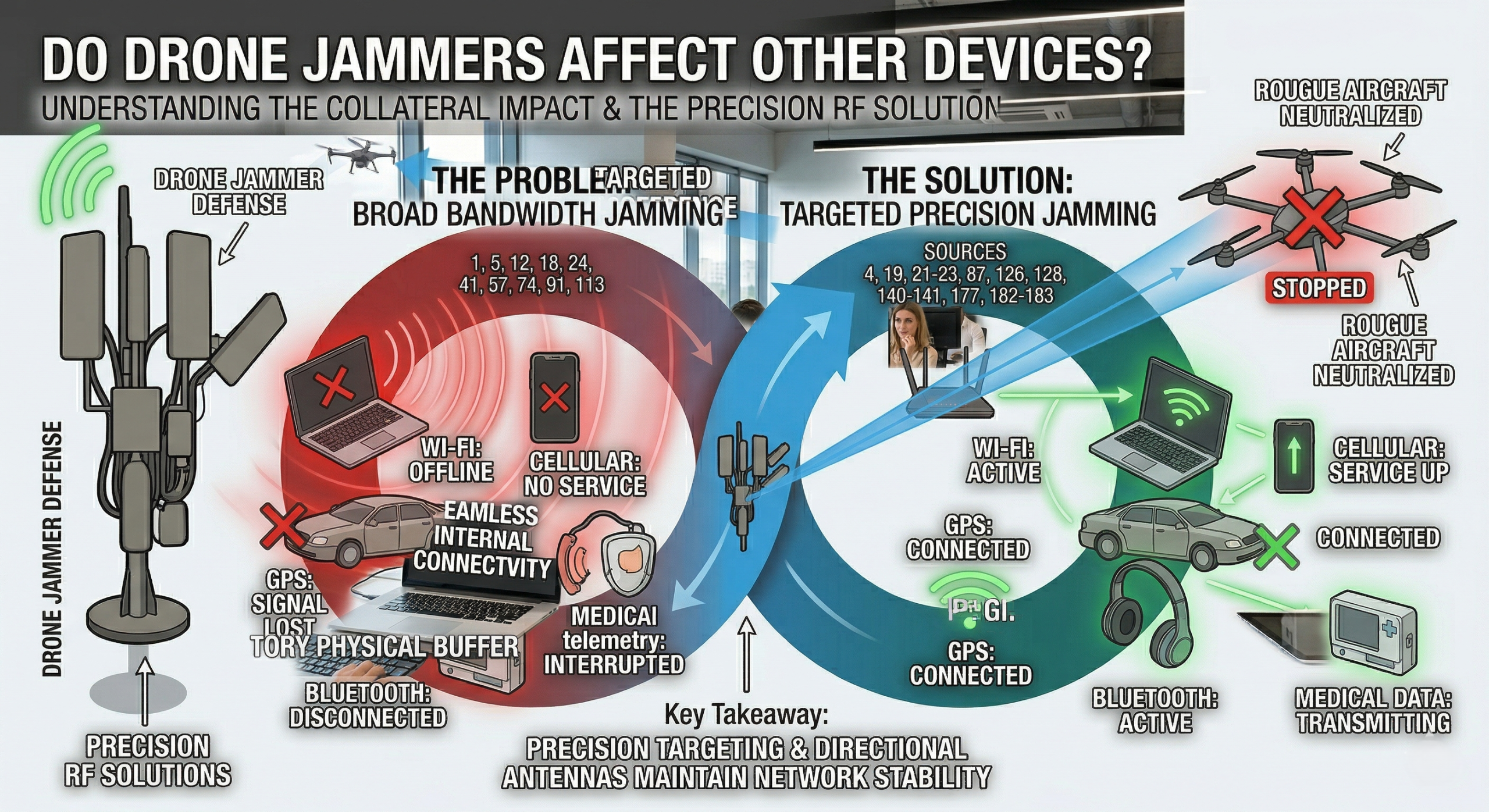
Yes, Drone Jammers can and often do affect other wireless devices nearby if they operate on similar frequency bands. Imagine a scenario: you are running a high-security facility, and an unauthorized aircraft enters restricted airspace. You activate your defense system, but suddenly local communication networks drop, leaving security teams isolated and frustrated. Here is the deal: operators can neutralize rogue aircraft without taking down an entire wireless infrastructure by utilizing precision-targeted radio frequency solutions.
How Do Drone Jammers Operate Effectively?
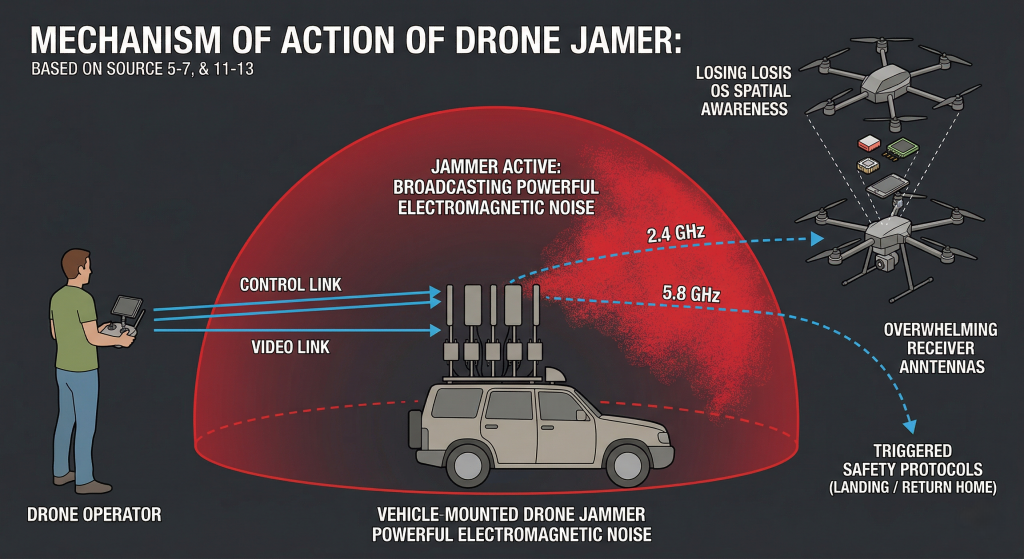
Drone jammers operate effectively by broadcasting powerful electromagnetic noise across specific radio frequencies, overpowering incoming control signals. These Drone Jammers disrupt communication links between an aircraft and its remote pilot, forcing that vehicle into landing or returning home. Overwhelming a receiver with interference neutralizes any airborne threat instantly. Understanding this mechanism remains necessary for deploying security measures safely without causing unintended network blackouts.
What Mechanisms Power Signal Disruptors?
Signal disruptors rely on advanced oscillators and amplifiers, generating robust radio frequency waves that mask legitimate commands. You might be wondering: how do these devices target specific threats? Systems scan local environments for active aircraft frequencies, emitting counter-signals featuring much higher amplitude levels. This brute-force method guarantees receiver antennas only pick up jamming noise rather than operator instructions. Consequently, affected aircraft trigger default safety protocols automatically, avoiding catastrophic crashes.
Are Frequencies Shared With Other Tech?
Many commercial quadcopters utilize common frequency bands overlapping with everyday household and office electronics.
- The 2.4 GHz band supports wireless routers alongside cordless phones.
- A 5.8 GHz spectrum accommodates high-speed networking and video feeds.
- Satellite frequencies manage navigation for both aircraft and automotive positioning systems.Because these channels remain shared, broadcasting broad interference naturally impacts adjacent civilian technologies operating within nearby airspace.
Why Is Targeting Necessary For Jamming?
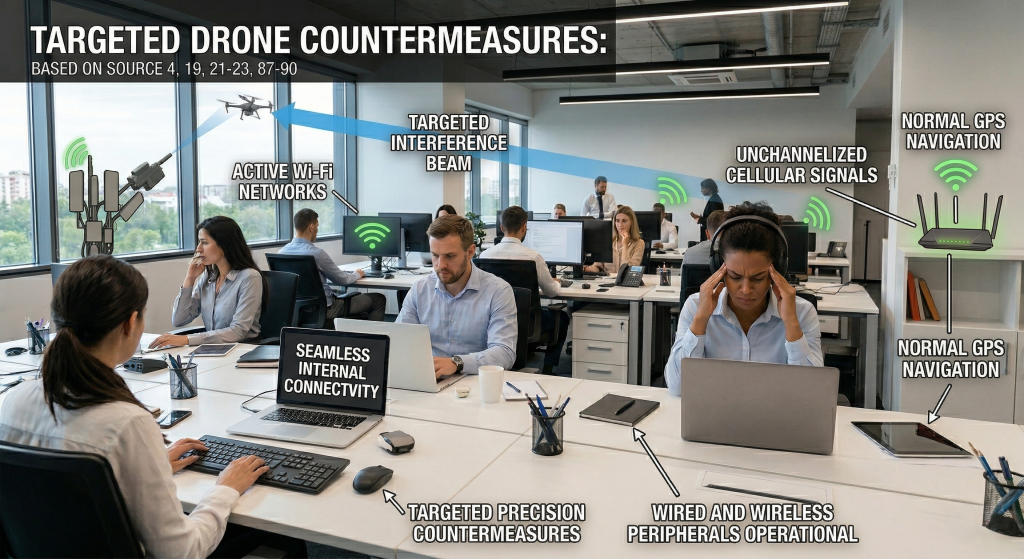
Targeted jamming focuses interference exclusively on identified threat frequencies rather than blanketing an entire spectrum. This precision minimizes collateral damage affecting internal business networks and residential electronics. Modern systems utilize directional antennas, concentrating jamming power into a narrow beam toward specific targets.
Targeted frequency disruption guarantees communications remain online while neutralizing immediate airborne threats.
Key Takeaway: Precision targeting and directional antennas are necessary requirements for maintaining local network stability while stopping unauthorized aircraft.
Do Drone Jammers Disrupt Wi-Fi Networks?
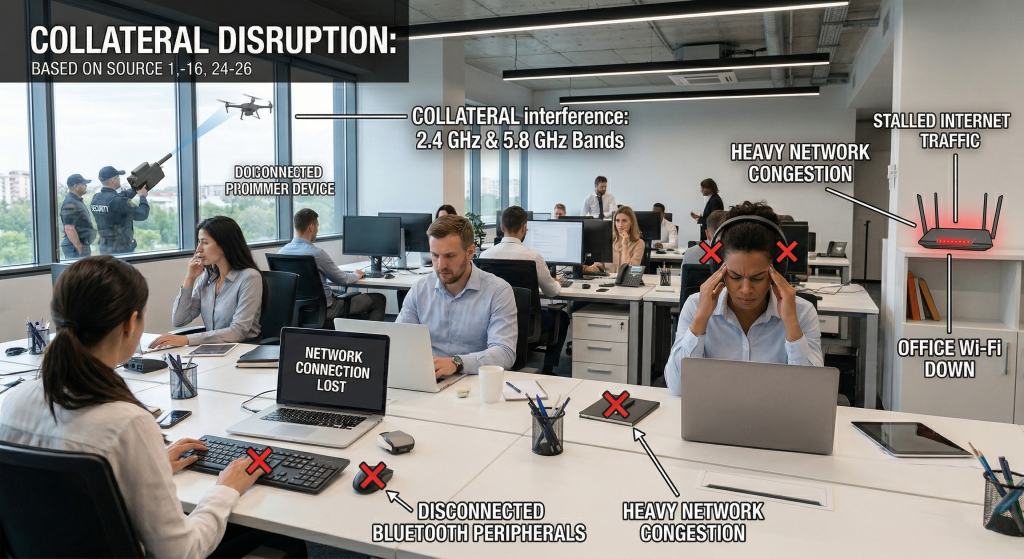
Yes, drone jammers frequently disrupt local Wi-Fi networks because both systems rely heavily on identical frequency spectrums. When you activate defense hardware near an office building, overlapping signals create heavy congestion that router antennas cannot filter. This interference causes severe packet loss, leading directly toward disconnected peripherals and stalled internet traffic. Maintaining productivity requires network administrators coordinating security deployments alongside local wireless infrastructure layouts.
How Do Common Spectrums Overlap Constantly?
A vast majority of commercial aircraft and office wireless routers transmit data across identical bands. Look at it this way: flooding a 2.4 GHz channel stopping a quadcopter simultaneously drowns out router signals. Your laptops struggle distinguishing legitimate network data from overwhelming security noise. Overlap makes collateral interference almost inevitable unless you deploy highly calibrated equipment.
Can You Protect Local Wi-Fi Routers?
Protecting local routers requires combining strategic equipment placement with advanced network configuration.
- Shield server rooms using radio-frequency blocking materials, isolating critical signals.
- Upgrade office networks utilizing Wi-Fi 6E, accessing less congested channels.
- Position security disruptors as far away from central communication hubs as physically possible.Implementing these structural barriers allows you maintain seamless internet connectivity during active security events.
What Happens During Active Interference?
During active interference, networks experience extreme latency as devices repeatedly attempt resending dropped data packets. Users notice immediate buffering, failed file transfers, and eventual disconnection from local network resources.
Selecting appropriate operational bands for internal systems drastically reduces severity regarding active signal interference.
Key Takeaway: Migrating essential business operations toward alternative network bands prevents security protocols from crashing daily workflows.
Are Bluetooth Devices Vulnerable To Jamming?
Yes, Bluetooth devices remain extremely vulnerable because they operate directly within crowded 2.4 GHz frequency ranges. When Drone Jammers flood this specific band, short-range communication between your peripherals severs instantly. Wireless keyboards, mice, and headsets stop functioning until security systems power down completely. Understanding this vulnerability helps you prepare backup wired equipment for major operational tasks.
Does Bluetooth Rely On Similar Frequencies?
Bluetooth technology uses frequency-hopping spread spectrum techniques across crowded bands, avoiding minor everyday noise. What is the real story? Hopping mechanisms cannot escape continuous, high-power jamming signals blanketing entire spectrums simultaneously. Security devices emit far more power than small peripheral batteries generate, overpowering connections completely. Consequently, low-power accessories fail syncing with host computers.
Will Headphones Lose Connection Immediately?
Wireless headphones experience immediate audio stuttering followed by complete disconnection whenever disruptors activate nearby.
- Audio streams require continuous data packets, which jamming noise blocks entirely.
- Peripherals attempt reconnecting endlessly, rapidly draining internal battery reserves.
- Normal functionality only returns once interference sources deactivate completely.Keeping wired headphones available guarantees communication remains uninterrupted during unforeseen airspace security events.
How Quickly Do Devices Recover Signal?
Peripherals typically recover connections within a few seconds after jamming transmissions cease entirely. Host computers continuously scan for paired accessories, automatically re-establishing links once spectrums clear.
Wired alternatives provide foolproof methods avoiding operational delays when utilizing high-powered security equipment.
Key Takeaway: Relying on wired peripherals in high-security zones completely eliminates risks regarding unexpected Bluetooth disconnections.
Can Cellular Signals Be Blocked Accidentally?
Yes, cellular signals suffer accidental blocking if drone jammers employ ultra-wideband interference or lack proper calibration. While most commercial quadcopters avoid mobile networks, advanced models utilize 4G or 5G for extended range. Targeting specific cellular frequencies stopping specialized threats means mobile phones nearby lose service. Careful frequency selection remains strictly necessary, preserving urgent mobile communications.
Are Mobile Phones Immune To Disruption?
Mobile phones lack natural immunity against disruption, especially operating near poorly calibrated RF equipment. Here is the deal: cheap uncertified disruptors leak interference across adjacent spectrums, unintentionally hitting cellular bands. This phenomenon, known as spectral bleed, causes nearby smartphones dropping calls and losing mobile data access. Utilizing high-quality, certified security hardware prevents destructive frequency leaks impacting your workforce.
Do Jammers Target LTE Or 5G?
Standard security disruptors rarely target LTE or 5G networks unless specifically configured countering cellular-controlled aircraft.
- Traditional quadcopters rely heavily on standard radio frequencies rather than mobile data networks.
- Advanced custom aircraft utilize cellular modules bypassing standard RF security measures.
- Blocking cellular threats requires highly specialized authorization due public safety concerns.You must assess local threat landscapes before acquiring equipment capable of disrupting mobile data.
What Risk Does Collateral Blocking Present?
Collateral blocking presents massive safety risks, preventing employees contacting emergency services during incidents. Regulatory bodies strictly monitor cellular interference, and accidental disruptions lead toward severe operational penalties.
Restricting interference toward standard radio bands guarantees teams retain full access regarding urgent cellular communication networks.
Key Takeaway: Avoiding cellular frequency disruption remains necessary for maintaining emergency contact capabilities and complying with federal communication laws.
Do GPS Navigation Systems Suffer Outages?
Yes, GPS navigation systems suffer immediate outages because Drone Jammers frequently target satellite frequencies disabling automated flight paths. Aircraft rely on satellite signals maintaining stability, holding positions, and executing autonomous return-to-home commands. Blocking satellite bands means aircraft lose spatial awareness, drifting or triggering emergency landings. Unfortunately, ground-based navigation devices nearby also lose satellite fixes.
Why Do Drones Require GPS Signals?
Modern unmanned aerial vehicles require GPS signals executing complex flight patterns and maintaining aerodynamic stability. Ready for the good part? Cutting off satellite connections forces aircraft relying entirely on manual piloting. If operator RF control links sever simultaneously, vehicles become completely helpless. Dual-layered interference approaches remain highly reliable methods for neutralizing sophisticated aerial threats.
Can Nearby Cars Lose GPS Tracking?
Ground vehicles traveling near active security deployments absolutely lose navigation capabilities temporarily.
- Delivery trucks experience frozen maps alongside inaccurate location routing.
- Autonomous warehouse vehicles halt operations if relying on external satellite positioning.
- Ride-sharing services fail pinpointing exact pickup locations within affected radii.You must consider impacts regarding local logistics when placing high-powered satellite disruptors near public roadways.
How Can You Limit GPS Interference?
Limiting satellite interference requires using directional antennas projecting jamming signals upward rather than outward. Aiming interference cones exclusively into the sky leaves ground-level devices largely unaffected.
Directing interference beams vertically allows security teams neutralizing airborne threats while preserving ground-level logistics.
Key Takeaway: Utilizing directional antennas focusing interference upwards prevents severe disruptions affecting local ground transportation and delivery routing.
Are Medical Devices Affected By Interference?
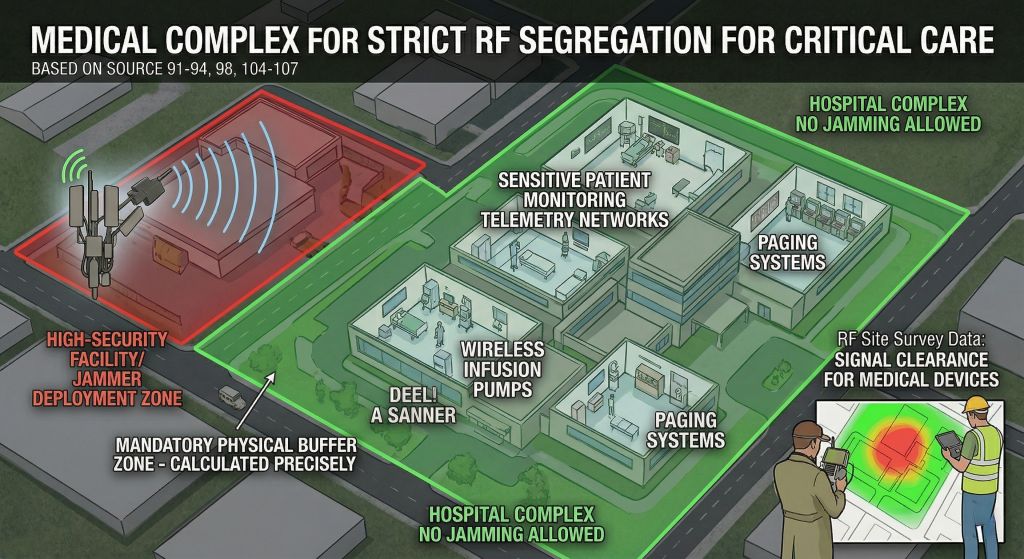
Yes, sensitive medical devices suffer interference if drone jammers emit overpowering signals near clinical environments. While life-saving implants feature heavy shielding, massive RF bursts still cause minor operational anomalies. Hospitals utilize extensive telemetry networks monitoring patient health, which often operate on vulnerable wireless frequencies. Deploying high-powered security equipment near medical facilities requires extreme caution alongside specialized engineering consultations.
Do Pacemakers Operate On RF Bands?
Modern pacemakers occasionally use low-power radio frequencies communicating diagnostic data toward external monitors. This is where it gets interesting: federal regulations require implants incorporating robust shielding against everyday electromagnetic noise. However, military-grade security equipment generates noise levels far exceeding normal environmental parameters, posing theoretical risks. You must prioritize patient safety, establishing strict physical exclusion zones around health facilities.
Is Hospital Equipment At Risk Here?
Hospital telemetry systems and wireless monitoring equipment remain highly susceptible facing sudden bursts of broad-spectrum interference.
- Wireless infusion pumps momentarily lose connections with central nursing stations.
- Mobile diagnostic carts depend entirely on uninterrupted Wi-Fi updating patient electronic health records.
- Paging systems utilized by emergency response teams experience delayed message delivery.Consulting clinical IT departments guarantees security protocols avoid compromising urgent patient care infrastructure.
What Precautions Guarantee Maximum Safety?
Establishing rigorous physical distance buffers between security hardware and medical buildings provides highly effective safety guarantees. RF engineers conduct thorough site surveys, mapping out safe deployment zones preventing overlapping interference.
Strictly adhering toward calculated buffer zones guarantees airspace defenses avoid interfering with life-saving clinical operations.
Key Takeaway: Maintaining substantial physical distance from healthcare facilities remains mandatory when operating high-powered radio frequency security equipment.
What Factors Determine Interference Range?
Total power output and antenna design dictate effective interference ranges for Drone Jammers. High-wattage amplifiers push signals further, creating massive disruption bubbles spanning several kilometers. Conversely, low-power handheld units only affect localized areas, making them safer for crowded urban environments. Carefully calibrating power settings lets you tailor disruption radii matching exact property boundaries.
Does Jammer Power Output Matter Most?
Power output drives how far interference signals successfully travel while remaining effective. But here is the kicker: simply maximizing power creates excessive collateral damage affecting innocent neighboring businesses. Well-engineered systems balance adequate transmission strength with intelligent targeting, stopping threats efficiently. Selecting appropriate wattage guarantees neutralizing targets without violating federal spectrum regulations.
How Do Physical Obstacles Alter Range?
Physical structures and geographic features drastically reduce effective distances regarding radio frequency interference signals.
- Dense concrete buildings absorb and block signals, creating safe zones behind structures.
- Thick forest canopies scatter frequencies, reducing overall impact radii significantly.
- Metal fencing and reflective surfaces bounce signals, creating unpredictable interference patterns.Understanding local topography allows you predicting exactly where disruption occurs and where it fails.
Can Weather Conditions Impact Signals?
Heavy rain, dense fog, and severe atmospheric humidity act as natural dampeners affecting high-frequency radio transmissions. Water droplets absorb electromagnetic energy, shortening effective reaches regarding security equipment during severe storms.
Adapting security protocols accounting for severe weather guarantees consistent airspace protection year-round.
Key Takeaway: You must factor local architecture, weather patterns, and power output accurately calculating true security radii.
Are There Ways To Mitigate Wireless Impact?
Yes, highly effective ways exist mitigating wireless impact while operating drone jammers for corporate security. Employing smart technology lets you create surgical strikes against threats rather than indiscriminate blasts. Advanced software allows operators tuning frequencies precisely, avoiding channels actively utilized by local office equipment. This careful approach maintains operational harmony between vital security systems and daily business communications.
How Do Directional Antennas Help?
Directional antennas focus radio frequency energy into tight, concentrated beams rather than broadcasting 360-degree circles. You might be wondering: how does this protect the office? If threats approach from northern directions, antennas blast interference exclusively northward, leaving southern networks untouched. Architectural designs represent reliable methods protecting facilities without disrupting internal operations.
Can Frequency Tuning Prevent Overlap?
Precise frequency tuning empowers operators attacking exact channels rogue aircraft use communicating.
- Systems scan airspace identifying specific narrow bands utilized by threats.
- Disruptors then target only exact frequencies, leaving remaining spectrums clean.
- Internal Wi-Fi and Bluetooth devices continue operating normally on adjacent, undisturbed channels.Intelligent targeting protocols represent gold standards regarding modern, responsible airspace defense.
Why Is Strategic Deployment Necessary?
Strategic deployment guarantees disruption hardware rests far away from sensitive communication hubs and server rooms. Placing equipment on elevated rooftops or perimeter fences pushes interference zones outward, away from employees.
Combining directional hardware with intelligent frequency tuning delivers robust security while preserving corporate network integrity.
Key Takeaway: Investing in advanced directional hardware and frequency-tuning software represents the best method preventing self-inflicted network outages.
What Are The Legal Rules For Jammer Usage?
Legal rules regarding Drone Jammers remain incredibly strict because unauthorized interference violates federal communications laws. Most countries consider civilian use of signal-blocking equipment entirely illegal, regardless of perceived security threats. Only authorized government agencies, military personnel, and specific law enforcement units possess legal rights operating this hardware. You must navigate complex regulations carefully, avoiding massive fines and potential criminal prosecution.
Do Regulatory Bodies Restrict Operation?
Federal organizations strictly regulate airwaves, guaranteeing emergency services and commercial flights operate safely. What is the real story? Private citizens and corporate entities cannot legally purchase, operate, or market active signal-blocking devices domestically. Agencies view unauthorized interference as severe threats toward public safety and aviation infrastructure. You must consult specialized legal counsel before attempting integrating active countermeasures into security postures.
Are There Fines For Unlawful Disruption?
Unlawful disruption regarding communication networks carries devastating financial penalties and severe legal consequences for offending organizations.
- Regulatory bodies regularly issue six-figure fines toward companies caught utilizing unapproved blocking hardware.
- Equipment faces immediate confiscation, leaving facilities completely unprotected and financially compromised.
- Corporate officers face personal criminal liability for intentionally disrupting emergency communication channels.Ignorance never represents acceptable defenses when federal spectrum regulations face active violations.
How Can Authorized Users Stay Compliant?
Authorized government entities must follow rigid operational guidelines, including logging usage times and limiting power outputs. Thorough training programs guarantee operators understand legal boundaries alongside technical limitations regarding equipment.
Understanding precise legal standing prevents catastrophic compliance failures when upgrading physical security infrastructure.
Key Takeaway: You must secure explicit federal authorization before deploying any active signal-blocking technology protecting corporate assets.
How Should Businesses Plan Jammer Deployment?
Businesses must plan drone jammers deployment by conducting exhaustive risk assessments and engaging certified radio frequency engineers. Before purchasing hardware, you need mapping existing wireless infrastructure, identifying potential conflict zones. Collaborating with legal experts guarantees defense strategies align perfectly with local and federal communication regulations. Meticulous planning phases guarantee investments enhance security without destroying internal network efficiency.
What Site Assessments Are Mandatory?
Comprehensive RF site surveys remain mandatory, mapping baseline radio noise currently present across entire facilities. Look at it this way: you cannot protect environments you do not fully understand. Engineers identify dead zones, pinpoint active communication hubs, and model how interference propagates through specific buildings. Data allows architects positioning security hardware where it provides maximum protection with minimum internal disruption.
How Do You Balance Security And Connectivity?
Balancing robust security with seamless connectivity requires integrating passive detection systems alongside active disruption hardware.
- Utilize radar and optical sensors tracking aerial threats without emitting harmful radio interference.
- Only activate disruption sequences as last resorts when threats breach defensive perimeters.
- Automate shutdown processes so interference stops immediately once aircraft are neutralized.Layered approaches guarantee daily operations remain untouched until absolute emergencies dictate forceful responses.
Can RF Antenna Modules Optimize Setup?
High-quality RF antenna modules optimize setups by focusing jamming energy exactly where it proves most effective. Upgrading customized modules improves signal clarity and reduces spectral bleed causing collateral network damage.
Thorough professional planning transforms potentially disruptive security measures into seamlessly integrated corporate defense systems.
Key Takeaway: Partnering with specialized engineers and legal experts guarantees smooth, compliant, and highly effective security installations.
Final Thoughts
Addressing airborne threats without sacrificing internal connectivity requires strategic planning and advanced radio frequency engineering. Implementing directional antennas and intelligent frequency tuning allows organizations to neutralize rogue aircraft while keeping nearby wireless devices fully operational. If you require specialized engineering expertise to build a compliant and highly effective airspace defense system, contact us today. We build precision RF solutions that keep the low-altitude economy safe, secure, and continuously connected.
FAQ
Q1: Can I operate this security equipment on my private corporate campus?
No, private businesses cannot legally operate active signal-blocking technology in most jurisdictions. Federal communications agencies strictly reserve these capabilities for military and authorized law enforcement to prevent public network interference.
Q2: What’s the best way to stop an unauthorized aircraft without disrupting my office Wi-Fi?
The best way relies on utilizing highly directional antennas combined with precise frequency tuning software. This allows you to aim a narrow interference beam exclusively at the threat, leaving your broad internal networks completely untouched.
Q3: How do I know if my local Bluetooth devices will fail during a security event?
You will know immediately because wireless keyboards, mice, and headsets suffer severe latency or complete disconnection. Because Bluetooth operates on the widely targeted 2.4 GHz band, it remains highly susceptible to collateral interference.
Q4: Can I protect my cellular network from accidental signal blocking?
Yes, you can protect cellular networks by confirming your security hardware is carefully calibrated to avoid mobile data bands. High-quality equipment prevents spectral bleed, confirming LTE and 5G emergency communications remain online.
Q5: What’s the most decisive factor when calculating the true disruption range?
The most decisive factor is the combination of power output and physical environmental obstacles. Concrete buildings, dense trees, and even heavy rain significantly absorb radio frequencies, reducing the overall effective radius.
Authorized RF engineering and compliance review
For regulated RF systems, this page should be used as an engineering and compliance review path, not as a public deployment checklist. CorelixRF starts with authorization status, operating region, frequency plan, output limit, antenna interface, safety controls, thermal limits and acceptance documents.
- RFQ checklist – send the data buyers usually forget, including band, power, duty cycle, interface and test standard
- delivery documentation – check what documents can support incoming inspection, FAT review and long-term maintenance
- quality and certification review – review the quality and compliance evidence before the project moves into procurement
- RF front-end platform – compare the RF chain as a system instead of selecting one isolated module
- RF configurator – turn frequency, power, thermal and interface requirements into a first configuration brief
- case studies – review similar engineering paths before sending an RFQ
- engineering contact – send the application notes, block diagram or target specification to engineering sales
This keeps the discussion inside lawful, authorized RF programs while still giving procurement teams a clear way to request amplifier, antenna, SDR source, documentation and factory review.
Wireless Network RF Interference Review Path
For authorized security, test or integration programs, use this article as a compliance-first planning reference rather than an operating instruction. The practical next step is to review the RF chain as an engineered system: source, amplifier, antenna, control interface, load condition, thermal margin and acceptance evidence.
- Review RF front-end platform architecture when the project combines signal source, amplifier, antenna and control logic.
- Compare RF power amplifier platforms for band, output power, duty cycle, cooling and protection behavior.
- Match RF antenna platforms to coverage pattern, gain, connector, VSWR and installation limits.
- Prepare an RFQ checklist before requesting datasheets, test data or a factory engineering review.
Send your RF system requirements to CorelixRF engineering for a compliance-aware review path.