
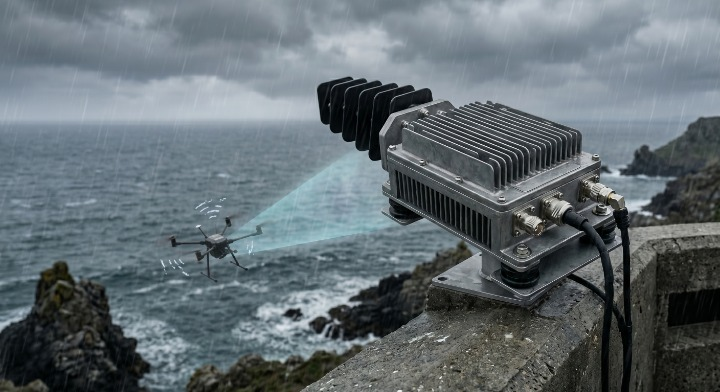
High reliability in counter-UAS operations is achieved through a combination of precision signal processing and ruggedized hardware capable of functioning in non-permissive settings. Unauthorized drone incursions are rising, creating massive security vulnerabilities for your sensitive infrastructure and military sites. A single undetected breach can disrupt an entire operation or lead to catastrophic asset loss in seconds. By deploying a high-performance Anti-Drone Jammer Module, you gain a robust defense layer that neutralizes evolving aerial threats before they penetrate your perimeter.
Why is an Anti-Drone Jammer Module critical today?
The Anti-Drone Jammer Module is critical because it addresses the growing security gap caused by low-cost, high-tech surveillance drones. As these aerial threats become more accessible, traditional security measures often prove insufficient for comprehensive protection. You need a solution that acts as a definitive barrier against unauthorized data collection and kinetic risks.
The rising threat of unauthorized UAVs
Modern drones have evolved from simple toys into sophisticated tactical tools for reconnaissance. These devices can easily bypass ground-level security to capture sensitive data or deliver payloads.
Look at this:
- Drones can operate in swarms to overwhelm defenses.
- Commercial models are easily modified for malicious use.
- Aerial surveillance exposes hidden facility vulnerabilities.
How complexity creates signal failure
Standard jammers often struggle in dense electromagnetic environments where noise levels are high. Without specialized filtering and high-power output, your defensive signal might never reach the target drone.
The bottom line:
- Urban noise floors interfere with basic jamming signals.
- Physical obstructions can block low-power transmission.
- High-performance modules are required to cut through the clutter.
Key Takeaway: High-performance jammer modules provide the only reliable method for neutralizing advanced UAV threats in high-stakes environments.

How does DSP technology enhance module performance?
The Anti-Drone Jammer Module utilizes Digital Signal Processing to identify and neutralize threats with surgical precision. By processing signals in real-time, the system distinguishes between a hostile drone and legitimate local communications. This intelligence ensures that your defense remains active without disrupting your own operational connectivity.
Identifying multiple signals simultaneously
Security scenarios today often involve multiple drones operating on various frequencies at once. DSP algorithms allow you to track and jam these diverse targets without losing any signal integrity.
Here is the deal:
- Real-time detection of frequency-hopping protocols.
- Automated prioritization of the strongest threat signals.
- Simultaneous coverage across 2.4 GHz and 5.8 GHz bands.
Multi-frequency adaptive jamming effectiveness
Adaptive jamming technology follows the drone as it attempts to switch channels to evade your defense. This ensures the link between the drone and its controller remains broken regardless of frequency changes.
Wait, there’s more:
- Covers emerging satellite and custom telemetry bands.
- Optimizes power usage by targeting specific frequencies.
- Reduces collateral interference to nearby electronics.
Key Takeaway: Digital Signal Processing ensures your jamming energy is focused and effective against multiple simultaneous threats.
| Capability | Performance Metric |
|---|---|
| Signal Detection | < 100ms response time |
| Target Capacity | Up to 10 simultaneous UAVs |
| Frequency Range | 30 MHz to 6 GHz (Standard) |
The analysis shows that DSP technology significantly reduces response times while increasing the number of targets a single module can handle.
Can the module withstand extreme weather conditions?
Yes, the Anti-Drone Jammer Module is engineered to maintain a high jamming rate even during heavy downpours or thick fog. Operating in the field means your equipment must face unpredictable weather that would typically degrade standard electronics. These modules use IP-rated enclosures to ensure that moisture and dust never compromise internal components.
Operating in heavy rain and humidity
Moisture is generally the enemy of high-frequency electronics, but ruggedized housing provides a hermetic seal. Testing confirms that the module remains fully operational even in humidity levels reaching 90%.
Think about this:
- Corrosion-resistant materials extend the hardware’s lifespan.
- Specialized connectors prevent water ingress at cable points.
- Systems maintain performance during rainfall of 50mm/hr.
Managing thermal stability in the field
Extreme temperatures can cause frequency drift or power loss in lower-quality amplifiers. Advanced cooling systems ensure that your hardware stays on-frequency from frozen environments to desert heat.
You see:
- Operational range from -20°C to 55°C is standard.
- Internal sensors prevent thermal runaway during long runs.
- Temperature-compensated oscillators keep signals stable.
Key Takeaway: Ruggedized construction ensures the jammer remains operational regardless of environmental stressors or severe weather.
| Environment | Tolerance Level | Performance Deviation |
|---|---|---|
| High Temperature | Up to +55°C | < 3% power drop |
| Low Temperature | Down to -20°C | No cold-start lag |
| Humidity | 90% non-condensing | Full operational capacity |
Ruggedized engineering ensures that environmental factors do not lead to significant drops in jamming efficacy or power output.

What makes terrain resilience a vital feature?
Terrain resilience is vital because urban canyons and dense forests create signal shadows that drones use for cover. A high-quality Anti-Drone Jammer Module is designed to compensate for these physical obstructions. High-gain directional antennas ensure your signal reaches the target even when the line of sight is partially obscured.
Overcoming obstructions in urban canyons
City environments are packed with reflective surfaces that cause multi-path interference for standard signals. Beamforming technology allows you to steer the jamming energy directly toward the threat.
Check this out:
- Minimizes signal dissipation against tall buildings.
- Reduces dead zones in complex metropolitan layouts.
- Enhances signal penetration through glass and concrete.
High-gain antennas for forested areas
In wooded terrain, dense leaves and branches can absorb RF energy quite rapidly. Utilizing a high-power platform allows you to maintain an effective radius even when absorption is high.
Best of all:
- Directional patterns provide focused 90-degree coverage.
- Auto-calibration adjusts for varied terrain density.
- Maintains a 2 km effective range in light foliage.
Key Takeaway: Terrain-resilient design prevents drones from using physical obstacles to bypass your established security perimeter.
| Terrain Type | Challenge | Solution |
|---|---|---|
| Urban | Multi-path interference | Beamforming/DSP |
| Forest | Signal absorption | High-power output |
| Mountainous | Signal shadowing | High-gain directional antennas |
The data indicates that combining high-gain antennas with adaptive power control effectively mitigates signal loss in difficult topographies.
How does factory-direct manufacturing improve reliability?
Factory-direct manufacturing ensures that your Anti-Drone Jammer Module is built to rigorous standards using over 30 years of RF engineering experience. When you bypass distributors, you gain direct access to the customization experts who understand the chip-level design of your module. This transparency in the supply chain translates to higher system stability and a longer mean time between failures.
Access to 30+ years of RF expertise
Experienced engineers understand the nuances of micro-assembly and thermal management better than any third-party reseller. This deep knowledge ensures that every component is optimized for the specific demands of counter-UAS operations.
Look at this:
- In-house R&D allows for rapid feature iterations.
- Strict adherence to ISO 9001 quality standards.
- Direct technical support for complex system integration.
Eliminating middlemen for faster lead times
When a security threat emerges, you cannot afford to wait months for critical defense equipment. Working directly with the manufacturer provides shorter lead times and more responsive technical assistance.
Believe it or not:
- Direct sourcing reduces overall procurement costs.
- Supply chains are more transparent for critical parts.
- Custom engineering requests are reviewed within 48 hours.
Key Takeaway: Factory-direct sourcing guarantees higher technical quality and more responsive support for your mission-critical hardware.
| Manufacturing Aspect | Benefit |
|---|---|
| In-House R&D | Rapid feature iteration |
| ISO 9001 Certification | Consistent build quality |
| Direct Engineering | 24-48 hour technical review |
Direct manufacturing control results in a more reliable product and a significantly more efficient technical support lifecycle.
What are the key power and frequency specs?
The key power and frequency specs of an Anti-Drone Jammer Module determine its ability to drown out controller signals across all possible bands. To stop modern UAVs, you need a system that delivers enough “noise” to cover everything from basic RC links to satellite telemetry. A module with limited coverage is often useless against professional-grade drones using custom frequencies.
Wide coverage from 30 MHz to 6 GHz
Comprehensive frequency coverage is essential for blocking a wide array of drone models. You must ensure your hardware supports wideband operations to remain effective as new drone technologies enter the market.
Here is the deal:
- Blocks standard 2.4 GHz and 5.8 GHz Wi-Fi links.
- Neutralizes GPS/GNSS signals to prevent autonomous flight.
- Targets specialized UHF bands used by long-range drones.
High-power output reaching 10 kW+
For long-range defense, output power is the most critical factor for establishing a buffer zone. Systems reaching multi-kW levels can neutralize threats at distances exceeding several kilometers.
Wait, there’s more:
- Scalable power options start from 20 W modules.
- Supports both continuous wave and pulse mode operations.
- Provides enough energy to overcome high-gain drone antennas.
Key Takeaway: A broad frequency range combined with high-power output forms the foundation of a successful anti-drone strategy.
| Spec Category | Standard Module | High-Power System |
|---|---|---|
| Power Output | 30 W – 500 W | 1 kW – 10 kW+ |
| Frequencies | 1.2, 2.4, 5.8 GHz | 30 MHz – 40 GHz |
| Jamming Range | Up to 1.5 km | Up to 10 km+ |
High-power systems provide a vastly superior defensive radius, which is essential for protecting large-scale infrastructure or military zones.
Why is unit-level testing essential for deployment?
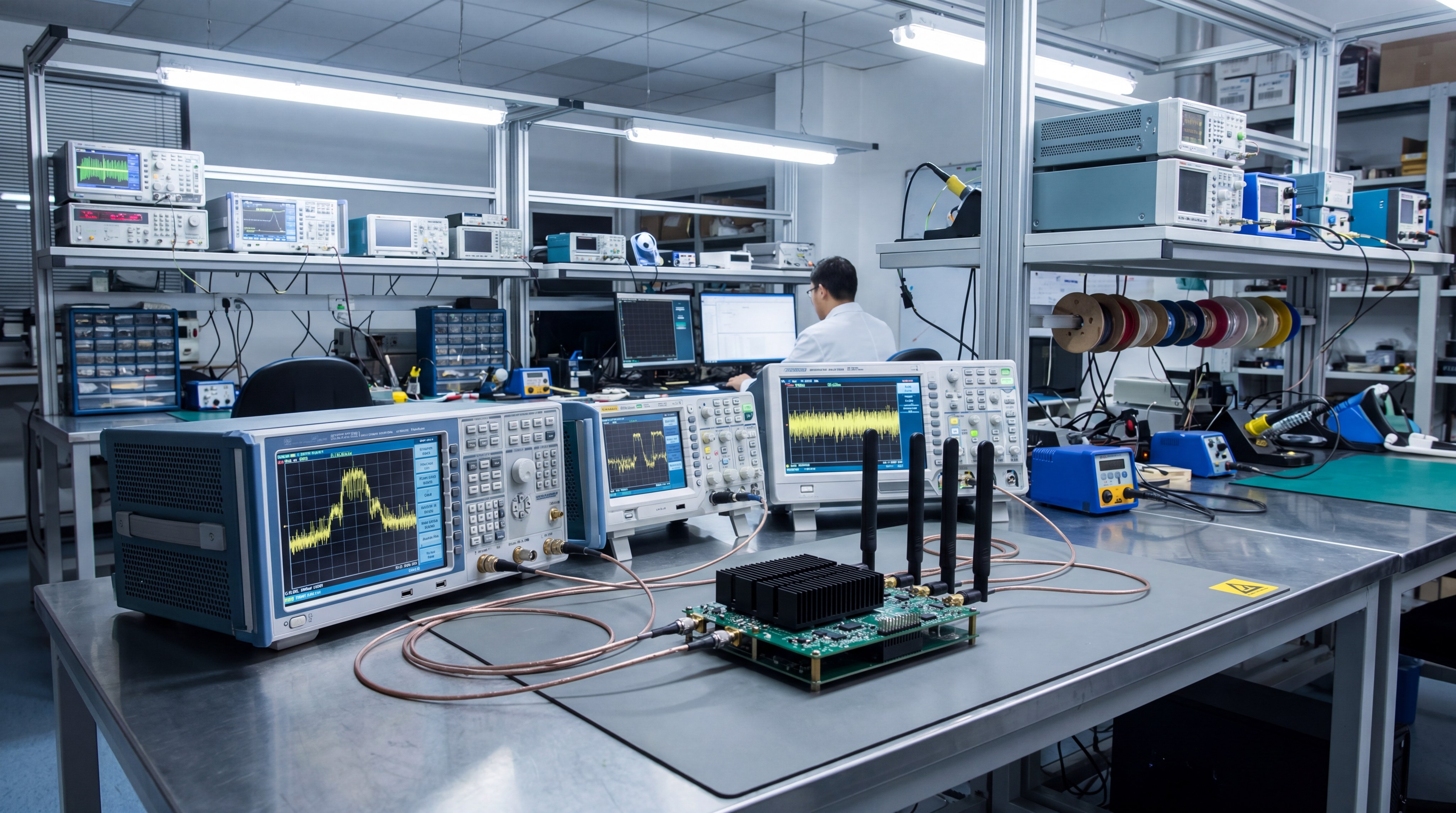
Unit-level testing is essential because it verifies that the specific Anti-Drone Jammer Module you receive meets every datasheet specification. Many manufacturers only perform batch testing, which can lead to individual units failing once they are integrated into your network. According to recent news, verified performance data for each unit is now a standard requirement for high-security defense contracts.
Moving beyond sampled data estimates
Unit-level validation ensures that gain flatness, VSWR protection, and harmonic distortion are all within acceptable limits. You need the confidence that your specific hardware will perform exactly as promised during a real-world incursion.
Look at this:
- Individual S-parameter validation for every unit.
- Full power burn-in testing to ensure longevity.
- Spectral purity checks to prevent unintended interference.
Verified performance for mission-critical setups
When integrating a module into a larger defense network, you must have a verified performance baseline. Having a dedicated test report for each unit simplifies the troubleshooting process and speeds up deployment.
The bottom line:
- Reduces the risk of integration delays.
- Provides a documented history of hardware performance.
- Ensures consistent jamming range across multiple units.
Key Takeaway: Individual unit testing eliminates performance uncertainty and ensures the module will perform reliably in the field.
| Test Parameter | Importance | Verification Method |
|---|---|---|
| VSWR | Prevents amplifier burnout | 100% Load testing |
| Gain Flatness | Ensures consistent jamming | Full-band sweep |
| Power Output | Guarantees effective range | Calibrated power meter |
Rigorous unit-level testing is the only way to guarantee that every deployed module meets the high standards required for critical defense.
How do self-diagnostic features prevent mission failure?
Self-diagnostic features prevent mission failure by monitoring the health of the Anti-Drone Jammer Module in real-time. A jammer that fails silently is worse than having no jammer at all, as it creates a false sense of security. Automated alerts allow your technicians to perform maintenance or swap units before a security breach actually occurs.
Continuous thermal and signal monitoring
Internal sensors track the temperature of power transistors and the health of the output signal constantly. If the system detects overheating, it can automatically trigger cooling fans or reduce power to protect the hardware.
You see:
- Real-time status reporting via Ethernet or RS485.
- Over-temperature protection prevents permanent damage.
- Output power monitoring confirms active jamming status.
Automated alerts and fail-safe protocols
If a critical fault is detected, the module can switch to a redundant power unit or alert your central command center. This ensures your defense perimeter remains active even if one component experiences an anomaly.
Wait, there’s more:
- VSWR monitoring detects antenna or cable faults.
- Fail-safe modes prioritize essential frequency bands.
- Automated logging helps with post-event analysis.
Key Takeaway: Self-monitoring features maximize system uptime and provide the situational awareness needed for a reliable aerial defense.
| Diagnostic Feature | Function | User Alert |
|---|---|---|
| Thermal Sensor | Prevents overheating | Visual/Software Alarm |
| VSWR Monitor | Detects antenna faults | Critical System Alert |
| Power Monitor | Confirms signal output | Status Dashboard |
Real-time diagnostics are essential for maintaining a persistent defense posture and ensuring that hardware issues are addressed before they compromise security.
Can custom RF engineering solve specific site challenges?
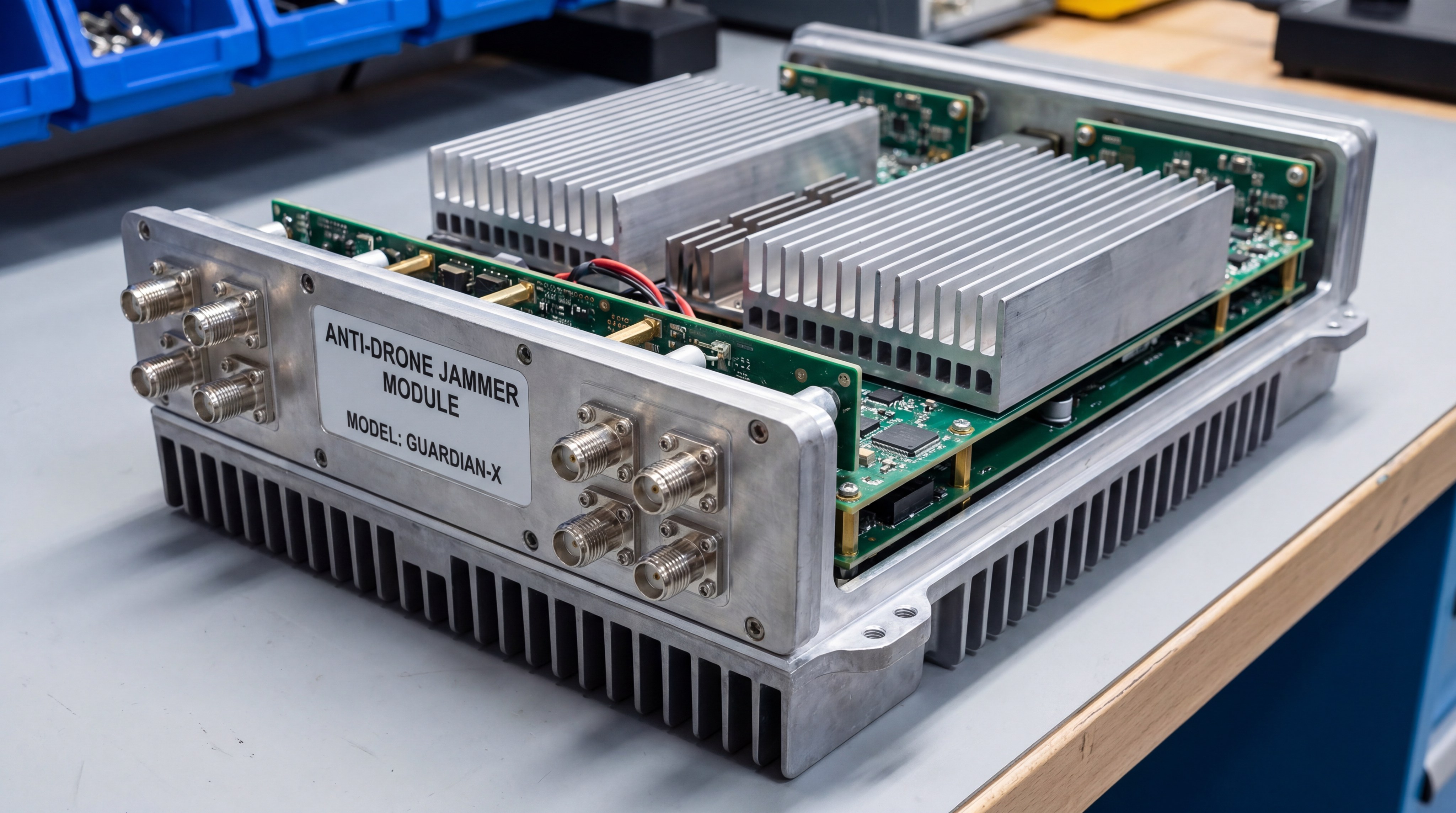
Yes, custom RF engineering allows you to tailor the Anti-Drone Jammer Module to meet the unique characteristics and constraints of your specific site. Every environment has different RF noise levels and physical layouts that a standard module might not fully address. Customization ensures that your defense system is perfectly optimized for your operational reality.
Tailoring band coverage and interfaces
Some regions use unconventional frequencies for drone communication that require specialized filtering. Custom engineering allows you to add specific bands like 433 MHz or 915 MHz, which are often used by long-range UAVs.
Look at this:
- Custom form factors for vehicle or manpack mounting.
- Specialized cooling solutions for high-power demands.
- Integration with unique command and control interfaces.
Integrating SDR and antenna platforms
For a complete defense solution, your jammer module must work seamlessly with Software Defined Radio sources and high-efficiency antennas. Engineering teams can design a unified RF chain that maximizes the performance of every individual component.
Check this out:
- Optimization of the entire signal path for maximum gain.
- Integration with third-party drone detection sensors.
- Customized mechanical housing for specific enclosures.
Key Takeaway: Custom RF solutions ensure that your jammer is perfectly optimized for the specific challenges of your operational environment.
| Customization Option | Benefit | Application |
|---|---|---|
| Mechanical Housing | Fits specific enclosures | Manpack or Vehicle |
| Frequency Tuning | Targets non-standard UAVs | Specialized Military |
| Control Protocol | Seamless system integration | Remote Command Centers |
Tailored engineering solutions provide the flexibility needed to overcome site-specific obstacles that standard hardware cannot address.
Frequently Asked Questions (FAQ)
Can I integrate this module into a mobile vehicle platform?
Yes, these modules are specifically designed with high vibration resistance for vehicle-mounted applications. They support various DC power inputs and can be housed in custom mechanical enclosures for rugged use.
What’s the best way to determine the required jamming range?
The best way is to conduct a professional site survey to identify potential drone launch points and terrain obstructions. For most high-security perimeters, a minimum 2 km radius is recommended to provide adequate reaction time.
How do I know if the module is effectively jamming a drone?
The module’s control interface provides real-time feedback on current signal output and system health. In the field, you will see the drone either hover in place, return to its starting point, or land immediately upon signal loss.
Can I operate the jammer 24/7 without damaging the hardware?
Absolutely, provided the module is equipped with an appropriate cooling system for continuous operation. Our industrial-grade platforms feature thermal protection and are rated for prolonged, persistent use in the field.
How do I know if the frequency range is sufficient for my needs?
The most critical bands are 2.4 GHz and 5.8 GHz, but adding 1.2 GHz for GPS is vital for a complete defense. If you operate in a region with non-standard drones, custom frequency tuning may be necessary.
*
High reliability in counter-drone defense is not a luxury—it is a necessity for protecting high-value assets in an increasingly transparent world. By choosing an Anti-Drone Jammer Module engineered for resilience, you solve the critical problem of unauthorized aerial incursions and the agitation of potential security breaches. CorelixRF is committed to delivering the most advanced RF power platforms to secure your airspace and provide peace of mind in complex environments. To discuss your specific site requirements or request a technical review, contact us today.