
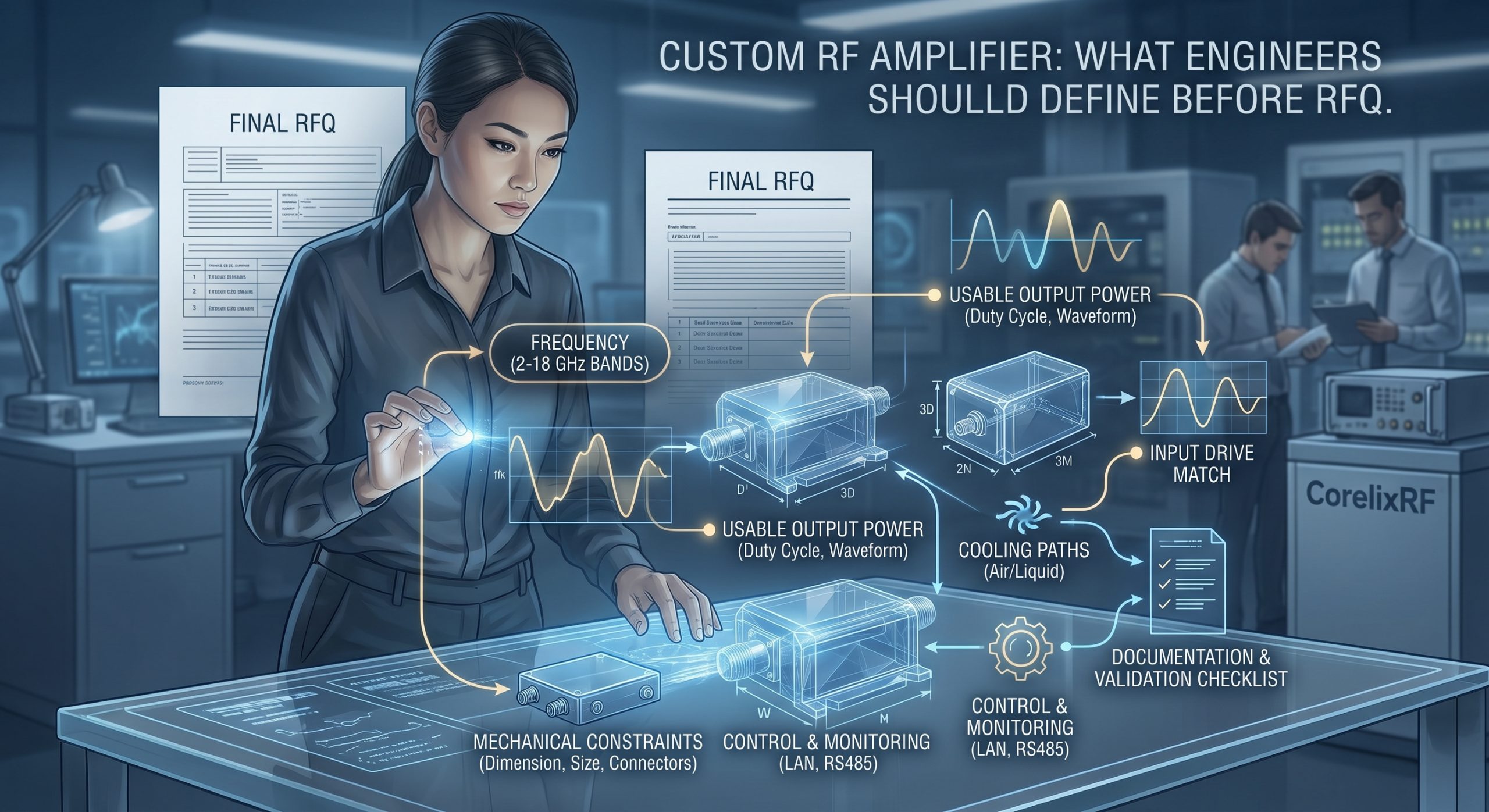
A custom RF amplifier project usually starts when a standard model is close but not quite right. The frequency window may be unusual. The connector path may need to match an existing enclosure. The customer may need a specific control interface, a rack format, a modified cooling path, or documentation that supports internal engineering approval.
The most productive RFQ does not begin with “please quote a custom amplifier.” It begins with a structured engineering description. That description helps the manufacturer decide whether a standard platform can be adapted or whether a deeper custom design review is needed.
CorelixRF supports standard and custom RF amplifier paths across multiple frequency ranges, including 2-6 GHz, 6-18 GHz, 18-40 GHz, EMC-related platforms, UHF/specialized models, and project-specific RF systems. The checklist below helps buyers prepare the information that matters.
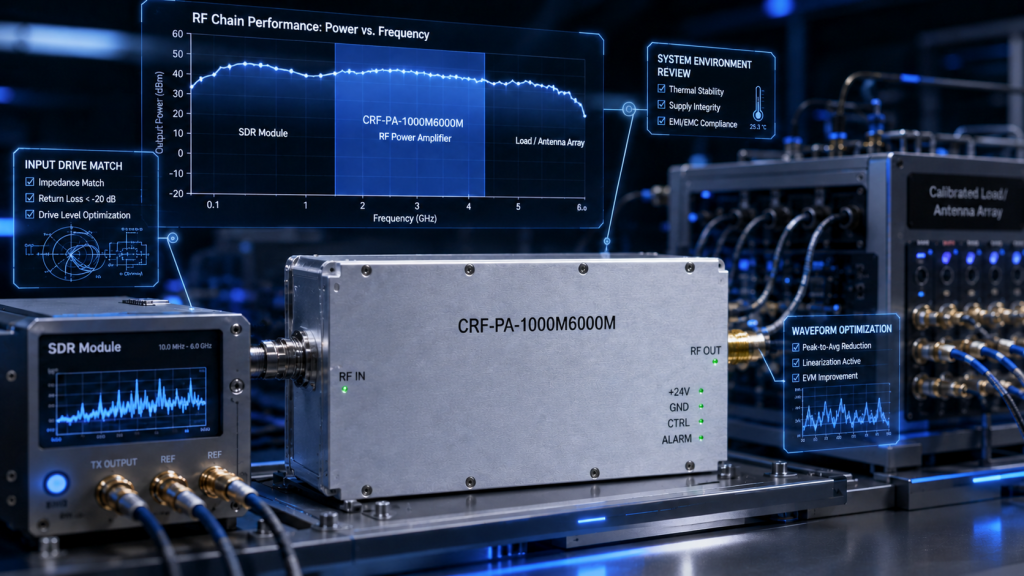
RFQ field: frequency requirement
Frequency is the first decision point. State whether the amplifier must cover a full broadband range or a narrower operating window. A request for 2-18 GHz, 6-18 GHz, or 18-40 GHz can mean many different things depending on whether the system uses the full span or only a few critical bands.
If the project has priority frequencies, list them. If band-edge performance matters, say so. If the amplifier only needs to work in a focused range, a custom review may identify a more practical option than forcing a full-band design.
RFQ field: usable output power
Output power should be described as more than a target wattage. Include required power across frequency, duty cycle, waveform type, operating mode, and load condition. If the amplifier must maintain a minimum output at a specific frequency, that requirement should be explicit.
For high-power broadband RF amplifiers, delivered power also depends on cable loss, adapters, load match, and thermal behavior. A useful RFQ explains the system environment, not just the desired number on the datasheet.
RFQ field: input drive and signal source
The amplifier must match the upstream source. If the source is a signal generator, SDR module, exciter, synthesizer, or existing RF chain, include available input power and waveform details. Input drive range affects gain selection and whether extra driver stages or attenuation are needed.
This is especially important for SDR-based systems, swept test setups, and waveform simulation. The amplifier should be reviewed as part of the RF chain rather than as an isolated block.
RFQ field: connector and mechanical constraints
Custom RF amplifier projects often become mechanical projects. Connector type, connector location, enclosure dimensions, mounting method, weight limit, cable access, and rack format can all affect feasibility. For mmWave amplifiers, connector and waveguide paths become even more important.
If the amplifier must fit an existing chassis or replace another unit, provide dimensional limits and photos or drawings if available. If there is flexibility, say that too. Engineering teams can often recommend a simpler path when they understand what is fixed and what can move.
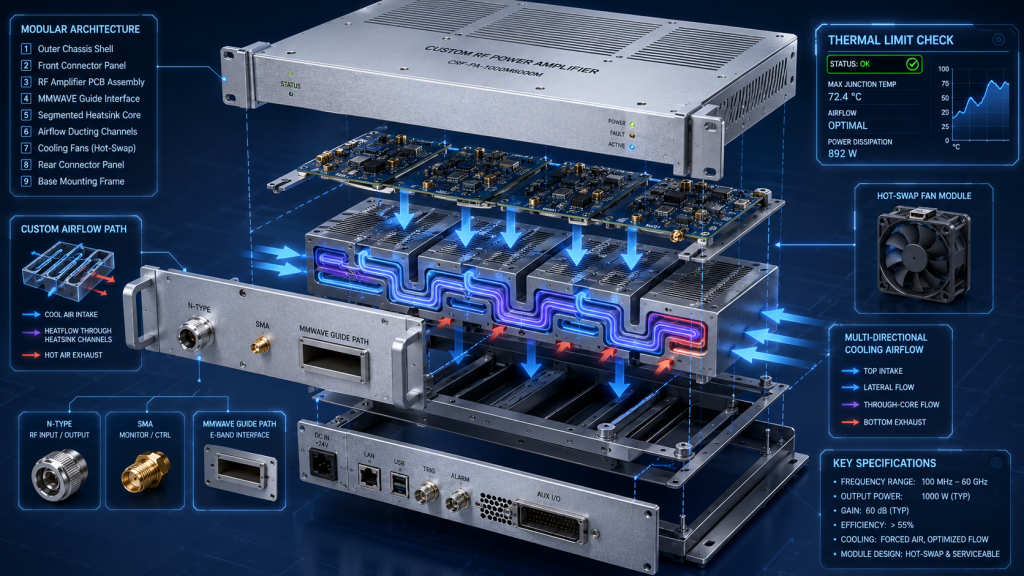
RFQ field: cooling and duty cycle
Cooling is not an afterthought. Air-cooled modules, rack systems, and custom chassis options all require different planning. Duty cycle, ambient temperature, airflow direction, enclosure ventilation, and installation altitude can influence the final design.
For a custom RF power amplifier, thermal limits should be reviewed before the buyer commits to output power. A smaller unit may be possible at a lower duty cycle, while continuous operation may require a larger heat path or rack-level solution.
RFQ field: control and monitoring
Some projects only require basic enable control. Others need RS485, LAN, GPIB, alarms, forward and reflected power monitoring, temperature monitoring, gain control, or software integration. Control requirements affect hardware and firmware decisions, so they should be included early.
If the amplifier will sit inside a larger automated RF system, describe the expected command interface and monitoring workflow. This prevents late-stage changes that can slow down integration.
RFQ field: documentation and validation
Engineering buyers may need datasheets, mechanical drawings, test curves, inspection records, unit-level test data, packing documents, or project-specific validation notes. Procurement teams may need quality documentation or factory information before approving a supplier.
State these needs before quotation. A manufacturer can then confirm what is available for the standard platform and what may require project-level agreement.
Decision path
- If the standard model meets the frequency, power, connector, and cooling requirement, start with the standard platform.
- If the RF path is acceptable but the enclosure or interface is not, request a platform adaptation review.
- If the frequency window, power behavior, mechanical package, and control logic are all specialized, request a custom RF amplifier review.
When a standard model is still the best answer
Not every custom request needs a custom design. Sometimes the best solution is a standard amplifier with a documented integration review. Standard platforms can reduce cost, risk, and lead time if they meet the real requirement.
A good manufacturer should help identify whether a standard 2-6 GHz, 6-18 GHz, 18-40 GHz, EMC, or narrowband platform is a better starting point. Custom work should solve a real constraint, not create extra complexity by default.
FAQ
What information should I send for a custom RF amplifier quote?
Send frequency range, output power, duty cycle, waveform, input drive, connector preference, cooling limits, mechanical constraints, control interface, documentation needs, quantity, and project timeline.
Can a standard RF amplifier be modified?
In many cases, a standard platform can be reviewed for connector, interface, frequency window, mechanical, or documentation requirements. Feasibility depends on the model and project conditions.
What is the biggest mistake in custom amplifier RFQs?
The biggest mistake is giving only frequency and wattage while omitting duty cycle, input drive, cooling, connector path, and integration constraints.
When should I request engineering review?
Request review before the mechanical or RF chain design is frozen. Early review can reduce redesign risk.