
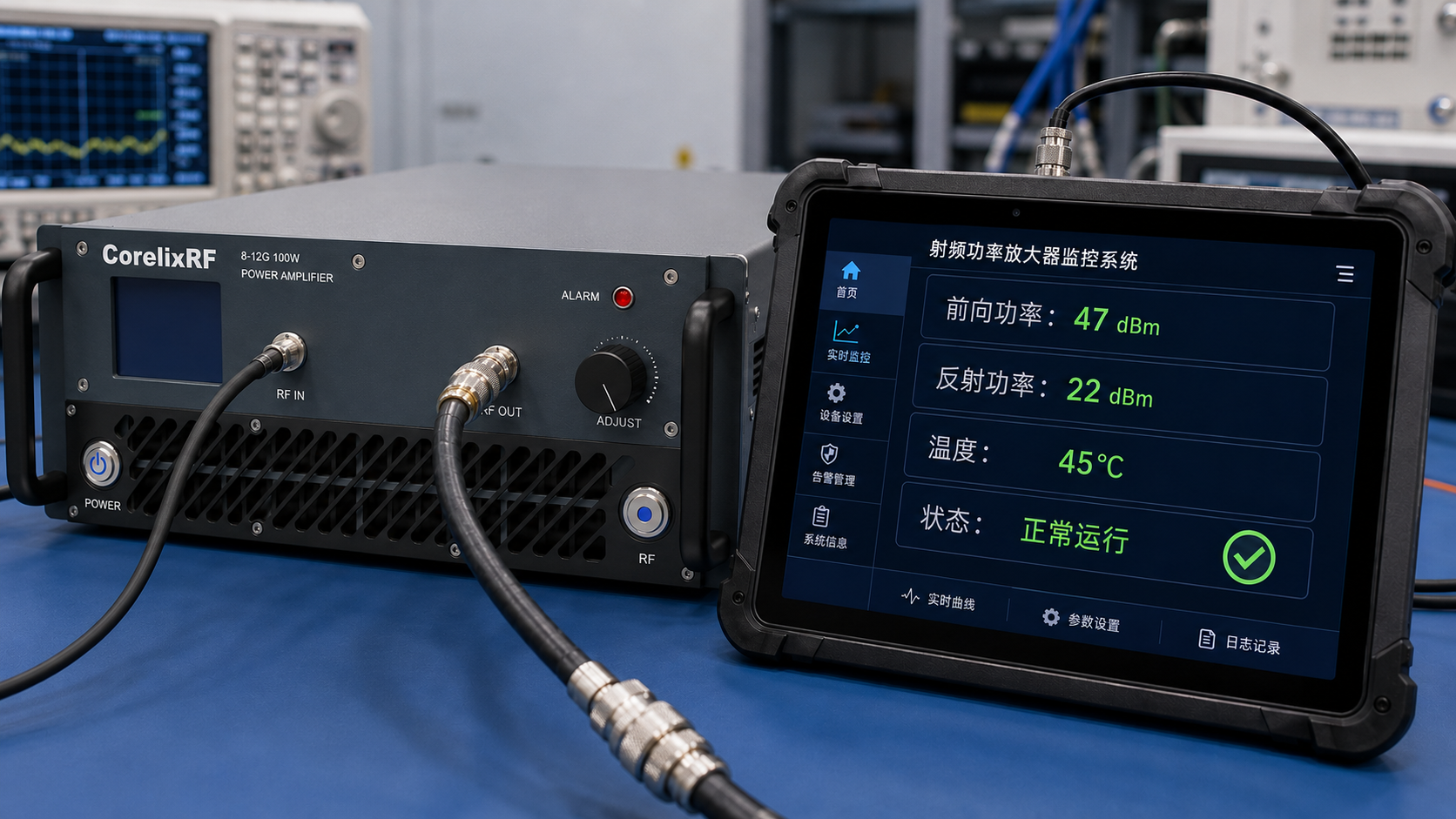
RF power amplifier test data is often the difference between a confident purchase and a risky catalog match. For engineers, integrators, and procurement teams, a datasheet is the beginning of the review, not the end. The right test information helps confirm whether the amplifier will deliver usable power, stable gain, acceptable input match, manageable thermal behavior, and the right interface fit for the real system.
CorelixRF emphasizes factory-side engineering review, documented model data, and project-level validation support across RF amplifier platforms. This article explains what buyers should ask for before ordering a broadband RF amplifier, microwave amplifier, EMC amplifier, or custom RF power module.
Evidence item 1: output power across the operating range
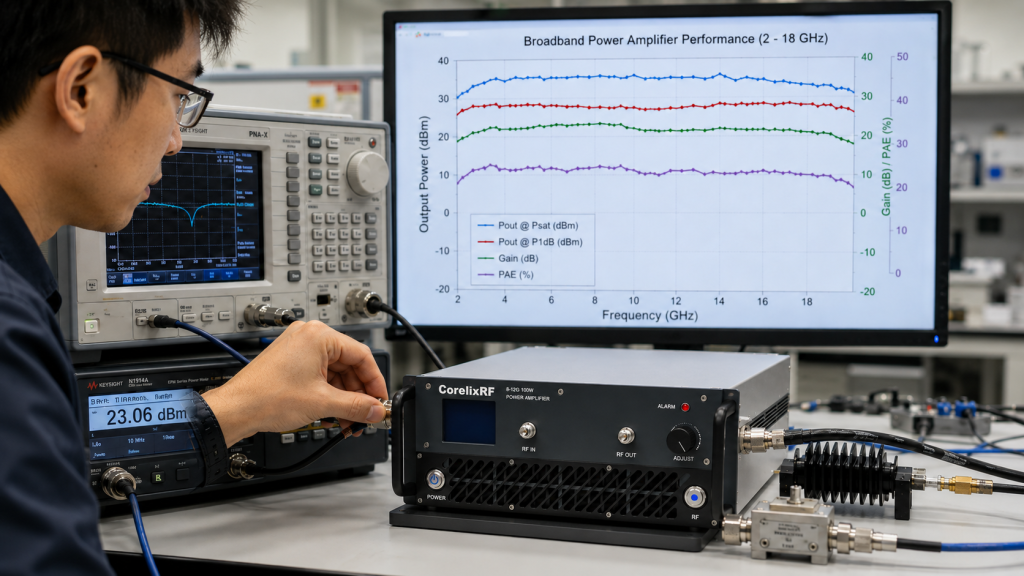
The most obvious test item is output power, but the important version is output power across the required frequency range. A broadband amplifier may have different behavior at the low end, center, and high end of the band. For a 2-6 GHz, 6-18 GHz, or 18-40 GHz amplifier, ask whether curves or measured data are available for the selected model.
If the application needs a minimum output at specific frequencies, state those frequencies in the RFQ. This helps the supplier confirm whether the standard model is a fit or whether a custom review is needed.
Evidence item 2: gain and gain flatness
Gain tells the buyer how much input drive is needed. Gain flatness tells the engineer how predictable the amplifier is across the band. In swept testing, communication signal evaluation, SDR-based waveform amplification, or calibration-sensitive systems, gain variation can affect the entire test plan.
Ask for gain behavior across the band and confirm the input drive range. If the signal source has limited output power, this information is essential.
Evidence item 3: input match, VSWR, and load conditions
Input match affects how the amplifier interacts with the upstream source. Output load condition affects performance and protection planning. Buyers should ask what load assumptions are used in the datasheet and whether the amplifier includes protection or monitoring features relevant to the intended application.
For higher-frequency and higher-power systems, cable loss, adapter quality, couplers, isolators, attenuators, and loads should be reviewed as a complete RF path. The amplifier does not operate in isolation.
Evidence item 4: thermal and duty-cycle information
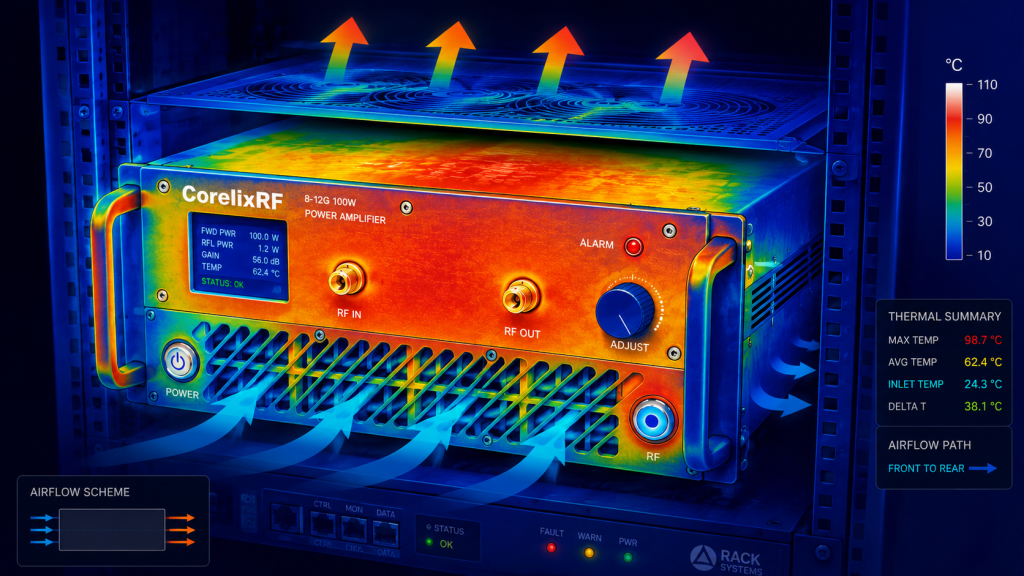
Thermal behavior is a practical reliability issue. A power amplifier that works on an open bench may need a different cooling plan inside a rack, chamber, cabinet, or vehicle platform. Ask how cooling is handled, what airflow is expected, and what duty cycle or operating mode assumptions apply.
For air-cooled amplifiers, review airflow direction, ambient temperature, installation spacing, and whether the final system will restrict ventilation. For rack amplifiers, confirm rack height, air path, and service access.
Evidence item 5: control and monitoring verification
Modern RF systems often require more than RF output. RS485, LAN, GPIB, enable control, alarms, temperature monitoring, forward/reflected power monitoring, and status reporting may be part of the integration requirement.
Before ordering, define how the amplifier will be controlled and what signals or commands the system needs. Then ask the supplier to confirm the available interface and documentation for the selected model.
Evidence item 6: mechanical and connector documentation
Mechanical drawings prevent late surprises. Connector type, connector location, module dimensions, rack height, mounting points, weight, and cable access all affect integration. For 18-40 GHz mmWave amplifiers, connector and waveguide details can also affect delivered power and calibration.
Buyers should request dimensional drawings or outline references before final approval, especially for custom RF systems or OEM integration.
Evidence item 7: factory validation and shipment records
A strong procurement review may require more than a datasheet. Depending on the project, buyers may ask for model-level test curves, unit-level test records, inspection records, packing information, or validation notes. Availability can vary by model and order scope, so this should be discussed early.
Factory-direct communication helps because the same team that builds and tests the amplifier can clarify what documentation is realistic for the project.·············
Quick audit table
| Evidence | Why it matters | Status before PO |
|---|---|---|
| Output power by frequency | Confirms usable RF margin | Request if band-edge power matters |
| Gain curve | Confirms source drive fit | Request for broadband systems |
| Mechanical outline | Prevents enclosure mismatch | Request before integration release |
| Connector details | Protects RF path design | Confirm by model |
| Cooling assumptions | Reduces thermal risk | Confirm for rack/enclosure use |
| Control interface | Supports automation | Confirm command path |
Why this matters for procurement
Procurement teams are often measured on price, lead time, and supplier qualification. Engineering teams are measured on whether the hardware works. RF power amplifier test data connects those two concerns. It reduces mismatch risk, helps compare suppliers, and gives the buyer a defensible basis for approval.
The best RFQ asks for the right evidence before the order is placed. That does not mean every project needs a custom test report. It means the buyer should understand what data exists and what should be confirmed for the application.
FAQ
What test data should I request for an RF power amplifier?
Start with output power, gain, gain flatness, input match, connector details, cooling information, control interface, and mechanical drawings.
Is a datasheet enough for ordering?
For simple cases, it may be enough. For integration, broadband testing, or custom systems, additional curves or engineering review can reduce risk.
Should I ask for unit-level test records?
If the project requires documented validation, ask early. Availability depends on model, order scope, and project requirements.
Why does test setup matter?
Cable loss, adapters, load condition, and measurement instruments can affect apparent amplifier performance, especially at microwave and mmWave frequencies.