

Buying high-power anti-drone technology often feels like navigating a hidden technical minefield. You select what looks like an advanced multi-band system only to discover it drops output power when temperatures climb or fails to intercept modern frequency-shifting target threats. It is easy to buy the wrong equipment. A single miscalculation can render a major defensive security investment completely useless in under thirty seconds. This detailed guide reveals common high-frequency purchasing pitfalls and presents engineered solutions to maximize your counter-UAS infrastructure spend. As a premier source for Anti-Drone Systems backed by decades of proven RF manufacturing experience, CorelixRF delivers the precise technical insights defense procurement officers need to secure critical airspace.
1. Why Do Procurement Officers Overlook Total Frequency Coverage in Anti-Drone Systems?
Total frequency coverage remains the single most common blind spot in modern airspace security procurement. Here’s the deal: many standard intercept systems only target common 2.4GHz or 5.8GHz commercial drone bands. Modern tactical threats routinely operate outside these frequencies by utilizing custom sub-GHz channels or extended super-high-frequency bands.
If your hardware cannot jam across a continuous spectrum, it creates massive blind spots that sophisticated adversaries will quickly exploit. This is where it gets interesting… A truly secure system requires broad RF chain integration that covers everything from 30MHz up to 6GHz without gaps.
What Happens When Lower Bands Are Ignored?
- Commercial drones often get modified to run on 433MHz or 915MHz frequencies.
- Security teams remain blind to low-frequency command signals until it is too late.
- Standard commercial jammers lack the broad architecture to stop custom long-range threats.
How Do Millimeter-Wave Threats Bypass Basic Setups?
- Advanced military-grade threats utilize high-frequency bands to transmit data rapidly.
- Most standard counter-UAS setups completely lack receiver modules for these upper bands.
- Custom multi-band power amplifiers are required to counter high-frequency telemetry.
| Frequency Band | Common Application | Vulnerability Level |
| 30MHz – 1000MHz | Tactical UAV Command, Modified RC Links | Extremely High |
| 1000MHz – 3000MHz | Standard GNSS Navigation, Mainstream Commercial Drones | High |
| 3000MHz – 6000MHz | High-Speed Data Links, Advanced Industrial Formats | Medium to High |
Analyzing this spectral data reveals that any gap in your amplification chain creates an instant doorway for unauthorized drone penetration.
Key Takeaway: Ensuring continuous frequency coverage from 30MHz to 6GHz protects your infrastructure against both basic RC drones and highly customized tactical threats.
image: An infographic diagram showcasing the full radio frequency spectrum from 30MHz to 6GHz, highlighting the gaps left by standard jammers versus continuous coverage. Aspect ratio 16:9.
2. Why Does Power Degradation Ruin Your Anti-Drone Systems Investment?
System degradation under harsh field conditions can completely destroy your defense capabilities during a critical security event. You might be wondering: why do field systems fail to stop targets at their rated operational distance? The main culprit is severe thermal power drop within the core solid-state power amplifier modules.
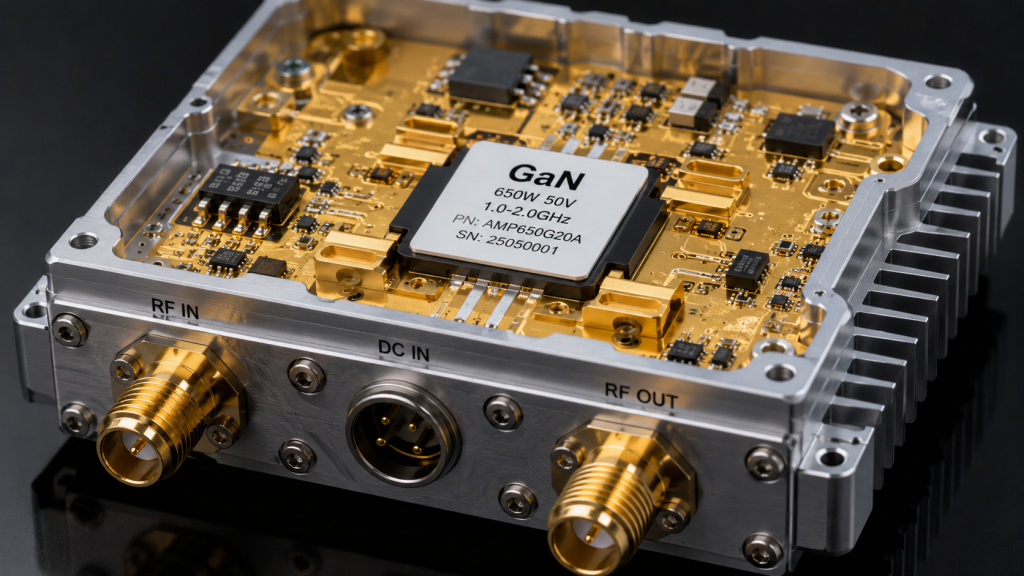
Cheap components overheat rapidly during continuous wave jamming operations and this causes the output wattage to plummet mid-operation. Ready for the good part? High-efficiency GaN power platforms mitigate this issue entirely by providing stable output even during extended thermal stress.
What Causes Thermal Droop in Amplifiers?
- Poor internal impedance matching creates excess heat inside the amplifier housing.
- Standard aluminum heat sinks without proper optimization fail to dissipate heat fast.
- Continuous transmission forces the system to scale back power to prevent total burnout.
How Does Power Headroom Protect Your Airspace?
- Engineering a buffer of fifteen percent power headroom keeps components running cool.
- Stable gain flatness ensures consistent signal density across the entire operating band.
- High-power redundancy keeps the defense perimeter stable during long-duration threats.
| Hardware Feature | Standard Market Component | CorelixRF GaN Platform Spec |
| Power Headroom | 0% Buffer (Runs at absolute limit) | ≥15% Power Redundancy |
| Gain Flatness | ±3.0 dB (Inconsistent output) | <1.5 dB Flatness |
| Thermal Stability | Drops up to 40% power over time | 0% Degradation under continuous load |
This baseline comparison shows that choosing military-grade GaN platforms prevents your defensive shield from collapsing when the hardware heats up.
Key Takeaway: Demanding verified GaN technology with at least fifteen percent power headroom ensures your system maintains its defensive range during sustained drone attacks.
image: A technical schematic visualizing a high-efficiency GaN power amplifier module layout with optimized thermal dissipation pathways. Aspect ratio 16:9.
3. Why Are Fixed Frequency Anti-Drone Systems Ineffective Against Modern Swarms?
Static defense mechanisms cannot survive in today’s dynamic electronic warfare environments. What’s the real story? Traditional jammers transmit on a single fixed frequency block which makes them incredibly easy to bypass using basic automated flight patterns. Modern automated drone swarms utilize smart software-defined radios to hop across frequencies the instant they detect active interference.
Procuring static transmitters means you are investing in yesterday’s technology to fight tomorrow’s highly adaptive airborne threats. But here’s the kicker… Your defensive infrastructure needs intelligent software-defined signal sources that match target maneuvers in real time.
Can Your Hardware Handle Real-Time Frequency Hopping?
- Fixed systems cannot track fast signal shifts across wide tactical bands.
- Dual independent output channels allow a system to jam and scan simultaneously.
- Adaptive algorithms must control the transmission to stay ahead of drone target logic.
Why Do Multi-Waveform Signals Matter for Jamming?
- Drones rely on diverse signals like GNSS, LFM, and advanced OFDM protocols.
- Simple white noise jamming fails against tightly encrypted military control links.
- Smart digital signal sources generate custom waveforms to disrupt any incoming protocol.
| Signal Source Type | Frequency Flexibility | Modulation Capabilities |
| Legacy Analog Source | Fixed blocks only | Basic Noise Injection |
| Advanced SDR Digital Source | 100MHz – 6000MHz Real-Time Hopping | Multi-Waveform (CW, LFM, GNSS, OFDM) |
The contrast here proves that software-defined signal control is absolutely mandatory for disrupting modern commercial and military drone protocols.
Key Takeaway: Incorporating intelligent SDR digital signal sources allows your security array to counter adaptive frequency-hopping drone swarms effectively.
image: A clean digital chart displaying frequency-hopping signal waveforms tracking and intercepting multiple targets across a wide band. Aspect ratio 16:9.
4. Why Should You Distrust Unverified Multi-Vendor RF Chains?
Assembling defensive hardware from disconnected online component traders is an expensive recipe for system-level failure. Look at it this way: if you source your power amplifier from one vendor, your signal source from a second, and your antennas from a third, nobody takes responsibility for the final integration.
Mismatched impedance and poor Voltage Standing Wave Ratio performance will cause energy to reflect backward into your own modules. Anti-Drone Systems require precision-matched RF chains engineered from the ground up by a single dedicated manufacturer. This is where it gets interesting… A true factory partner builds every single link to work together flawlessly.
What Are the Risks of Mismatched VSWR?
- High VSWR reflects destructive power back into the main transmitter module.
- Mismatched interfaces cause severe insertion loss and weaken overall jamming ranges.
- Component component friction shortens the lifespan of expensive defense assets.
Why Is Single-Manufacturer Engineering Superior?
- Integrated design ensures perfect synchronization between signal sources and amplifiers.
- Factory tuning optimizes power transfer from the final amplifier stage to the antenna.
- Testing protocols cover the entire integrated ecosystem rather than isolated boxes.
| Integration Strategy | Insertion Loss | System Failure Point |
| Multi-Vendor Assembly | High (>2.5dB loss due to bad matching) | Component Interface Friction |
| Single-Factory RF Chain | Low (<0.5dB optimized connection) | Integrated Protection Circuitry |
Reviewing these integration metrics illustrates that sourcing from a unified manufacturer eliminates dangerous insertion losses and protects your hardware from internal damage.
Key Takeaway: Sourcing an entire unified RF chain from a certified manufacturer ensures optimal system compatibility and prevents costly field integration failures.
image: A high-fidelity industrial block diagram illustrating a complete RF chain from signal generation to the directional antenna. Aspect ratio 16:9.
5. Why Is a 46-Step Quality Protocol Necessary for Anti-Drone Systems?
Many commercial grade assembly lines cut corners during environmental testing to speed up their delivery schedules. Let’s face it: an anti-drone system sitting on a hot desert border or a freezing maritime checkpoint faces extreme environmental abuse. If your supplier stops quality checking after basic PCBA functional validation, the system will likely fail when exposed to real-world deployment stress.
Your procurement checklist must mandate strict military-grade production protocols to survive real-world deployment conditions. Ready for the good part? Adhering to a comprehensive 46-step testing workflow ensures absolute reliability across thousands of deployed units.
Why Does Thermal Cycling Save Lives?
- Rapid temperature changes reveal weak solder joints before units leave the factory floors.
- Extreme chamber testing simulates harsh operational environments from desert heat to arctic cold.
- Sustained aging verification ensures components can handle long-duration active missions.
What Does Conformal Coating Protect Against?
- Moisture, salt fog, and fine dust quickly corrode unprotected high-frequency circuits.
- Specialized coatings protect high-density multi-layer boards from atmospheric shorts.
- Advanced physical vibration testing ensures stable connection integrity inside mobile vehicle platforms.
| Testing Phase | Standard Testing Scope | 46-Step Military-Grade Protocol |
| Inspection Depth | Basic component check | IQC Incoming Inspection to final aging |
| Environmental Stress | Room temperature turn-on | Deep thermal cycling, vibration, salt fog exposure |
This comparison shows why rigorous multi-phase testing is required to keep defensive systems operational under brutal field conditions.
Key Takeaway: Verifying that your manufacturer utilizes an exhaustive 46-step quality protocol protects your long-term investment from premature field failure.
image: A clean factory laboratory view showing an RF module undergoing strict thermal chamber and spectrum analyzer validation. Aspect ratio 16:9.
6. Why Do Buyers Ignore Laboratory Verification When Ordering Power Amplifiers?
Relying on unverified datasheets from third-party brokers is a major gamble with your site security budget. Here’s the deal: some suppliers copy specifications from competitors without owning the vector network analyzers or spectrum analyzers needed to verify those numbers.
When you purchase unverified hardware, you are essentially flying blind into a complex theater of electronic defense. But here’s the kicker… True technical authority is earned inside a fully equipped, high-precision RF laboratory.
Why Are True Vector Network Analyzer Graphs Mandatory?
- True VNA plots prove the exact input and output return loss metrics.
- Graphic documentation verifies that gain remains perfectly flat across the target spectrum.
- Real testing data prevents surprises when integrating units into larger systems.
How Do Real Simulation Reports Prevent Field Failures?
- High-precision scopes capture exact pulse rise times for rapid target response.
- Vacuum reflow systems ensure perfect component placement on complex microwave boards.
- Certified lab reports provide proof of performance that satisfies strict defense requirements.
| Verification Asset | Broker Documentation | Factory Lab Certification |
| Data Origin | Estimated text files | Real-time VNA and Spectrum Analyzer plots |
| Standard Compliance | Unverified claims | Full compliance with MIL-STD-810 precision |
These documentation standards emphasize that certified laboratory validation is the only way to guarantee your hardware performs exactly as advertised.
Key Takeaway: Always demand verified vector network analyzer plots and spectrum reports directly from the manufacturing factory before signing any contract.
image: A modern, high-tech industrial testing laboratory with high-precision oscilloscopes and vector network analyzers displaying live RF metrics. Aspect ratio 16:9.
7. Why Is Fixed Off-the-Shelf Hardware a Trap for Complex RF Integration?
Standard catalog items rarely fit perfectly into custom naval vessels, mobile vehicle arrays, or remote border outposts. You might be wondering: why do system integrators struggle during final mechanical assembly? They are trapped by rigid, unalterable chassis dimensions and fixed interface protocols.
Every unique defense deployment presents specific physical layout, power consumption, and thermal dissipation requirements. This is where it gets interesting… Choosing an engineering-driven manufacturer allows you to customize every aspect of the RF block to match your exact project parameters.
Can Your Supplier Re-Engineer the Enclosure?
- Standard housings often fail to fit inside tight mobile defense turrets.
- Custom aluminum heat sinks can be reshaped to utilize existing vehicle airflow.
- Tailored mounting brackets eliminate the need for costly field modifications.
Why Must Interface Protocols Remain Flexible?
- Command systems use diverse data interfaces like RS422, Ethernet, or custom CAN bus.
- Hardware must accept custom software commands without adding heavy conversion adapters.
- Configurable output power allows engineers to match local power grids perfectly.
| Manufacturing Approach | Design Adaptability | Engineering Support |
| Off-the-Shelf Catalog | Completely locked specifications | Basic sales email support |
| Custom RF Engineering | Tailored frequency, power, and housing | Direct access to dedicated RF engineers |
This structural flexibility proves that custom engineering support is crucial for seamlessly embedding high-power hardware into complex defense infrastructure.
Key Takeaway: Partnering with an agile OEM/ODM manufacturer allows you to modify frequency, housing, and data protocols for seamless system integration.
image: A high-precision 3D CAD design visualization showing a custom-engineered RF power amplifier chassis being optimized for tight system enclosures. Aspect ratio 16:9.
8. Why Does Lacking Global Deployment Experience Equal Risk?
An unproven system is a major liability when deployed on the frontline of critical infrastructure security. What’s the real story? A system designed solely in an isolated laboratory often fails when confronted with real-world border environments or high-interference airport airspaces.
Different regions present unique regulatory constraints, environmental challenges, and distinct tactical drone behaviors. Ready for the good part? Working with a manufacturer that has successfully deployed hardware across Europe, the Middle East, and Southeast Asia ensures your equipment is built on proven field history.
Why Do Cross-Border Environmental Lessons Matter?
- Systems optimized for high-humidity coastal zones will not fail from internal moisture.
- High-temperature desert experience teaches engineers how to prevent thermal shutdown.
- Deployed field data helps refine internal matching networks against real-world interference.
How Does Global Compliance Speed Up Your Project?
- Proven international export experience guarantees smooth shipping through customs checkpoints.
- Compliance with global defense standards prevents costly regulatory rebuild delays.
- Experienced teams understand how to securely package sensitive microwave modules for transit.
| Deployment Region | Environmental Challenge | Engineered Factory Solution |
| Middle East | Extreme Heat, Fine Dust | Sealed IP67 Enclosures, Deep Heat Sinks |
| Coastal Europe | High Salt Fog, Moisture | Complete Conformal Coating, Stainless Hardware |
This global field history demonstrates that choosing a partner with international deployment experience protects your project from environmental failures.
Key Takeaway: Selecting a partner with verified international deployment history ensures your hardware can survive diverse field conditions and complex regulatory checks.
image: A global deployment map infographic highlighting critical infrastructure security locations across Europe, the Middle East, and Asia. Aspect ratio 16:9.
9. Why Do Long Procurement Timelines Leave Airspace Vulnerable?
Delays in receiving your technical hardware leave your perimeter unprotected against rapidly evolving airborne threats. Look at it this way: waiting six to nine months for custom RF modules leaves an unacceptable security window open for unauthorized drone activity.
Many brokers add weeks to the schedule simply passing emails back and forth because they don’t control the production line. But here’s the kicker… Working directly with a large-scale manufacturer with massive facility space solves this bottleneck completely.

How Do In-House Scaling Resources Accelerate Delivery?
- Massive production facilities allow for rapid scaling from prototypes to mass production.
- Large engineering teams can review project schematics and return layouts in 24 hours.
- In-house wave soldering and CNC machining speed up mechanical turnaround times.
Why Do Rapid Technical Responses Prevent Mistakes?
- Direct communication with factory engineers eliminates costly translation errors.
- Instant access to raw component stocks keeps production lines moving forward.
- Fast prototyping validation gets your final security platform into the field months ahead of schedule.
| Supplier Type | Initial Technical Response | Mass Production Lead Time |
| Third-Party Broker | 5 – 7 Business Days | 24 – 36 Weeks (Highly unstable) |
| Direct 400+ Person Factory | Under 24 Hours | 6 – 8 Weeks (Controlled line) |
This comparison clearly shows that eliminating middlemen is the fastest way to accelerate your defensive readiness.
Key Takeaway: Streamlining your procurement by dealing directly with a high-capacity factory minimizes delivery lead times and gets defenses online fast.
image: A dynamic manufacturing timeline graphic contrasting the sluggish, multi-week broker path against direct, high-capacity factory output. Aspect ratio 16:9.
10. Why Is Post-Sales Technical Isolation a Major Operational Risk?
Your procurement responsibility does not end the moment the hardware crate arrives at your receiving facility. Let’s face it: high-power RF systems are complex, dynamic ecosystems that require ongoing optimization as field threats adapt.
If your supplier disappears or lacks true engineering depth after processing your payment, your team is left isolated when configuration challenges arise during installation. This is where it gets interesting… Long-term defensive success requires direct, unhindered access to factory engineering support throughout the entire product lifecycle.
Why Is Direct Lifecycle Engineering Access Crucial?
- Factory teams help tune antenna matching networks during tricky field setups.
- Engineering support can guide firmware updates for software-defined radio boards.
- Lifecycle backing protects your technology from becoming obsolete as target threats evolve.
How Does Secure Project Handling Maintain Operational Security?
- Clear intellectual property protection keeps your tactical layouts fully confidential.
- Direct factory communication channels prevent sensitive project designs from leaking.
- Secure data archiving ensures easy sourcing for identical drop-in replacement parts years down the road.
| Support Model | After-Sales Availability | Project Security Level |
| Trading Agent Support | Basic manual downloads only | Low (Shared through open channels) |
| Direct Factory Partnership | Dedicated lifecycle engineer access | Maximum (Confidential handling protocols) |
This service comparison highlights why direct factory technical backing is essential for maintaining operational security over the lifespan of your installation.
Key Takeaway: Securing lifetime technical support from a dedicated factory partner keeps your counter-UAS array effective and adaptable for years to come.
image: A corporate technical engineering icon layout visualizing secure lifecycle support and direct technical consultations. Aspect ratio 16:9.
Reviewing Your Strategic Counter-UAS Procurement Path
Avoiding common high-frequency purchasing mistakes requires shifting focus from cheap, unverified components to fully integrated, military-grade RF chains. This comprehensive guide has detailed why broad frequency bands, stable GaN power platforms, and direct factory verification are mandatory for protecting critical perimeters. CorelixRF eliminates integration risks by manufacturing every critical component from signal source to radiation under a strict 46-step quality protocol. Let our expert engineering team accelerate your project timeline and deliver the robust, field-tested protection your airspace demands. To secure your critical infrastructure and get a complete technical response within 24 hours, contact us today to start your custom engineering consultation.
FAQ
Q1: Can I source individual RF components from different vendors for my security assembly?
No, combining unverified multi-vendor modules usually causes severe insertion loss and dangerous VSWR mismatches. Sourcing a fully integrated RF chain from a single manufacturer ensures total component compatibility and maximum transmission range.
Q2: What’s the best way to prevent power dropping when transmitters run continuously in hot climates?
Specify solid-state platforms built on advanced GaN technology that include a minimum of fifteen percent power headroom. This architecture maintains stable gain flatness and prevents power degradation during long-duration operations under harsh thermal stress.
Q3: How do I know if an amplifier supplier provides real, accurate technical metrics?
Always demand original vector network analyzer and spectrum analyzer test graphs directly from the factory laboratory. Avoid brokers who only offer text-based spec sheets without verified engineering data or MIL-STD simulation test reports.
Q4: Can I modify the mechanical enclosure and data protocols of standard off-the-shelf jammers?
Yes, but only if you work directly with an agile OEM/ODM manufacturer that offers full custom engineering services. Direct factory customization allows you to adapt the frequency bands, housing sizes, and control interfaces to match your specific vehicle or structural layout.
Q5: How do I know if a system can handle modern frequency-hopping tactical drone swarms?
Ensure your setup incorporates intelligent software-defined radio signal sources rather than old static analog noise transmitters. Modern SDR units support real-time frequency hopping and generate multi-waveform signals like GNSS, LFM, and OFDM to disrupt adaptive flight logic.
Authorized RF engineering and compliance review
For regulated RF systems, this page should be used as an engineering and compliance review path, not as a public deployment checklist. CorelixRF starts with authorization status, operating region, frequency plan, output limit, antenna interface, safety controls, thermal limits and acceptance documents.
- RFQ checklist – send the data buyers usually forget, including band, power, duty cycle, interface and test standard
- delivery documentation – check what documents can support incoming inspection, FAT review and long-term maintenance
- quality and certification review – review the quality and compliance evidence before the project moves into procurement
- RF front-end platform – compare the RF chain as a system instead of selecting one isolated module
- RF configurator – turn frequency, power, thermal and interface requirements into a first configuration brief
- case studies – review similar engineering paths before sending an RFQ
- engineering contact – send the application notes, block diagram or target specification to engineering sales
This keeps the discussion inside lawful, authorized RF programs while still giving procurement teams a clear way to request amplifier, antenna, SDR source, documentation and factory review.
Procurement Review Path for RF System Buyers
To reduce procurement risk before an RFQ, compare system scope with RF front-end platform planning, then match it to suitable RF power amplifier platforms. Use the RF inquiry form to send band, power, interface, cooling and acceptance-document requirements for CorelixRF engineering review.