
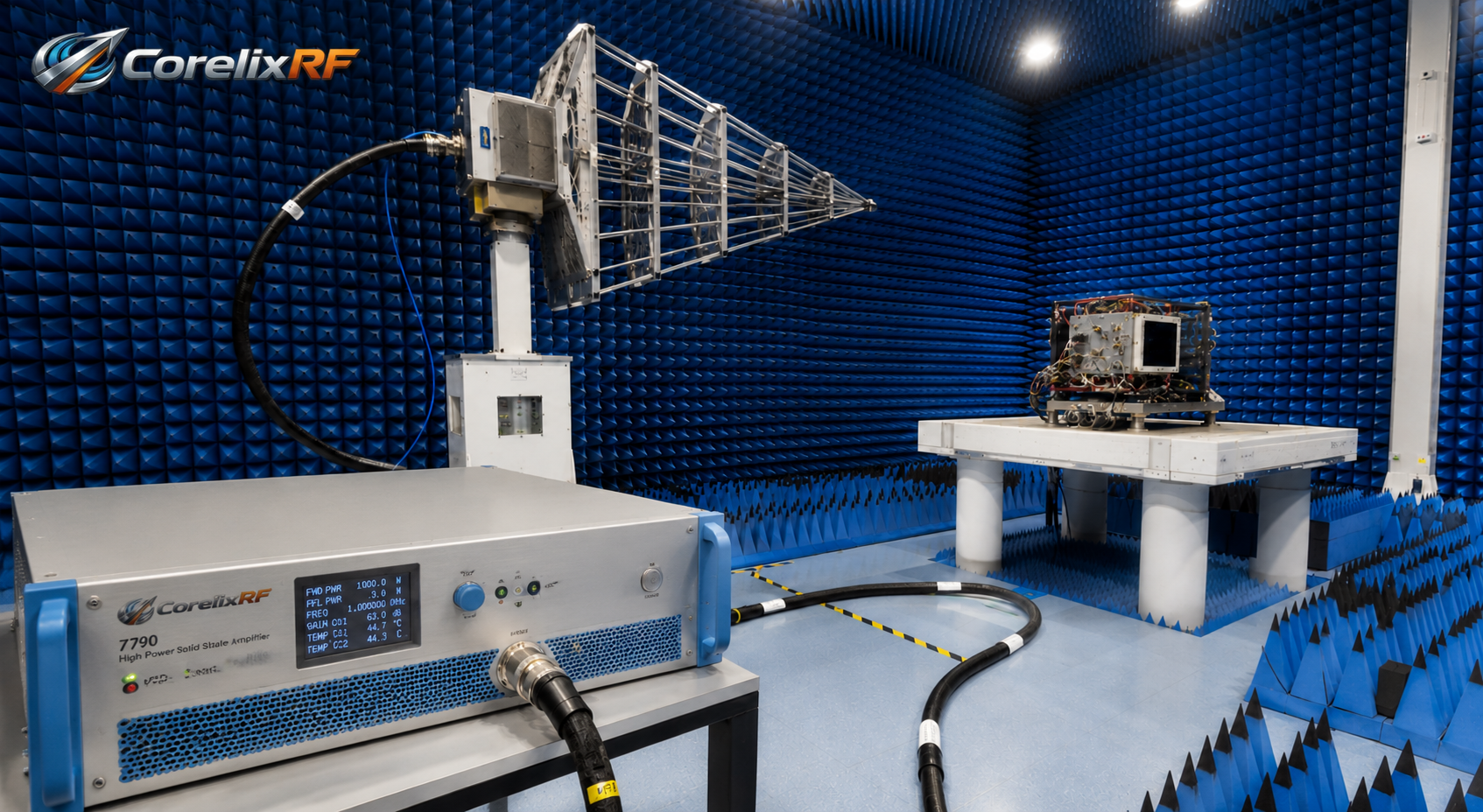
Gain flatness is one of the most important but least understood specifications in wideband RF amplifier selection. Engineers often focus first on frequency range and output power, but a wideband RF amplifier that has too much gain variation across the band can make a test system harder to calibrate, reduce repeatability, and create unexpected power differences at the device under test.
For CorelixRF customers, gain flatness matters in solid state RF amplifier, RF power amplifier, microwave power amplifier, custom RF amplifier, and high power RF amplifier projects. It is especially important when one amplifier must cover multiple operating bands, such as 30-512 MHz, 300-1700 MHz, 300-2700 MHz, 2-6 GHz, 6-18 GHz, or higher microwave ranges.
What Gain Flatness Means
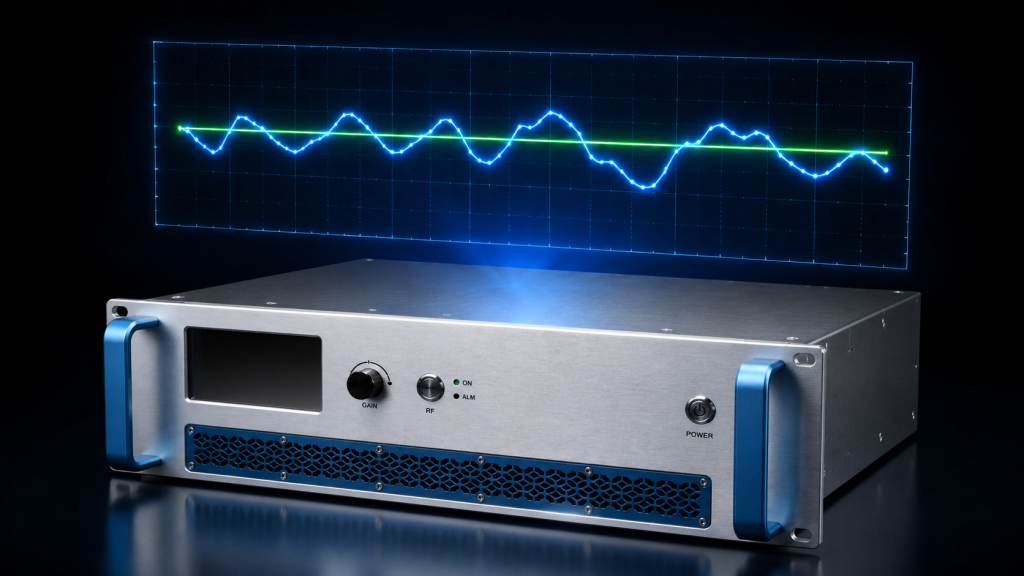
Gain is the ratio between input signal level and output signal level. Gain flatness describes how much that gain changes across the operating frequency range. A perfectly flat amplifier would provide the same gain at every frequency, but real RF amplifiers vary because of transistor behavior, matching networks, connectors, layout, thermal conditions, and frequency-dependent losses.
For a narrowband amplifier, gain variation may be modest across the operating band. For a wideband RF amplifier, the challenge becomes larger. The wider the frequency span, the more carefully engineers should review gain behavior, output power consistency, and system calibration.
Why Gain Flatness Affects Output Power
If source drive stays constant but amplifier gain changes across frequency, output power also changes. A frequency point with higher gain may produce more output than expected, while a point with lower gain may fall short of the target. In laboratory testing, this can create inconsistent stress levels at the DUT. In communication systems, it can affect link behavior. In EMC testing, it can affect the field or injected level that the lab is trying to control.
For this reason, wideband RF amplifier selection should include the expected source level, amplifier gain, system losses, required output at the load, and acceptable variation. The amplifier should be reviewed as part of a complete RF chain, not as an isolated product.
Gain Flatness and Calibration
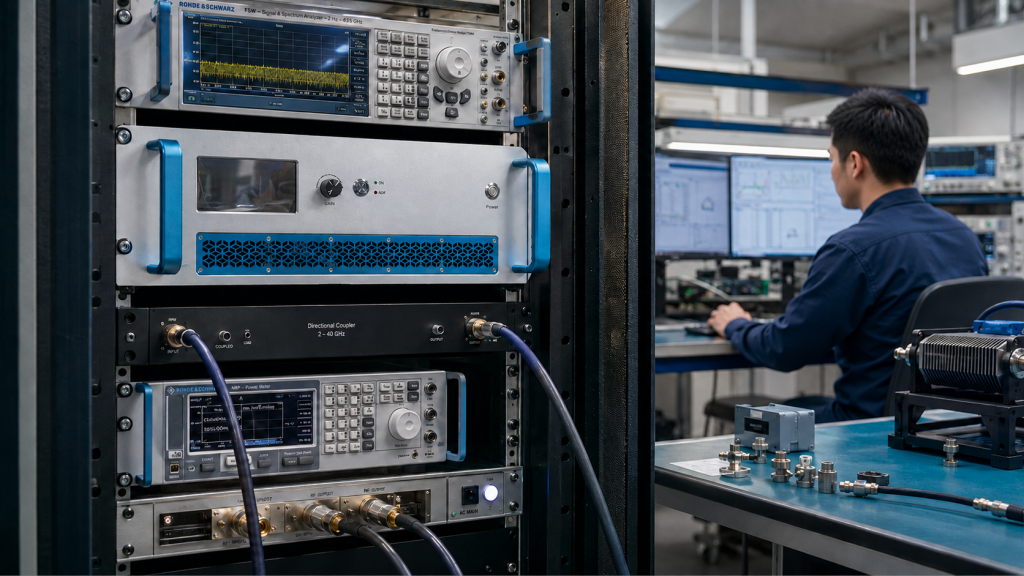
Many RF systems handle gain variation through calibration. A lab may measure output at each frequency and use correction tables in the signal source or control software. This can work well, but it requires stable amplifier behavior, repeatable connectors, controlled temperature, and a known RF path.
If the amplifier will be used in a production test rack, field platform, or EMC lab, the calibration process should be considered during selection. A high power RF amplifier may need monitoring, directional couplers, or power sensors depending on the required repeatability.
Wideband Versus Custom Frequency Windows
Wideband coverage is useful, but it should not be chosen automatically. If an application only needs a smaller part of the spectrum, a custom RF amplifier or narrower standard range may provide a better balance of gain flatness, output behavior, efficiency, and thermal performance.
For example, a system that only works in VHF/UHF may not need a 300-2700 MHz amplifier. A project that only works in X-band may not need a very broad microwave power amplifier. Choosing the correct frequency window can make the entire system easier to specify and validate.
How to Discuss Gain Flatness in an RFQ
When requesting a wideband RF amplifier, engineers should provide the required frequency range, expected input drive level, desired output power, acceptable variation, operating mode, duty cycle, load condition, and whether the system will be calibrated. If the application has important frequency points, list them.
CorelixRF can review these details through the amplifier product family at CorelixRF and the contact path at CorelixRF. The more specific the frequency and power targets are, the more useful the technical response can be.
Gain Flatness in Different Applications
In EMC applications, gain flatness supports controlled field or injected levels across a sweep. In radar applications, gain behavior can affect pulse amplitude and repeatability. In communication systems, gain variation can affect link margin and waveform behavior. In lab testing, gain flatness helps engineers compare devices across frequency without constantly reworking the setup. In aerospace systems, repeatable gain behavior can simplify verification and documentation.
Practical Checklist
Before choosing a wideband RF amplifier, confirm the required frequency span, power at the load, available input drive, gain target, acceptable gain variation, cable and fixture losses, calibration method, cooling limits, connector type, and operating mode. If the requirement is unclear, start with the application and work backward to the amplifier.
FAQ
What is gain flatness in an RF amplifier?
Gain flatness describes how much amplifier gain changes across the operating frequency range.
Why is gain flatness important for wideband RF amplifiers?
It affects output power consistency, calibration effort, repeatability, and the ability to compare results across frequency.
Can calibration solve gain flatness problems?
Calibration can help, but it requires stable amplifier behavior and a repeatable RF path. It is not a substitute for choosing the correct amplifier.
Should I choose a custom RF amplifier for better gain behavior?
If the real operating band is narrower than a standard wideband product, a custom RF amplifier review may improve the balance of flatness, output, efficiency, and integration.
CTA: Contact CorelixRF to review gain flatness requirements for a wideband RF amplifier.