
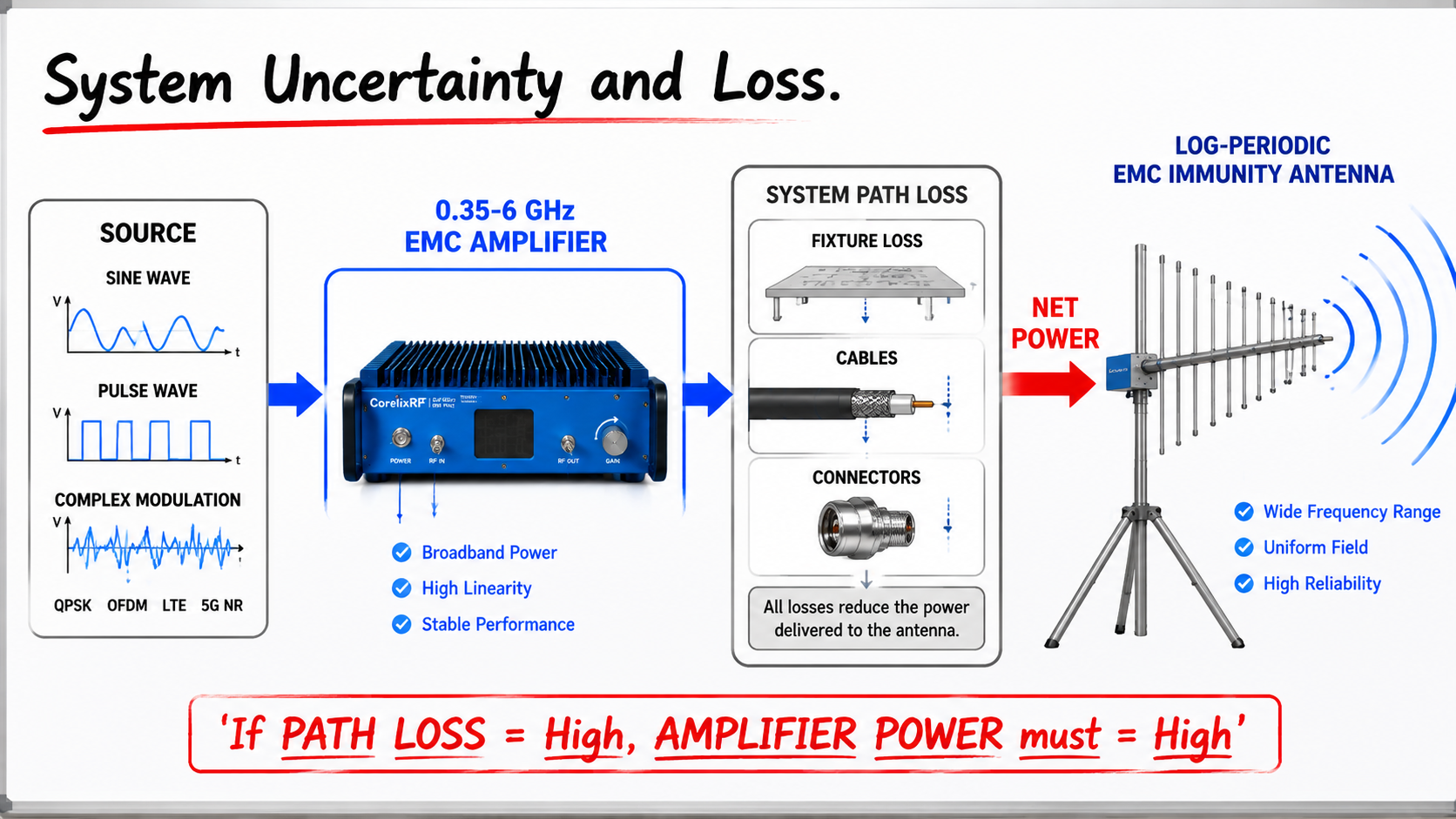
A 0.35-6 GHz EMC RF amplifier is useful when a lab or OEM system needs multi-octave RF coverage for immunity support, communications test, broadband signal injection, or interference-related validation. The right amplifier should be selected from the test method, fixture loss, field target, modulation, duty cycle, and integration limits, not only from its frequency range.
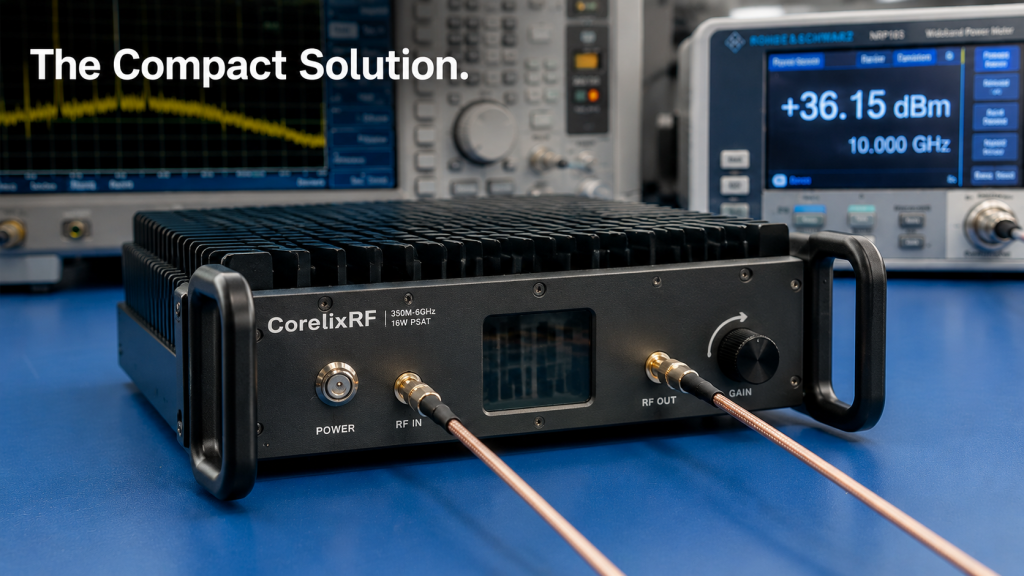
CorelixRF’s CRF-PA-350M6000M-16W reference datasheet lists 350 MHz to 6 GHz coverage, 16 W rated output power, 46 dB minimum small-signal gain, 20 dB maximum gain adjustment, SMA-Female input/output, compact air-cooled mini enclosure, temperature/current diagnostics, and alarm protection. This provides a practical baseline for engineers comparing an EMC RF amplifier with larger rack-mounted broadband platforms.
Why EMC-focused RF amplifier requirements are specific
EMC-related work often involves fixtures, antennas, couplers, field probes, and calibration steps. The amplifier is one part of a larger uncertainty chain. If the fixture or antenna path has high loss, a 16 W amplifier may or may not support the desired test level. If the application is a compact OEM test station, however, a small air-cooled platform may be more practical than a high-power rack unit.
The correct RFQ should state the test standard or internal method, frequency range, target field or load power, modulation, duty cycle, fixture loss, and available input drive. That lets CorelixRF decide whether a compact broadband RF power amplifier or a higher-power configuration is the better fit.
Review gain adjustment and source drive
The reference platform includes 46 dB minimum gain and up to 20 dB gain adjustment. Gain adjustment is useful when the same amplifier supports multiple test setups or when software needs to reduce output without changing hardware. It also helps protect fixtures and devices during setup.
For repeatable RF testing and validation, document the source level, external attenuation, expected amplifier drive, and control method. If the amplifier will be automated, define whether gain is manually set, remotely controlled, or fixed during a test sequence.
Compact enclosure benefits and limits
The 0.35-6 GHz 16 W reference uses a compact air-cooled mini enclosure with SMA-Female RF input and output. This can be convenient for bench systems, portable setups, and embedded test hardware. It also means thermal airflow and connector strain relief must be considered during installation.
Do not assume a compact amplifier can be placed in a sealed box without thermal review. If airflow is restricted, describe the enclosure and duty cycle in the RFQ. For special packaging, CorelixRF’s custom RF development path is the safer route.
When to move to a higher-power EMC amplifier
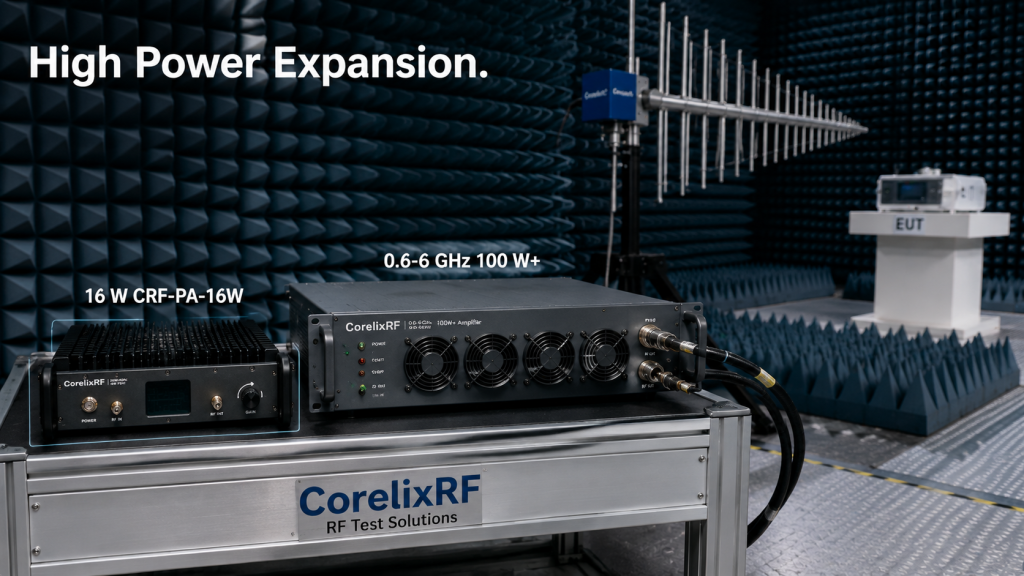
If the test setup requires more field strength, higher fixture loss compensation, or longer high-duty operation, a larger amplifier may be required. CorelixRF’s local EMC files also include 0.6-6 GHz 100 W and higher-power configurations, so the product family can be reviewed by output class.
A procurement comparison should include the required margin, cooling format, connector rating, and expected growth of the test program. Buying too little power creates repeated retesting problems; buying too much power without controls can complicate safety and fixture protection.
How to position this content for search intent
Engineers searching for an EMC RF amplifier usually want practical selection help, not broad marketing language. They need to know whether a compact 0.35-6 GHz amplifier can support their fixture, what information belongs in the RFQ, and when to move to a higher-power platform. This article should therefore target long-tail searches such as 0.35-6 GHz EMC RF amplifier, compact broadband RF amplifier, and immunity test RF amplifier selection.
Those terms are specific enough to attract readers with real test requirements while avoiding unsupported claims about formal test compliance. The article should not promise that one amplifier automatically meets a named standard. Instead, it should explain how the amplifier can support a test setup when the chamber, antenna, coupler, calibration method, and test level are properly reviewed.
Internal review questions before purchase
Before buying an EMC amplifier, the lab should answer several practical questions. What frequency points are actually tested? What field or load level is required? How much loss exists between the amplifier output and the target? Is the test continuous, modulated, pulsed, or swept? Will the amplifier be manually operated, or will software control gain and alarms?
These questions help CorelixRF determine whether the compact 16 W platform is appropriate or whether a 0.6-6 GHz 100 W class amplifier should be reviewed. They also help the buyer avoid a mismatch between a convenient enclosure and the true power or cooling requirement.
FAQ
What is a 0.35-6 GHz EMC RF amplifier used for?
It supports broadband RF test and immunity-related setups where the system needs coverage from hundreds of megahertz into microwave frequencies.
Is 16 W enough for EMC testing?
It depends on fixture loss, target field or load power, antenna efficiency, modulation, duty cycle, and required margin. Provide those details during RFQ review.
Why is gain adjustment useful in EMC work?
Gain adjustment helps control output level across setups, protect devices during setup, and support repeatable calibration procedures.
What should I include in an EMC amplifier RFQ?
Include frequency range, target level, fixture or antenna path loss, waveform, modulation, duty cycle, connector needs, cooling limits, and control requirements.