
Engineering Review Record
Subject: CRF-PA-500M2000M-25W rack fit for a 500 MHz to 2 GHz wideband RF amplifier requirement.
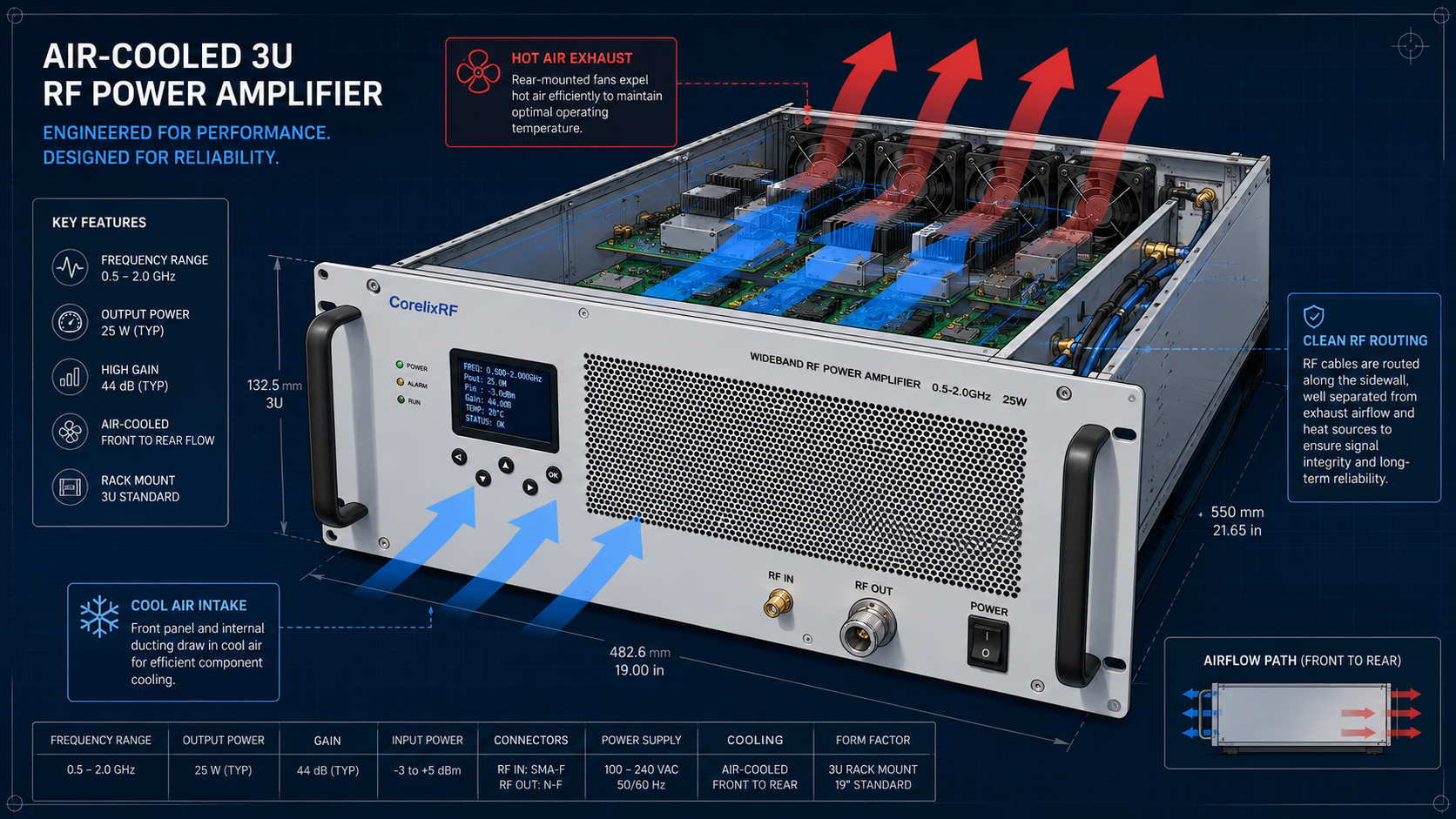
Specification evidence: The local datasheet identifies a GaN SSPA covering 500 MHz to 2 GHz with 25 W rated output power, 44 dB minimum gain, 20 dB maximum gain control, SMA-Female input, N-Female output, an air-cooled 19-inch 3U rack-mount configuration, temperature and current monitoring, alarm protection, and project-ready control interfaces.
Review question: Can this amplifier be treated as a rack-ready candidate before the team has defined source limit, reference plane, airflow, connector hardware, and acceptance data? The answer is yes only if those assumptions are written into the review file. A wideband RF amplifier is not a one-number purchase; the rack around it decides whether the published band and power are usable in the real bench.
Board Finding 1: Frequency Intent Is Too Broad Until It Is Scheduled
A 500 MHz to 2 GHz range can support communication-system validation, receiver stress testing, RF interference bench work, and general test instrumentation. Those applications may share the same amplifier but not the same operating method. The review file should list exact spot frequencies, sweep behavior, dwell time, waveform type, source level, and output target. If the work crosses sub-bands, mark which points are acceptance points and which are exploratory checks.
The board should reject an RFQ that says only “500 MHz to 2 GHz, 25 W.” That phrase is a useful headline for search, but it leaves the source, load, measurement plane, and rack environment undefined. A better request connects the frequency list to the physical bench and the data package required before use.
Board Finding 2: Gain Control Needs an Operating Rule
The listed 20 dB gain-control range is useful, but only when operators know the starting state, allowed adjustment range, and logging requirement. With 44 dB minimum gain, source limiting should be set before the first full-output test. The review record should state who can change gain, how source drive is limited, and whether gain state appears in the acceptance data.
CorelixRF’s RF integration material is the natural internal link here because the source, amplifier, load, monitoring, and control path must be reviewed together. A strong rack review does not ask whether the amplifier is powerful enough in isolation. It asks whether the complete chain can be operated repeatedly without private knowledge.
Board Finding 3: Connectors and Airflow Are Release Criteria
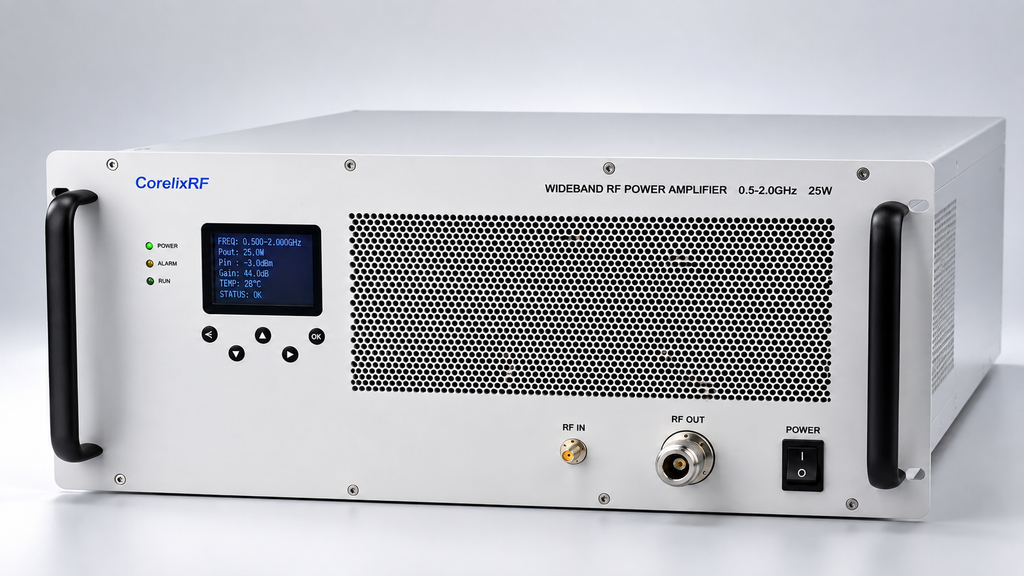
The SMA-Female input and N-Female output should appear in the rack drawing, cable list, coupler list, load list, and spare adapter plan. If the system requires another connector path, that change belongs in the quotation request, not in a late assembly note. The air-cooled 3U configuration also needs intake clearance, exhaust clearance, service access, and a route that keeps RF cables away from hot exhaust.
For adjacent EMC-style work, link the requirement to CorelixRF’s EMC RF amplifier context; for broader product comparison, use the high-frequency RF capability page. Those links help the article serve engineers who search by application and engineers who search by frequency band.
Board Decision
Advance the CRF-PA-500M2000M-25W as a candidate only when the RFQ includes frequency points, source drive range, output reference plane, rack airflow, load rating, control method, alarm response, and requested acceptance data. Hold the design if any of those items are missing. The hold is not hesitation; it is the mechanism that keeps a clean amplifier choice from turning into a rack troubleshooting exercise.
Action Register
Owner: RF engineering. Provide the frequency list, source drive limit, output reference plane, and expected waveform or modulation condition. This prevents the amplifier from being accepted on a convenient test point while the actual use case sits somewhere else in the band.
Owner: Mechanical or rack integration. Confirm the 3U rack location, airflow direction, cable route, connector access, and service clearance. The action is complete only when the rack drawing shows where heat leaves the equipment and where operators can inspect RF connections.
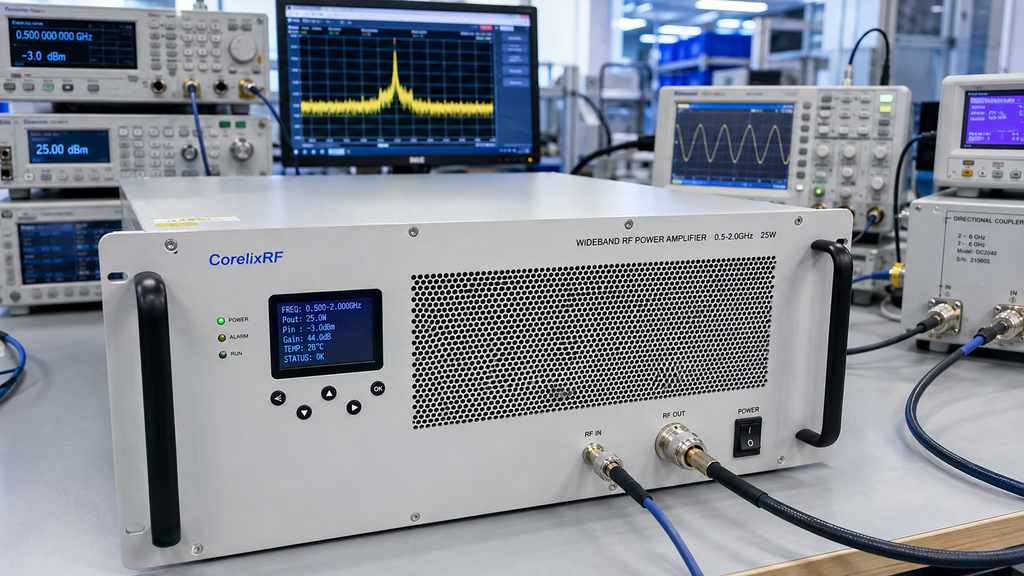
Owner: Test engineering. Define the acceptance record: frequency points, gain-control state, measured output, run duration, diagnostic readings if available, alarm state, and any deviation. The record should be repeatable by another operator, not merely understandable to the person who built the first setup.
Owner: Procurement. Keep the quotation request tied to the technical actions. Ask which items are standard for the selected configuration and which require project review. That separation protects the buyer from treating every desired interface or data item as automatically included.
FAQ
What frequency range is listed for CRF-PA-500M2000M-25W?
The local CorelixRF specification evidence lists 500 MHz to 2 GHz.
What output power is listed?
The local datasheet lists 25 W. The usable condition should still be reviewed against waveform, reference plane, load, thermal boundary, and acceptance method.
What should be included in the RFQ?
Include frequency points, waveform, source level, output reference plane, load condition, connector path, cooling boundary, control interface, alarm behavior, and requested test data.
Does this article claim stock, certification, or customer deployment?
No. It stays inside local product specifications and general engineering guidance.
What is the main integration caution?
Do not release the rack design until gain state, airflow, load rating, and output reference plane are documented.