
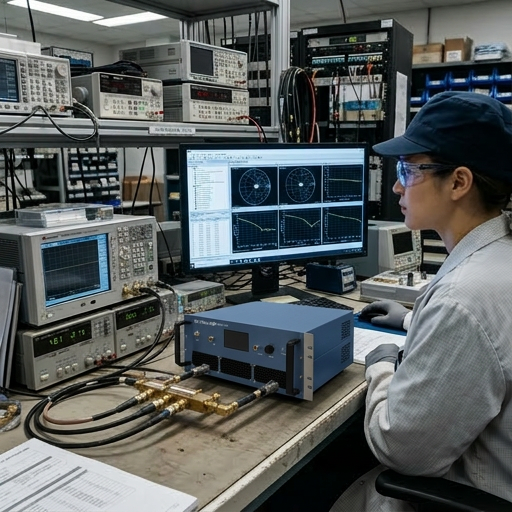
An 80 MHz-1 GHz high power EMC RF amplifier is often selected for radiated immunity labs, pre-compliance benches, and broadband RF stress setups where delivered field strength matters more than a simple catalog watt number. The local CorelixRF specification library includes CRF-PA-80M1000M filenames from 50 W through high-power variants such as 1000 W, 1200 W, and 2000 W. That makes the family relevant for labs that need to compare smaller validation benches with higher-power immunity systems.
This guide explains how to structure the selection process without claiming guaranteed compliance, available inventory, or unverified performance values. It is written for engineers, lab managers, and technical buyers preparing an RFQ.
Begin With the Test Requirement, Not the Amplifier Size
For an 80 MHz-1 GHz high power EMC RF amplifier, the useful starting point is the required field strength or delivered power at the test setup. Antenna factor, chamber geometry, cable loss, couplers, switches, and test distance all affect the power needed from the amplifier. A 500 W amplifier in one setup may not create the same field as a 500 W amplifier in another setup if the antenna and losses differ.
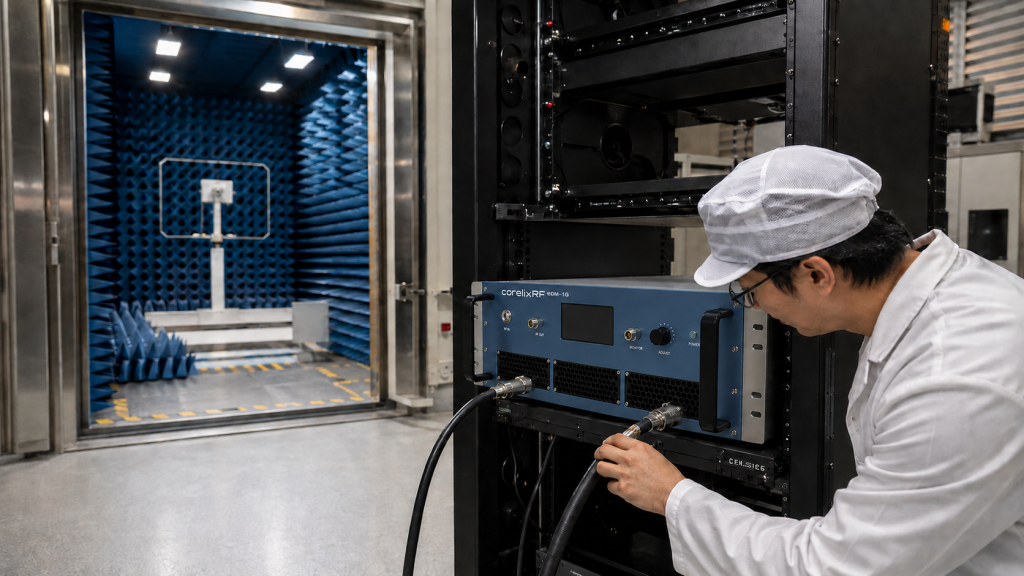
Before asking for a quote, document the target frequency range, required field level, modulation, dwell time, antenna, chamber or open-area setup, cable length, and test standard context if applicable. CorelixRF can then review amplifier fit as part of the system path.
Why 80 MHz-1 GHz Remains a Common EMC Window
The 80 MHz-1 GHz range appears frequently in immunity-related planning because it covers a broad lower-frequency region where antennas, chamber behavior, and cable loss can vary significantly. Labs often need enough power margin to keep tests repeatable across the band, especially when the setup changes between devices or fixtures.
A broadband solid-state amplifier can reduce equipment changes and support automated sweeps, but it should still be validated with the actual antenna path. CorelixRF resources on RF testing and validation and manufacturing and engineering are relevant when documentation, repeatability, and acceptance data matter to the buying decision.
Compare Power Classes Carefully
The local CRF-PA-80M1000M filenames include 50 W, 100 W, 200 W, 250 W, 400 W, 500 W, 600 W, 1000 W, 1200 W, and 2000 W variants. That broad range supports different lab needs, but it also makes requirement discipline important.
A lower-power unit may support conducted experiments, pre-checks, or limited-field work. A higher-power amplifier may be required for larger test distances, higher field levels, lossy antennas, or additional RF path loss. The right comparison is delivered field or delivered power, not just amplifier output rating.
Cooling and Operating Profile
High-power EMC testing can create sustained thermal demand. The RFQ should state expected test duration, dwell time, modulation, ambient temperature, rack airflow, and whether the amplifier must run in automated sequences. If the lab expects long operating windows, this should be explicit.
Cooling constraints are not secondary details. A high-power amplifier in a crowded rack, near other heat-producing equipment, or in a room with limited airflow needs a different review than a unit with open ventilation. Ask CorelixRF to confirm the recommended operating environment and any installation requirements for the selected model.
Protection and Monitoring
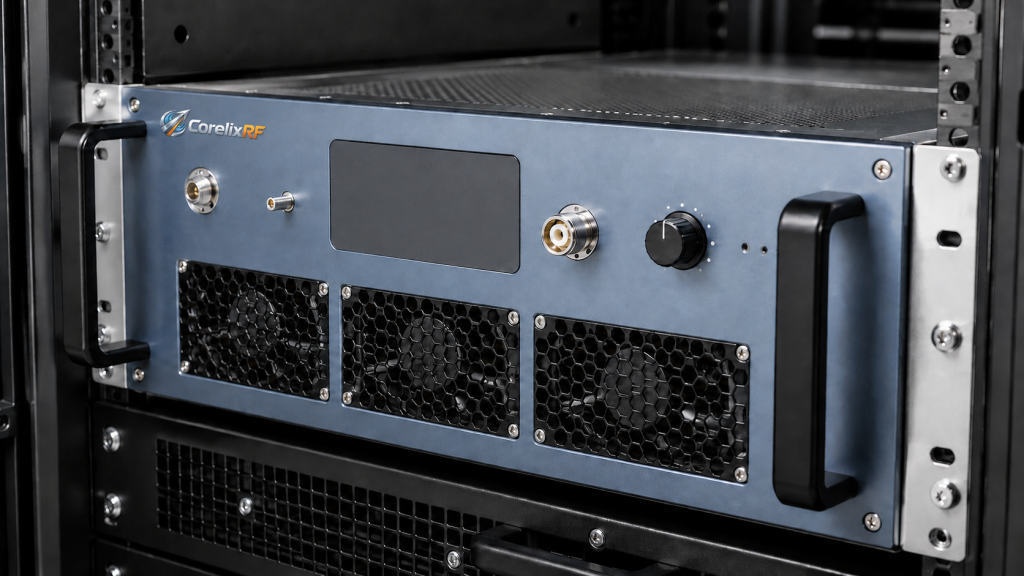
EMC systems can present changing load conditions, especially when antennas, couplers, cables, or fixtures are changed. Buyers should request confirmation of available protection behavior, including mismatch handling, over-temperature response, input overdrive handling, and status indication.
Remote control may also be important. Automated immunity systems often need amplifier enable control, fault status, and integration with lab software. If the amplifier must support a specific control environment, state that early so CorelixRF can decide whether a standard product is suitable or whether a custom RF amplifier review is needed.
RFQ Checklist for Immunity Labs
Send CorelixRF the following information:
- Frequency range: 80 MHz-1 GHz or a narrower sub-band.
- Target field strength, test distance, antenna, and chamber details.
- Cable, coupler, switch, and fixture losses.
- Required modulation, dwell time, duty cycle, and sequence duration.
- Preliminary power class and required margin.
- Rack, airflow, supply, and installation constraints.
- Control interface, monitoring, protection, and interlock expectations.
- Required test data, documentation, and acceptance process.
This keeps the amplifier discussion anchored in practical EMC engineering. It also reduces the risk of ordering a unit that looks right by wattage but does not match the actual lab path.
When to Ask for Custom Review
A standard product may be the fastest route when frequency, power, controls, and mechanical layout match the lab. A custom review becomes useful when the lab needs a different interface, enclosure, cooling approach, control behavior, documentation package, or system-level integration support.
CorelixRF can review the requirement and recommend whether the standard 80 MHz-1 GHz family is the right starting point. The best first message includes the test goal, the known RF path, and the constraints that cannot change.
FAQ
What local 80 MHz-1 GHz power classes are visible?
The local CRF-PA-80M1000M filenames include multiple classes from 50 W to higher-power variants such as 1000 W, 1200 W, and 2000 W. Confirm final specifications against current datasheets.
Can amplifier wattage alone define an EMC immunity setup?
No. Field strength depends on antenna, distance, chamber behavior, cable loss, couplers, modulation, and calibration. Amplifier wattage is only part of the system.
Why are protection features important in EMC labs?
Load conditions can change as antennas, fixtures, and cables are adjusted. Mismatch handling, thermal behavior, and status monitoring should be confirmed for the selected model.
When should a lab request custom amplifier review?
Request custom review when the standard product does not match the control interface, enclosure, cooling, documentation, protection, or integration requirements.