
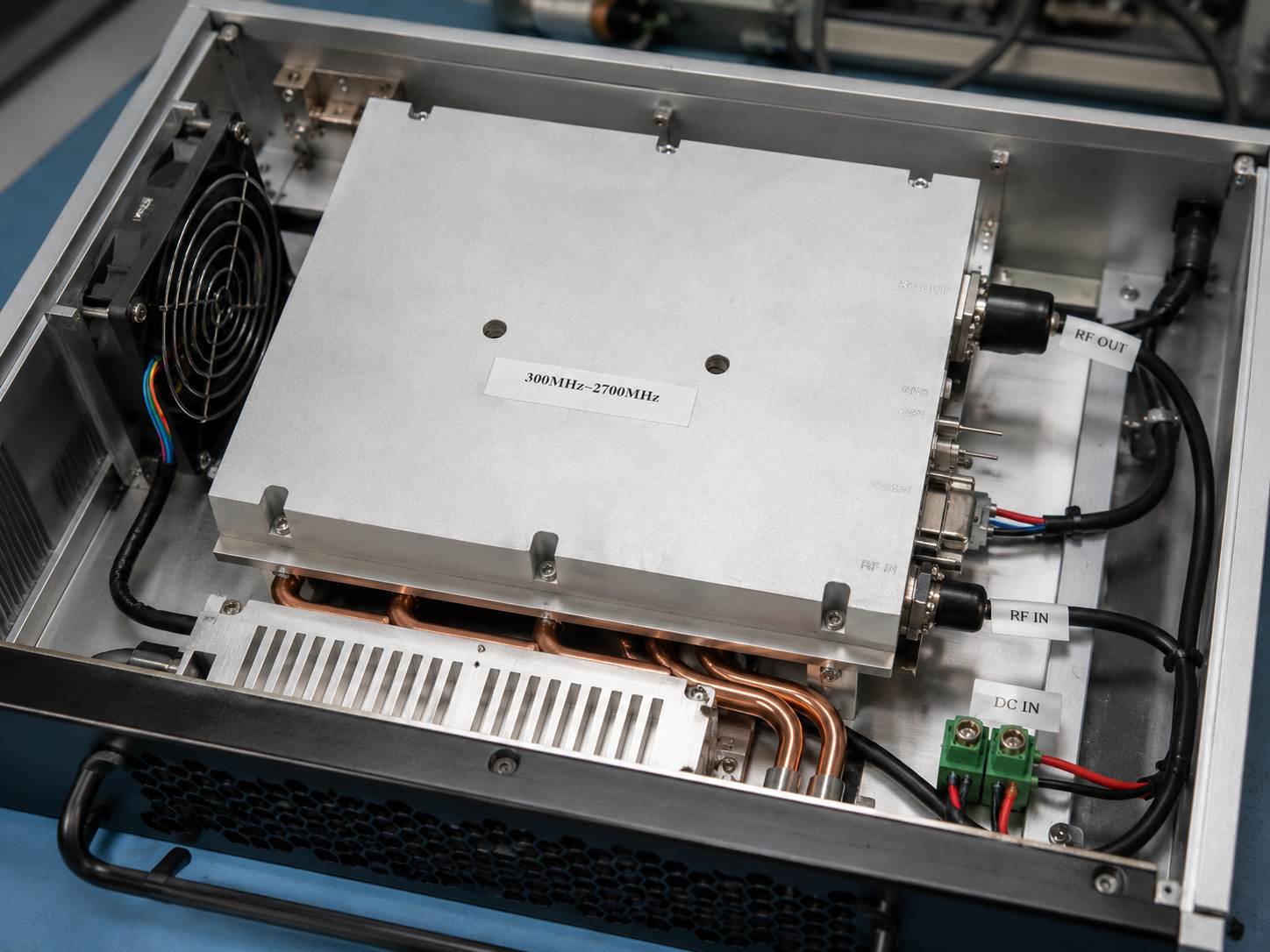
A 300-2700 MHz wideband RF amplifier is attractive when a test bench or compact RF platform must cover several operating bands without changing amplifier hardware. It can support wideband validation, multi-band communication evaluation, SDR-related test chains, and OEM systems that need flexibility in a limited mechanical space.
CorelixRF’s 300-2700 MHz amplifier path is positioned for wideband test and compact multi-band use. This is a distinct topic from microwave amplifier selection because the engineering priorities often center on usable coverage, power class, heat, DC current, flatness, and the ability to reduce model switching in a practical lab or system workflow.
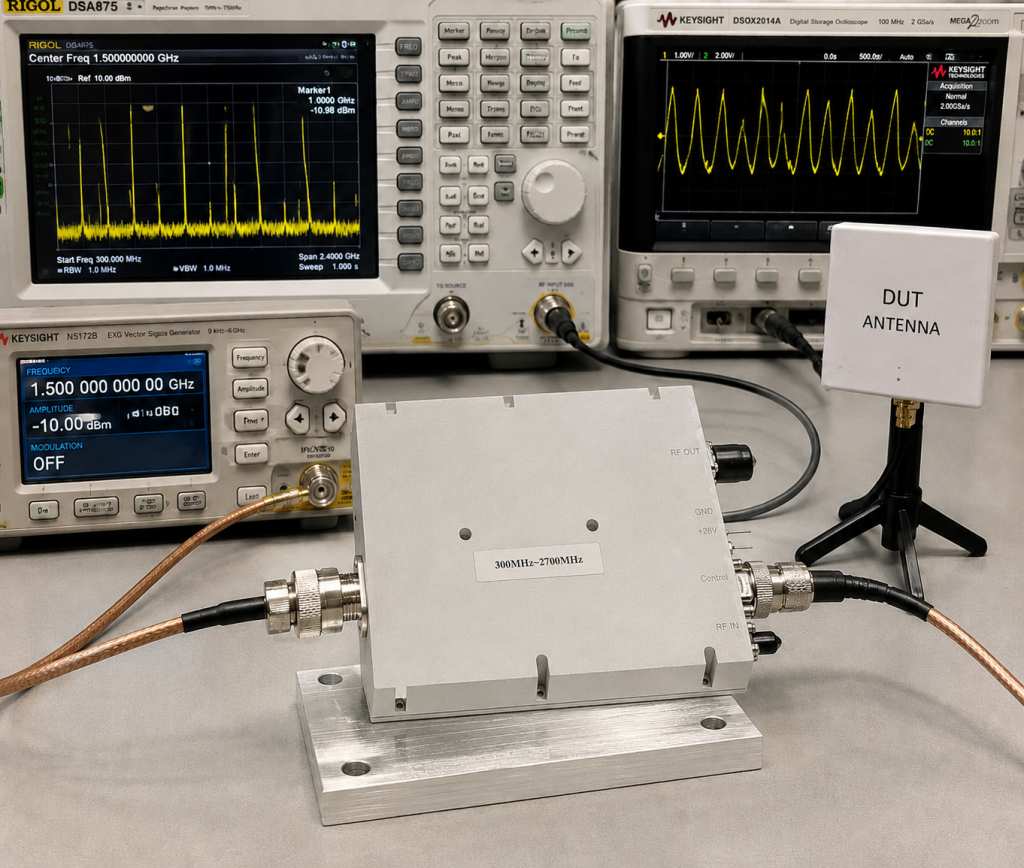
The Main Benefit: Fewer Amplifier Changes
Multi-band RF testing can become slow when each frequency window requires a different amplifier, cable setup, gain plan, and verification step. A 300-2700 MHz platform helps reduce that friction. It gives engineers one amplifier family to evaluate across several lower and mid-band RF points, which can improve test repeatability and simplify bench operations.
That does not mean every project should choose the widest amplifier available. The real question is whether the system benefits from broad coverage enough to justify any tradeoffs in gain flatness, power behavior, cooling, or cost. If the operating range is only 300-1700 MHz, CorelixRF’s 300-1700 MHz RF amplifier path may be the more focused starting point.
Power Class Selection for Wideband Testing
CorelixRF’s public standard CW matrix shows 300-2700 MHz models across 30 W, 50 W, 100 W, 150 W, and 200 W classes, with typical gain increasing by output class. That range gives engineers a structured way to select a power class before asking for detailed confirmation.
The power class should be selected from the load requirement backward. Start with the required RF level at the DUT, antenna input, or subsystem port. Then subtract losses from cables, filters, switches, couplers, and adapters. Finally, compare the required amplifier output with available source drive and desired gain margin.
Compact Integration and Thermal Review
The phrase “compact multi-band” should not be read as “thermal planning is optional.” A wideband amplifier may be installed in a portable test set, rack drawer, vehicle-based enclosure, or OEM chassis. In each case, the amplifier’s cooling path and current draw need early review.
Engineers should confirm supply voltage, expected current, cooling method, airflow direction, mounting surface, connector location, and whether the amplifier will run continuously or in test intervals. These factors decide whether a standard model is practical or whether a custom configuration should be discussed through CorelixRF’s RF power amplifier inquiry path.
Applications That Fit 300-2700 MHz
Good-fit applications include wideband RF validation, multi-band communication testing, SDR output amplification, subsystem evaluation, compact RF test boxes, and OEM projects where multiple bands must be supported in one hardware design. The amplifier can also support comparison testing where engineers want to keep the same gain chain while changing frequency.
Poor-fit cases are just as important. If the project is strictly VHF/UHF, a 30-512 MHz amplifier may be more suitable. If the project is S/C-band microwave work, a 2-6 GHz amplifier path may fit better.
FAQ
What is a 300-2700 MHz wideband RF amplifier used for?
It is used for multi-band RF testing, SDR amplification, compact RF systems, communication evaluation, and OEM integration where broad lower/mid-band coverage is useful.
Why choose 300-2700 MHz instead of 300-1700 MHz?
Choose 300-2700 MHz when the system must reach higher frequency points. Choose 300-1700 MHz when the project has a narrower mid-band requirement.
What should be checked before choosing a power class?
Check required load power, cable and fixture losses, input drive, gain margin, duty cycle, current draw, cooling, and connector requirements.
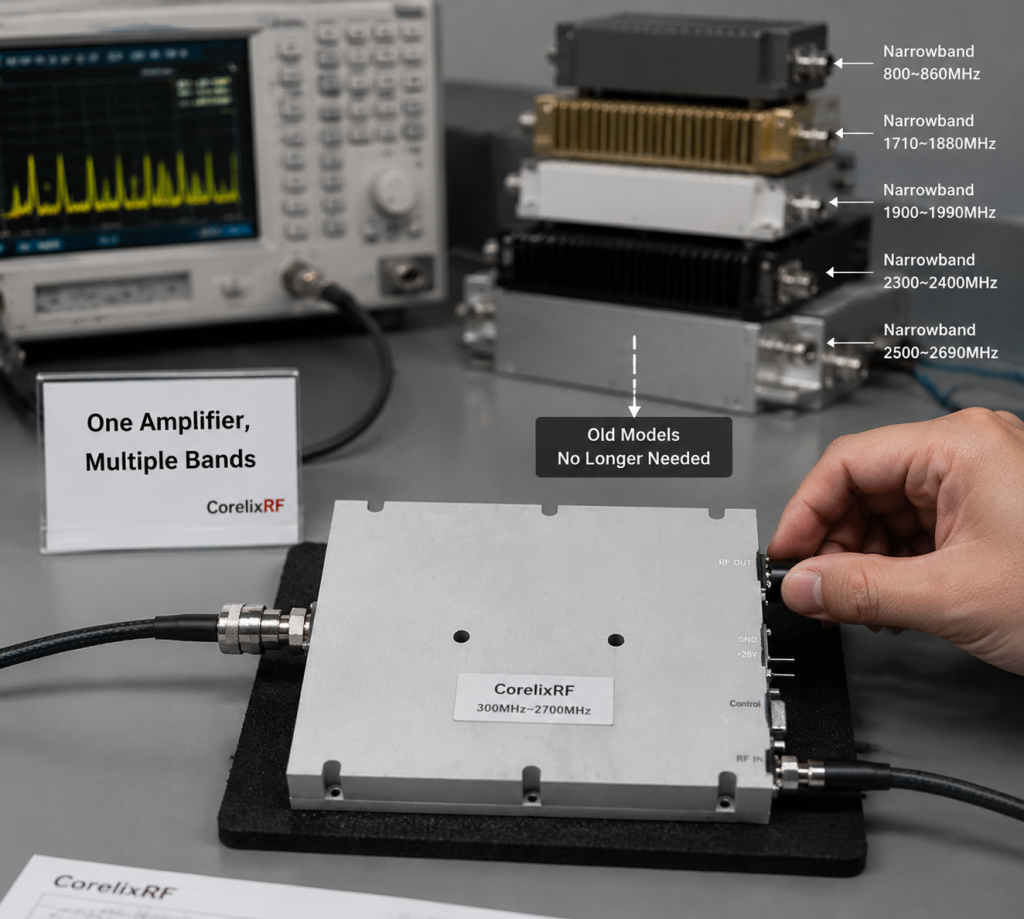
Can a wideband amplifier replace multiple narrowband units?
Sometimes. It can reduce hardware switching, but final suitability depends on power, flatness, efficiency, thermal behavior, and system requirements.