
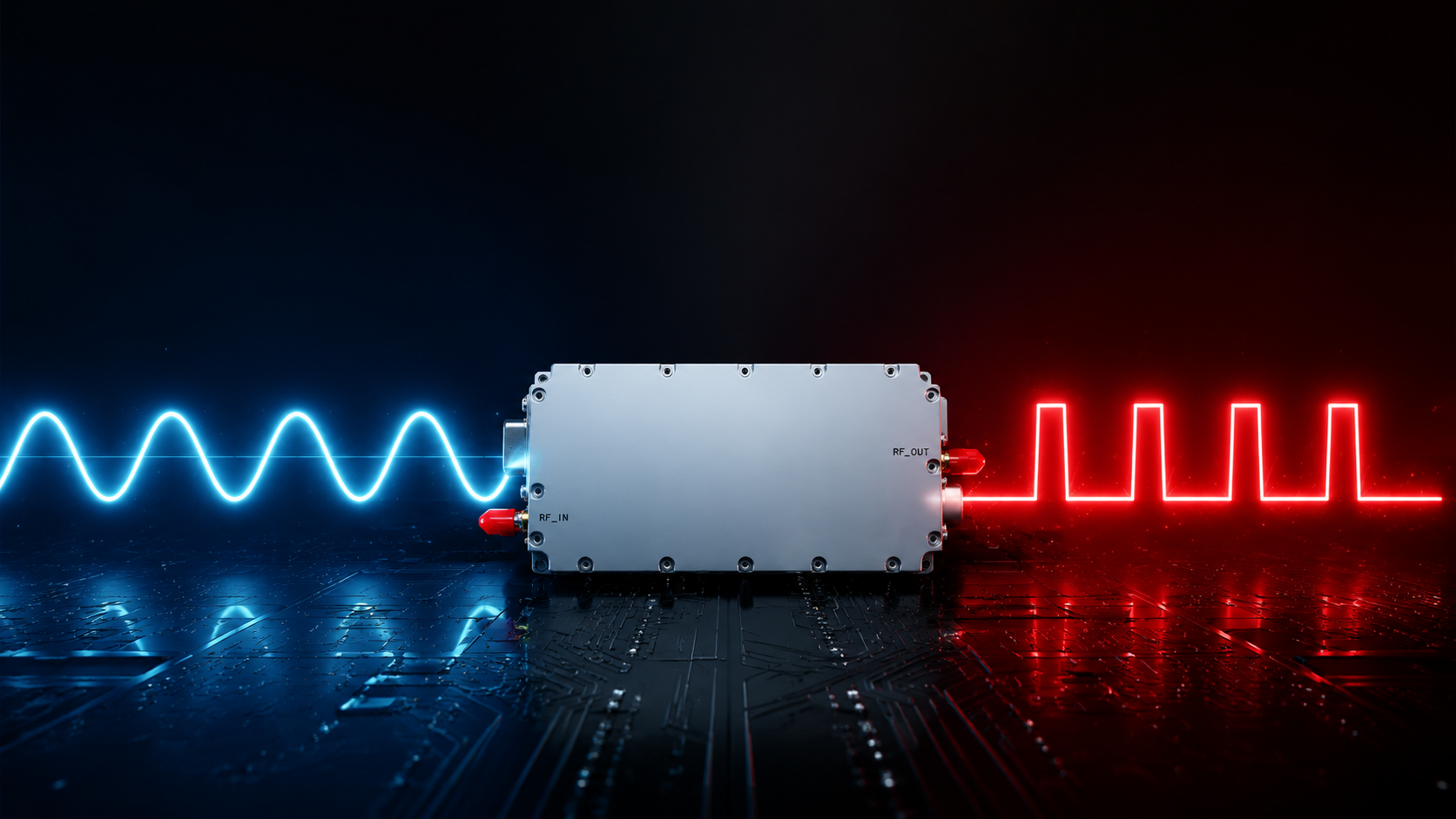
CW and pulsed RF amplifiers can look similar in a product search, but they are specified in very different ways. A CW RF power amplifier is usually reviewed around continuous output, average power, cooling, and long-duration stability. A pulsed RF power amplifier is reviewed around peak power, pulse width, PRF, duty cycle, timing, average power, and protection behavior.
For CorelixRF customers, the operating mode affects solid state RF amplifier selection, microwave power amplifier design, high power RF amplifier cooling, and custom RF amplifier review. Engineers should define CW or pulsed operation before comparing product pages, because the same frequency and wattage can mean different things under different modes.
What CW Operation Means
CW stands for continuous wave. A CW amplifier is expected to deliver RF power continuously or for extended operating periods under defined thermal conditions. The main questions are frequency range, output power, gain, input drive, linearity if needed, supply voltage, current draw, cooling method, load condition, and connector rating.
CW amplifiers are common in communication systems, EMC testing, laboratory signal amplification, RF component evaluation, and general RF power delivery. The product family at includes standard CW amplifier paths across VHF/UHF, wideband, and microwave ranges.
What Pulsed Operation Means
A pulsed amplifier does not deliver RF power continuously. Instead, it delivers energy in pulses. The specification must include peak power, pulse width, pulse repetition frequency, duty cycle, burst format, timing control, average power, and expected run time. Without these details, the amplifier supplier cannot accurately review thermal load, power supply sizing, or protection strategy.
Pulse mode is common in radar, electronic testing, peak-power experiments, and specialized RF systems. A microwave power amplifier used for pulsed operation may need different biasing, timing, or protection behavior than a CW amplifier at the same frequency.
Peak Power and Average Power
Peak power is the highest power during the pulse. Average power depends on peak power and duty cycle. This distinction is essential. A high peak power amplifier with low duty cycle may have a very different thermal profile from a lower peak power amplifier operating continuously.
For high power RF amplifier selection, average power often decides cooling and current requirements. Peak power may define the RF output stage and protection design, but average heat must still be removed from the amplifier.
Why Duty Cycle Matters
Duty cycle is the percentage of time the amplifier is transmitting. A small duty cycle may allow higher peak power for short periods, while a large duty cycle pushes the amplifier closer to CW-like thermal behavior. Engineers should never submit a pulsed RFQ with only frequency and peak wattage.
The RFQ should include pulse width, PRF, burst length, off time, source drive level, load condition, and whether the amplifier must support external trigger or gating.
Choosing Between CW and Pulsed Amplifiers
Choose a CW RF power amplifier when the application requires continuous output, steady test levels, long dwell times, or communication operation. Choose a pulsed RF amplifier when the application requires short RF bursts, peak power behavior, radar-like timing, or pulse-controlled testing.
If the application includes both modes, explain both operating cases. A custom RF amplifier review may be required if the same hardware must support unusual CW and pulsed requirements.
Application Examples
EMC labs often use CW or swept RF output for immunity-related work, but some setups may include special modulation or dwell requirements. Radar systems usually require pulsed operation with careful peak power, timing, and load review. Communication systems may use CW-like or modulated operation with linearity concerns. Lab testing can involve either CW sweeps or pulse experiments. Aerospace platforms may require detailed documentation, thermal analysis, control interfaces, and environmental review.
How to Build a Better RFQ
For CW operation, provide frequency range, output power, drive level, gain, modulation if any, duty condition, load, connector, cooling, supply, and mechanical constraints. For pulsed operation, add peak power, pulse width, PRF, duty cycle, burst pattern, timing method, average power expectation, and protection requirements.
CorelixRF can review standard and custom RF amplifier needs through . A clear operating-mode description helps route the request to the right amplifier platform, whether the project needs a wideband RF amplifier, microwave power amplifier, high power RF amplifier, or custom RF amplifier.
FAQ
Can a CW amplifier be used for pulsed operation?
Sometimes, but only after engineering review. Pulse operation may require different timing, protection, drive, and thermal assumptions.
Can a pulsed amplifier be used continuously?
Not necessarily. A pulsed amplifier may not be designed for continuous average power, even if its peak output is high.
What is the most important pulsed amplifier specification?
Peak power, pulse width, PRF, and duty cycle must be reviewed together. No single number is enough.
Why does operating mode affect cooling?
CW operation creates steady thermal load, while pulsed operation creates heat based on average power and duty cycle. Both must be managed correctly.
CTA: Contact CorelixRF to compare CW and pulsed RF amplifier options.