

Drone jamming technology has evolved from basic, single-frequency analog blockers to highly sophisticated, software-defined systems utilizing GaN power amplifiers for multi-band continuous coverage. Imagine deploying a security team to protect a critical military installation, only to watch unauthorized UAVs easily bypass your single-band defense systems. This vulnerability leaves your airspace completely exposed to advanced threats. Modernized Drone Jamming platforms provide the definitive answer by delivering intelligent, wideband frequency control to neutralize any incoming threat.
What Are the Origins of Early Drone Jamming Systems?
Early analog setups formed the foundational origins of defense hardware before rapid technological shifts demanded more complex architectures. You might recall when legacy systems relied solely on fixed-frequency oscillators that could only target one specific commercial UAV band at a time. This foundational Drone Jamming equipment was bulky, inefficient, and required manual tuning to operate successfully.
How Did Early Systems Operate?
Legacy defense modules functioned by overwhelming receiver antennas with raw, untargeted radio waves. Operators faced severe limitations when trying to adapt to new frequencies in the field.
Here is the deal: early architectures simply lacked the computational power to identify and track dynamic targets.
- They required massive power supplies to function.
- They offered very narrow operational spectrums.
- They lacked modularity for quick field repairs.
What Were Their Main Limitations?
Single-band limitations meant that adversaries could easily bypass defenses by hopping to an alternative frequency. Your security teams were often left vulnerable against multi-vector attacks.
Key Takeaway: Understanding the constraints of early designs helps you appreciate the necessity for modern, adaptable broadband architectures.
Analyzing the shift from legacy components reveals clear operational disparities.
| Feature | Early Systems | Modern Counterparts |
| Spectrum | Single-band | Full-band |
| Control | Manual tuning | Software-defined |
| Power | High loss | GaN optimized |
Why Is Drone Jamming Shifting to Smart SDR Platforms?
The shift to Software Defined Radio platforms provides operators with real-time frequency hopping and adaptive waveform generation capabilities. Your modern defense strategy requires systems that can instantly recognize and adapt to unknown UAV protocols without hardware changes. The integration of SDR into drone jamming frameworks allows for intelligent signal generation that counters agile threats seamlessly.
Can SDR Adapt to New Threats?
SDR architectures allow your engineers to update interference protocols purely through software modifications. This eliminates the need to physically replace modules when facing novel adversary tactics.
What is the real story? Hardware-bound systems are obsolete the moment a new communication protocol hits the sky.
- SDR supports multiple waveforms like CW, LFM, and OFDM.
- Updates happen remotely via secure network patches.
- Operators gain real-time spectral analysis capabilities.
How Does Digital Control Improve Efficiency?
Digital precision guarantees that interference energy is concentrated exactly where the target signal operates. You reduce wasted transmission power and minimize collateral disruption to friendly communications.
Key Takeaway: Upgrading to SDR platforms guarantees your security infrastructure remains future-proof against rapidly changing aerospace threats.
Evaluating SDR metrics showcases significant operational upgrades.
| Metric | Hardware-bound | SDR-based |
| Upgradability | Physical replacement | Remote patch |
| Modulation | Fixed | Programmable |
| Accuracy | Broad spectrum | Highly targeted |
How Does GaN Power Amplification Improve Drone Jamming?
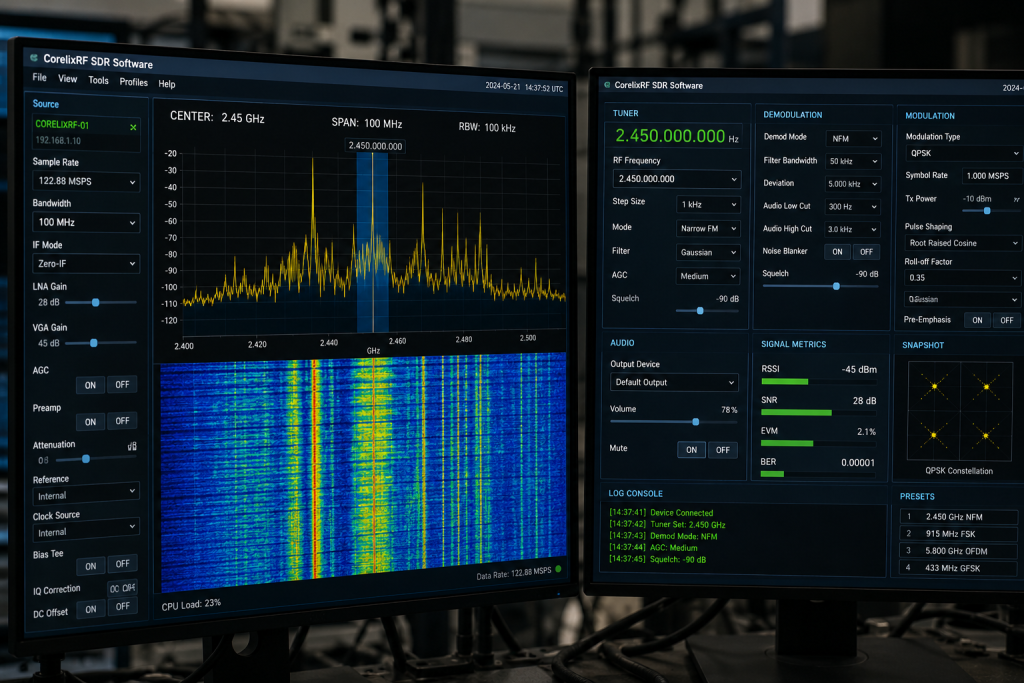
Gallium Nitride technology drastically improves power output, thermal efficiency, and bandwidth capabilities within defense communication arrays. When you deploy counter-UAV measures in extreme environments, you need components that maintain stable output without degrading under heat stress. Implementing GaN into your Drone Jamming infrastructure guarantees high-power continuous coverage from 30MHz to 6GHz.
Why Outperform Legacy Silicon?
Traditional silicon-based amplifiers struggle to maintain linearity across wide frequency bands at high power levels. Your teams need hardware that pushes boundaries without catastrophic thermal failures.
Ready for the good part? GaN devices operate at much higher voltages and temperatures, delivering superior power density.
- GaN allows for smaller, more compact module designs.
- Thermal conductivity is significantly superior to older materials.
- Power added efficiency reduces overall system energy consumption.
Does GaN Support Continuous Operations?
High-efficiency characteristics mean these amplifiers can sustain continuous wave output for extended operational periods. You can rely on these arrays to protect critical infrastructure 24/7 without performance drops.
Key Takeaway: Integrating GaN technology is a non-negotiable requirement for achieving military-grade power redundancy and reliability.
Comparing amplifier materials highlights the clear superiority of advanced compounds.
| Specification | LDMOS | Gallium Nitride |
| Power Density | Moderate | Exceptional |
| Bandwidth | Narrow | Ultra-wide |
| Thermal Tolerance | Low | Extreme |
What Role Do Multi-Band Frequencies Play in Drone Jamming?
Multi-band capabilities guarantee that defense systems can simultaneously neutralize threats operating across various commercial and proprietary communication channels. Modern UAVs often utilize dual-band or frequency-hopping links to evade basic countermeasures. A robust drone jamming architecture must seamlessly cover VHF, UHF, GNSS, and standard Wi-Fi bands simultaneously.
How Do Multi-Band Arrays Work?
These arrays utilize integrated combiners to merge different frequency outputs into a unified, high-power transmission. Your system can blanket an entire operational zone with targeted interference across all known communication vectors.
This is where it gets interesting: Advanced matrices can dynamically allocate power to the specific bands where activity is detected.
- Simultaneous disruption of navigation and control links.
- Seamless coverage across the 30MHz to 6000MHz spectrum.
- Elimination of operational blind spots.
Why Are Single-Band Units Obsolete?
Relying on a single frequency band leaves your perimeter vulnerable to drones programmed to switch channels upon losing signal. You cannot afford to leave any portion of the electromagnetic spectrum undefended.
Key Takeaway: Adopting a full-band approach guarantees complete airspace denial against sophisticated, multi-channel aerial incursions.
A multi-band configuration offers absolute coverage against diverse vectors.
| Capability | Single-Band | Multi-Band |
| Target Range | Limited | Universal |
| Evasion Risk | High | Minimal |
| Power Allocation | Fixed | Dynamic |
Can Drone Jamming Effectively Counter Swarm Attacks?
Advanced counter-measure arrays neutralize swarm attacks by generating wide-area electromagnetic interference fields that sever the control links of multiple targets instantly. Facing a coordinated multi-UAV assault requires your defenses to process and react faster than human operators can manage. Upgraded Drone Jamming networks utilize phased array antennas to project immense, directed energy toward incoming swarms.
What Tactics Defeat Swarm Logic?
Swarms rely on constant inter-device communication to maintain formation and execute complex maneuvers. Disrupting this localized mesh network forces the individual units into automated fail-safe modes.
But here is the kicker: Severing the GNSS signals simultaneously causes the entire group to lose spatial awareness.
- Rapid spatial energy distribution across wide angles.
- Simultaneous disruption of telemetry and video feeds.
- Forcing immediate return-to-home or hover protocols.
How Do Antennas Handle Multiple Vectors?
High-gain directional antennas combined with omnidirectional modules create a layered defense perimeter. You can pinpoint the primary assault vector while maintaining a general protective dome around your facility.
Key Takeaway: Preparing for swarm scenarios mandates deploying high-power, multi-directional disruption arrays that act instantly.
Defensive strategies must adapt to the volume of incoming targets.
| Threat Type | Primary Defense | Required Technology |
| Single Target | Directional tracking | High-gain Yagi |
| Mesh Swarm | Area denial | Phased array matrix |
| Autonomous | GNSS spoofing | SDR signal source |
How Are AI Algorithms Upgrading Drone Jamming Tactics?
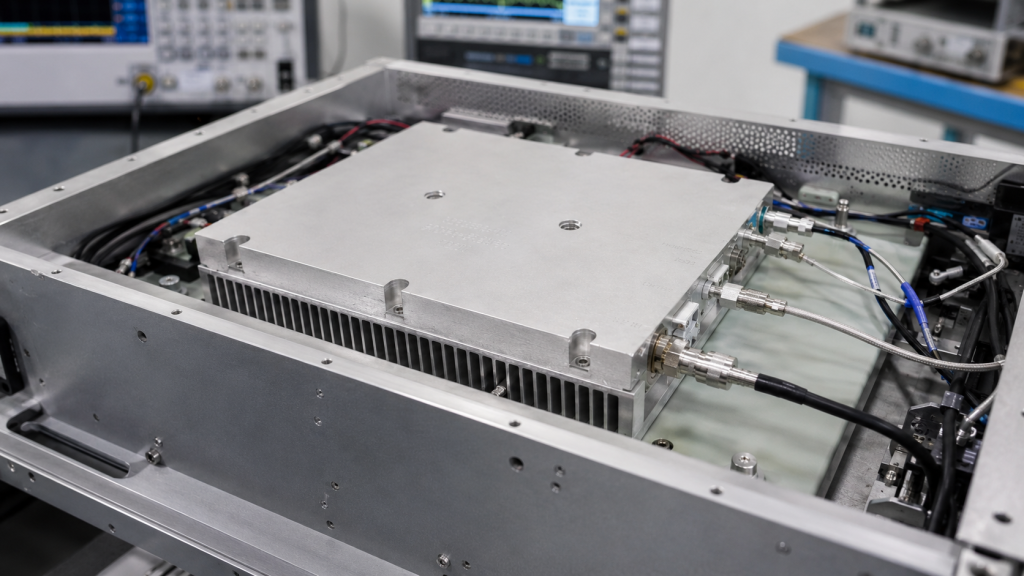
Artificial intelligence improves tactical execution by autonomously analyzing the electromagnetic spectrum to identify, classify, and target specific UAV signatures in milliseconds. Human reaction times are simply insufficient when defending against automated, high-speed aerospace incursions. Integrating machine learning into your drone jamming platform enables predictive threat modeling and automated response protocols.
How Does Automated Detection Work?
Neural networks constantly monitor ambient RF noise, isolating anomalies that match known UAV communication patterns. Your system alerts operators while simultaneously initiating pre-authorized countermeasures.
You might be wondering: Does the system learn from new threats? Yes, edge computing nodes update their signature libraries dynamically.
- Algorithmic filtering of benign background signals.
- Instantaneous classification of the invading vehicle type.
- Automated selection of the optimal interference waveform.
Can AI Optimize Power Usage?
Smart algorithms distribute amplifier power only to the active frequencies, conserving energy and reducing thermal load. You benefit from extended operational lifespans and lower failure rates across your hardware matrix.
Key Takeaway: Leveraging AI-driven spectrum analysis transforms reactive defenses into an autonomous, proactive security shield.
The introduction of algorithms drastically reduces response latency.
| Function | Manual Operation | AI-Enhanced |
| Threat ID | Minutes | Milliseconds |
| Waveform Choice | Static | Adaptive |
| Resource Use | Maximum | Optimized |
Why Is Portability Mandatory for Modern Drone Jamming?
Portability allows tactical teams to deploy robust counter-UAV measures in dynamic, off-grid environments without relying on fixed infrastructure. When your personnel are operating in remote border zones, bulky stationary equipment becomes a logistical liability. Advancements in miniaturized Drone Jamming hardware now pack military-grade output into ergonomic, battery-operated backpack units.
What Defines a Tactical Unit?
Tactical units must balance raw transmission power with strict weight limitations and battery efficiency. Your mobile squads need gear that integrates seamlessly with their existing loadouts.
Here is the deal: True portability requires high power density components that do not sacrifice operational bandwidth.
- Lightweight aluminum heat-sink designs.
- Hot-swappable, high-capacity battery modules.
- Ruggedized, weather-resistant outer casings.
How Does Form Factor Impact Deployment?
Compact form factors allow for rapid deployment in urban settings, VIP protection details, or fast-moving convoys. You can establish secure airspace bubbles literally anywhere your team travels.
Key Takeaway: Prioritizing modular and portable architectures extends your operational reach far beyond the perimeter of static facilities.
Comparing form factors reveals the tactical advantages of miniaturization.
| Deployment | Fixed Installation | Man-Portable Unit |
| Setup Time | Days | Seconds |
| Power Source | Grid / Generator | Battery Packs |
| Mobility | Zero | High |
What Are the Thermal Challenges in Drone Jamming Hardware?
Managing thermal output is the primary engineering hurdle when sustaining high-power, multi-band radio frequency transmissions over extended periods. Excessive heat degrades amplifier linearity, reduces overall output power, and ultimately leads to catastrophic component failure. Overcoming these thermal barriers in drone jamming architectures requires advanced materials and intelligent chassis engineering.
How Do Systems Dissipate Heat?
High-performance arrays utilize active liquid cooling loops or heavily finned aerospace-grade aluminum heat sinks to draw thermal energy away from the core logic boards. Your equipment must maintain specific internal temperatures to meet strict military-quality protocols.
What is the real story? Poor thermal management is the leading cause of field failures in continuous-wave transmission arrays.
- Implementation of phase-change thermal interface materials.
- Dynamic forced-air fan modulation based on sensor feedback.
- Physical separation of power supply and RF amplifier stages.
Why Does Linearity Drop Under Heat?
As transistor junction temperatures rise, the electrical characteristics shift, causing signal distortion and a drop in effective interference range. You must insist on components tested rigorously in vacuum reflow and thermal cycling chambers.
Key Takeaway: Robust thermal architecture is the foundation that guarantees continuous, reliable power output in harsh operational theaters.
Examining cooling techniques highlights the path to system stability.
| Cooling Method | Efficiency | Maintenance Need |
| Passive Air | Low | Zero |
| Forced Air | Moderate | Low |
| Liquid Loop | Maximum | High |
How Does Regulatory Compliance Affect Drone Jamming?
Strict regulatory frameworks dictate the allowable frequencies, power levels, and deployment scenarios for electromagnetic interference devices to prevent disruption of civil aviation. Navigating the complex legal landscape is mandatory before you procure or deploy any counter-measure hardware. Securing certified Drone Jamming equipment guarantees your operations remain legally compliant while maintaining maximum security efficacy.
Who Regulates Airspace Security?
National communications commissions and aviation authorities maintain rigid oversight over all radio frequency transmissions. Your legal team must work closely with procurement officers to obtain necessary authorizations and end-user certificates.
This is where it gets interesting: Only authorized military, law enforcement, and specific critical infrastructure operators can legally activate these arrays.
- Strict adherence to local spectrum allocation laws.
- Implementation of geofencing and localized power limits.
- Mandatory reporting of localized interference events.
Why Are End-User Controls Necessary?
Unregulated use of high-power transmitters can accidentally blind civilian air traffic control or emergency responder networks. You must source hardware from manufacturers that build in fail-safes and programmable boundary limits.
Key Takeaway: Aligning your technological capabilities with national regulatory frameworks shields your organization from severe legal liabilities.
Understanding compliance requirements streamlines the procurement process.
| Requirement | Civil Sector | Military Sector |
| Licensing | Highly Restricted | Pre-Authorized |
| Power Limits | Strictly Capped | Tactical Discretion |
| Range | Localized | Long-Range |
What Does the Future Hold for Drone Jamming Capabilities?
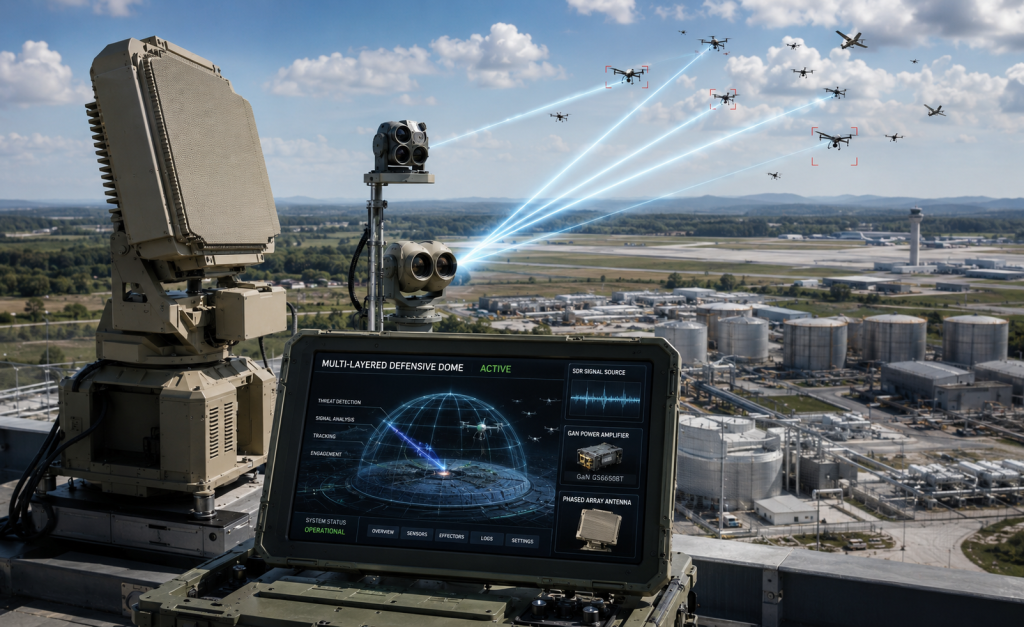
The future of defense technology centers on hyper-integrated ecosystems that combine electromagnetic disruption, directed energy, and kinetic countermeasures into a single autonomous network. As adversarial UAVs become faster and more resilient, your defense infrastructure must evolve beyond standalone radio frequency units. The next generation of drone jamming platforms will feature quantum-resistant protocols and orbital-level coordination.
Will Directed Energy Replace RF?
High-energy laser systems and microwave weapons will augment, rather than replace, traditional radio frequency disruption methods. Your future defense matrices will automatically select the most appropriate weapon type based on the target’s proximity and shielding.
Ready for the good part? Integrating SDR arrays with directed energy creates an impenetrable, multi-layered defensive dome.
- RF disruption for long-range early engagement.
- Directed energy for close-proximity hard kills.
- Seamless data sharing between all defensive nodes.
How Will Cloud Computing Integrate?
Decentralized cloud servers will aggregate threat data from global defense networks, instantly updating your local systems with new adversarial signatures. You will benefit from a worldwide intelligence mesh that adapts to emerging threats in real-time.
Key Takeaway: Investing in modular, software-upgradable hardware today guarantees your facility is ready to integrate tomorrow’s advanced unified defense networks.
Anticipating future trends allows for strategic infrastructure investments.
| Technology | Current State | Future State |
| Integration | Standalone | Fully Networked |
| Countermeasure | RF Disruption | Multi-vector (RF + Laser) |
| Intelligence | Localized | Global Cloud Mesh |
Final Thoughts
Addressing modern aerial threats requires moving away from outdated, single-band analog devices toward software-defined, GaN-powered wideband architectures. We solve the complex challenge of sustained, military-grade spectrum dominance, allowing you to secure your most critical assets without compromise. Our engineering team builds the core RF modules that power the world’s most advanced defense systems. Whether you are a system integrator or a procurement authority, contact us today to build your customized engineering proposal. CorelixRF is dedicated to manufacturing the ultimate truth in engineering, driving the future of reliable, full-band RF chain solutions globally.
FAQ
Q1: What’s the best way to define this specific defensive technology?
It is the deliberate transmission of radio frequency signals to disrupt the communication links between a UAV and its operator. This forces the unauthorized vehicle to land, hover, or return to its origin, neutralizing the threat.
Q2: How do I know if these disruption modules actually work?
They work by overpowering the target’s receiver with a higher-energy noise floor on specific control frequencies. Because the drone’s antenna is flooded with your generated interference, it can no longer process genuine command telemetry.
Q3: Can I deploy these arrays to stop autonomous pre-programmed attacks?
Yes, by utilizing GNSS spoofing and wide-band GPS disruption. When a vehicle loses its satellite navigation fix, its autonomous programming fails, forcing an emergency descent or rendering it completely lost.
Q4: What’s the best method to guarantee continuous operation without hardware failure?
Implementing advanced GaN solid-state technology paired with aggressive thermal management. These engineering choices prevent heat degradation and guarantee the linear power output necessary for 24/7 localized airspace defense.
Q5: How do I know if my facility requires single-band or multi-band hardware?
You always require multi-band hardware for robust security. Commercial off-the-shelf UAVs frequently utilize frequency hopping or dual-band links, making single-band defenses entirely obsolete against modern incursions.
Authorized RF engineering and compliance review
For regulated RF systems, this page should be used as an engineering and compliance review path, not as a public deployment checklist. CorelixRF starts with authorization status, operating region, frequency plan, output limit, antenna interface, safety controls, thermal limits and acceptance documents.
- RFQ checklist – send the data buyers usually forget, including band, power, duty cycle, interface and test standard
- delivery documentation – check what documents can support incoming inspection, FAT review and long-term maintenance
- quality and certification review – review the quality and compliance evidence before the project moves into procurement
- RF front-end platform – compare the RF chain as a system instead of selecting one isolated module
- RF configurator – turn frequency, power, thermal and interface requirements into a first configuration brief
- case studies – review similar engineering paths before sending an RFQ
- engineering contact – send the application notes, block diagram or target specification to engineering sales
This keeps the discussion inside lawful, authorized RF programs while still giving procurement teams a clear way to request amplifier, antenna, SDR source, documentation and factory review.
C-UAS RF Technology Review Path
For authorized RF technology refresh projects, translate reliability and documentation requirements into RF power amplifier platform choices, RF front-end architecture and antenna/load planning. Share frequency bands, output targets, duty cycle, cooling method, VSWR protection and validation evidence needs through the RF inquiry form.