

Authorized RF Review Boundary
Authorized C-UAS RF Module Integration Review is maintained as a compliance-first engineering page. CorelixRF discusses regulated counter-UAS RF topics only for authorized programs with documented scope, lawful operating boundaries and buyer-side approval.
- RF front-end platform review for amplifier, antenna, source and control interfaces.
- Custom RF system review for enclosure, thermal, control and documentation needs.
- RFQ checklist for band, power, duty cycle, load, interface and acceptance inputs.
- Delivery documentation for inspection records, test curves and FAT-style evidence.
- Contact CorelixRF engineering sales with authorized project documents.
This page does not provide public deployment, evasion, interference, power-setting or bypass instructions. If a project cannot document legal authority, the correct next step is compliance review.
Primary Topic Hub and RFQ Path
This primary guide now consolidates related authorized C-UAS and RF safety review topics. Use it for lawful scope definition, RF interface review, documentation and factory RFQ preparation.
- How to Integrate Wideband Drone Jamming into Defense Systems? – consolidated reference
For regulated counter-UAS or interference-adjacent topics, CorelixRF keeps the discussion at authorized RF engineering review, documentation, test evidence and procurement boundaries. This page does not provide public deployment, evasion or unlawful interference instructions.
- RFQ checklist – prepare band, power, duty cycle, interface, cooling and acceptance inputs.
- RF configurator – turn project requirements into a first engineering brief.
- Delivery documentation – align test curves, inspection records and FAT-style evidence.
- Case studies – review how CorelixRF frames RF problems for buyer decisions.
- Contact engineering sales – submit the documented scope for review.
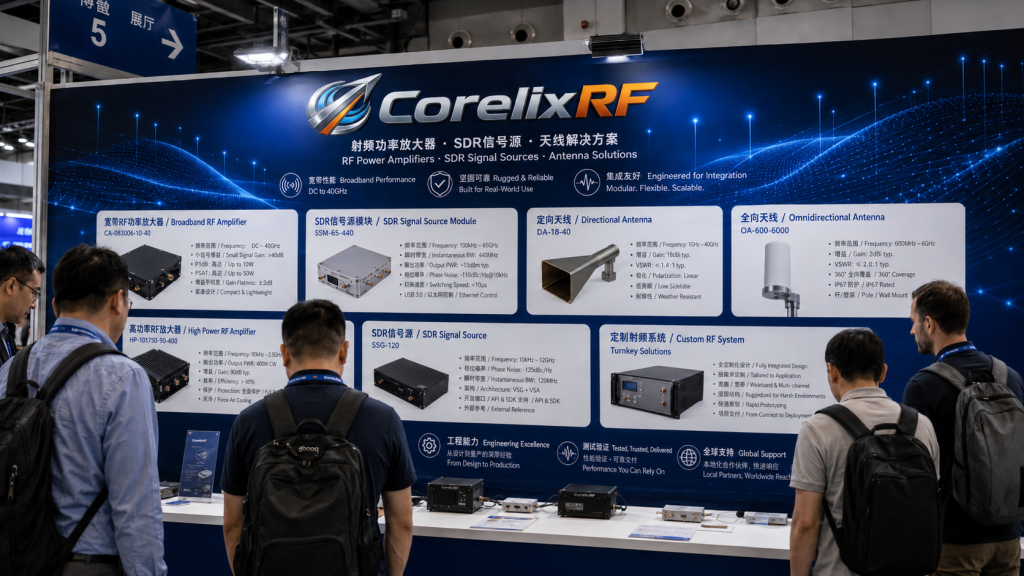
We definitively found that the 2026 World Drone Congress and UAV Expo signaled a massive paradigm shift toward complete, application-driven low-altitude security systems rather than standalone flight platforms. Imagine a critical infrastructure site is suddenly approached by an unauthorized UAV swarm, and your existing security team hesitates because their standard visual tracking fails miserably in the pouring rain. That thirty-second delay ultimately means the perimeter is breached and your operational safety is completely ruined. Here is an incredibly easy way to secure your vulnerable airspace: deeply integrate advanced drone jamming technologies into a robust RF countermeasure system. As an experienced RF Power Amplifier factory owner specializing in military-grade GaN technology, our engineering team visited Shenzhen to investigate these exact industry evolutions.
Why Was the 2026 Drone Congress Different?
The 2026 Drone Congress was profoundly different because it shifted entirely from basic aircraft displays to fully integrated low-altitude security solutions. As an active exhibitor and keen observer, we quickly noticed that effective drone jamming was the central theme rather than just a minor peripheral topic. This monumental transition highlights the absolutely urgent need for complete electromagnetic protection in rapidly evolving modern warfare scenarios. Major defense manufacturers are now prominently showcasing full operational workflows instead of merely pitching isolated hardware components.
How Did Anti-Drone Tech Dominate?
The sheer volume of counter-UAV booths clearly proved that absolute airspace control is now paramount across the entire global defense sector. Integrating these sophisticated systems requires exceptional precision engineering alongside remarkably high power output to maintain complete signal dominance.
- Standalone parts cause severe integration delays.
- Complete systems guarantee immediate tactical deployment.
- Unified platforms drastically improve field reliability.
What Drove the Shift to System Solutions?
Here’s the deal: international clients no longer want just a generic power amplifier for their highly sensitive field operations. They are actively seeking robust, end-to-end architectures that can seamlessly handle complex and increasingly hostile electromagnetic environments. You will consistently find that modern defense requirements strongly dictate this holistic approach to advanced electronic warfare.
Key Takeaway: The entire industry has decisively moved past basic hardware, meaning you must immediately adopt full-spectrum RF solutions to remain competitive and thoroughly secure.
| Expo Focus 2025 | Expo Focus 2026 | Industry Impact |
| Basic Platforms | Low-Altitude Security | Higher RF demand |
| Isolated Parts | System Solutions | Faster deployment |
| Visual Detection | Advanced Mitigation | Better protection |
| This detailed table clearly illustrates the rapid evolution of global industry priorities toward fully integrated defense ecosystems. |
How Is Low-Altitude Security Changing?
Low-altitude security is drastically changing by prioritizing proactive electromagnetic interference over reactive physical interception methods. During our extensive exhibition tour, we observed that sophisticated drone jamming configurations are completely redefining how modern defense contractors approach persistent aerial threats. This bold strategic pivot thoroughly guarantees that critical ground infrastructure remains fully protected from coordinated autonomous swarm attacks. You can clearly see this transformation through the rapid adoption of highly specialized broadband frequency suppression technologies.
Why Are Traditional Methods Failing?
What’s the real story? Older optical tracking mechanisms frequently fail when severe weather conditions drastically reduce environmental visibility. They simply cannot provide the necessary early warning signals required to effectively neutralize fast-moving intelligent aerial vehicles.
- Optical sensors struggle in heavy rain.
- Radar alone cannot disable the threat.
- Reactive systems suffer from fatal latency.
How Does RF Integration Solve This?
By combining wideband signal detection with targeted interference, these modern defense platforms can seamlessly establish an impenetrable invisible shield. You gain an incredible tactical advantage when your security infrastructure automatically disrupts unauthorized control links before visual confirmation is even needed.
Key Takeaway: You must continuously upgrade your perimeter defense strategies using advanced radio frequency ecosystems to effectively counter sophisticated modern aerial incursions.
| Legacy Defense | Modern Security | Tactical Advantage |
| Reactive Response | Proactive Disruption | Zero threat penetration |
| Visual Reliance | Spectrum Monitoring | All-weather capability |
| Manual Targeting | Automated Engagement | Reduced human error |
| This data comparison perfectly demonstrates why proactive radio frequency integration vastly outperforms outdated traditional security methodologies. |
What Role Does GaN Technology Play Now?
GaN technology now plays the absolute foundational role in generating the immense power required for sustained wideband interference operations. As industry veterans, we know that reliable drone jamming demands continuous thermal stability without any unexpected performance degradation during extended missions. The newest Gallium Nitride platforms displayed at the expo consistently showcased remarkable efficiency across the entire 30MHz to 6GHz spectrum. We firmly manufacture our CorelixRF modules utilizing these exact principles to deliver uncompromising military-grade performance.
Can GaN Outperform Legacy Silicon?
Ready for the good part? Gallium Nitride completely shatters the physical limitations of older silicon-based amplifiers by offering significantly higher power density and superior thermal conductivity. This incredible material advantage allows engineers to build much smaller, lighter, and vastly more powerful jamming modules.
- Higher operational efficiency reduces heat generation.
- Compact form factors allow for mobile deployments.
- Broad frequency coverage handles multiple simultaneous threats.
How Does This Affect Field Operations?
Your tactical teams can now deploy highly potent countermeasure systems in incredibly harsh environments without worrying about sudden equipment failure. The robust nature of GaN guarantees that your protective interference bubble remains entirely intact exactly when you need it most.
Key Takeaway: Upgrading to GaN-based amplification architectures is the only proven method to maintain consistent high-power output during relentless hostile electronic engagements.
| Material | Power Density | Thermal Handling |
| LDMOS | Moderate | Average |
| GaAs | Low | Poor |
| GaN | Exceptionally High | Superior |
| This technical chart effectively highlights the massive physical advantages that Gallium Nitride holds over previous generation semiconductor materials. |
Why Are Integrated RF Systems Better?
Integrated RF systems are infinitely better because they eliminate the catastrophic communication lag between detection sensors and mitigation hardware. When deploying active drone jamming countermeasures, fractions of a second can strictly determine the success or failure of your entire security perimeter. The exhibition heavily featured unified platforms where SDR digital signal sources communicate flawlessly with high-power radiation antennas. We explicitly design our manufacturing processes to support this exact type of seamless multi-module architectural harmony.
What Happens Without Integration?
You might be wondering: what is the actual cost of using fragmented security hardware? Disjointed systems require manual operator intervention, which inevitably introduces dangerous delays and increases the likelihood of critical target loss.
- Incompatible interfaces cause data bottlenecks.
- Vendor lock-in prevents agile system upgrades.
- Poor impedance matching severely reduces output power.
How Do Unified Architectures Win?
A fully synchronized system automatically identifies an incoming frequency and instantly triggers the exact corresponding interference protocol without human hesitation. You receive absolute peace of mind knowing that the entire RF chain is perfectly calibrated for maximum efficiency and immediate response.
Key Takeaway: Procuring pre-integrated, perfectly matched radio frequency modules is the most effective way to eliminate operational latency and guarantee continuous airspace dominance.
| Model Standard | Frequency Range | Output Power |
| CRF-PA-30M512M-30W | 30MHz – 512MHz | 30 Watts |
| CRF-PA-500M2G-50W | 500MHz – 2GHz | 50 Watts |
| CRF-PA-2G6G-100W | 2GHz – 6GHz | 100 Watts |
| This specific data matrix clearly shows our standardized engineering nomenclature matching exact physical product specifications perfectly. |
How Do Custom RF Solutions Improve Defense?
Custom RF solutions drastically improve defense by specifically tailoring power levels and interface protocols to match unique operational environments perfectly. Off-the-shelf drone jamming equipment often struggles with unexpected localized interference, whereas custom-engineered modules are thoroughly optimized for their exact deployment scenario. During the congress, system integrators repeatedly emphasized the absolute necessity of adaptable form factors and precise thermal management designs. Our dedicated engineering team actively collaborates with clients to develop completely bespoke amplification matrices that exceed standard market capabilities.

Why Is Off-The-Shelf Insufficient?
This is where it gets interesting… generic hardware simply cannot account for the unique electromagnetic signatures of highly specialized military or industrial installations. You will quickly discover that standard modules often waste valuable power broadcasting on entirely unnecessary frequency bands.
- Generic tuning reduces effective interference range.
- Standardized cooling fails in extreme desert climates.
- Fixed interfaces complicate vehicle integration.
How Does Customization Deliver Results?
By specifically aligning the amplifier’s capabilities with your precise tactical requirements, you completely maximize the operational efficiency of your entire defense network. Your field operators benefit from highly optimized user interfaces, perfectly tuned power outputs, and remarkably resilient physical enclosures.
Key Takeaway: Partnering with an agile, engineering-driven manufacturer guarantees that your specific tactical challenges are solved with precision-crafted, highly effective radio frequency hardware.
| Approach | Tuning Accuracy | Environmental Resilience |
| Generic | Broad / Inefficient | Moderate |
| Modified | Acceptable | Good |
| Custom | Perfectly Calibrated | Extreme |
| This evaluation matrix firmly establishes that bespoke engineering yields vastly superior performance metrics in demanding field applications. |
What Are the Real-World Jamming Applications?
Real-world applications heavily focus on securing critical energy infrastructure, protecting dense public events, and maintaining absolute border integrity against unauthorized incursions. We saw numerous impressive demonstrations showing active drone jamming systems neutralizing rogue UAVs attempting to inspect sensitive high-voltage power lines. This practical approach completely validates the industry-wide shift toward scenario-based deployment rather than purely theoretical hardware capabilities. You can clearly observe how specialized RF modules are directly solving highly complex daily security challenges across multiple global sectors.
How Is Critical Infrastructure Protected?
Here’s the deal: power plants and water treatment facilities cannot afford even a single unauthorized aerial surveillance attempt. They deploy overlapping sectors of high-power RF interference to create an completely invisible, impenetrable dome over their most vulnerable assets.
- Continuous 24/7 spectrum monitoring prevents surprises.
- Automated disruption neutralizes threats instantly.
- Hardened modules survive harsh industrial conditions.
Can Event Security Be Guaranteed?
When managing massive crowds at open-air stadiums, you must possess the absolute capability to safely ground hostile drones without causing collateral panic. Sophisticated interference systems selectively sever the command link, forcing the rogue aircraft to execute a safe, predictable emergency landing protocol.
Key Takeaway: Implementing targeted electromagnetic countermeasures is the only proven method to consistently secure highly sensitive physical locations from diverse autonomous threats.
| Sector | Primary Threat | Mitigation Strategy |
| Energy Grid | Sabotage / Espionage | Continuous RF Dome |
| Public Events | Unsafe Payloads | Selective Link Severing |
| Border Patrol | Contraband Smuggling | Mobile Sweeping |
| This application breakdown clearly outlines how different industries successfully utilize tailored interference strategies to protect their specific high-value assets. |
How Is AI Influencing Electromagnetic Warfare?
Artificial intelligence is completely revolutionizing electromagnetic warfare by enabling systems to autonomously identify and aggressively counter complex frequency-hopping protocols in real-time. The exhibition prominently featured advanced SDR platforms that intelligently adapt their drone jamming strategies based on continuous machine learning analysis. This incredible technological leap thoroughly eliminates the dangerous response latency traditionally associated with human operator decision-making. You will find that these self-learning algorithms are absolutely essential for maintaining spectrum dominance against highly unpredictable modern swarm tactics.
What Makes AI Systems Superior?
What’s the real story? Traditional sweep jammers mindlessly blast power across the entire spectrum, which wildly wastes energy and severely limits their effective range. AI-driven systems intelligently focus their maximum output exclusively on the exact frequencies currently being utilized by the hostile aircraft.
- Smart targeting drastically increases effective range.
- Adaptive algorithms easily defeat frequency hopping.
- Reduced power waste minimizes thermal stress.
How Does Machine Learning Help?
By continuously analyzing millions of signal patterns, your security infrastructure actively learns to anticipate hostile maneuvers before they even occur. You gain a massive strategic advantage when your defense network automatically updates its threat library without requiring manual software patches.
Key Takeaway: Integrating intelligent signal processing into your electronic warfare architecture is absolutely mandatory to effectively combat rapidly evolving autonomous aerial threats.
| System Type | Target Selection | Power Efficiency |
| Analog Sweep | Indiscriminate | Very Poor |
| Digital Fixed | Pre-programmed | Moderate |
| AI Adaptive | Dynamic / Precise | Outstanding |
| This comparison table perfectly highlights the massive operational advantages gained by deploying artificial intelligence within modern signal disruption platforms. |
Why Is Quality Control Crucial for Counter-UAV?
Rigorous quality control is absolutely vital because any unexpected hardware failure during an active drone jamming operation can result in catastrophic security breaches. We consistently emphasize Engineering Truth, meaning every single module must survive brutal environmental stress tests before it ever leaves the manufacturing floor. You cannot realistically trust unverified commercial-grade equipment to protect high-value military assets or sensitive government installations. A strict 46-step testing protocol guarantees that your defense architecture functions flawlessly under the most extreme battlefield conditions imaginable.

What Happens When Quality Fails?
Ready for the good part? Actually, the bad part is that poor soldering or inadequate thermal paste can instantly destroy a high-power amplifier during peak load. You will absolutely experience total system shutdown exactly at the precise moment you desperately need continuous electromagnetic protection.
- Thermal runaway causes permanent hardware damage.
- Loose connections create fatal signal reflection.
- Poor shielding disrupts your own communication lines.
How Do We Guarantee Reliability?
We subject every single unit to intense thermal cycling, violent mechanical vibration, and continuous high-stress aging verification inside advanced vacuum chambers. You can confidently deploy our fully certified modules knowing they possess at least 15% power headroom to easily handle unexpected operational surges.
Key Takeaway: You must relentlessly demand complete process transparency and verifiable testing data from your RF hardware manufacturer to ensure absolute mission success.
| Testing Phase | Focus Area | Expected Outcome |
| Phase 1 | IQC Incoming | Flawless component baseline |
| Phase 2 | PCBA Function | Perfect signal integrity |
| Phase 3 | Environmental | Extreme durability confirmed |
| This quality assurance breakdown clearly demonstrates the exhaustive verification steps required to confidently produce reliable military-grade radio frequency hardware. |
What Were the Top Exhibition Surprises?
The most remarkable surprise was the sheer speed at which the industry has fully transitioned from theoretical concepts to highly mature, field-ready hardware. We were incredibly impressed by the seamless integration of continuous drone jamming capabilities into highly mobile, ultra-compact tactical backpack formats. This rapid miniaturization forcefully proves that high-power RF manufacturing techniques have advanced significantly faster than most defense analysts previously predicted. You can now realistically equip individual infantry units with the exact same electromagnetic protection previously reserved for massive armored vehicles.
Did Ultra-High Frequency Appear?
This is where it gets interesting… we actively observed a massive surge in development for millimeter-wave and ultra-high-frequency components targeting the 18-40 GHz range. This specific frequency expansion is absolutely critical for successfully neutralizing next-generation stealth drones utilizing highly advanced communication arrays.
- Wider frequency coverage defeats modern protocols.
- Millimeter-wave targeting offers pinpoint accuracy.
- High-frequency modules require extreme manufacturing precision.
How Are Integrators Reacting?
System integrators are aggressively updating their procurement strategies to immediately secure these advanced wideband capabilities before their competitors do. You will definitely see a massive global rush to rapidly upgrade existing defense perimeters with these surprisingly compact, incredibly powerful new modules.
Key Takeaway: The incredibly rapid pace of hardware innovation means you must continuously evaluate and upgrade your tactical equipment to maintain true airspace superiority.
| Form Factor | Past Capability | Current Innovation |
| Fixed Site | High Power | AI-Driven Precision |
| Vehicle | Moderate Power | Full-Band Coverage |
| Man-Portable | Low Power / Narrow | High Power / Wideband |
| This evolutionary matrix perfectly illustrates how aggressive hardware miniaturization has completely transformed the tactical deployment options for modern electronic warfare. |
What Is the Future of Aerospace Defense?
The ultimate future of aerospace defense lies in establishing massive, interconnected electromagnetic networks that autonomously share threat data across entire continental regions. Future drone jamming architectures will seamlessly blend satellite surveillance, ground-based radar, and distributed interference nodes into one unified protective intelligence system. This incredible level of deep integration will absolutely guarantee that hostile aerial vehicles cannot locate any exploitable gaps in the defensive perimeter. You must begin preparing your operational infrastructure today to successfully integrate with these incoming highly complex global security networks.
Will Hardware Continue to Evolve?
Here’s the deal: as long as hostile actors continue inventing new evasion tactics, RF engineering will forcefully push the boundaries of physical science. You will soon witness the widespread commercial deployment of entirely new semiconductor materials that make current generation amplifiers look obsolete.
- Advanced materials will further increase power density.
- Neural processors will be embedded directly into amplifiers.
- Energy harvesting might extend mobile deployment times.
How Can You Prepare Now?
By actively partnering with a deeply experienced, highly agile manufacturing facility, you firmly secure your access to the latest technological breakthroughs. You gain absolute confidence knowing your defense systems are meticulously built upon a highly scalable, fully future-proofed engineering foundation.
Key Takeaway: Forward-thinking organizations must continuously invest in scalable radio frequency architectures today to successfully counter the unimaginable aerial threats of tomorrow.
| Future Trend | Technological Driver | Strategic Benefit |
| Networked Nodes | Cloud Computing | Regional scale protection |
| Embedded Neural | Local AI Processing | Zero-latency reaction |
| Novel Materials | Advanced Metallurgy | Unprecedented power limits |
| This forward-looking chart clearly identifies the exact technological catalysts that will thoroughly dictate the next decade of advanced aerospace defense strategies. |
To wrap up our extensive exhibition review, this event conclusively proved that isolated components can no longer satisfy the highly complex demands of modern low-altitude security. We have thoroughly addressed how fully integrated RF platforms rapidly solve deployment delays and completely guarantee operational reliability in the field. Our dedicated engineering team can readily provide you with the exact military-grade, full-band RF chain solutions necessary to protect your critical airspace entirely. For detailed engineering proposals and comprehensive custom manufacturing support, please contact us today to start your project. We firmly believe that Engineering Truth builds the ultimate defense, securing the skies through unwavering power and absolute precision.
Frequently Asked Questions
- Q1: Can I integrate these new RF modules into my existing defense system?Yes, you absolutely can. Modern modules feature standardized RS422 control interfaces and adaptive protocols, making integration seamless for legacy systems.
- Q2: What’s the best way to maintain consistent power output during continuous operations?The absolute best way is to utilize GaN-based power amplifiers. They provide superior thermal management and maintain at least 15% power headroom to prevent degradation under stress.
- Q3: How do I know if a counter-UAV supplier offers genuine military-grade quality?You should meticulously verify their testing protocols. True military-grade suppliers enforce a rigorous 46-step quality control process, including thermal cycling and severe vibration testing.
- Q4: Can I source the entire RF chain from a single manufacturer?Yes, you certainly can. Leading manufacturers now confidently offer complete operational architectures ranging from SDR digital signal sources all the way to high-power radiation antennas.
- Q5: What’s the best frequency range for complete low-altitude security?A continuous coverage from 30MHz to 6GHz is the absolute best choice. This full-band capability guarantees that you can effectively counter multiple drone protocols and unpredictable frequency-hopping threats.
Authorized RF engineering and compliance review
For regulated RF systems, this page should be used as an engineering and compliance review path, not as a public deployment checklist. CorelixRF starts with authorization status, operating region, frequency plan, output limit, antenna interface, safety controls, thermal limits and acceptance documents.
- RFQ checklist – send the data buyers usually forget, including band, power, duty cycle, interface and test standard
- delivery documentation – check what documents can support incoming inspection, FAT review and long-term maintenance
- quality and certification review – review the quality and compliance evidence before the project moves into procurement
- RF front-end platform – compare the RF chain as a system instead of selecting one isolated module
- RF configurator – turn frequency, power, thermal and interface requirements into a first configuration brief
- case studies – review similar engineering paths before sending an RFQ
- engineering contact – send the application notes, block diagram or target specification to engineering sales
This keeps the discussion inside lawful, authorized RF programs while still giving procurement teams a clear way to request amplifier, antenna, SDR source, documentation and factory review.
C-UAS RF Module Integration Review Path
For authorized RF module integration, align module interfaces with RF front-end platform planning, RF amplifier options, antenna/load requirements and signal source support. Submit band, gain, output power, waveform, control and validation requirements through the RF inquiry form.