
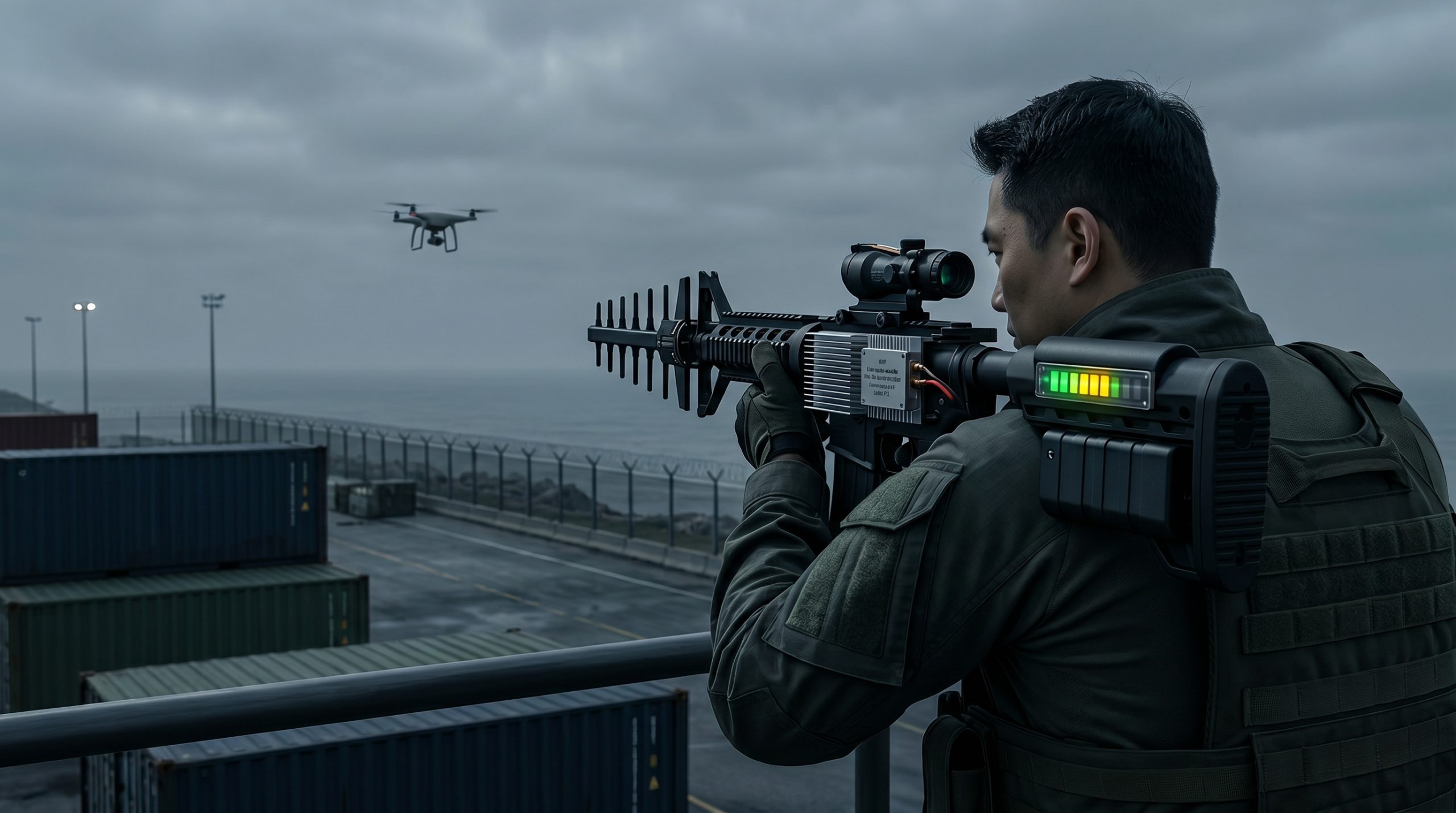
To operate a drone jammer gun with precision, you must align the directional antenna perfectly with the target while matching the exact frequency bands used by the drone’s communication and GPS protocols. Imagine this: a rogue drone suddenly breaches your secured airspace, creating an immediate security threat and forcing your response team into a state of panic. Relying on visual tracking alone often results in missed targets, leaving your critical infrastructure completely exposed to surveillance or worse. Here is an easy way to neutralize the threat instantly using a properly calibrated Drone Jammer Gun. By mastering proper alignment and frequency control, you can safely bring down unauthorized drones in seconds.
What Are The Core Principles Of A Drone Jammer Gun?
The core principles of a drone jammer gun rely on emitting concentrated radio frequency energy to sever the control and navigation links between the operator and the unmanned aerial vehicle. Operating a Drone Jammer Gun effectively requires a fundamental understanding of how electromagnetic interference disrupts specific signal bands. You disrupt the communication pathway by broadcasting a stronger signal on the exact same frequencies the drone uses to navigate. This localized interference forces the drone into its pre-programmed safety protocols, which usually means it will either land immediately or return to its home point.
What Frequencies Secure The Airspace?
A successful disruption depends entirely on targeting the correct frequency bands utilized by commercial and custom drones. Here is the deal: modern systems operate across multiple spectrums simultaneously to maintain stable connections. You must ensure your equipment covers these vital ranges to achieve a complete signal disconnect.
- 2.4 GHz for standard commercial video and control links.
- 5.8 GHz for high-definition, real-time video feeds.
- 1.5 GHz specifically to block GPS and GLONASS navigation signals.
How Does Directional Antennas Work?
Directional antennas focus the RF energy into a narrow beam, multiplying the effective jamming range and preventing accidental interference with friendly equipment. This is where it gets interesting… unlike omnidirectional antennas that scatter power everywhere, these specialized antennas act like a concentrated flashlight beam. You point the energy directly at the threat, which maximizes the disruption power at the source. This targeted approach is what gives operators the ability to safely manage crowded airspace without causing widespread communication failures.
Why Is Power Management Crucial?
Efficient power management ensures the equipment can sustain continuous output without overheating or experiencing dangerous voltage drops. Running out of battery mid-operation completely invalidates your defensive posture.
Key Takeaway: Understanding the interplay between frequency coverage and focused RF energy is the absolute foundation of successful drone neutralization.
| Component | Function | Critical Parameter |
| Antenna | Focuses RF beam | Beamwidth angle |
| Amplifier | Boosts signal strength | 150W ≤ 20A stability |
| Battery | Sustains operation | Continuous run time |
Analysis: The stability of the amplifier at high power directly dictates the maximum effective range and reliability of the system.
How To Assess Environments For A Drone Jammer Gun?
Assessing the environment for a drone jammer gun involves scanning for physical obstacles, identifying friendly RF signals, and evaluating the exact distance to the aerial threat. Before activating your Drone Jammer Gun, you must quickly analyze the surrounding area to ensure optimal line-of-sight and avoid collateral disruption. Buildings, dense foliage, and metal structures can reflect or absorb your radio frequency signals, drastically reducing your operational effectiveness. You have to position yourself where the signal path to the drone is completely unobstructed.
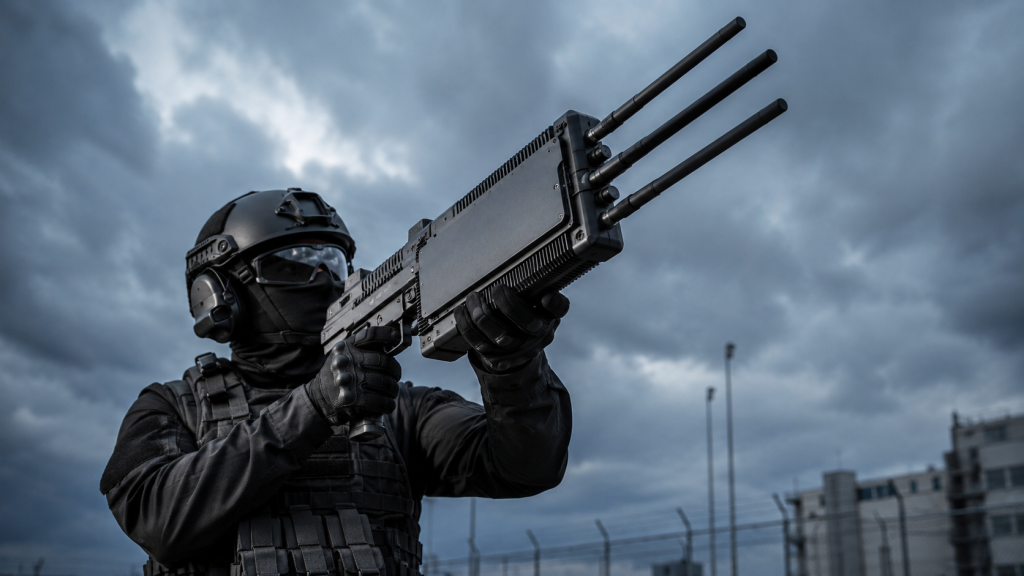
What Are The Common RF Obstacles?
Physical barriers are not the only obstacles; dense urban environments are flooded with background radio frequency noise. You might be wondering: how do you overcome this invisible interference? You must evaluate if the target is flying near cell towers or Wi-Fi hubs.
- Heavy concrete buildings absorb and block signal penetration.
- Large metallic structures cause unpredictable signal reflections.
- Existing communication towers create competing background noise.
How To Evaluate The Threat Distance?
Accurately judging the distance to the drone ensures you are operating within the effective range of your equipment’s output power. Truth be told: firing too early simply drains your battery and alerts the operator, while firing too late risks the drone completing its mission. You must wait until the target enters your confirmed operational envelope. This disciplined approach guarantees maximum energy transfer to the drone’s receivers.
Can You Identify Friendly Signals?
Mapping out friendly communication lines prevents you from accidentally taking down your own security team’s radios or local Wi-Fi networks. But here’s the kicker… collateral damage in RF warfare can be just as harmful as the drone threat itself.
Key Takeaway: A thorough environmental assessment guarantees that your focused RF energy hits the intended target without disrupting essential local communications.
| Obstacle Type | Impact on Signal | Mitigation Strategy |
| Concrete Walls | High absorption | Reposition for line-of-sight |
| Metal Structures | High reflection | Adjust firing angle |
| RF Congestion | Signal dilution | Increase output power |
Analysis: Environmental factors dictate positioning, making line-of-sight the most critical variable in urban operations.
What Is The Best Stance For A Drone Jammer Gun?
The best stance for a drone jammer gun is a balanced, shoulder-supported position with your feet shoulder-width apart to absorb weight and maintain steady tracking. Holding a Drone Jammer Gun for extended periods requires proper ergonomics to prevent muscle fatigue and ensure precise aiming. You should tuck the stock firmly into your shoulder pocket and use your non-dominant hand to support the front handguard. This stable foundation allows you to smoothly pan and tilt the device as the aerial target moves erratically.
How Do You Stabilize Your Upper Body?
Locking your elbows and utilizing your core muscles prevents the heavy equipment from swaying during an active engagement. Look at this: many operators fail because they rely solely on their arm strength, which quickly leads to micro-tremors. You must engage your chest and back muscles to create a rigid platform for the antenna. This technique allows for fluid, sweeping motions that mirror the drone’s flight path.
Why Is Foot Placement So Important?
Proper foot placement provides the balance needed to rotate your entire body without losing your footing on uneven terrain. Ready for the good part? By pivoting from your hips and keeping your feet planted, you maintain a consistent aiming arc.
- Keep your lead foot pointed toward the target area.
- Bend your knees slightly to absorb sudden movements.
- Distribute your body weight evenly across both legs.
Can Slings Improve Your Accuracy?
Using a tactical sling shifts the weight of the device from your arms to your torso, drastically extending your operational endurance. A heavy-duty two-point sling gives you the freedom to scan the sky without exhausting your muscles.
Key Takeaway: Adopting a fundamentally sound physical stance translates directly to higher accuracy and longer operational endurance during critical security events.
| Stance Element | Primary Benefit | Error Consequence |
| Shoulder Pocket | Recoil/weight management | Arm fatigue and shaking |
| Core Engagement | Smooth tracking | Jerky, inaccurate aiming |
| Foot Placement | Full-body balance | Tripping or losing target |
Analysis: Physical fatigue is the leading cause of missed targets, making ergonomic support accessories highly recommended.
How To Accurately Aim A Moving Drone Jammer Gun?
Accurately aiming at moving targets requires you to lead the drone slightly and sweep the RF beam across its anticipated flight path. When tracking with a Drone Jammer Gun, you cannot simply point at where the drone is currently located. You must anticipate its trajectory and project your invisible cone of interference ahead of its movement. Because the beamwidth of the antenna covers a specific angle, keeping the drone centered within this cone is essential for sustained disruption.
What Is The Sweeping Technique?
The sweeping technique involves moving the emitter back and forth across the drone’s path to ensure the signal catches the receiver. This is where it gets interesting… drones often drop in altitude or bank sharply when they first encounter interference. You have to adapt your tracking instantly to keep them bathed in the disruptive frequency.
- Start tracking slightly ahead of the drone.
- Sweep horizontally if the drone attempts evasion.
- Maintain the sweep until the drone visibly lands.
How Do Optics Enhance Precision?
Using integrated red-dot sights or magnified optics allows you to maintain visual contact with small, high-altitude targets that are difficult to track with the naked eye. Why does this matter? At distances over 500 meters, a small commercial drone looks like a speck of dust. High-quality optics ensure your RF beam remains perfectly centered on the threat. This visual confirmation is critical for verifying that the target has been neutralized.
Can You Track Erratically Flying Drones?
Tracking erratic targets requires you to rely on gross motor skills and wide-angle beam positioning rather than hyper-focused pinpointing. You should widen your stance and prepare to pivot rapidly to match sudden changes in speed or direction.
Key Takeaway: Consistent target tracking is achieved by anticipating flight paths and utilizing optics to maintain center-mass alignment within the RF beam.
| Tracking Method | Target Type | Beam Application |
| Center Hold | Hovering drones | Direct, sustained exposure |
| Lead Tracking | Fast moving targets | Projected path coverage |
| Area Sweeping | Erratic evaders | Broad sector disruption |
Analysis: Employing the area sweeping method increases the probability of neutralization when dealing with highly maneuverable targets.
What Frequencies Work Best For A Drone Jammer Gun?
The best frequencies are 2.4 GHz and 5.8 GHz for control signals, paired with 1.5 GHz to disable the drone’s GPS navigation systems. Tuning your Drone Jammer Gun to these specific bands ensures you sever all operational ties between the rogue device and its pilot. You must activate these frequencies simultaneously to prevent the drone from automatically switching to a backup control channel. Overwhelming the receiver with a CRF-PA-30M512M-30W structured signal guarantees a complete blackout of incoming commands.
Why Target The 2.4 GHz Band?
The 2.4 GHz band is the universal standard for almost all commercial and custom-built drone communication protocols. Here is the deal: if you do not successfully jam this primary channel, the pilot retains full control of the aircraft. You must ensure your amplifier delivers high-fidelity noise across this entire spectrum.
- It carries the main telemetry data.
- It handles basic flight commands.
- It is highly susceptible to targeted RF noise.
How Does GPS Jamming Work?
Disrupting the 1.5 GHz band blinds the drone to its physical location, preventing it from executing pre-programmed flight paths or returning home. You might be wondering: what happens when a drone loses GPS? In most cases, it enters a slow, vertical descent to avoid crashing blindly. This controlled landing allows your security team to safely recover the device for forensic analysis.
What Are Custom Frequency Modules?
Custom frequency modules allow you to adapt your equipment to combat specialized military or proprietary drones operating outside standard commercial bands. Upgrading your hardware to cover ultra-high frequencies ensures you are prepared for next-generation threats.
Key Takeaway: Simultaneous disruption of control, video, and navigation frequencies is the only proven method to guarantee complete drone neutralization.
| Frequency Band | Target System | Expected Outcome |
| 2.4 GHz | Primary Control | Loss of pilot steering |
| 5.8 GHz | Video Transmission | Blinding the operator |
| 1.5 GHz | GPS / GLONASS | Forced hovering or landing |
Analysis: Depriving the operator of video feedback on 5.8 GHz induces panic and severely degrades their ability to maneuver.
How To Verify Your Drone Jammer Gun Is Working?
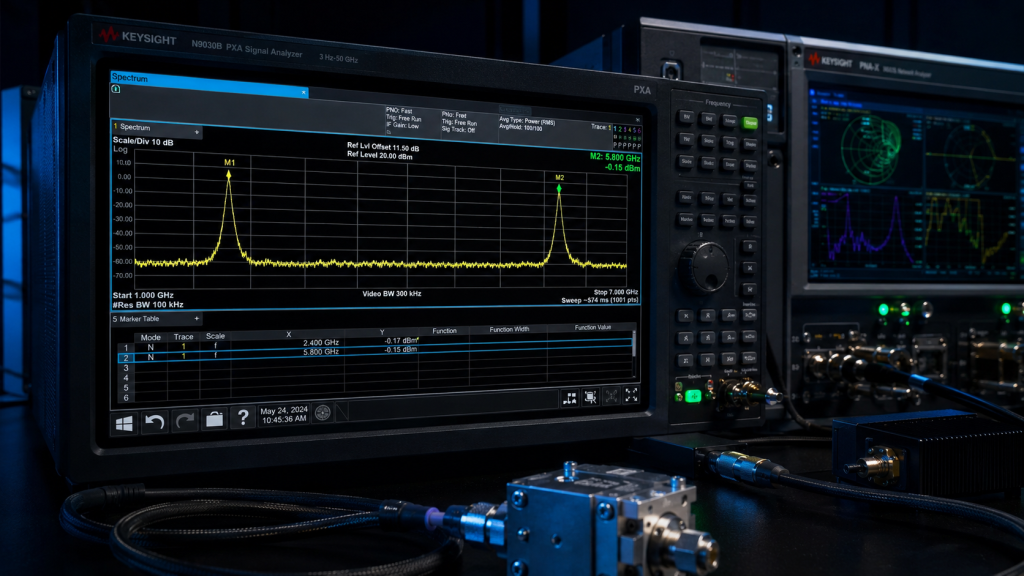
You verify functionality by performing routine pre-operation tests using a localized spectrum analyzer to confirm RF output across all active bands. A Drone Jammer Gun is a highly sophisticated piece of equipment that requires regular validation to ensure it will perform during an actual crisis. You should observe the visual indicators on the device, such as power lights and voltage meters, to confirm stable internal operations. Furthermore, conducting scheduled field tests against a controlled, friendly drone provides definitive proof of system readiness.

What Do The Indicator Lights Mean?
Indicator lights provide real-time feedback on battery health, module temperature, and active frequency transmission status. Let’s dive in: a flashing warning light often indicates an impedance mismatch or a dangerous spike in operating temperature. You must pay close attention to these signals to prevent catastrophic hardware failure.
- Green lights indicate optimal output power.
- Yellow lights warn of approaching thermal limits.
- Red lights signal an immediate critical fault.
How To Use A Spectrum Analyzer?
A handheld spectrum analyzer allows you to visualize the invisible RF energy leaving your antenna, confirming that the signal is dense and properly formed. Look at this: without testing equipment, you are essentially guessing if your device is actually transmitting. You can instantly see if a specific frequency module has degraded over time. This scientific approach guarantees your equipment is performing strictly according to its engineering specifications.
Why Are Live Field Drills Important?
Live field drills expose operators to realistic scenarios, allowing them to practice tracking and confirming interference on moving targets. These exercises build muscle memory and ensure your team trusts the equipment implicitly.
Key Takeaway: Routine technical validation using testing equipment combined with live drills ensures your hardware is always mission-ready.
| Verification Step | Tool Used | Action Required |
| Power Check | Internal Meters | Verify voltage stability |
| Output Check | Spectrum Analyzer | Confirm RF band presence |
| Field Test | Test Drone | Execute mock engagement |
Analysis: Utilizing a spectrum analyzer eliminates the guesswork and provides hard data on your equipment’s transmission health.
What Safety Protocols Apply To A Drone Jammer Gun?
Safety protocols require you to never point the active device at humans, avoid prolonged exposure to the antenna path, and strictly monitor battery temperatures. Operating a Drone Jammer Gun safely means respecting the immense power of concentrated radio frequency radiation. You must ensure that the firing path is clear of bystanders and sensitive medical equipment, such as pacemakers, which could be disrupted by the signal. Properly grounding the equipment during charging and storage is also mandatory to prevent electrical hazards.
How To Manage Radiation Exposure?
Standing behind the directional antenna completely shields you from the forward-facing RF energy beam. But here’s the kicker… stepping in front of the active emitter can expose your tissue to concentrated electromagnetic waves. You must maintain strict physical discipline and ensure your team stays behind the firing line.
- Always keep the emitter pointed downrange.
- Never inspect the front of an active antenna.
- Turn off the power immediately after the threat is cleared.
Why Monitor Thermal Limits?
High-power GaN amplifiers generate significant heat, and ignoring thermal warnings can lead to internal component meltdown or battery fires. Truth be told: pushing the equipment past its duty cycle is a common and dangerous mistake. You have to let the aluminum heat-sink do its job and allow for proper cooling periods. This practice drastically extends the lifespan of your critical hardware.
What Are Battery Storage Rules?
Lithium-ion power sources require cool, dry storage environments and should never be left fully charged for extended periods of inactivity. Utilizing fire-proof storage cases minimizes the risk of thermal runaway during long-term storage.
Key Takeaway: Strict adherence to physical safety and thermal management protocols protects both the operator and the longevity of the equipment.
| Safety Concern | Primary Risk | Prevention Method |
| RF Exposure | Tissue heating | Stand behind the antenna |
| Thermal Overload | Hardware meltdown | Adhere to duty cycles |
| Battery Failure | Fire hazard | Use fire-proof storage |
Analysis: Operator positioning is the simplest and most effective method to mitigate any potential risks associated with RF exposure.
How To Maintain And Store Your Drone Jammer Gun?
You maintain the device by cleaning the antenna interfaces, checking for physical casing damage, and storing it in a climate-controlled, humidity-free environment. Taking care of your Drone Jammer Gun ensures that the sensitive internal electronics remain shielded from environmental degradation. You must regularly inspect all physical connections and cables for signs of wear or fraying that could cause electrical shorts. Proper maintenance protocols transform a temporary security tool into a reliable, long-term asset.
How To Clean The Equipment?
Using compressed air and specialized electronic contact cleaners prevents dust and moisture from interfering with the high-frequency connectors. What’s the real story? A single speck of dirt on a coaxial connection can drastically reduce your output power and cause impedance mismatches. You must wipe down the external casing with a damp cloth and ensure the heat-sink fins are completely clear of debris.
- Blow out dust from cooling vents regularly.
- Apply contact cleaner to all RF interfaces.
- Inspect physical switches for smooth operation.
Why Is Humidity Control Crucial?
Moisture is the absolute enemy of complex circuit boards, causing invisible corrosion that leads to sudden and unpredictable system failures. This is where it gets interesting… storing your equipment in a standard locker is not enough to protect it from changing weather. You should use a hard case equipped with silica gel desiccants to aggressively absorb ambient moisture. This ensures the internal PCBA functions perfectly when you need it most.
How Do You Manage Firmware Updates?
Some advanced digital systems require occasional firmware patches to recognize and combat newly developed drone communication protocols. Checking for software updates keeps your equipment relevant against evolving technological threats.
Key Takeaway: Rigorous cleaning and climate-controlled storage are non-negotiable requirements for preserving the operational integrity of high-power RF hardware.
| Maintenance Task | Frequency | Purpose |
| Interface Cleaning | Post-operation | Prevent signal loss |
| Desiccant Check | Monthly | Prevent internal corrosion |
| Battery Cycling | Quarterly | Maintain charge capacity |
Analysis: Preventative maintenance directly correlates with a reduction in catastrophic failures during active security deployments.
Can Weather Impact A Drone Jammer Gun Operation?
Heavy rain, dense fog, and extreme temperature fluctuations can absorb RF signals and drastically reduce the effective operational range of the equipment. Operating a Drone Jammer Gun in adverse weather requires you to understand how moisture interacts with electromagnetic waves. You must account for signal degradation by closing the distance to the target or increasing the power output to punch through the atmospheric interference. Recognizing these environmental limitations prevents you from overestimating your defensive capabilities.
How Does Rain Affect Signal Strength?
Water droplets in the air scatter and absorb high-frequency signals, particularly the 5.8 GHz band used for video transmission. You might be wondering: does this mean the device is useless in a storm? No, but your effective range might be cut in half.
- Heavy rain causes severe signal attenuation.
- Fog diffuses the focused RF beam outward.
- Snow accumulation on the antenna blocks transmission.
Why Do Extreme Temperatures Matter?
Freezing temperatures drastically reduce battery efficiency, while extreme heat forces the internal amplifiers to hit their thermal limits much faster. Ready for the good part? By keeping batteries warm before deployment and using shaded areas during summer operations, you can mitigate these effects. You must monitor your equipment closely to prevent environmentally induced shutdowns.
Can Wind Influence The Engagement?
While wind does not affect the RF signal, it heavily influences the flight path of the target drone, making tracking significantly more difficult. You must broaden your sweeping stance to compensate for a drone being pushed erratically by heavy gusts.
Key Takeaway: Adjusting your tactical approach and power management strategies is essential to overcome the physical limitations imposed by severe weather.
| Weather Condition | Primary Effect | Tactical Adjustment |
| Heavy Rain | Signal absorption | Decrease engagement distance |
| Extreme Cold | Battery drain | Pre-warm power sources |
| High Winds | Erratic drone movement | Widen tracking sweep |
Analysis: Anticipating signal attenuation during rainstorms allows operators to adjust their firing timing for maximum effectiveness.
How To Troubleshoot A Faulty Drone Jammer Gun?
You troubleshoot faults by systematically isolating the power supply, checking the antenna connections, and verifying the internal amplifier status indicators. When a Drone Jammer Gun fails to neutralize a target, you must immediately diagnose the root cause without panicking. You should first ensure the battery is fully seated and delivering the correct voltage to the system. Bypassing assumptions and relying on a logical diagnostic checklist ensures you can quickly bring the system back online.
How To Diagnose Power Failures?
If the device refuses to turn on, the issue is almost always related to the battery contacts or a blown internal safety fuse. Look at this: many operators assume the entire unit is broken when the problem is just a loose power cable. You must inspect the battery terminals for corrosion and confirm the main power switch is functioning mechanically.
- Swap the battery for a known good unit.
- Check all exterior cable connections.
- Verify the integrity of the power switch.
What Causes Poor Range Performance?
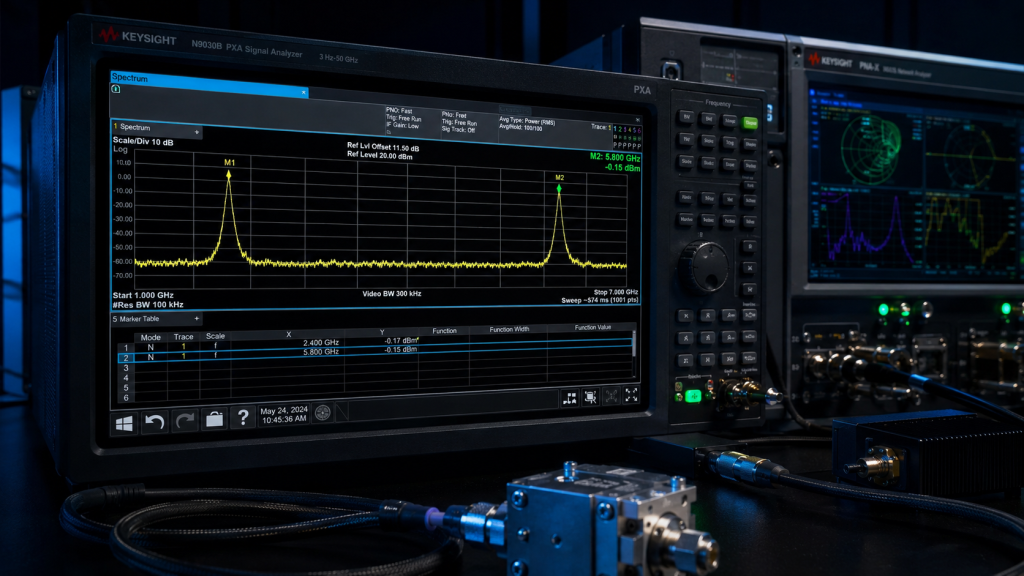
A sudden drop in effective range is typically caused by a damaged antenna element or an internal impedance mismatch in the amplifier module. Truth be told: dropping the unit can misalign the internal directional elements, ruining the beam focus. You must use a testing meter to check the VSWR performance and ensure the energy is actually leaving the device. If the energy is reflecting back inside, the unit requires professional repair.
How To Handle Overheating Shutdowns?
If the system powers down unexpectedly during operation, it has likely triggered its thermal protection circuit due to inadequate cooling. You must move the unit to a shaded area and allow the internal heat-sinks to naturally dissipate the built-up temperature.
Key Takeaway: A calm, step-by-step diagnostic approach allows operators to quickly resolve common technical issues and restore security coverage.
| Fault Symptom | Probable Cause | Immediate Action |
| No Power | Battery failure / Fuse | Swap power source |
| Short Range | Antenna damage | Inspect physical connections |
| Sudden Shutdown | Thermal overload | Allow unit to cool down |
Analysis: Identifying whether a failure is power-related or RF-related dictates the speed at which a unit can be returned to service.
In conclusion, mastering the operation of this equipment requires a deep understanding of RF principles, environmental awareness, and precise physical tracking techniques. By following proper maintenance and troubleshooting protocols, you ensure your airspace remains secure against unauthorized aerial threats. CorelixRF is dedicated to providing uncompromising, engineering-driven RF solutions that perform flawlessly in the most demanding environments. If you are ready to upgrade your security infrastructure with military-grade RF technology, please reach out and contact us today for a comprehensive system consultation.
FAQ
Q1: Can I use this equipment to disable multiple drones at the exact same time?
Yes, you can disrupt multiple targets simultaneously if they are clustered together. Because the directional antenna emits a cone of RF energy, any drone caught within that specific beamwidth will lose its communication links.
Q2: What’s the best way to determine if the target has been successfully neutralized?
The best indicator is a sudden change in the target’s flight behavior. You will typically see the drone stop its forward momentum, begin hovering in place, or initiate a slow, controlled vertical descent as its safety protocols take over.
Q3: How do I know if my battery has enough charge for a full deployment?
You must check the integrated voltage meter or battery indicator lights before beginning your shift. Relying on guesswork is dangerous; always ensure your power source is at maximum capacity to guarantee sustained RF output during an emergency.
Q4: Can I operate the equipment safely from inside a vehicle or building?
No, operating from behind glass or metal enclosures severely limits your effectiveness. These materials reflect and absorb the radio frequency signals, drastically reducing your range and potentially bouncing harmful RF energy back toward the operator.
Q5: What’s the best method to practice tracking without draining the battery?
You should conduct dry-fire drills using deactivated equipment to build muscle memory. Tracking birds or friendly test drones with the power turned off allows you to perfect your physical stance and sweeping techniques without generating unnecessary heat or utilizing battery life.
Authorized RF engineering and compliance review
For regulated RF systems, this page should be used as an engineering and compliance review path, not as a public deployment checklist. CorelixRF starts with authorization status, operating region, frequency plan, output limit, antenna interface, safety controls, thermal limits and acceptance documents.
- RFQ checklist – send the data buyers usually forget, including band, power, duty cycle, interface and test standard
- delivery documentation – check what documents can support incoming inspection, FAT review and long-term maintenance
- quality and certification review – review the quality and compliance evidence before the project moves into procurement
- RF front-end platform – compare the RF chain as a system instead of selecting one isolated module
- RF configurator – turn frequency, power, thermal and interface requirements into a first configuration brief
- case studies – review similar engineering paths before sending an RFQ
- engineering contact – send the application notes, block diagram or target specification to engineering sales
This keeps the discussion inside lawful, authorized RF programs while still giving procurement teams a clear way to request amplifier, antenna, SDR source, documentation and factory review.
Portable RF Device Safety Review Path
For authorized portable C-UAS RF device reviews, keep safety, legal scope and documentation at the center while mapping requirements to RF power amplifier modules, RF front-end protection and antenna/load planning. Send bands, duty cycle, output targets, thermal limits and evidence-record needs through the RF inquiry form.