
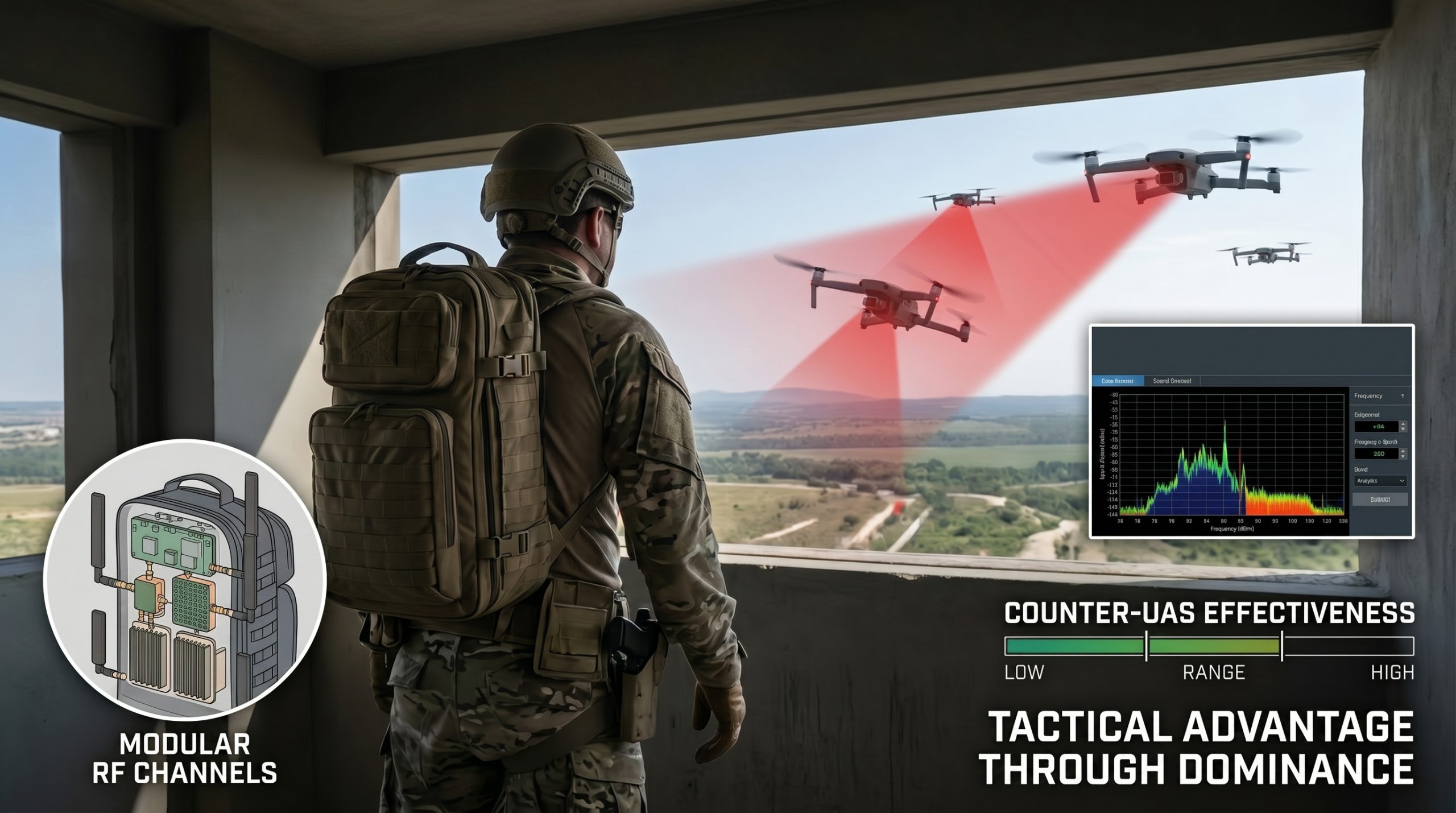
How Does a Drone Jammer Backpack Support Tactical Operations? A drone jammer backpack supports tactical operations by providing mobile, immediate RF disruption against hostile UAV threats directly from the infantry level. Imagine your infantry unit moving through a hostile urban sector where sudden enemy reconnaissance drones spot your exact position. The exposure immediately risks your entire squad to artillery fire or ambushes. Providing a man-portable Drone Jamming solution allows your team to sever the drone’s communication link instantly, neutralizing the threat before it reports back. With military-grade RF capabilities, you can regain control of the electromagnetic environment and guarantee mission security.
How Is Drone Jamming Integrated Into Backpacks?
How Is Drone Jamming Integrated Into Backpacks? Drone jamming is integrated into backpacks by utilizing high-efficiency GaN power amplifiers and compact SDR modules housed within ruggedized, heat-dissipating shells. Implementing mobile Drone Jamming requires engineers to balance high-power RF outputs with the ergonomic constraints of a human loadout. You rely on this seamless integration to carry a full-spectrum defense system without hindering your physical mobility in the field.
What defines a tactical jammer?
A tactical jammer is defined by its ability to deliver targeted electromagnetic interference while surviving extreme combat conditions. You need equipment that withstands drops, vibrations, and water exposure. But here’s the kicker… modern tactical setups are not just rugged; they are highly intelligent digital platforms. ● Continuous frequency coverage ● 30W–200W configurable output ● Aluminum heat-sink integrated design
How does the system architecture work?
The architecture links an SDR digital signal source to wideband amplifiers, pushing RF energy through specialized directional and omni antennas. You can seamlessly disrupt video feeds and control signals by targeting specific frequency hopping patterns.Key Takeaway: The modular architecture of a drone jammer backpack guarantees you maintain a continuous, high-power defensive perimeter while staying mobile.
| Component | Function | Advantage |
| GaN Amplifiers | Boosts RF signal power | Highly efficient |
| SDR Module | Generates digital signals | Programmable control |
| Antenna Array | Directs jamming beams | Precise targeting |
This architectural design guarantees maximum disruption efficiency while keeping your loadout weight manageable.
Why Is Drone Jamming Required for Infantry Safety?
Why Is Drone Jamming Required for Infantry Safety? Drone jamming is required for infantry safety because it strips the enemy of aerial intelligence, preventing coordinated strikes on your position. Tactical Drone Jamming creates an invisible dome of protection that stops explosive-laden commercial UAVs from reaching your troops. When you deploy these countermeasures, you effectively blind the adversary’s overwatch capabilities.
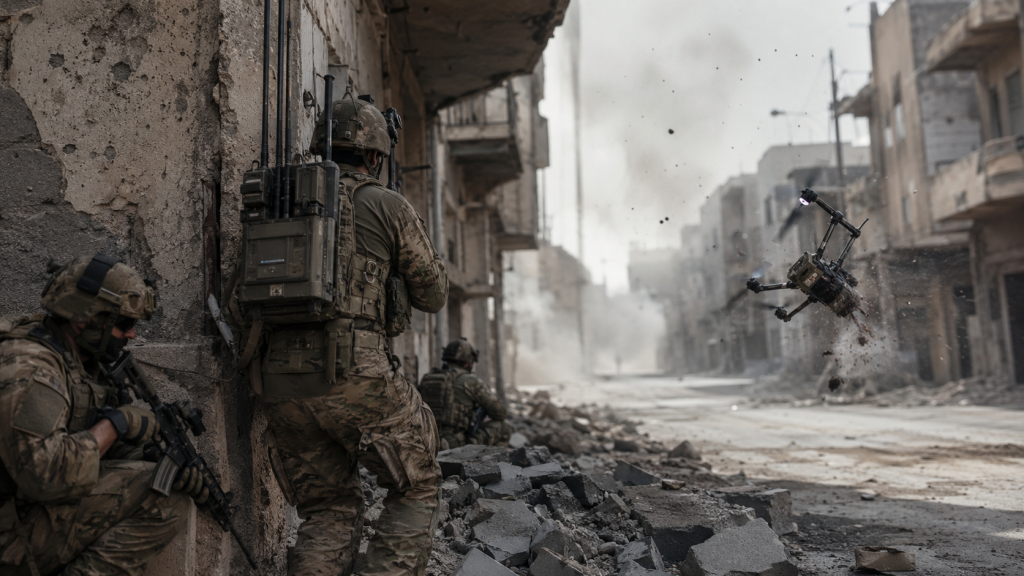
What are the main battlefield threats?
Hostile forces actively modify commercial off-the-shelf drones to carry payloads or act as forward observers. Your squad faces threats that are small, fast, and incredibly difficult to shoot down with conventional firearms. What’s the real story? Electronic warfare is often the only reliable defense against these agile aerial threats. ● Kamikaze FPV drones ● Aerial reconnaissance units ● GPS-guided payload drops
How is perimeter defense established?
Perimeter defense is established by activating the backpack’s omnidirectional antennas to broadcast interference across standard UAV frequencies. You can walk through contested zones while the system automatically neutralizes incoming signals.Key Takeaway: Carrying a man-portable jammer drastically reduces casualty rates by proactively neutralizing aerial threats before they enter lethal range.
| Threat Type | Jamming Action | Result |
| FPV Drones | Disrupts control link | Immediate crash |
| Recon UAVs | Blocks video feed | Blinds operator |
| GPS Drones | Spoofs navigation | Forces return home |
Deploying electronic countermeasures neutralizes these modern threats far more reliably than kinetic weapons.
What Frequencies Does Backpack Drone Jamming Target?
What Frequencies Does Backpack Drone Jamming Target? Backpack drone jamming targets standard commercial UAV bands like 2.4GHz and 5.8GHz, alongside GPS and custom datalink frequencies spanning 30MHz to 6GHz. Effective Drone Jamming requires continuous frequency coverage to address both commercial toys and modified military reconnaissance tools. You must have the ability to sweep multiple bands simultaneously to guarantee no drone slips through your defenses.
Can it block custom drone protocols?
Yes, SDR-based systems can analyze and adapt to non-standard frequencies and hopping patterns used by advanced adversaries. You are no longer limited to jamming just Wi-Fi or standard RC bands. Ready for the good part? Real-time frequency hopping analysis allows your backpack to outsmart even the most complex proprietary protocols. ● 100MHz–6000MHz frequency range ● Real-time frequency hopping ● Multi-waveform support
How are GPS signals jammed?
The system disrupts the GNSS signals that drones rely on for autonomous navigation, forcing them into a hovering or landing state. By overwhelming the weak satellite signals with a localized RF broadcast, you strip the drone of its spatial awareness.Key Takeaway: Thorough frequency coverage guarantees you can defeat any drone, regardless of its make, model, or communication protocol.
| Frequency Band | Common Usage | Jamming Effect |
| 433 MHz / 900 MHz | Long-range control | severs telemetry |
| 2.4 GHz / 5.8 GHz | Video & direct control | Blinds live feed |
| GNSS (L1/L2) | Autonomous navigation | Stops waypoint travel |
Overwhelming these specific frequency bands secures complete control over the local airspace.
How Does Drone Jamming Handle Multiple UAV Threats?
How Does Drone Jamming Handle Multiple UAV Threats? Drone jamming handles multiple UAV threats by radiating broadband interference that simultaneously suppresses numerous signals within its effective radius. When facing a drone swarm, Drone Jamming allows you to deploy a wide-area electronic net rather than targeting individual units. You can confidently secure your airspace even when adversaries launch coordinated multi-drone attacks against your squad.
How does wideband suppression work?
Wideband suppression blasts RF noise across a massive spectrum, effectively drowning out all control and video signals in the vicinity. You do not need to aim precisely; the system acts like a floodlight of interference. This is where it gets interesting… you can neutralize a dozen drones as easily as a single one. ● Omni-directional coverage ● Simultaneous multi-band output ● High power density algorithms
Is directional targeting possible?
While wideband is great for swarms, you can also use directional antennas to focus your jamming power on a specific threat vector. This extends your effective range significantly while conserving battery life.Key Takeaway: The ability to switch between omnidirectional swarm defense and focused directional attacks gives you ultimate tactical flexibility.
| Antenna Mode | Threat Scenario | Benefit |
| Omnidirectional | Drone swarms | 360-degree protection |
| Directional | Distant single target | Extended jamming range |
| Hybrid | Mixed environments | Adaptable threat response |
Switching antenna modes allows your team to dynamically adapt to varying battlefield threat concentrations.
Can Drone Jamming Backpacks Operate on the Move?
Can Drone Jamming Backpacks Operate on the Move? Drone jamming backpacks can operate on the move because they utilize shock-mounted internal components and self-contained battery ecosystems designed for mobile infantry. Tactical Drone Jamming provides a moving bubble of protection, allowing your squad to advance through contested territory safely. You don’t need to halt your patrol to deploy countermeasures, making certain operational momentum remains uninterrupted.
How durable are the internal components?
Military-grade jammers undergo extreme stress and environmental testing, including vibration testing and conformal coating. You can sprint, dive, and crawl without fear of breaking delicate RF circuitry. You might be wondering… how does it survive such abuse? The answer lies in rigorous 46-step quality control protocols. ● PCBA Functional Validation ● Thermal cycling test ● Final aging verification
Does movement affect the jamming range?
Movement does not inherently decrease the jamming range, but terrain obstacles encountered while walking can temporarily block RF lines of sight. You must maintain situational awareness to guarantee your antennas have clear propagation paths.Key Takeaway: True tactical mobility means your electronic warfare capabilities travel seamlessly alongside your front-line infantry units.
| Environmental Test | Purpose | Field Benefit |
| Vibration Testing | Simulates combat movement | Prevents component failure |
| Thermal Cycling | Tests extreme weather | Maintains reliable output |
| Conformal Coating | Blocks moisture | Allows rainy operations |
Rigorous environmental testing guarantees your backpack functions flawlessly during intense kinetic maneuvers.
How Is Power Managed in Drone Jamming Backpacks?
How Is Power Managed in Drone Jamming Backpacks? Power is managed in drone jamming backpacks through high-density lithium-ion cells and intelligent power distribution boards that prioritize critical frequency bands. Operating a Drone Jamming system requires massive amounts of energy, so balancing output with battery life is required. You can monitor power consumption via integrated displays to guarantee your system remains active during critical mission phases.
How long does the battery last?
A typical mission loadout provides continuous jamming for up to two hours, or significantly longer if used intermittently in standby mode. You can easily swap modular battery packs in the field to extend your operational window. Now, consider this… smart power algorithms only boost output when a threat is actively detected. ● High-density lithium cells ● Hot-swappable battery modules ● Smart standby algorithms
Can it be powered externally?
Yes, most tactical backpacks feature interfaces to connect to vehicle power systems or larger stationary generators. When you establish a temporary forward operating base, you can plug in for indefinite continuous protection.Key Takeaway: Intelligent power management and modular batteries guarantee you never lose electronic superiority due to a dead system.
| Power Mode | Output Level | Battery Drain |
| Continuous Sweep | Maximum | Very High |
| Reactive Jamming | High (when triggered) | Moderate |
| Standby Mode | Minimal | Low |
Utilizing smart power modes significantly extends your operational duration in the field without sacrificing safety.
What Are the Thermal Limits of Drone Jamming Gear?
What Are the Thermal Limits of Drone Jamming Gear? The thermal limits of drone jamming gear are expertly managed by aluminum heat-sink integrated designs that prevent output degradation during sustained operation. Effective Drone Jamming relies on GaN power amplifiers that inherently generate intense heat, requiring sophisticated cooling solutions. You can rely on these systems to maintain a stable, high-power output even in scorching desert environments.
Why is heat dissipation critical?
If a high-power amplifier overheats, it will automatically throttle its output, significantly reducing your defensive jamming radius. You need equipment that aggressively vents heat to maintain ≥15% power redundancy. Think about it… a jammer that fails under a hot sun is a fatal liability. ● Aluminum heat-sink chassis ● Active cooling fans ● Thermal throttling protection
How does the backpack stay cool?
The backpack shell is essentially a massive radiator, utilizing thermal paste and heat pipes to pull heat away from the core GaN modules. You will feel warmth against your gear, but the specialized padding protects the operator from burns.Key Takeaway: Superior thermal engineering guarantees your jamming output remains fully effective regardless of the ambient temperature.
| Cooling Mechanism | Function | Operator Benefit |
| Integrated Heat-sink | Absorbs module heat | Maintains RF power |
| Active Fans | Expels hot air | Prevents throttling |
| Padded Backing | Insulates the user | Prevents operator burns |
Advanced thermal management architectures establish constant mission readiness in extreme combat climates.
How Does Drone Jamming Avoid Friendly Comm Disruption?
How Does Drone Jamming Avoid Friendly Comm Disruption? Drone jamming avoids friendly comm disruption by utilizing programmable SDR interfaces that allow operators to carve out specific frequency safe zones. While Drone Jamming is designed to create chaos for the enemy, you must maintain clear communication channels with your own squad. You can configure the system to leave your proprietary tactical radio bands completely untouched.
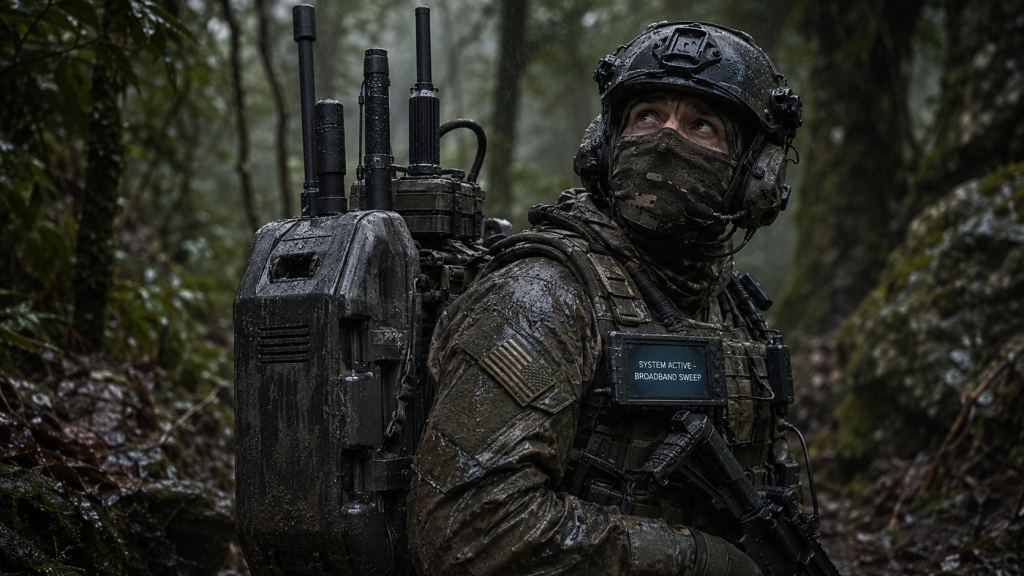
What is frequency notching?
Frequency notching is a software-defined capability that creates precise “holes” in the jamming spectrum. You can blast interference across the entire 400MHz band while leaving the exact 410MHz channel open for your encrypted radios. Why does this matter? It allows you to fight electronically without blinding your own command and control. ● Programmable safe zones ● RS422 control interfaces ● Precision bandwidth filtering
Can it integrate with existing radios?
Advanced backpacks can physically interface with your tactical comms, automatically syncing hopping patterns to guarantee mutual non-interference. You achieve seamless interoperability between your electronic warfare and communication assets.Key Takeaway: Software-defined radio technology empowers you to dominate the electromagnetic spectrum without silencing your own team.
| Feature | Description | Tactical Value |
| Frequency Notching | Creates spectrum gaps | Protects friendly comms |
| Sync Interfaces | Connects to radios | Automated hopping safety |
| Bandwidth Filters | Cleans signal edges | Reduces collateral noise |
Implementing precise frequency control prevents the dangerous fratricide of friendly communication networks.
Are Drone Jamming Backpacks Customizable for Missions?
Are Drone Jamming Backpacks Customizable for Missions? Drone jamming backpacks are highly customizable, allowing defense procurement authorities to specify power levels, frequency bands, and interface protocols before deployment. Custom Drone Jamming solutions guarantee your hardware perfectly matches the specific threat profile of your operational theater. You can partner with engineering teams to build a system from prototype to mass production that meets your exact needs.
What components can be customized?
You can tailor everything from the internal GaN power amplifiers to the external antenna form factors. If you are operating in urban environments, you might prioritize higher frequencies; in open terrain, lower frequencies for range. Let’s dive a little deeper… true customization extends deep into the software protocol layers. ● Frequency band customization ● Power level customization ● OEM / ODM support
How fast can custom units be deployed?
With engineering-driven manufacturing, a custom prototype can often be rapidly developed and tested in an advanced RF laboratory. You receive equipment verified to MIL-STD-810 precision in a fraction of traditional procurement timelines.Key Takeaway: Custom RF manufacturing allows you to equip your infantry with the exact tools needed to counter highly specific regional threats.
| Customization Option | Application | Benefit |
| Custom Frequencies | Regional threat adaptation | Targeted effectiveness |
| Variable Power Levels | Weight vs. Range balancing | Optimized loadouts |
| Protocol Design | Countering proprietary tech | Future-proof defense |
Tailoring your hardware specifications directly translates to higher survival rates for deployed units.
What Is the Future of Portable Drone Jamming Systems?
What Is the Future of Portable Drone Jamming Systems? The future of portable drone jamming systems lies in AI-driven cognitive electronic warfare that automatically detects, analyzes, and neutralizes unknown signals instantly. Drone Jamming is rapidly evolving from a brute-force RF broadcast into a highly surgical, intelligent defensive mechanism. You will soon carry backpacks that learn enemy tactics in real-time, adapting their jamming waveforms on the fly.
Will systems become lighter?
Advancements in GaN technology and solid-state batteries are continuously shrinking the size and weight of high-power RF modules. You will eventually see backpack systems transition into lightweight vest-integrated modules. Here’s the deal… reducing weight directly increases infantry endurance and combat effectiveness. ● Miniaturized GaN modules ● Solid-state battery integration ● Vest-wearable form factors
How will AI change drone jamming?
Artificial intelligence will enable the system to autonomously identify the best jamming strategy without operator input, reacting faster than any human could. You will simply turn the system on, and the AI will perfectly manage power, frequencies, and targeting.Key Takeaway: The integration of AI and miniaturized RF components will make tactical jammers an invisible, effortless shield for future infantry.
| Future Tech | Capability | Operational Impact |
| Cognitive AI | Autonomous signal analysis | Instant threat response |
| Solid-State Power | Higher energy density | Lighter equipment weight |
| Vest Integration | Wearable form factor | Improved physical agility |
Embracing these future technologies will secure definitive electronic superiority in tomorrow’s conflicts.
Final Thoughts
Ultimately, a backpack jammer is no longer a luxury; it is a critical survival tool for modern infantry fighting in drone-heavy battlefields. From intelligent frequency notching to ruggedized thermal management, these man-portable systems allow you to seize control of your airspace instantly. If you are ready to equip your forces with military-grade RF chain solutions that guarantee operational security, contact us today to discuss your project requirements. We specialize in engineering-driven manufacturing that bridges the gap between complex electronic warfare concepts and reliable frontline hardware. Tactical advantage through dominance is our ultimate commitment to your mission success.
FAQ
Q1: Can I operate the jammer while moving through rough terrain? Yes, absolutely. Military-grade backpack jammers are built with shock-mounted internal components and conformal-coated PCBs, meaning they easily withstand intense vibrations and extreme environments without losing RF output.
Q2: How do I know if the system is blocking the right frequencies? You can verify the targeted frequencies via the integrated SDR digital displays. The system provides real-time signal analysis and lets you visually confirm that the 100MHz–6000MHz sweeping bands are actively suppressing hostile signals.
Q3: What’s the best way to prevent the jammer from overheating? The best way is to rely on the unit’s built-in aluminum heat-sink chassis and active cooling fans. These thermal optimization features automatically dissipate the intense heat generated by GaN amplifiers, preventing power degradation.
Q4: Can I prevent the jammer from disrupting my team’s radios? Yes, you can easily avoid friendly fire by using the programmable frequency notching feature. This allows you to carve out specific safe zones in the jamming spectrum, making certain your encrypted tactical communications remain crystal clear.
Q5: How do I know if my battery will last the entire mission? You can accurately monitor battery life through the smart power distribution interface. By utilizing hot-swappable, high-density lithium cells and reactive standby modes, you guarantee continuous protection for extended tactical operations.
Authorized RF engineering and compliance review
For regulated RF systems, this page should be used as an engineering and compliance review path, not as a public deployment checklist. CorelixRF starts with authorization status, operating region, frequency plan, output limit, antenna interface, safety controls, thermal limits and acceptance documents.
- RFQ checklist – send the data buyers usually forget, including band, power, duty cycle, interface and test standard
- delivery documentation – check what documents can support incoming inspection, FAT review and long-term maintenance
- quality and certification review – review the quality and compliance evidence before the project moves into procurement
- RF front-end platform – compare the RF chain as a system instead of selecting one isolated module
- RF configurator – turn frequency, power, thermal and interface requirements into a first configuration brief
- case studies – review similar engineering paths before sending an RFQ
- engineering contact – send the application notes, block diagram or target specification to engineering sales
This keeps the discussion inside lawful, authorized RF programs while still giving procurement teams a clear way to request amplifier, antenna, SDR source, documentation and factory review.
Tactical RF Pack Engineering Review Path
For authorized tactical RF pack requirements, compare RF power amplifier platforms, portable antenna options and RF front-end integration planning before RFQ. Use the RF inquiry form to send band, output power, thermal limit, battery/runtime target, interface and acceptance-document requirements.