
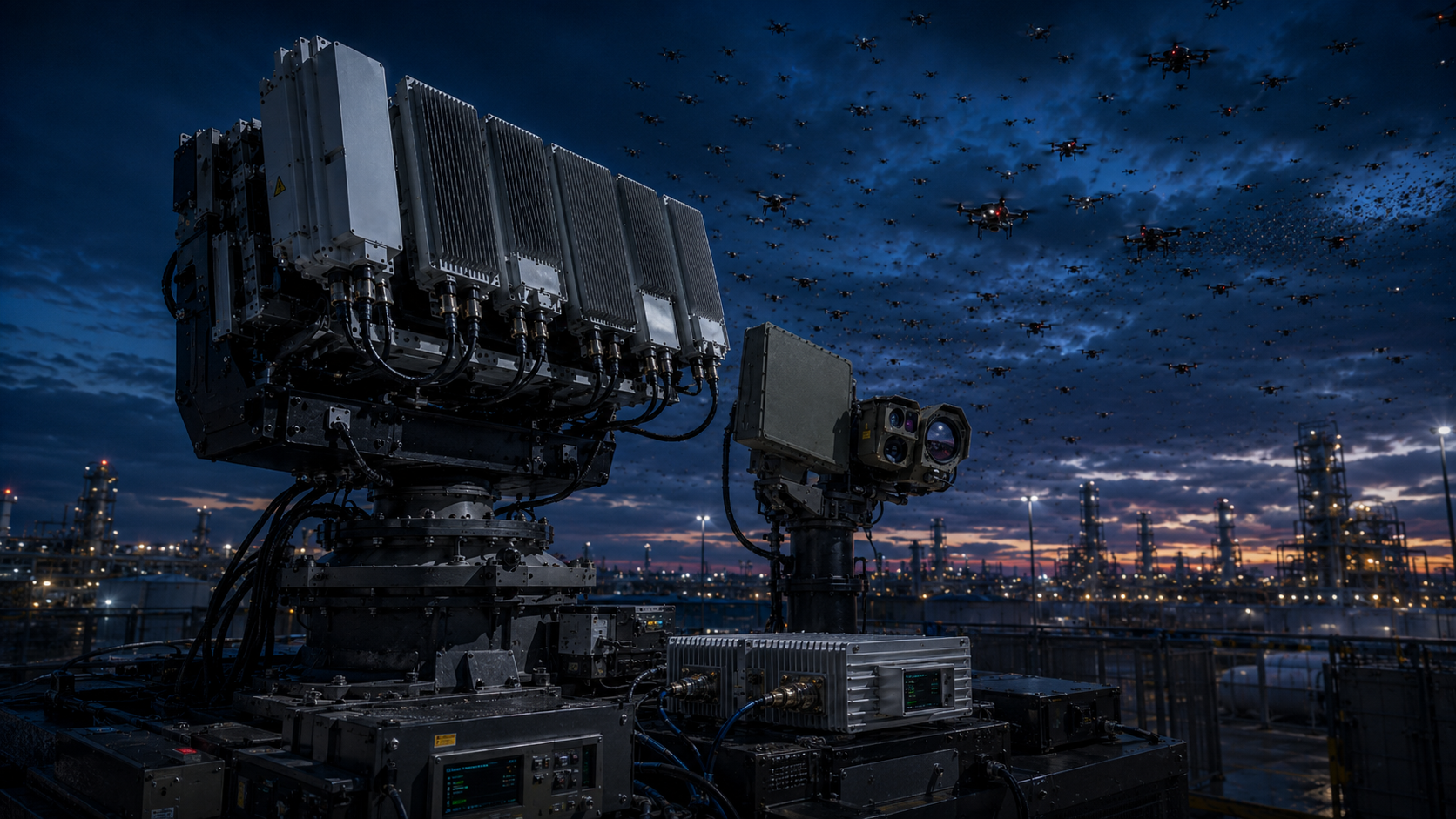
Multiple decentralized nodes designed specifically overwhelm traditional singular target defenses make Drone Swarms inherently dangerous. Picture a high-security military installation monitoring airspace calmly when suddenly dozens of tiny radar blips appear simultaneously. Your security personnel panic as legacy tracking systems lock up while attempting track an impossible number of incoming threats. Modern high-power RF disruption platforms offer an immediate tactical solution capable of neutralizing entire hostile networks instantly.
What Are Drone Swarms and Why Are They Rising?
Cooperative autonomous flight patterns combined with extremely low production costs explain why Drone Swarms multiply rapidly across modern battlefields. These decentralized aerial units operate collectively without requiring individual pilots. Adversaries increasingly deploy these coordinated networks because cheap commercial parts allow massive force projection quickly.
How Has Swarm Technology Evolved Recently?
Past aerial units required dedicated human operators controlling single aircraft manually from remote locations. Now we see fully autonomous collectives leveraging advanced mesh networking capabilities effortlessly. Here’s the deal, modern decentralized networks share targeting data instantly among surviving units if one gets destroyed.
- Unmanned units adapt flight routes dynamically upon detecting countermeasures.
- Decentralized nodes require zero human intervention during mission execution.
- Massive group numbers guarantee several units survive initial kinetic strikes.
Why Do Commercial Components Accelerate Threats?
Cheap off-the-shelf electronics provide terrifying asymmetric advantages for non-state actors globally. You face massive risks when adversaries weaponize simple civilian technology against multi-million-dollar infrastructure.
| Feature | Legacy UAVs | Modern Swarm Units |
| Flight Control | Manual | Autonomous |
| Unit Cost | High | Extremely Low |
| Defense Difficulty | Moderate | Severe |
This rapid commercial evolution highlights why integrating scalable wideband countermeasures remains absolutely mandatory today.
Key Takeaway: Recognizing how cheap commercial components fuel massive autonomous network capabilities helps you prepare better defensive strategies.
How Do Drone Swarms Communicate Effectively?
Advanced RF mesh networks enable Drone Swarms share telemetry and targeting data instantly among themselves. Individual nodes act as relays guaranteeing seamless communication across vast operational distances. If one node fails suddenly another takes over immediately without dropping necessary connections.

What Role Do SDR Systems Play?
Software Defined Radio platforms grant these unmanned vehicles incredible frequency agility during active missions. Operators program complex hopping algorithms designed specifically evade standard monitoring equipment. You might be wondering, how exactly do these machines maintain solid links under heavy interference?
- They shift operating frequencies automatically upon detecting external jamming attempts.
- Unmanned nodes encrypt their communication channels dynamically preventing signal hijacking.
- SDR systems process complex multi-waveform signals using minimal onboard power.
Can We Disrupt Their Internal Networks?
Severing those internal communication links neutralizes their collective intelligence entirely. You must deploy wideband high-power disruption tools capable covering every possible frequency spectrum simultaneously.
| Communication Type | Vulnerability | Countermeasure |
| GPS Navigation | High | RF Spoofing |
| Command Link | Moderate | Broadband Jamming |
| Internal Mesh | Low | Cognitive EW |
Understanding these communication protocols allows security teams deploy targeted disruption methods highly effectively.
Key Takeaway: Severing internal mesh network communication loops immediately degrades a coordinated attack into chaotic individual failures.
What Makes Drone Swarms Lethal for Facilities?
Sheer numbers combined with coordinated attack vectors make Drone Swarms uniquely lethal against static high-value infrastructure. Legacy air defenses simply lack adequate tracking capacity for handling dozens of small targets simultaneously. Attackers intentionally overwhelm your expensive interceptors using cheap disposable units during initial assault waves.
How Do They Overwhelm Air Defenses?
Traditional kinetic interceptor systems typically track only a handful of targets per minute. Adversaries launch fifty autonomous nodes simultaneously completely saturating your defensive tracking capabilities. What’s the catch? Once those radar systems lock up attempting process too much data the remaining attackers slip past unseen.
- Massive target numbers exhaust kinetic ammunition supplies incredibly fast.
- Low flying altitudes shield incoming threats from long-range detection arrays.
- Coordinated multi-directional strikes split defensive attention fatally.
Are Asymmetric Economics Driving This Threat?
A single Patriot missile costs millions whereas attackers spend mere thousands assembling an entire swarm. You quickly face an unwinnable financial battle relying solely upon kinetic interception methods.
| Defense Method | Cost Per Engagement | Swarm Effectiveness |
| Kinetic Missile | Extremely High | Very Low |
| Gun Systems | Moderate | Moderate |
| RF Jamming | Very Low | Extremely High |
Analyzing these cost ratios proves why electronic warfare solutions provide the only sustainable defensive strategy.
Key Takeaway: Adopting scalable electronic countermeasures prevents your facility from losing an asymmetric financial war against cheap aerial threats.
Why Do Legacy Radars Fail Against Drone Swarms?
Minuscule radar cross sections allow Drone Swarms evade legacy detection arrays designed for large fighter jets. These synthetic materials reflect almost zero radio energy back toward traditional monitoring equipment. Conventional tracking algorithms also filter out slow-moving objects assuming they represent birds naturally.

How Does Flight Profile Affect Detection?
Most modern autonomous units hug terrain flying just meters above ground level. This extremely low altitude keeps them hidden beneath standard radar horizons effectively. This is where it gets interesting, combining low altitude with tiny physical profiles renders them practically invisible.
- Small plastic bodies generate incredibly weak radar return signatures.
- Terrain masking techniques block direct line-of-sight detection requirements.
- Slow flight speeds trigger traditional ground-clutter filtering algorithms automatically.
Why Is Multi-Sensor Fusion Required Now?
Relying entirely upon one sensor type guarantees major detection failures during complex engagements. You must combine optical cameras with acoustic sensors alongside specialized high-frequency radar modules.
| Sensor Type | Primary Advantage | Major Weakness |
| Legacy Radar | Long Range | Misses Small Targets |
| Optical/Thermal | Visual Confirmation | Weather Dependent |
| RF Detection | Tracks Control Signals | Useless if Radio Silent |
Fusing data from multiple distinct sensors creates a broad defensive umbrella capable identifying hidden threats.
Key Takeaway: Implementing multi-sensor fusion platforms guarantees early detection even when autonomous units attempt terrain masking techniques.
How Can Electronic Warfare Defeat Drone Swarms?
Flooding operational frequencies with high-power RF noise allows electronic warfare systems defeat Drone Swarms instantly. This invisible force field breaks critical command links causing unmanned units crash immediately. Modern jamming modules offer continuous full-band coverage guaranteeing no hostile signal escapes disruption.
Why Are Broadband Frequencies Necessary?
Adversary operators modify their equipment constantly seeking unprotected communication channels. Narrowband jammers fail completely when an incoming threat utilizes unexpected or modified frequency bands. But here’s the kicker, modern full-band disruption platforms cover everything from 30MHz up past 6GHz simultaneously.
- Continuous spectrum coverage blocks hopping algorithms instantly.
- High-power outputs extend your protective perimeter miles outward.
- Software-defined parameters allow real-time adjustments during active engagements.
Does GPS Spoofing Actually Work?
Transmitting fake satellite coordinates tricks autonomous units into landing safely away from your facility. You gain immense tactical advantages forcing hostile networks off-course without firing a single bullet.
| EW Technique | Immediate Effect | Ideal Scenario |
| Broadband Jamming | Immediate Crash | Mass Swarm Attack |
| GPS Spoofing | Route Diversion | Securing Urban Areas |
| EMP Blast | Complete Destruction | Last Resort Defense |
Deploying flexible electronic countermeasures guarantees your facility remains protected against rapidly evolving wireless threats.
Key Takeaway: Deploying continuous full-band RF disruption creates an impenetrable electronic dome securing your valuable assets flawlessly.
What Role Do GaN Amplifiers Play in Jamming?
Gallium Nitride semiconductors generate massive RF power required for effective Drone Swarms neutralization across vast distances. These advanced components provide superior thermal efficiency compared against legacy silicon alternatives. CorelixRF integrates these high-power modules directly into our military-grade jamming platforms globally.

How Does Power Relate to Range?
Pushing more watts through an antenna increases your effective disruption radius exponentially. Low-power systems might protect a single vehicle but fail guarding entire military bases. Truth be told, maximizing your amplifier output stands as the single most necessary factor for early threat neutralization.
- Higher wattage outputs overpower hostile control signals easily.
- Increased power density allows smaller equipment footprints overall.
- Stable amplification guarantees consistent defensive perimeters during prolonged engagements.
Why Is Thermal Management So Necessary?
Continuous high-power transmissions generate immense heat capable destroying sensitive internal electronics rapidly. You require advanced aluminum heat-sinks alongside active cooling mechanisms for sustaining maximum operational uptime.
| Tech Material | Thermal Efficiency | Power Density |
| Legacy LDMOS | Average | Low |
| Gallium Arsenide | Good | Moderate |
| Gallium Nitride | Exceptional | Extremely High |
Integrating premium GaN technology guarantees your counter-measure systems operate flawlessly even under extreme environmental conditions.
Key Takeaway: Upgrading your defensive platforms with advanced GaN amplification guarantees massive disruption ranges alongside incredible operational stability.
How Do RF Systems Identify Hostile Drone Swarms?
Advanced spectrum analysis tools match intercepted radio signals against extensive threat libraries identifying Drone Swarms instantly. Cognitive electronic warfare platforms differentiate between friendly security drones and unauthorized hostile intruders automatically. This precision identification prevents your defensive systems from jamming friendly neighborhood communications accidentally.
What Is RF Fingerprinting?
Every remote controller emits a unique microscopic variation within its transmission waveform. Highly sensitive receivers capture these variations creating precise digital fingerprints for every airborne device. You might be wondering, how fast does this identification process actually happen?
- Digital signal processing identifies complex waveforms within milliseconds.
- Cloud-connected threat libraries update known hostile signatures globally.
- Automated systems trigger appropriate jamming responses without human delay.
Can We Track Frequency Hopping Targets?
Modern SDR technology sweeps entire frequency ranges constantly seeking brief transmission bursts. You maintain solid tracking data even when adversaries attempt hiding their communication channels rapidly.
| Detection Method | Target Focus | Speed |
| Signal Library Match | Known Threats | Instantaneous |
| RF Fingerprinting | Unique Hardware | Very Fast |
| Cognitive Analysis | Unknown Anomalies | Fast |
Leveraging automated cognitive analysis provides unparalleled situational awareness during complex multi-target electromagnetic engagements.
Key Takeaway: Implementing cognitive RF fingerprinting allows your security personnel identify and neutralize unauthorized aerial units instantly without disrupting friendly operations.
What Challenges Arise in Urban Counter-UAS?
Dense concrete environments reflect RF signals unpredictably complicating Drone Swarms detection immensely within city limits. Blanket jamming operations risk disabling necessary civilian infrastructure like hospital communication networks accidentally. Urban defenders require surgically precise disruption tools capable targeting specific hostile frequencies cleanly.
How Do We Mitigate Collateral Interference?
Deploying highly directional antennas focuses your jamming energy exactly where hostile threats exist. This narrow beam approach leaves surrounding civilian communication networks entirely unaffected. What’s the real story? You must balance aggressive threat neutralization against maintaining basic city services during active incidents.
- Directional beams concentrate disruption power maximizing target impact.
- Low-power localized spoofing diverts threats without causing widespread GPS failures.
- Smart frequency notching protects vital emergency responder channels actively.
Why Are Kinetic Options Unsafe Here?
Shooting missiles into a crowded metropolis guarantees unacceptable civilian casualties from falling debris. You must rely upon soft-kill electronic measures forcing unauthorized units land safely.
| Environment | Safe Neutralization | Unsafe Option |
| Open Desert | Kinetic Interceptors | N/A |
| Naval Fleet | EMP Blasts | Unrestricted Jamming |
| Dense Urban | Directional RF Jamming | Explosive Missiles |
Selecting appropriate urban counter-measures requires balancing defensive lethality alongside strict civilian safety requirements.
Key Takeaway: Deploying highly directional RF disruption guarantees successful urban defense missions while completely eliminating dangerous kinetic collateral damage risks.
How Are Militaries Adapting to Drone Swarms?
Armed forces globally now integrate dedicated electronic warfare squads alongside traditional infantry confronting Drone Swarms daily. Relying exclusively upon singular defense layers proves disastrous against multi-domain aerial assaults. Modern military doctrines demand broad networked defense architectures spanning across all operational theaters.
What Is Layered Air Defense?
A robust defensive posture combines long-range early warning radars with mid-range electronic disruption tools. Short-range kinetic systems act strictly as a final protective barrier if electronic measures fail. Here’s the deal, this layered approach guarantees multiple opportunities for neutralizing incoming threats before they reach valuable assets.
- Early warning networks provide necessary preparation time for defensive crews.
- High-power RF jamming serves as primary wide-area defense mechanisms.
- Laser directed energy weapons offer precise terminal phase elimination.
Why Is Mobility So Necessary Now?
Static defense installations become easy targets for coordinated autonomous strikes. You must mount counter-measure systems onto mobile armored vehicles guaranteeing continuous protection during rapid troop movements.
| Defense Layer | Primary Technology | Effective Range |
| Outer Perimeter | High-Power SDR Jamming | > 10 km |
| Middle Zone | GPS Spoofing | 2 – 5 km |
| Inner Core | Directed Energy/Lasers | < 2 km |
Layering these distinct defensive technologies creates an impenetrable protective bubble over mobile military formations.
Key Takeaway: Integrating mobile layered defense architectures guarantees your forces remain protected against decentralized aerial threats during dynamic combat operations.
What Is Next for Counter-Swarm RF Defenses?
Artificial intelligence will soon automate entire electronic warfare engagements detecting and defeating Drone Swarms instantaneously. Future defense platforms will predict hostile flight paths using advanced machine learning algorithms perfectly. CorelixRF continuously develops next-generation cognitive radio modules pushing boundaries for military-grade protection globally.

How Will AI Transform Signal Jamming?
Neural networks analyze incoming spectrum data million times faster than human operators ever could. These intelligent systems generate custom disruption waveforms designed specifically for defeating unknown proprietary communication protocols. Ready for the good part? Autonomous defense networks will coordinate multiple jamming nodes simultaneously trapping attackers inside inescapable electromagnetic dead zones.
- Machine learning algorithms identify disguised command signals buried underneath heavy noise.
- Automated systems allocate optimal amplifier power distributing resources intelligently across multiple targets.
- Self-learning platforms update their threat libraries locally without requiring external cloud connections.
Are Directed Energy Weapons Better?
Combining cognitive RF jamming alongside high-power microwaves provides a devastating one-two punch against autonomous fleets. You completely disable their internal electronics permanently guaranteeing they never fly again.
| Future Tech | Primary Function | Expected Impact |
| AI Signal Gen | Defeats Unknown Protocols | Massive |
| HPM (Microwave) | Destroys Circuit Boards | Severe |
| Swarm vs Swarm | Autonomous Dogfighting | High |
Embracing these futuristic cognitive technologies remains mandatory for staying ahead against rapidly evolving asymmetric warfare capabilities.
Key Takeaway: Investing heavily into AI-driven cognitive electronic warfare guarantees your defensive infrastructure remains effective against tomorrow’s most advanced autonomous threats.
Securing Your Airspace
Securing high-value infrastructure against decentralized aerial threats requires transitioning away from legacy kinetic solutions toward advanced electronic warfare. We provide military-grade GaN RF chain solutions designed specifically for neutralizing complex modern electromagnetic threats seamlessly. Your security demands proven wideband disruption tools capable dominating contested airspaces instantly. CorelixRF stands committed toward engineering truth delivering uncompromising tactical superiority globally. For customized technical integration proposals contact us today protecting your valuable assets permanently.
Frequently Asked Questions
Q1: Can I defeat a massive swarm using traditional radar?
No. Legacy systems fail because these tiny units feature minuscule radar cross sections and fly incredibly low.
Q2: What’s the best way to stop autonomous threats in urban areas?
Directional RF jamming. This focused method neutralizes targets cleanly without causing dangerous civilian collateral damage or widespread communication blackouts.
Q3: How do I know if my current jammers are effective?
Check their frequency bandwidth and power output. Narrowband systems fail completely when modern threats utilize agile frequency-hopping algorithms across multiple spectrums.
Q4: Can I integrate new SDR modules into my existing security network?
Yes. Modern digital signal sources feature flexible RS422 control interfaces allowing seamless integration within legacy command architectures.
Q5: What’s the most vital hardware component for wide-area jamming?
Gallium Nitride (GaN) power amplifiers. These advanced semiconductor modules deliver extreme power density and superior thermal management required for long-range disruption.
Authorized RF engineering and compliance review
For regulated RF systems, this page should be used as an engineering and compliance review path, not as a public deployment checklist. CorelixRF starts with authorization status, operating region, frequency plan, output limit, antenna interface, safety controls, thermal limits and acceptance documents.
- RFQ checklist – send the data buyers usually forget, including band, power, duty cycle, interface and test standard
- delivery documentation – check what documents can support incoming inspection, FAT review and long-term maintenance
- quality and certification review – review the quality and compliance evidence before the project moves into procurement
- RF front-end platform – compare the RF chain as a system instead of selecting one isolated module
- RF configurator – turn frequency, power, thermal and interface requirements into a first configuration brief
- case studies – review similar engineering paths before sending an RFQ
- engineering contact – send the application notes, block diagram or target specification to engineering sales
This keeps the discussion inside lawful, authorized RF programs while still giving procurement teams a clear way to request amplifier, antenna, SDR source, documentation and factory review.
C-UAS RF Capacity Review Path
For authorized C-UAS RF capacity planning, translate coverage and duty-cycle requirements into RF power amplifier platform choices, RF front-end architecture and antenna/load interface planning. Share frequency bands, output targets, channel count, cooling method, enclosure constraints and compliance documentation needs through the RF inquiry form.